

Published: October 27, 2026
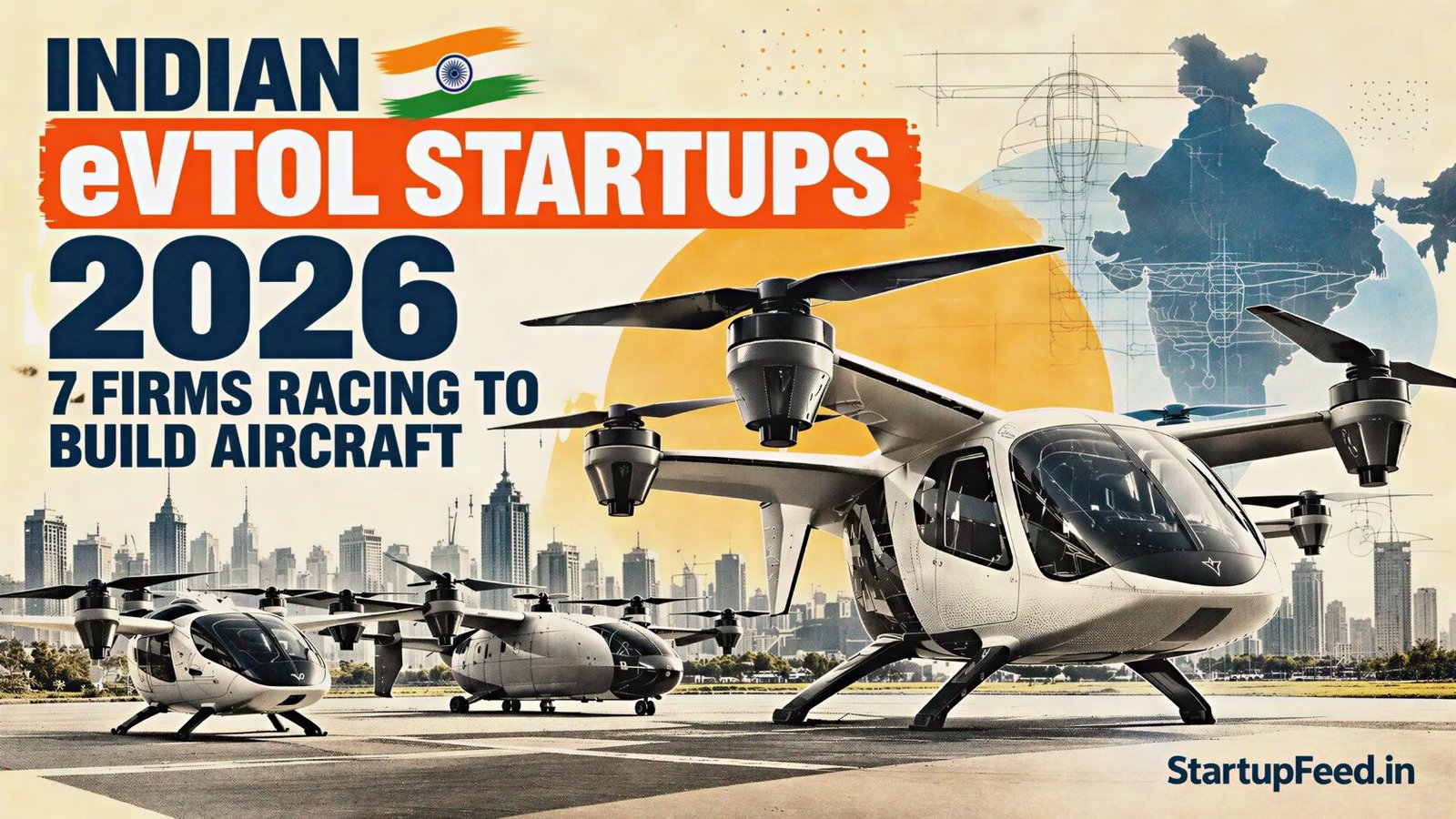
Indian eVTOL startups are small companies building whole electric aircraft, from passenger air taxis to cargo planes, instead of only supplying parts for foreign planemakers. For decades, India mainly made components. That is now changing. In June 2026, Chennai-based The ePlane Company assembled the first full-scale prototype of its e200X air taxi. In Bengaluru, Sarla Aviation flew a half-scale test aircraft more than 500 times. At least seven startups are now in this race, from Hyderabad to Mohali. None will carry a paying passenger before 2028.
StartupFeed Quick Take
- The ePlane Company assembled its full-scale e200X air taxi in June 2026 and plans certified test flights by mid-2027. It holds over 800 aircraft bookings.
- Sarla Aviation’s half-scale Sylla demonstrator logged 500-plus test runs and 18 hours of flight time. Rival BluJ Aerospace is flight-testing a 500 kg-class cargo aircraft.
- Seven Indian startups now build complete aircraft, from a 2-seat air taxi to a 1,000 kg pilotless cargo seaplane. None expects paying passengers before 2028.
In This Article
Why Indian eVTOL startups are building whole aircraft now
India has built aircraft parts for global firms like Boeing and Airbus for years. The new goal is bigger: own the full machine. That means the airframe, the electric motors, the batteries, the flight-control software and, in the end, the safety case that convinces a regulator.
Electric propulsion is what opened the door. An electric aircraft has far fewer moving parts than a jet. That lets a small, well-funded team design one in years, not decades. Sarla Aviation built its first half-scale test aircraft in about nine months.
The rules are catching up too. The Directorate General of Civil Aviation, India’s aviation regulator, now grants a Design Organisation Approval. This is the first-stage sign-off that lets a company design certified aircraft. The ePlane Company has held one since 2023. Nalwa Aero secured one in September 2025, the first Indian firm cleared to design a five-seat eVTOL.


The prize is clear. eVTOL means electric vertical take-off and landing. These aircraft lift off like a helicopter, then fly forward like a plane. In a city where a road trip takes two hours, that is a short hop. The hard part is proving it is safe.
The air taxi race: ePlane, Sarla, Nalwa and Zephyra
Four of the seven startups are chasing the passenger air taxi. The ePlane Company is closest to real hardware. Its e200X weighs 2.2 tonnes and carries a pilot and two passengers up to 110 km on one charge. The Chennai firm assembled the first full-scale prototype, called PT-01, in June 2026. It has raised about $21 Mn and holds more than 800 aircraft bookings, many from air ambulance operators. Certified flight tests are planned for mid-2027.
Sarla Aviation is building Shunya, a six-seat air taxi with seven electric motors. First it tested a smaller version. Over six months, its half-scale Sylla demonstrator completed more than 500 test runs and 18 hours of flight time. That made it the heaviest electric aircraft yet flown in India. Sarla has raised $10 Mn, backed by Accel and Nikhil Kamath. In September 2026 it signed Tata Elxsi to help with engineering and certification.
Two others are earlier. Nalwa Aero of Mohali has a design approval for its five-seat Nalwa 5X but is still flying sub-scale models. Zephyra Dynamics, started by a 2025 engineering graduate, has designed a single-seat aircraft called the Kestrel X2. For now it flies only in simulation, with a target range of 35 to 40 km.
Satya Chakravarthy, who founded The ePlane Company, frames the bet simply:
“The same airframe can move people as an air taxi, carry goods as a cargo aircraft, and save lives as an air ambulance, and it can do all three using the infrastructure cities already have.”
Satya Chakravarthy, founder, The ePlane Company. From the company’s assembly announcement, June 2026.
| Company | City | Aircraft | Carries | Stage (Oct 2026) |
|---|---|---|---|---|
| The ePlane Company | Chennai | e200X | Pilot + 2 passengers | Full-scale prototype built; ground tests |
| Sarla Aviation | Bengaluru | Shunya | 6 passengers + pilot | Half-scale demonstrator flown |
| BluJ Aerospace | Hyderabad | Gen #2 | Over 200 kg cargo | In flight testing |
| Aspera Industries | Bengaluru | Eureka | 1,000 kg cargo | Design stage; prototype planned |
| Cligent Aerospace | Ahmedabad | CL1000 | 9 passengers or 1,500 kg | Scaled model flown |
| Nalwa Aero | Mohali | Nalwa 5X | 5 passengers | Design approved; sub-scale models |
| Zephyra Dynamics | Bengaluru | Kestrel X2 | 1 passenger | Simulation only |
Beyond air taxis: cargo and regional aircraft
Not every startup wants to fly people. Some see cargo as the faster market, because freight does not need the same passenger safety case.
BluJ Aerospace in Hyderabad is the furthest along here. It unveiled its Gen #2 aircraft in May 2026, built on a design it calls VANTIS. The 500 kg-class aircraft can carry a payload above 200 kg and is already in flight testing for heavy logistics. BluJ, backed by Ideaspring Capital, plans a one-tonne version and a hydrogen-electric model by 2028.



Aspera Industries, also in Bengaluru, is chasing a bolder idea. In August 2026 its founder Khushi Mittal unveiled Eureka, a pilotless aircraft that takes off and lands on water. It is designed to carry 1,000 kg of cargo over 2,000 km and to fly freight for under $1 per tonne-kilometre. Aspera says sea shipping takes weeks and normal air freight costs about 20 times more. Eureka is still in design.
Cligent Aerospace of Ahmedabad is taking a third route. Its CL1000 is a hybrid-electric plane that mixes a battery with a small generator, so range is not capped by battery weight. In June 2026, a scaled model took off in just 22 metres from a dirt strip. The full aircraft is planned to carry nine passengers or 1,500 kg.
How far each startup has actually flown
The gap between a press photo and a flying aircraft is wide. Here is where each startup stands in October 2026, by what it has done rather than what it plans.
Three have flown real hardware, even if sub-scale. Sarla’s half-scale Sylla has flown. BluJ’s Gen #2 is in active flight testing. Cligent’s scaled model has flown short hops. The ePlane Company has built a full-scale aircraft but has not flown it yet, as ground tests come first. Aspera and Zephyra have flown nothing: Eureka is a design, and the Kestrel X2 exists in simulation. Nalwa holds a regulator’s design approval but is still on sub-scale models.
Approvals are a second yardstick. A Design Organisation Approval lets a firm design certified aircraft. Type certification, the far harder step, clears one specific aircraft to carry people. The ePlane Company has a design approval and says its e200X has entered the type-certification process. Nalwa Aero also holds a design approval. The others have not reported this stage. No Indian startup has yet earned type certification for a passenger eVTOL.
| Company | Flown a prototype? | DGCA design approval? | Target for operations |
|---|---|---|---|
| The ePlane Company | Full-scale built, not flown | Yes (2023) | Certified flights mid-2027 |
| Sarla Aviation | Half-scale flown | Not reported | Commercial around 2028 |
| BluJ Aerospace | Yes, in flight tests | Not reported | Scaling now |
| Cligent Aerospace | Scaled model flown | Not reported | Phased to full-scale |
| Nalwa Aero | Sub-scale only | Yes (2025) | Readiness by 2028 |
| Aspera Industries | No (design stage) | Not reported | Prototype next |
| Zephyra Dynamics | No (simulation) | Not reported | Prototype fabrication next |
What stands between a prototype and a paying passenger
A prototype is not a business. Between a test flight and a paying passenger lie years of work, and some programmes never cross that gap.
Certification is the biggest wall. Proving an aircraft is safe enough to carry people takes years of tests and paperwork with the DGCA. No Indian startup has cleared it yet. Even the frontrunners talk about certified passenger flights only from 2027 or 2028.
Batteries are the next limit. Today’s batteries store far less energy per kilogram than jet fuel. That caps how far and how heavy an electric aircraft can fly. It is why ranges are short, often under 150 km, and why Cligent and Aspera add a generator or chase cargo instead of people.
Money and manufacturing follow. Building aircraft at scale needs far more capital than most of these firms have raised. Sarla has secured $10 Mn and ePlane about $21 Mn, small sums for an aircraft programme. Global eVTOL firms with hundreds of millions have still slipped their timelines or failed.
So India now has test aircraft, design approvals and real engineering teams. What it does not yet have is a certified aircraft carrying a paying passenger. That is the line that still matters.
About Advanced Air Mobility in India
Advanced air mobility, or AAM, is the use of small electric aircraft to move people and cargo within and between cities, above road traffic. Most designs are eVTOLs, which take off straight up like a helicopter and then fly forward like a plane. India’s regulator, the DGCA, is still writing the detailed rules for how they will operate.
What to check before you believe an eVTOL timeline
- Has it flown real hardware, even a sub-scale model, or only shown renders and simulations?
- Does it hold a DGCA Design Organisation Approval, and has its aircraft entered type certification?
- What is the honest range on one charge, and does it match the mission the company sells?
- How much has it actually raised, against the hundreds of millions aircraft programmes usually need?
- Is there a named launch city, operator or airline partner, or only a target year?
StartupFeed Insight
The most telling number in this race is not speed or range. It is how far each aircraft has actually flown. On that measure, ePlane, Sarla, BluJ and Cligent lead, because they have hardware in the air or on a test rig. Aspera and Zephyra have bold designs and little else yet. Watch cargo, not air taxis, for the first real revenue: freight skips the passenger safety case, so BluJ’s logistics flights will likely carry commercial loads well before any Indian air taxi carries a paying passenger. Expect that first paid cargo flight within the next 18 months.
By Avinash Mishra, Business Correspondent
Frequently Asked Questions
Have a tip? Write to us at editorial@startupfeed.in.
Liked this story? Follow StartupFeed on Google so our reporting reaches you first.