

Quick Take
- MeitY is drafting common standards for messaging platforms, a government official told Hindustan Times.
- The Centre opposes WhatsApp usernames, citing impersonation, phishing and digital arrest scam risks.
- Zoho’s Arattai already disabled its username feature, signalling how founders may respond next.
In This Article
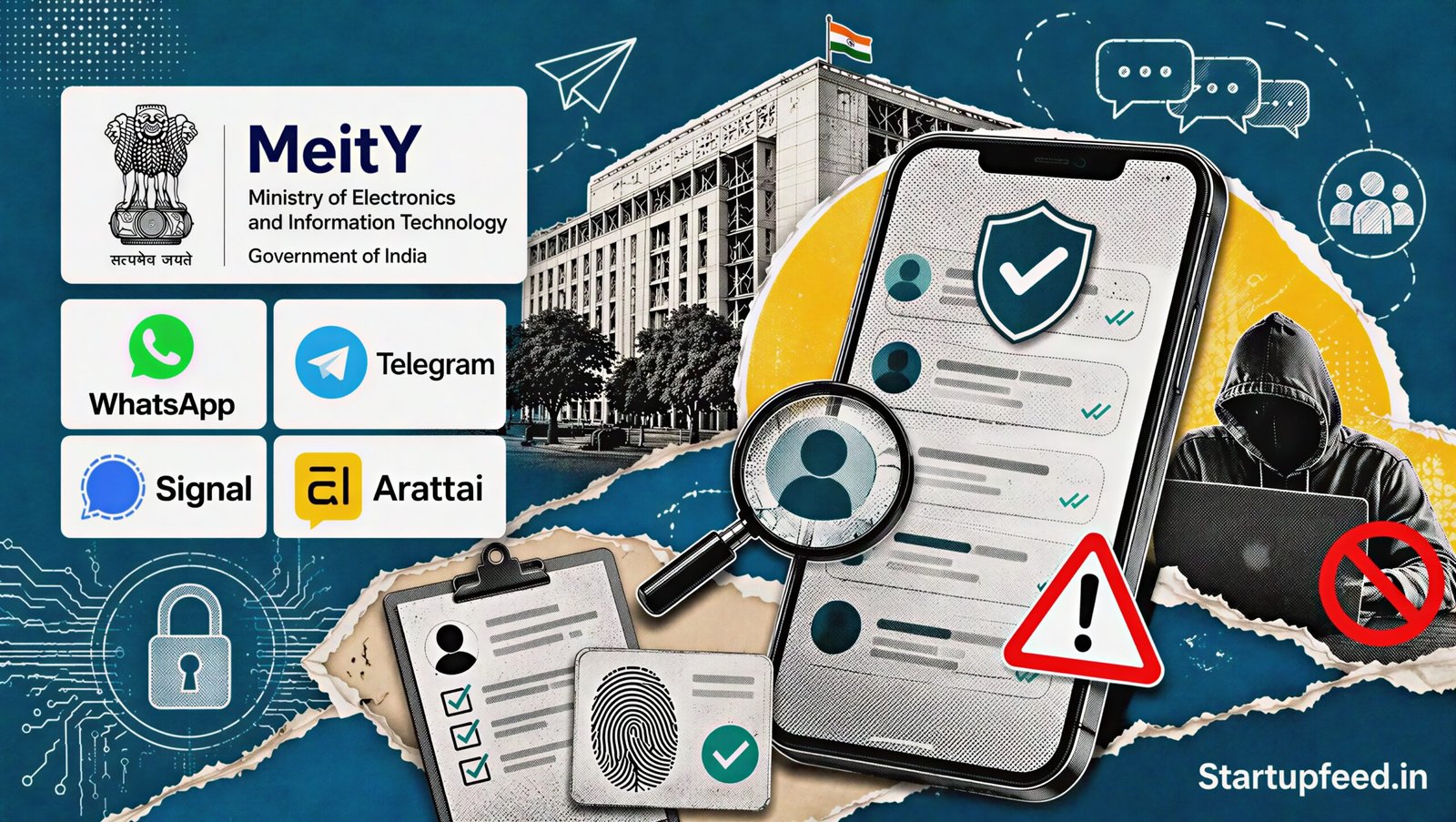
India’s IT ministry is drafting uniform social media rules for messaging platforms, a government official told Hindustan Times on July 11, 2026, as the Centre escalates its standoff with Meta over the WhatsApp username feature.
The proposed standards would give MeitY (Ministry of Electronics and Information Technology) legal backing to stop platforms from shipping specific features. The move follows a notice MeitY issued to Meta on July 1, 2026, over WhatsApp’s plan to let users chat without sharing phone numbers. WhatsApp announced username reservations on June 29, 2026, with the full feature due later this year.
StartupFeed Insight
The real signal here is not the WhatsApp notice, it is the word “uniform”. The official’s own admission, that the Centre cannot stop one platform while others offer the same thing, exposes the weak spot in the current approach. A notice under the IT Act is a per-platform tool. A standards framework is a per-feature tool, and that is a far bigger shift. Indian consumer app founders should watch this closely, because a product-approval layer built for messaging apps rarely stays inside messaging apps. StartupFeed expects MeitY to circulate a consultation draft on messaging standards before the end of 2026, and expects the identity question, not encryption, to be its core. By Soumya Verma.
Uniform Social Media Rules: What Is On The Table
The uniform social media rules would create a common standards framework that applies to every messaging platform operating in India, rather than a single-platform notice. A government official told Hindustan Times that the Centre wants legal backing before it stops any feature rollout.
| Item | Detail | Notes |
|---|---|---|
| Regulator | MeitY | Acting under the IT Act, 2000 and IT Rules, 2021 |
| Trigger event | WhatsApp username announcement | Announced June 29, 2026; notice issued within 48 hours |
| Platforms noticed | WhatsApp, Telegram, Signal | Telegram and Signal received notices on July 3, 2026 |
| Replies filed | WhatsApp and Telegram | Signal reply pending, per the official |
| Stated concern | Impersonation and fraud | Phishing, digital arrest scams, harder investigations |
| Next step | Industry consultation | Official said all messaging platforms will be consulted |
The most telling detail is the sequencing. MeitY moved against a feature first and is building the legal framework second, which is why the official flagged the need for uniform standards.
About The Username Feature
WhatsApp usernames let a person message someone new without revealing a phone number. Meta opened reservations on June 29, 2026, ahead of a phased global rollout later in 2026. The company said there is no searchable directory, that a contact must know the exact username, and that an optional username key adds a second layer of contact control. Meta has reserved handles for public figures, government entities and verified accounts, and blocked lookalike variations. A phone number is still needed to create a WhatsApp account.



What does this mean for messaging platforms?
A uniform standards framework would replace case-by-case notices with a single rulebook covering every messaging app in India. That changes the compliance calculus for both global platforms and Indian challengers.
It cannot be that we stop one platform from rolling out a feature while allowing others to continue offering the same thing. The rules have to be uniform for everyone, a government official reportedly said.
The official’s framing matters. Telegram and Signal have offered username-based contact for years, so blocking only WhatsApp would create an uneven field. WhatsApp is a Significant Social Media Intermediary (SSMI) under the IT Rules, 2021 published by MeitY, a category that applies to any platform above 50 lakh registered Indian users and carries extra due-diligence duties. For founders, the open question is whether a standards regime stops at messaging or extends to any feature that touches user identity.
Why is the Centre against the username feature?
MeitY opposes WhatsApp usernames because it believes hiding phone numbers weakens the traceability that Indian investigators rely on. The notice asked Meta to explain why action should not follow under the IT Act, 2000 and the IT Rules, 2021.
The scale argument sits at the centre of the government’s case. WhatsApp has more than 500 Mn users in India, its largest market. Officials say usernames at that scale could widen the surface for impersonation, phishing and digital arrest scams, and could slow law enforcement work.
The underlying fraud numbers are serious. Indians lost Rs 22,495 Cr ($237 Mn) to cyber fraud in 2025 across 28.15 lakh reported cases, per Ministry of Home Affairs data. Digital arrest scams alone accounted for 9% of that loss. Investment fraud drove 76%. Meta’s counterargument is that usernames reduce phone-number harvesting from group chats and cut exposure to SIM-swap attacks, which is a privacy gain the government has not directly answered. MeitY has separately been tightening the IT Rules through amendments notified in October 2025, so the ministry is already in an active rule-making cycle.
How are rival platforms responding?
Rival messaging platforms have split into three camps: comply and remove, respond and defend, or stay silent. Zoho’s Arattai took the first route within days of the WhatsApp notice.
| Platform | Username status | Response to MeitY |
|---|---|---|
| WhatsApp (Meta) | Reservation open, use not live | Reply submitted, under examination |
| Telegram | Live for years | Reply submitted |
| Signal | Live for years | Reply reportedly pending |
| Arattai (Zoho) | Being disabled | Voluntary removal, no notice received |
Zoho co-founder Sridhar Vembu said on X on July 2, 2026 that Arattai would disable its username-based account feature to comply with the regulatory change. No such regulation has been notified yet, which makes Arattai’s move pre-emptive rather than mandated. That gap is what makes the uniform social media rules the real story.



What’s Next
MeitY is examining the WhatsApp and Telegram replies and will consult all messaging platforms before deciding. Expect the ministry’s position on the WhatsApp rollout to become clear before the feature’s wider global launch in the second half of 2026. The consultation itself is the milestone worth tracking, because that is where the shape of any standards framework will first appear in public. Should India regulate app features before launch, or only after harm is proven?
Frequently Asked Questions
Have a tip? Write to us at editorial@startupfeed.in.
Liked this story? Follow StartupFeed on Google so our reporting reaches you first.