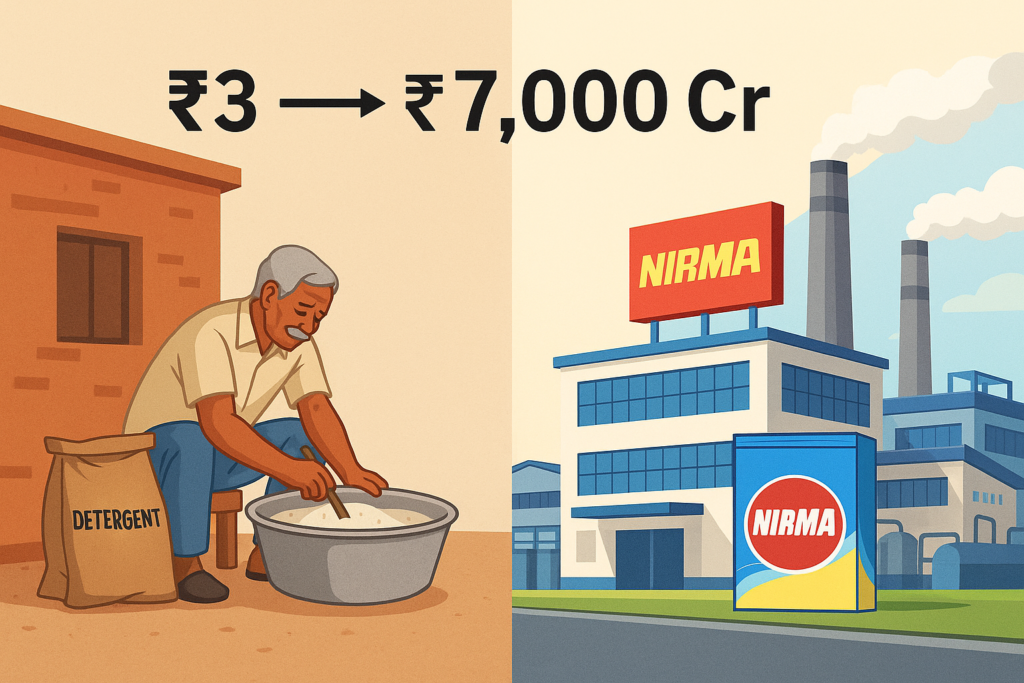
Summary Points:
- Started with Rs 3 and a homemade detergent formula.
- Battled giants like Hindustan Unilever in the detergent market.
- Focused on affordability and quality for middle-class families.
- Grew from door-to-door sales to a billion-dollar FMCG brand.
- Nirma became a case study of grit, smart pricing, and consumer trust.
In 1969, Karsanbhai Patel, a chemist from Gujarat, created a small batch of detergent in his backyard.
With just Rs 3 in investment, he made the detergent powder at home, packed it himself, and started selling it door-to-door on his bicycle.
At that time, major players like Hindustan Unilever’s Surf dominated the detergent market — but they sold at premium prices.
Karsanbhai had one simple idea: give the common Indian family a good-quality detergent at a price they can actually afford.
Cracking the Indian Market: Affordability and Trust
What made Nirma different?
Karsanbhai understood two things better than anyone else:
- Indian middle-class families needed affordable daily products.
- Trust would come if the quality matched or beat the expensive brands.
He priced Nirma detergent at Rs 3 per kilogram — nearly a third of what Surf charged.
Word-of-mouth spread fast.
Customers loved the product because it worked well without emptying their wallets.



ALSO READ: Pitch Perfect: How Incubators Are Grooming India’s Next VC-Backed Startups
Building the Brand: A New Way of Selling
Karsanbhai did not rely on big advertising at the beginning.
He:
- Built customer loyalty through personal interaction.
- Offered free home deliveries and money-back guarantees.
- Focused on expanding slowly from neighborhoods to cities.
Once the demand picked up, he invested in catchy, emotional marketing.
The iconic “Washing Powder Nirma” jingle became a part of every Indian household by the 1980s.
Competing with Giants: Smart Moves
Instead of directly fighting the giants head-on, Nirma took smarter routes:
- Lower costs: Local sourcing, simple packaging, and efficient distribution kept prices low.
- Broad reach: Targeted not just urban customers but also rural India, where big brands rarely reached.
- Diverse product range: Expanded into soaps, shampoos, and other FMCG products while keeping affordability intact.
Nirma soon became a household name, commanding massive volumes and disrupting traditional markets.
ALSO READ: New Leadership Era: Anant Ambani Joins RIL Board for Five Years
Scaling into a Rs 7,000 Crore Powerhouse
By the 1990s and early 2000s, Nirma was not just a detergent company anymore.
It had transformed into a multi-category FMCG giant, with businesses in:



- Detergents
- Soaps
- Toothpaste
- Edible salt
- Chemicals
The company built factories, created thousands of jobs, and even ventured into education and healthcare.
Today, Nirma’s estimated valuation crosses Rs 7,000 crore — a far cry from its Rs 3 beginnings.
Key Lessons from Nirma’s Journey
Nirma’s success teaches entrepreneurs and businesses simple but timeless lessons:
- Solve real problems. Price matters to millions of Indian families.
- Stay consistent. Good quality and affordability win in the long run.
- Expand wisely. Build strong foundations before entering new markets.
- Connect emotionally. A brand’s story can live in people’s hearts for decades.
Nirma didn’t just sell detergent — it sold hope, pride, and empowerment to everyday Indians.
Liked this story? Follow StartupFeed on Google so our reporting reaches you first.