


Quick Take
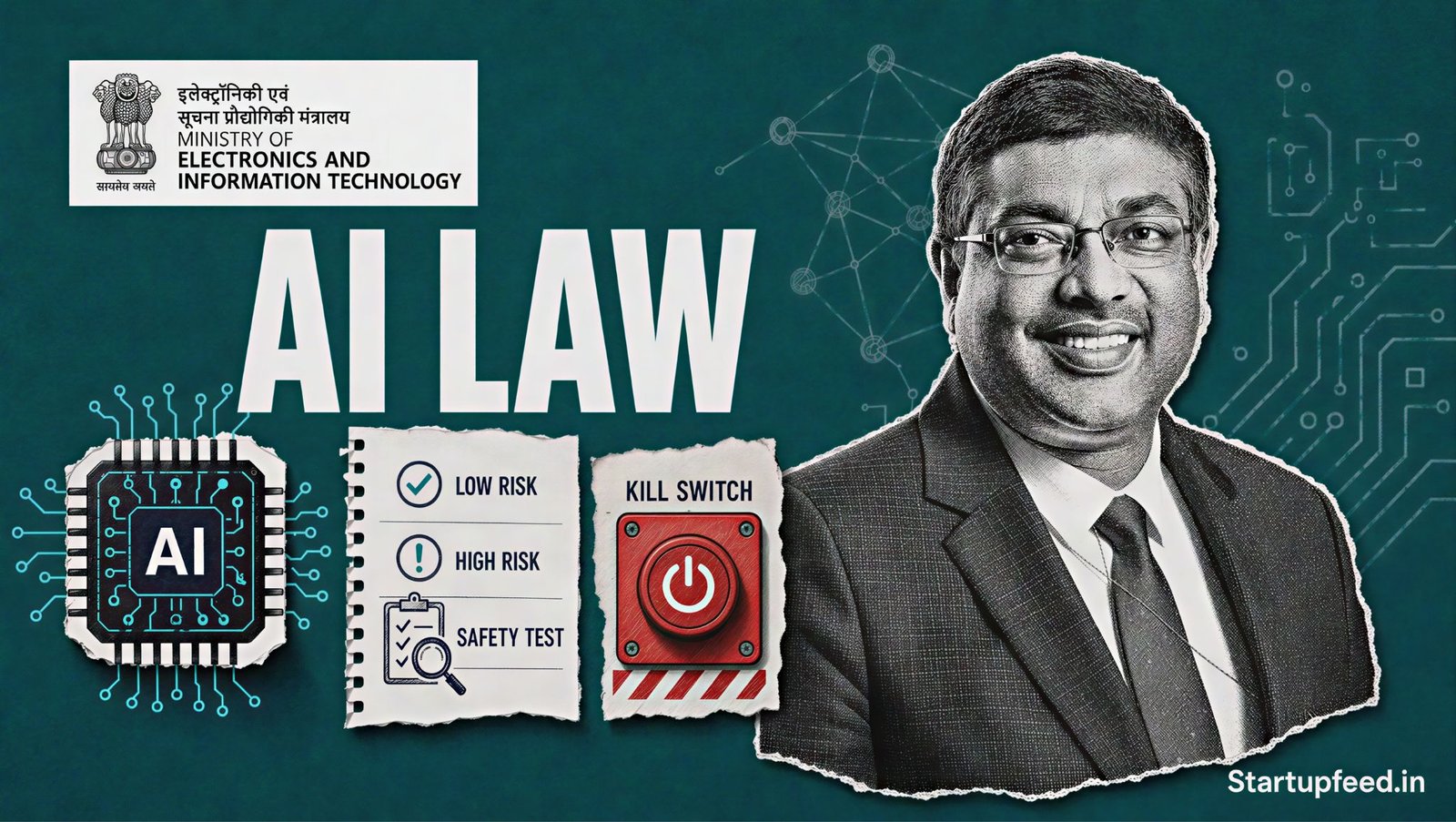
- India may frame a new AI law with graded, risk-based rules, an official told ET.
- Low-risk AI like chatbots stays light-touch; banking, finance and health AI face strict duties.
- The law may let the government order safety tests and disable dangerous AI systems.
In This Article
A proposed New AI Law India may classify modern AI systems and frame graded, risk-based rules, an official told The Economic Times on July 6, 2026. Low-risk AI would face minimal rules, while high-risk AI in banking, finance and health would face stricter duties.
The plan marks a shift from India’s earlier stance. In November 2025, the Ministry of Electronics and Information Technology (MeitY) had said a separate AI law was not needed yet, per its India AI Governance Guidelines. Officials now say the time to act is getting closer.
StartupFeed Insight
The real signal here is not the law itself but the power to disable an AI system and demand technical disclosure in an emergency. That single clause changes the risk maths for any founder building in banking, health or critical infrastructure, because a kill-switch mandate means model transparency stops being optional. Watch MeitY closely: StartupFeed expects a draft consultation paper or Digital India Act text carrying explicit AI risk tiers to surface for public comment before December 31, 2026. Startups in low-risk categories like productivity tools will likely stay light-touch, so the compliance gap between tiers will widen fast. By Avinash.
What the New AI Law India Proposes
The New AI Law India would sort AI systems by risk and match rules to that risk level, an official told ET. Chatbots, productivity tools and recommendation systems would sit in a low-risk band with minimal regulation.
High-risk AI used in critical sectors would carry heavier obligations. The official named banking, finance, health and critical infrastructure as areas needing stricter oversight, according to the ET report.
Key Provisions Under Discussion
| Provision | Detail | Source |
|---|---|---|
| Risk classification | Graded rules: minimal for low-risk AI, strict for high-risk AI | ET (official) |
| Safety testing power | Government may order and set parameters for safety tests of AI models | ET (official) |
| Disable mandate | Power to order disabling of dangerous AI systems in an emergency | ET (official) |
| Technical disclosure | Firms may need to disclose technical information during emergencies | ET (official) |
| IT Act amendment | Possible change to classify AI systems and define new roles | AI Governance Guidelines |
| Incident database | A national database for AI-related security incidents | AI Governance Guidelines |
The most striking part is the disable clause. Over the past year, the government has weighed whether firms should be directed to switch off dangerous AI systems or disclose technical details in an emergency, an official said on July 6, 2026.


About the India AI Governance Guidelines
The India AI Governance Guidelines are a non-binding policy framework released by MeitY on November 5, 2025, under the IndiaAI Mission. Drafted by a committee set up in July 2025, they rest on seven principles and propose bodies like the AI Governance Group (AIGG) and the IndiaAI Safety Institute. The New AI Law India may build on many of these recommendations, per the ET report.
Why Is India Planning This Now?
India is planning this law because existing rules were framed before modern AI, officials say. IT Secretary S Krishnan said last week that a separate law may be needed to counter evolving threats, according to the ET report.
“We have used the IT rules, and other provisions of existing law to address various concerns that AI raises, but now, probably the time has come to look at a separate legislation,” S Krishnan, IT Secretary, said, per Business Standard.
Krishnan noted that current rules had been adequate for deepfakes and synthetic content. Evolving cybersecurity challenges, he said, now require a separate law. This is a clear change from MeitY’s November 2025 view that no new AI law was needed.
What Changes for Founders and Firms?
For founders, the New AI Law India draws a sharp line between low-risk and high-risk AI. Teams building chatbots or productivity tools may see little extra compliance. Teams building AI for lending, diagnosis or public systems should plan for audits and disclosure duties.
The framework would also let sectoral regulators like the Reserve Bank of India (RBI), the Securities and Exchange Board of India (SEBI) and the Insurance Regulatory and Development Authority of India (IRDAI) prescribe their own AI rules, an official said. A national database for AI-related security incidents may also be created.
How Does India Compare With the EU?
India’s proposed risk-based model mirrors the European Union’s AI Act in structure but not in force. Both sort AI by risk level and both ease rules for low-risk uses. The EU model is a binding, product-safety style law, while India’s approach so far leans on existing statutes and voluntary codes.
| Dimension | India (proposed) | EU AI Act |
|---|---|---|
| Approach | Graded, risk-based; builds on IT Act | Binding, risk-classified law |
| Low-risk AI | Minimal rules | No new rules |
| Key deadline | No timeline announced yet | August 2, 2026 for high-risk AI |
What sets India apart is the mooted power to disable a dangerous AI system outright, a step the EU framework does not frame in the same way.


What’s Next
No draft Bill, consultation paper or timeline exists yet, officials stress. The next signal to watch is a public consultation or Digital India Act text carrying explicit AI risk tiers. Krishnan said the ministry can prepare draft legislation, though its final shape is not something he can predict. Will India’s graded model protect founders or slow them down?
Frequently Asked Questions
Have a tip? Write to us at editorial@startupfeed.in.
Liked this story? Follow StartupFeed on Google so our reporting reaches you first.