
Quick Take
| Acquirer: | TCL Electronics Holdings — China’s largest TV maker by volume, Hong Kong-listed |
| Seller: | Sony Group Corporation — Japan | Home entertainment = Bravia TVs, home audio, B2B displays |
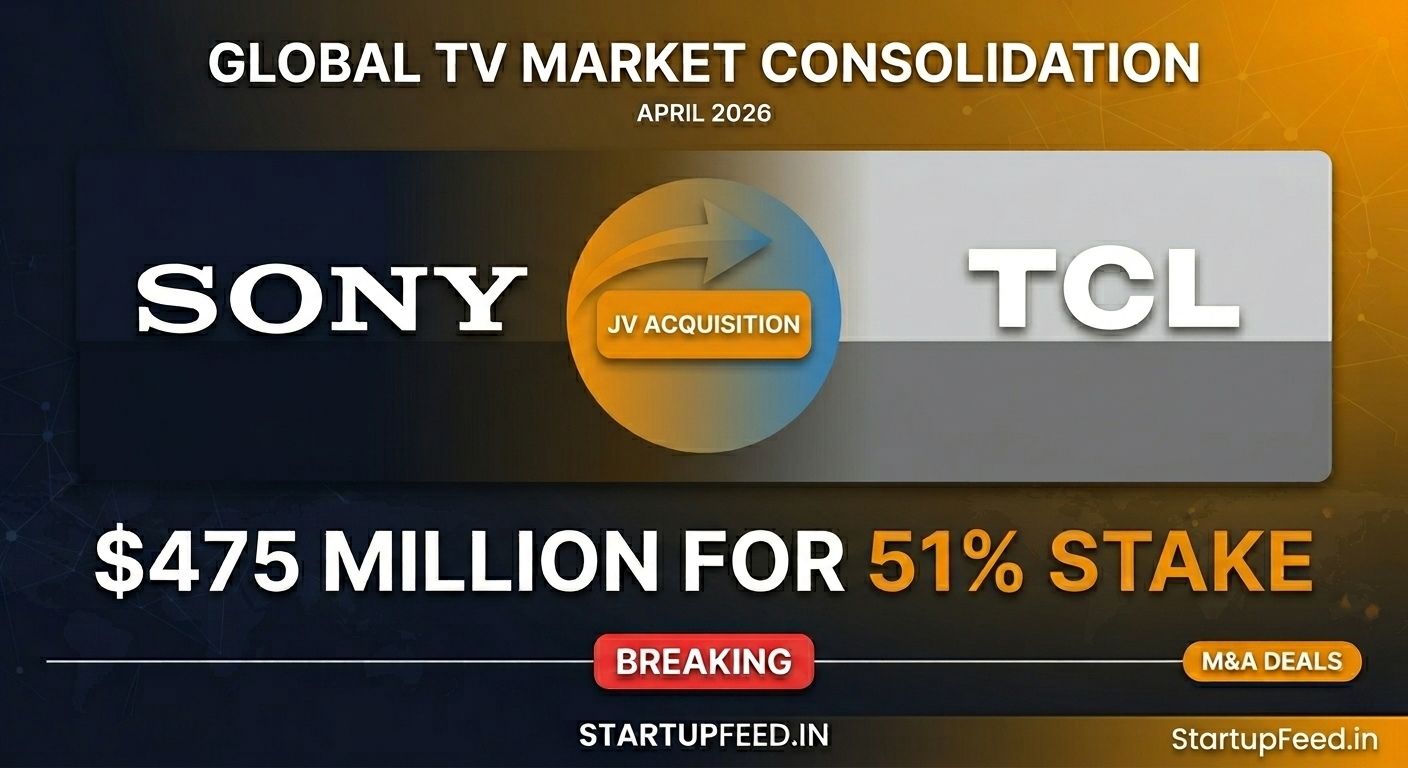
| Deal Size: | $475 Mn (75.4 Bn yen) for 51% stake in new JV + Sony EMCS Malaysia unit |
| New Entity: | Bravia Inc. — Tokyo HQ (Sony City Osaki) | Operations begin April 2027 |
| Market Reaction: | TCL shares surged 13% | Sony stock gained in Tokyo | Combined market share ~16.7% |
| What’s Next: | Regulatory approvals pending | Sony retains 49% + brand license | China plant talks ongoing |
Sony Group Corporation has officially signed a binding agreement to sell a 51% stake in its global home entertainment business to Chinese electronics giant TCL Electronics for 75.4 billion yen (approximately $475 million), confirming an earlier report. The deal creates a new joint venture called Bravia Inc. — headquartered in Tokyo — which will take over Sony’s entire Bravia TV business, home audio equipment, B2B displays, projectors, and manufacturing operations. TCL will hold 51%, Sony will retain 49%. The venture is expected to begin operations in April 2027, pending regulatory approvals.
StartupFeed Insight
| What this means: Sony is not quitting TVs. It is quitting the manufacturing grind. The Bravia brand, XR processing, and Sony’s Hollywood studio calibration stay Sony’s. The factories, supply chains, and day-to-day execution go to TCL. This is the definitive playbook for premium Japanese hardware brands in the age of Chinese manufacturing dominance. Winners:
Losers:
|
Deal Structure: What Is Being Transferred
| Bravia Inc. — Deal at a Glance | |
| New entity name | Bravia Inc. |
| Headquarters | Sony City Osaki, Tokyo, Japan |
| TCL stake | 51% (majority control) |
| Sony stake | 49% (with option to sell at predetermined price/date) |
| Consideration | 75.4 Bn yen (~$475 Mn) to Sony | May adjust for net debts and working capital at closing |
| Total enterprise value | 102.8 Bn yen (excluding China business) |
| What goes into Bravia Inc. | Bravia TVs | B2B flat-panel displays | LED displays | Projectors | Home audio (soundbars, home theatre) | R&D, design, manufacturing, sales, logistics, customer support |
| Manufacturing assets | TCL also fully acquires Sony EMCS (Malaysia) Sdn. Bhd. — Sony’s Malaysia manufacturing plant |
| China plant | Discussions ongoing for Sony’s Shanghai Suoguang Visual Products Co. — not yet included |
| Brand licensing | Sony licenses patents, proprietary technologies, and branding rights to Bravia Inc. | Products sell under both Sony and Bravia brands |
| Timeline | MoU: January 20, 2026 | Binding agreement: March 31, 2026 | Operations begin: April 2027 |
| Regulatory status | Pending approvals — deal not yet closed |
Why Sony Exited Majority Control: A Decade of Hardware Pressure
Sony’s journey to this deal is a masterclass in competitive erosion. The company has not manufactured its own display panels since the mid-2000s — it sold its LCD joint venture stake to Samsung in 2012. Since then, it has bought every panel from competitors: Samsung Display (LCD, QD-OLED), LG Display (WOLED), and more recently TCL CSOT (LCD). Paying competitors for core components while competing with them on the retail shelf is an inherently disadvantaged position.
The numbers tell the story: in the premium $2,500+ TV segment, Sony holds 15.7% revenue share against Samsung’s 53.1% and LG’s 26.1%. In the overall OLED segment, Sony holds just 10.2%, trailing both LG and Samsung. Meanwhile, TCL shipped ~29 million TVs in 2024 — approximately 14% global market share by volume — against Sony’s ~5.4% of global TV revenue

Sony’s response was a strategic retreat: focus on what it does uniquely well (XR picture processing, audio engineering, Hollywood studio calibration, brand prestige) and outsource what it no longer has structural advantage in (manufacturing scale, panel supply, supply chain efficiency). The deal with TCL is the logical endpoint of that strategy.
The TV business is a hyper-competitive, scale-driven and structurally low margin business, where Sony’s TV fortunes have weakened materially over the past decade amidst rising cost and competitive pressures.”
— Prabhu Ram, VP Industry Research Group, CyberMedia Research
What TCL Gets: Brand Equity It Could Never Build Alone
For TCL, this deal is a brand acquisition dressed as a manufacturing partnership. The company’s global ambitions have always been constrained by the same problem: consumers trust Samsung and Sony, not TCL, for premium products. Parks Associates data shows 83% of US internet households feel Sony makes good products and 73% trust the Sony brand. TCL starts from a much lower baseline in premium markets.
By controlling 51% of Bravia Inc., TCL now sells $3,000 Sony OLED TVs — products it could never have launched under its own brand at that price point. It gains access to Sony’s patent portfolio, XR processing technology, and the Bravia brand license. Combined, the Sony+TCL market share reaches an estimated ~16.7% globally — putting the joint venture on par with LG and firmly in Samsung’s sights.
A window is opening for Chinese brands to claim the top spot in the global television market.”
— Orient Securities, March 2026 Research Note
The Global TV Market: Before and After Bravia Inc.
| Player | Global Share / Position | Impact of Sony-TCL JV |
|---|---|---|
| Samsung | #1 | 53% of $2,500+ segment | New premium competitor with Sony brand + Chinese scale; Neo QLED under pressure |
| LG Electronics | #2 OLED leader | 26% of premium | Sony OLED lineup uncertain post-TCL; potential reduction in LG Display panel orders |
| Bravia Inc. (TCL+Sony) | ~16.7% combined | New #3 global power | Gains brand prestige + manufacturing scale; direct challenger to Samsung/LG |
| Hisense | Strong volume brand, no OLED | Faces stronger Chinese rival with premium branding capability |
| TCL (standalone) | ~14% volume share in 2024 | Absorbed into Bravia Inc. operations for home entertainment |
| Sony (standalone) | ~5.4% TV revenue pre-deal | Retains 49% + brand/IP income; frees capital for gaming, content, sensors |
What This Means for India’s TV Market
India is one of the world’s fastest-growing TV markets, and the Bravia Inc. deal could meaningfully change the competitive landscape here. Currently, Samsung and LG dominate the premium segment in India, with Sony holding niche but loyal market share in the Rs 60,000+ OLED category. TCL and Hisense have been aggressively expanding in the mid-market with Mini LED products.
Pricing could come down significantly: TCL’s supply chain efficiencies and panel manufacturing through CSOT could reduce the cost of Bravia OLED and Mini LED TVs by 20-30%. This would directly democratise Sony’s premium positioning in the Indian market.
Availability should improve: A recurring frustration for Indian consumers has been Sony TV stock availability and import delays. With TCL’s manufacturing scale — including its existing India-facing supply chain infrastructure — Bravia Inc. should be better positioned to serve demand.
Competition for Samsung and LG intensifies: Both Korean giants dominate India’s premium segment. A Sony-branded product at a lower price point, backed by TCL’s distribution capabilities, creates a genuine competitive threat.
Indian manufacturing opportunity: TCL CSOT already has panel manufacturing ties in India. Bravia Inc.’s need for efficient production could accelerate TCL’s India manufacturing investments under the PLI scheme for electronics.
The Bigger Picture: End of Japanese TV Dominance
The Sony-TCL deal completes a generational shift in the global consumer electronics industry. Foxconn acquired a 66% controlling stake in Sharp TV in 2016. Now Sony’s home entertainment business is 51% controlled by TCL. Both of Japan’s top two TV brands are majority-owned by Chinese companies.
The underlying economics are unforgiving. Chinese manufacturers produce more than two-thirds of the world’s LCD panels. BOE and TCL CSOT are the two dominant panel makers. Japanese TV brands have been buying panels from Chinese competitors for a decade, structurally disadvantaging themselves in cost and component innovation. As one analyst put it bluntly: “There are only a handful of factories in the world making large display panels, and most ‘TV brands’ are already layered on top of someone else’s glass and someone else’s factories.”
Sony is the last major Japanese TV brand to make this transition — and it is doing so on the most favourable terms of any Japanese company. It retains its brand, its IP, and its 49% stake. Panasonic, by contrast, had already exited the TV business entirely in many markets. Sony found a third way: let someone else run the factory, keep the brand, and collect the royalties.
What’s Next
- Regulatory approvals are still pending — the deal is not yet closed; completion expected before April 2027 launch
- Talks are ongoing for Sony’s China manufacturing unit (Shanghai Suoguang Visual Products Co.) — if acquired by TCL, would further reduce Sony’s hardware footprint
- Sony’s OLED lineup is the biggest open question: TCL historically avoids OLED panels (LG Display, Samsung Display). Will Bravia Inc. maintain Bravia 8/9 OLED flagships post-2027?
- TCL CSOT is building the world’s first inkjet-printed OLED plant (8.6-generation) — if it succeeds at TV scale, Bravia Inc. could debut a TCL-panel OLED Bravia by 2028-29
- Sony now pivots capital allocation fully toward PlayStation, Sony Pictures, Sony Music, image sensors, and professional cameras — the high-margin IP businesses
- Hisense may be the next acquisition target: Japanese-owned Panasonic TV business has been flagged by analysts as a possible next Chinese acquisition.
Liked this story? Follow StartupFeed on Google so our reporting reaches you first.