
Quick Take:
|
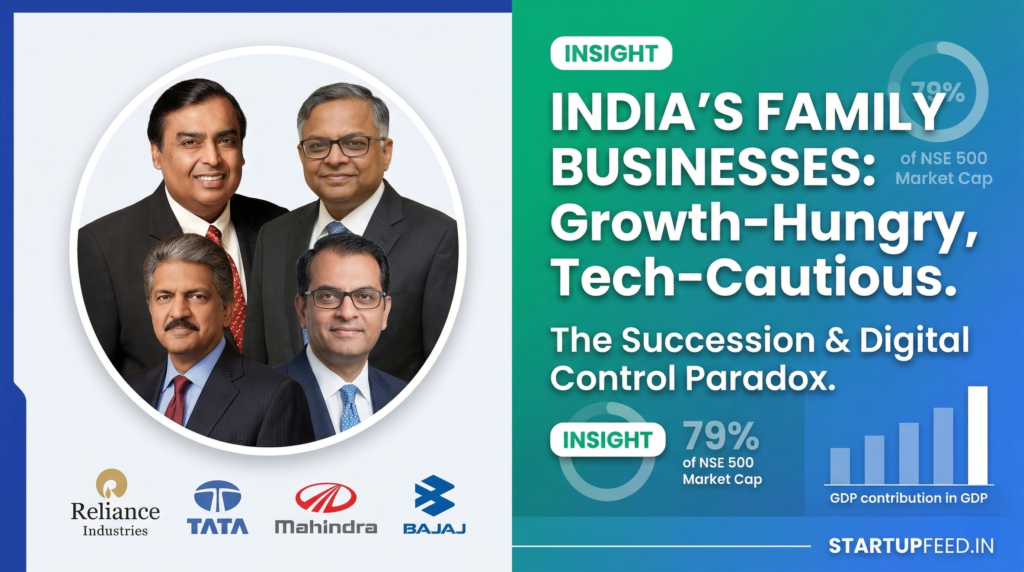
India’s family businesses are among the most studied, most celebrated, and most misunderstood institutions in the country’s economic history. They built India Inc from scratch — the Tatas, the Birlas, the Ambanis, the Mahindras, the Godrejs, the Bajajs — across textiles, steel, automobiles, chemicals, telecoms, and consumer goods. They survived partition, nationalisation, Licence Raj, liberalisation, and two decades of global competition. They are still standing, still dominant, still growing.
But they are also, increasingly, at a crossroads. The next decade of India’s economic growth will be defined by AI, data infrastructure, digital supply chains, and platform-based distribution — technologies that require not just investment, but structural transformation. And this is where India’s family businesses face their most complex challenge: they are growth-driven and capital-disciplined, but technology-cautious in a way that, if misunderstood, can be mistaken for conservatism. It is not. It is a rational, if sometimes paralyzing, recognition that technology decisions are not expense items. They are structural commitments.
StartupFeed Insight
| The framing that matters: When a family business decides to enter a new market, they are making a financial bet. The capital is at risk, but the business structure is not. If the bet goes wrong, they retreat, write off the loss, and the family’s information architecture remains intact. When the same family decides to implement an enterprise-wide ERP or a unified data analytics platform, they are making a structural commitment. The information flows in the business change permanently. Who sees what, who knows what, who can verify what — all of this gets redesigned. That redesign touches the deepest question in any family-controlled enterprise: who controls the business? This is why India’s most sophisticated family business promoters are not asking ‘which ERP should we buy’ or ‘how much should we spend on cloud’. They are asking: ‘What is the purpose of digitisation for this family, at this stage of our business lifecycle, given our succession plan and governance architecture?’ That is a profoundly different and more important question. Technology vendors who don’t understand this will keep losing deals they thought they had won. |
India’s Family Business Landscape: The Numbers
The scale of India’s family business economy is routinely underappreciated by the startup and VC community, which tends to focus on unicorns and PE-backed growth companies. The reality is that family businesses are the Indian economy in a way that is not visible from the Bengaluru startup corridor.
| Metric | Data |
|---|---|
| NSE 500 market cap share | ~79% of NSE 500 market capitalisation is in promoter-owned or family-controlled companies |
| GDP contribution | ~65% of India’s GDP generated by family-owned businesses (direct + indirect) |
| Employment | ~70-75 Mn jobs created directly; the largest employment category in the formal sector |
| Number of family businesses (>Rs 10 Cr revenue) | 111,000+ family businesses in India; largest concentration in Asia after China |
| Generation split (listed cos) | ~60% first-generation | ~30% second-generation | ~10% third-generation or beyond |
| Promoter holding (avg, NSE-listed) | ~52% promoter holding in NSE-listed family businesses, well above the SEBI minimum of 25% for listed companies |
| Sectors dominated | Manufacturing (steel, textiles, chemicals, auto components) | Infrastructure | Real estate | FMCG | Financial services | Healthcare | Agribusiness |
| Family businesses in Fortune India 500 | Over 340 of the Fortune India 500 companies are family-owned or family-promoted |
| Global ranking | India is the 3rd largest family business economy globally by number, after the US and China |
Growth-Driven: The Long-Term Capital Allocators
India’s prominent family businesses share one defining financial characteristic: extraordinarily long investment horizons. While publicly traded companies face quarterly earnings pressure and PE-backed companies face 5-7 year fund cycle pressure, family businesses can — and routinely do — make 10, 20, or 30-year bets. This long-termism, combined with disciplined capital allocation, has produced some of the most remarkable compounding stories in India’s corporate history.
| Family / Group | Long-Term Capital Allocation Story |
|---|---|
| Tata Group | Rs 9 lakh crore+ group revenue across 30 companies in 150+ countries. Long-term bets: Tata Steel’s Corus acquisition (2007, Rs 54,000 Cr), Jaguar Land Rover (2008, Rs 9,200 Cr), and Tata Electronics semiconductor investment (Rs 91,000 Cr) all made against short-term scepticism. Capital allocation discipline: Ratan Tata’s refusal to exit loss-making businesses before they turned strategic |
| Reliance Industries | Mukesh Ambani’s Jio bet: Rs 1.5 lakh crore invested over 2010-2016 in telecom infrastructure before a single rupee of revenue. A private family business making the largest pre-revenue capital bet in Indian corporate history. Now Rs 10 lakh crore in revenue. Capital discipline: every Jio investment was internally funded; no equity dilution until IPO plans |
| Mahindra Group | Anand Mahindra’s transformation of a post-Licence Raj auto manufacturer into a diversified Rs 2 lakh crore conglomerate. Long-term bets: Tech Mahindra (IT services), Mahindra Renewables, Mahindra Agribusiness. Capital discipline: willing to exit businesses that don’t meet ROCE thresholds (sold non-core assets in 2019-2020) |
| Bajaj Group | The Bajaj family’s Bajaj Auto and Bajaj Finserv exemplify capital discipline over growth optics. Rahul Bajaj famously resisted pressure to diversify into IT services during the 2000s bubble. Bajaj Finserv’s financial services play compounded at 25%+ CAGR over 15 years. Cash-generative businesses reinvested into patient financial services bets |
| Godrej Group | A 126-year-old group navigating fourth-generation succession while growing across consumer goods, real estate, agribusiness, and defence. Long-term bet: Godrej Properties’ land bank strategy built over decades before monetisation. Capital discipline maintained through HUF and holding company structures that prevent asset fragmentation |
| TVS Group | T.V. Sundaram Iyengar’s descendants have maintained TVS’s two-wheeler dominance through three generations without external private equity. Long-term bets: TVS Supply Chain Solutions IPO (2023), TVS Motor Company’s EV transition. Capital discipline: debt-averse culture; organic growth preference over acquisitions |
Tech-Cautious: Not Conservative. Strategic.
The technology-caution of Indian family businesses is widely observed but rarely correctly explained. Consultants and technology vendors typically attribute it to conservatism, risk-aversion, or lack of digital literacy. This diagnosis is usually wrong. The actual cause is more sophisticated — and more instructive.

|
This distinction is the master key to understanding India’s family business technology paradox. Consider a typical large family business in India — a third-generation textile manufacturer in Surat, or a second-generation pharma group in Ahmedabad, or a first-generation construction conglomerate in Hyderabad. The promoter family:
The asymmetry is not about the money. It is about what each decision does to the information architecture of the business. |
A new plant does not change who knows what in the family business. An ERP system does. The plant sits in a geography; the ERP sits in the centre of every financial flow, every inventory movement, every customer relationship. When a third-generation promoter in a 60-year-old family business contemplates implementing SAP S/4HANA across 8 business units, the deep question they are asking — often unconsciously — is: will my uncle still have the information advantage he needs to run his division his way? Will the CFO now see things I don’t want seen? Will the next generation be able to use this data to challenge the decisions I’ve made? These are governance questions, succession questions, and family dynamics questions — wearing the costume of technology procurement.
The Control Philosophy Debate: What Is Digitisation Actually For?
The most important insight in understanding Indian family business digitisation is this: the real debate is not about software. It is about control philosophy. Every family business has, implicitly or explicitly, a theory about who should have information, who should make decisions, and how accountability should flow. Digitisation forces that implicit theory to become explicit — which is both its greatest value and its greatest resistance generator.
| Control Philosophy | What Digitisation Looks Like | Indian Family Business Example |
|---|---|---|
| Centralised Control (Promoter-Run) | ERP is implemented with heavy access restrictions. Professional managers get operational dashboards; strategic financial data stays with promoters only. Technology serves execution, not governance | Typical first-generation promoter-managed business. Technology is a tool, not a governance mechanism. Often resists cloud because data residency outside family control is uncomfortable |
| Professional Management Trust (Promoter-Board) | Full ERP deployment with role-based access for all C-suite. Promoter reviews board-level dashboards; operational visibility given to professionals. Technology enables delegation | Mahindra Group under Anand Mahindra. Tata Group post-Ratan Tata. Professional CEOs trusted with full P&L visibility; promoter family reviews at board level. ERP and analytics are governance tools |
| Multi-Branch Family Governance | Digitisation is politically contested. Branch A’s SBU does not want Branch B’s family to see its margins. Unified ERP creates transparency that family politics has historically avoided | Godrej Group (Adi Godrej and Jamshyd Godrej era): multi-branch governance with distinct portfolios. Digitisation initiatives require alignment across family branches, not just business units |
| Succession-Oriented Digitisation | Next-generation leader drives digitisation as part of positioning for leadership transition. Technology is the vehicle for demonstrating competence and creating an institutional information base | Bajaj Finserv under Sanjiv Bajaj, TVS Motor under Sudarshan Venu, Nilkamal under the Parekh family: next-gen leaders used technology transformation as the proving ground for succession readiness |
| Partnership / JV Governance | Digitisation driven by external shareholder (PE, listed status, JV partner) requirements. Family may be reluctant, but governance obligations override control preferences | Hinduja Group’s listed entities, or any family business with a PE investor with board rights. Digital transparency is a contractual obligation, not a strategic choice |
When Families Align on Purpose: What Good Looks Like
The research and practitioner literature on family business transformation is unambiguous: when families align on the purpose of digitisation before selecting a platform, implementation outcomes are dramatically better. The failure mode is not technology selection — it is purpose misalignment. When Branch A sees digitisation as a governance tool and Branch B sees it as a surveillance mechanism, the implementation will fail regardless of whether SAP, Oracle, or any other vendor is selected.
The Purpose Alignment Framework (Before Any Technology Discussion):
|
| “When families align on the purpose of digitisation, there is better visibility, stronger governance, and scalable growth. Implementation becomes smoother because the conversation has already happened at the right level.” — Observed pattern in successful Indian family business technology transformations |
Three Outcomes of Purpose-Aligned Digitisation
When Indian family businesses get the purpose alignment right, three compounding outcomes emerge:
- Better Visibility: The End of Information Asymmetry as a Feature
In many Indian family businesses, information asymmetry is a feature, not a bug. The CFO knows more than the divisional head. The patriarch knows more than the CFO. The eldest son knows more than the son-in-law who runs the regional office. This asymmetry — built over decades of informal reporting, trusted relationships, and selective disclosure — is the source of control. But it is also the source of misallocation of capital, slow decision-making, and governance risk at scale. When a Rs 200 Cr family business becomes a Rs 2,000 Cr conglomerate, the patriarch cannot carry all the information in his head anymore. Digitisation — purpose-aligned — replaces informal information asymmetry with structured, role-appropriate visibility that scales with the business.

- Stronger Governance: From Trust-Based to Evidence-Based
Indian family businesses have historically run on trust-based governance: you trust your brother-in-law to run the northern operations because you have known him for 30 years, not because you have quarterly performance data on his unit. This works at small scale. It creates governance failures at large scale. The Hindenburg research reports on Indian conglomerates, the NCLAT cases involving family business disputes, and the governance controversies at several listed Indian family businesses all share a common root: absence of structured, verifiable governance information. Digitisation — implemented with SEBI-compliant board dashboards, real-time SBU P&L reporting, and ERP-based audit trails — shifts the governance model from trust-based to evidence-based. This is uncomfortable for some family members and liberating for others.
- Scalable Growth: Technology as the Infrastructure for the Next Generation
The third-generation challenge for Indian family businesses is not capital allocation — the founders’ track record provides that. It is institutional knowledge transfer. The founder who built the Rs 500 Cr textiles business has 40 years of supplier relationships, market intuition, and operational knowledge in his head. When he retires, that knowledge walks out the door unless it has been digitised into the institution — into CRM systems, supplier databases, process documentation, and operational SOPs. The families that have digitised well are not just better governed; they are more scalable because the next generation can inherit institutional intelligence rather than starting from intuition.
The Generation Gap in Technology Adoption
| Dimension | First Generation (Founder) | Second/Third Generation (Successor) |
|---|---|---|
| Technology philosophy | Tool for efficiency, not structural transformation. Trusts people over systems. ‘My accountant knows everything’ | Systems enabler and governance infrastructure. Digital-first decision-making. Values data over hierarchy |
| ERP relationship | Resistant. Views ERP as bureaucracy-generator and control-diluter. May have survived 30 years without it | Champion. Views ERP as professionalism signal and succession enabler. Often drives implementation as first major project |
| Data access philosophy | Information on need-to-know basis. Tight control over financial data. Distrusts dashboards that aggregate across SBUs | Role-based access as default. Board-level dashboards. Transparent performance management. Data as a shared resource |
| Technology investment horizon | Short-term ROI required. ‘Show me the revenue increase in 6 months’ | Long-term infrastructure bet. Willing to spend 18-24 months on implementation for 10-year benefit |
| Cloud attitude | Sceptical. ‘Our data on someone else’s servers’. On-premise preference | Comfortable with cloud. Multi-cloud strategy. Vendor diversification as risk management, not control preservation |
| AI / Analytics | Suspicious of AI replacing human judgment. ‘My 30 years of experience is better than any algorithm’ | Enthusiastic about AI augmentation. Data-driven decision support. Analytics before intuition as the preferred sequence |
| Typical outcome | Digital transformation stalls at ERP shortlist. Implementation starts, faces cultural resistance, gets delayed 2-3 years, or quietly abandoned | Drives transformation to completion with clear mandate. Uses technology to build institutional credibility. Often leads to external capital raise or listing |
Which Sectors Are Moving Faster — and Why
Technology adoption in Indian family businesses is not uniform. Sector dynamics, regulatory pressure, and customer expectations create very different digitisation trajectories across India’s family business landscape.
| Sector | Tech Adoption Speed | Driver / Reason |
|---|---|---|
| Financial Services (NBFC, Insurance) | Fast | RBI / IRDAI regulatory mandates; core banking system upgrades are compliance-driven, not choice-driven. Bajaj Finserv, Cholamandalam, Shriram Group all digitised under regulatory pressure |
| Pharmaceuticals / Healthcare | Fast | USFDA compliance requires digital audit trails and batch traceability. Export-led pharma families (Sun Pharma, Dr. Reddy’s origins) adopted ERP because global customers required it |
| Auto Components | Medium-Fast | Tier-1 automotive OEM customers (Maruti, Tata Motors, Hyundai) require supplier ERP integration for JIT supply chains. Digitisation is a customer requirement, not a choice |
| Retail / FMCG | Medium | Channel complexity (GT + MT + e-commerce) forces some digitisation. However, promoter-run kiranas and regional distributors resist. D2C brands within family groups adopting fast |
| Real Estate | Slow-Medium | Largely unregulated historically; RERA has forced some digital compliance. But most family real estate businesses still run on Excel, personal relationships, and informal ledgers. Godrej Properties is exception, not norm |
| Textiles / Apparel | Slow | Large number of family businesses, fragmented sector, price-sensitive. ERP ROI hard to demonstrate in commodity-margin business. Adoption concentrated in export-oriented players with Western buyer compliance requirements |
| Agribusiness / Commodities | Very Slow | Spot-market driven, weather-dependent, highly informal. Technology adoption is supply-chain-facing (agritech platforms) rather than enterprise-wide. ITC’s e-Choupal and Mahindra’s agribusiness arm are outliers |
| IT / Technology Services | Fast by definition | Wipro, HCL, LTI — all family-origin technology companies. Digitisation is the core product, not an operational challenge. Internal systems are world-class because the company exists to build world-class systems for others |
Case Study Spotlights: How India’s Biggest Families Have Navigated the Tech-Control Tension
Tata Group: The Institutional Approach
The Tata Group’s approach to digitisation is perhaps the most instructive because it reflects a promoter family that consciously chose to institutionalise governance. Ratan Tata’s transformation of the group in the 1990s was not just about global acquisitions — it was about building the Tata Business Excellence Model (TBEM), a structured governance and performance management framework modelled on the Malcolm Baldrige framework. TBEM created a standardised language of performance across 30 diverse Tata companies, enabling the Tata Sons board to maintain oversight without controlling individual companies’ operations. TCS — the group’s technology flagship — became the internal system-builder, providing digital backbone to other Tata entities. The result: a family that controls 31% of a Rs 30 lakh crore group without needing to micromanage individual operating companies because the governance infrastructure makes accountability transparent.
Reliance: Internalising the Digital Infrastructure
Mukesh Ambani’s approach to digitisation is categorically different — and reveals a different control philosophy. Rather than deploying third-party enterprise software to run Reliance’s businesses, Ambani built the digital infrastructure himself through Jio. Jio is not just a telecom company — it is the data network on which Reliance’s retail, e-commerce, financial services, and healthcare businesses run. By owning the infrastructure layer, the Ambani family retains complete control over the data flows that underpin every Reliance business. This is the purest expression of the family business technology-control thesis: when control of data infrastructure is existential, build it yourself. External vendors cannot be trusted with the architecture of a Rs 10 lakh crore empire.
Mahindra Group: The Professional Management Partnership
Anand Mahindra’s tenure at Mahindra offers the most studied example of a family business promoter who consciously chose to use digitisation as the mechanism for professionalising governance. Under Anand’s leadership, Mahindra deployed group-wide ERP and analytics systems, created independent boards for each listed entity, and — critically — recruited professional CEOs who were given full operational autonomy backed by digital performance visibility. The promoter family retained strategic oversight and brand guardianship while professional managers ran the operating companies with full data access. The result: Mahindra grew from a Rs 20,000 Cr group in 2000 to Rs 2 lakh crore+ today, while the promoter family’s holding actually declined as a deliberate governance choice.
What This Means for the Indian Startup Ecosystem
For the Indian startup and technology sector, India’s family businesses represent the largest untapped enterprise technology market in the country. But capturing this market requires understanding the control philosophy dynamic that drives technology purchasing decisions in family businesses. Several implications follow:
|
What’s Next: The Digitisation Decade for India’s Family Businesses
Three macro-forces will drive family business digitisation in India over the next 10 years, regardless of individual promoter preference:
| Force | Mechanism |
|---|---|
| Succession Events | India’s first-generation founder cohort (built businesses 1980-2010) is approaching retirement. Second-generation successors — MBA-educated, digital-native, globally exposed — are entering leadership. Every succession event is a technology investment trigger. Estimate: 40,000+ significant family business successions in next 10 years |
| Capital Market Access | As family businesses seek public listings, PE investments, or GCC (Global Capability Centre) partnerships, they face inescapable governance digitisation requirements. SEBI’s strengthened related-party transaction rules, audit committee requirements, and board independence norms all require digital audit trails and real-time reporting |
| Customer / Supplier Requirements | Supply chain digitisation cascades downward. As Tata Motors, Maruti, and Reliance Retail digitise their procurement, they impose ERP integration requirements on their suppliers and distributors. Family businesses that cannot integrate digitally into their largest customers’ supply chains will lose market share to digitally compliant competitors |
| AI-Enabled Decision Support | The arrival of affordable, deployable AI that provides natural-language interfaces to business data is lowering the adoption friction dramatically. A promoter who was never going to read a PowerBI dashboard might well ask a conversational AI interface ‘how did our Hyderabad plant perform last quarter compared to Chennai’ — and act on the answer |
| Regulatory Formalisation | GST (implemented 2017), TDS on payments, and the upcoming expansion of digital reporting requirements are already forcing small and mid-size family businesses into digital accounting. The tax system is digitising family business finance from the outside in, regardless of promoter preference |
India’s family businesses are not technology’s opponents. They are its most discerning customers. They have seen enough consultants sell ERP implementations that went over budget, under-delivered, and created political crises within the family governance structure. Their caution is earned scepticism, not ignorance. The technology companies and startup founders who will win the Indian family business market are those who understand that the procurement decision is ultimately a governance philosophy alignment — and who bring that conversation to the promoter before they show a demo.
Liked this story? Follow StartupFeed on Google so our reporting reaches you first.