
Every billion-dollar company in the world is built on a business model — a specific answer to one question: how do you create value, deliver it, and capture revenue from it? The product, team, technology, and marketing all matter enormously. But the business model is the invisible architecture underneath everything else. Get it right and the company scales. Get it wrong and no amount of great product or great team can save the business.
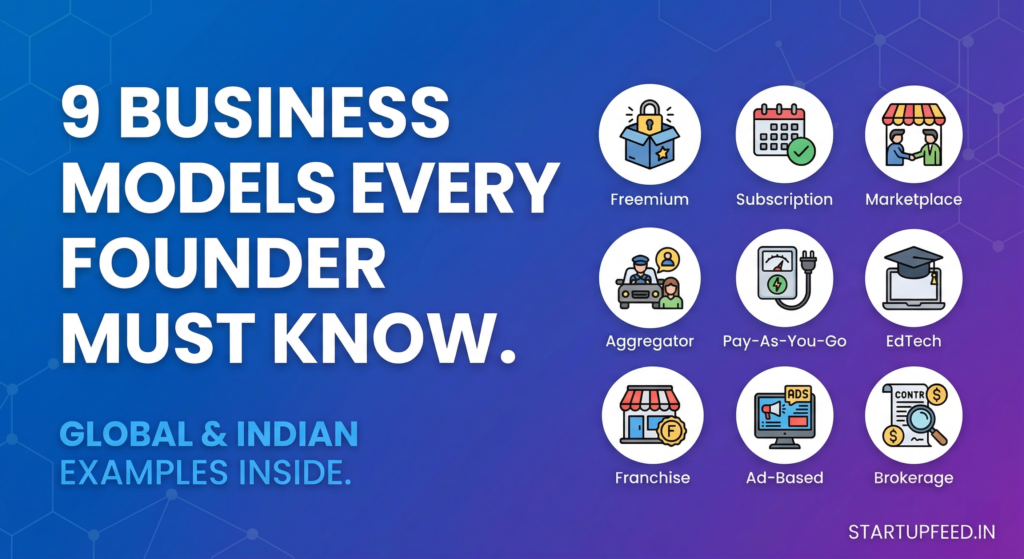
Here are the 9 most important startup business models operating today — each explained with how it works, where it generates revenue, who executes it best globally and in India, and what every founder needs to know before choosing or combining them.
Quick Reference:
| # | Model | Core Revenue Mechanism | Global Example | India Example |
|---|---|---|---|---|
| 1 | Freemium | Free tier + paid upgrade for premium features | Google, Spotify, Dropbox | Zoho, Grammarly India, Canva India |
| 2 | Subscription | Recurring fee for access to product/service | Netflix, Notion, Slack | Zerodha Kite, Hotstar, ClearTax |
| 3 | Marketplace | Platform connecting buyers & sellers; earns take rate | Amazon, Etsy | Flipkart, Meesho, Urban Company |
| 4 | Aggregator | Standardises & packages third-party supply; brand owns experience | Uber, Airbnb | Ola, Zomato, OYO |
| 5 | Pay-As-You-Go | Charge for actual consumption; no upfront commitment | AWS, Google Cloud, Twilio | Razorpay, Juspay, Cloudnine Hospitals |
| 6 | EdTech (D2L) | Courses, certifications, upskilling; freemium-to-paid funnel | Coursera, Duolingo | PhysicsWallah, BYJU’S, Unacademy |
| 7 | Franchise | License brand + systems to operators; earn fee + royalty | KFC, McDonald’s, Subway | Burger Singh, Chai Point, Smoke House Deli |
| 8 | Ad-Based | Free service; charge advertisers for user attention | Facebook/Meta, Google Search | ShareChat, InMobi, Dailyhunt |
| 9 | Brokerage | Facilitate transactions; earn commission/spread | eBay, StockX | Zerodha, Groww, Cars24 |
Model 1: Freemium Give free. Convert to paid.
The freemium model offers a core product for free — permanently, not as a trial — while charging for premium features, higher usage limits, team collaboration, or advanced capabilities. The free tier is the acquisition channel. The paid tier is the business. The art of freemium is designing the boundary between free and paid so that exactly the right users upgrade at exactly the right moment.
| Revenue Engine | Conversion rate from free to paid (typically 2-10%). Premium tier pricing: individual, team, and enterprise tiers. Add-on features, storage, API access, custom domains, advanced analytics. |
|---|---|
| Global Anchors | Google (Workspace: 2 Bn+ free Gmail users; enterprises pay for Drive, Meet, security tools) | Spotify (600 Mn free / 240 Mn paid, May 2024) | Dropbox (750 Mn registered users; ~17 Mn paid) | Slack (free for small teams; enterprises pay per seat) | Zoom | Grammarly | Duolingo (also EdTech — model overlap) |
| Indian Anchors | Zoho (free-to-paid SaaS suite — one of India’s most successful B2B freemium stories; bootstrapped to $1 Bn+ ARR) | PhysicsWallah (200+ free YouTube channels drive millions of users into paid app courses) | ShareChat (free social media converts users into ad inventory) | Canva India (design templates free; Canva Pro paid) | Grammarly India | Hiver (Gmail-based helpdesk; free-to-enterprise) |
| Strengths | No sales cost for acquisition (word-of-mouth). Network effects compound. Product sells itself. High LTV once converted. Data from free users improves product. |
| Challenges | Free tier infrastructure costs real money. Conversion rates are low. Premium features must be compelling enough to pay for — but not so good they should have been free. Abuse of free tier by large teams kills unit economics. |
| Founder Watch | Design the ‘upgrade trigger’ carefully. The moment a free user hits a limit (storage, users, features) must feel natural and urgent, not punitive. The wrong limit design kills conversion. Test: can your free users explain to someone else why they upgraded? |
Model 2: Subscription Predictable revenue, compounding retention.
The subscription model charges users a recurring fee — monthly, annual, or multi-year — for continuous access to a product, service, or content library. Unlike freemium, subscription typically requires payment to access at all (though free trials are common). The business value proposition is continuity: the service is better the longer you use it, making churn expensive for the customer.
| Revenue Engine | Monthly / Annual Recurring Revenue (MRR / ARR). Upsell to higher tiers (individual → family → team → enterprise). Reduce churn = reduce cost. Long-term customers are more profitable than new acquisitions. |
|---|---|
| Global Anchors | Netflix (270 Mn subscribers globally, as of Q1 2024) | Notion | Adobe Creative Cloud (pivoted from perpetual licence to subscription — transformed its financials) | Salesforce | Microsoft 365 | Spotify (paid tier) | The Economist | Substack |
| Indian Anchors | Zerodha Kite (Rs 300/month flat; disrupted India’s brokerage model) | Hotstar / Disney+ Hotstar (IPL rights-led subscriber acquisition; 38 Mn+ subs) | ClearTax / Clear (tax filing + compliance subscription for businesses) | Keka HR | Freshworks (SaaS; Nasdaq-listed Indian company) | Lenskart (annual lens subscription) | 1mg Advantage |
| Strengths | Revenue is predictable — investors love ARR/MRR metrics. Customer lifetime value (LTV) compounds over time. Monthly cash flow visibility. Upsell paths are clear. |
| Challenges | High churn = death. Subscriber acquisition cost (CAC) must be recovered within first 3-6 months. Content or feature staleness drives churn. Annual prepay locks in cash but creates refund risk. |
| Founder Watch | Track cohort retention obsessively, not just gross subscriber count. A business adding 10,000 subscribers/month while losing 9,500 is running on a treadmill. NPS (Net Promoter Score) is the leading indicator of churn 2-3 months before it shows up in numbers. |
Model 3: Marketplace Facilitate the transaction. Keep the take rate.
A marketplace connects buyers and sellers (or service seekers and providers) and earns a commission — called a ‘take rate’ or ‘rake’ — on every transaction that flows through the platform. The marketplace does not own the inventory; it owns the trust, discovery, and transaction infrastructure. The fundamental challenge is the chicken-and-egg problem: sellers won’t come without buyers, and buyers won’t come without sellers.
| Revenue Engine | Gross Merchandise Value (GMV) x Take Rate = Revenue. Listing fees (some models). Promoted listings / advertising (Amazon Sponsored Ads is enormous). Fulfilment services (Amazon FBA). Financial services (loans to sellers, buyer EMI). |
|---|---|
| Global Anchors | Amazon (global marketplace; seller services now ~$140 Bn revenue stream) | Etsy (handmade/vintage; 90 Mn buyers) | eBay (early marketplace pioneer) | Airbnb (accommodation marketplace) | Fiverr / Upwork (services marketplace) |
| Indian Anchors | Flipkart (India’s largest e-commerce marketplace; acquired by Walmart for $16 Bn in 2018) | Meesho (social commerce marketplace; 150 Mn+ transacting users) | Urban Company (home services marketplace; Rs 750+ Cr revenue) | Rapido | Apna (blue-collar jobs marketplace) | Tractors and Farm Equipment (B2B marketplace) |
| Strengths | Asset-light: no inventory risk. Scales exponentially with more participants. Network effects create defensibility. Take rate compounds with GMV growth. |
| Challenges | Cold-start problem (chicken-and-egg). Race to zero take rates in commoditised categories. Amazon vs sellers tension (platform competes with its own supply). Fraud and trust management at scale. |
| Founder Watch | The most important number is not GMV — it’s ‘liquidity rate’: what percentage of listings result in a completed transaction? A marketplace with high listings but low liquidity has a discovery or trust problem. Solve liquidity before scale. |
Model 4: Aggregator Own the demand. Standardise the supply.
The aggregator model was defined by Ben Thompson’s Aggregation Theory: aggregators control demand (users), onboard fragmented supply (drivers, restaurants, hotels), standardise the customer experience under their brand, and extract value from that position. Unlike a marketplace, the aggregator owns the customer relationship, sets standards for supply, and can commoditise the supplier. The aggregator’s brand is the product — not the individual service provider’s.
| Revenue Engine | Commission per transaction (Uber takes 25-35% of each ride fare). Surge pricing captures value during peak demand. Subscription for power users (Uber One). Advertising (Zomato Gold, Swiggy One). Logistics revenue (delivery fees). |
|---|---|
| Global Anchors | Uber (ride aggregation; 9.4 Mn monthly active drivers; 131 Mn monthly users) | Airbnb (accommodation aggregation — blurs with marketplace) | DoorDash | Instacart | Booking.com (hotel aggregation) |
| Indian Anchors | Ola (ride aggregation; competes with Uber India) | Zomato (food delivery + restaurant discovery aggregation; listed; Rs 4,200+ Cr quarterly revenue) | Swiggy (food + quick commerce aggregation; listed) | OYO (hotel aggregation + standardisation; $2.5 Bn valuation) | UrbanClap / Urban Company (home services) | Porter (logistics aggregation) |
| Strengths | Rapid scale through third-party supply onboarding. Defensible brand position (user habit is with platform, not provider). Data advantage grows with scale. Can enter adjacent categories. |
| Challenges | Supply-side dependence — drivers/restaurants have power to decamp en masse. Regulatory risk (gig worker classification, data localisation). Profitability requires dense local supply-demand clusters. Race to subsidise both sides initially. |
| Founder Watch | The aggregator’s moat is habit, not switching cost. A user who uses Zomato out of habit (because it’s the first thing they open) is 10x more valuable than a user who chooses Zomato because of a coupon. Build habit before cutting subsidies. |
Model 5: Pay-As-You-Go (Consumption-Based) You pay for what you use. Nothing more.


The pay-as-you-go (PAYG) or consumption-based model charges customers only for what they actually consume — compute hours, API calls, transactions, kilowatt-hours, SMS messages, or any other measurable unit of value. There is no upfront commitment and no minimum subscription. This lowers the barrier to entry massively (any startup can begin using AWS for $5/month) and creates a revenue model where the supplier’s revenue grows perfectly in line with the customer’s usage and success.
| Revenue Engine | Unit economics: revenue = units consumed x price per unit. Gross margin improves as infrastructure costs are amortised over more usage. Reserved instance / committed-use discounts lock in revenue. Usage growth from existing customers is pure expansion revenue. |
|---|---|
| Global Anchors | AWS / Amazon Web Services (largest cloud provider globally; $100 Bn+ annual revenue) | Google Cloud | Microsoft Azure | Twilio (pay-per-SMS, pay-per-call) | Stripe (pay-per-transaction: 2.9% + $0.30) | Snowflake (pay per compute credit) | OpenAI API (pay per token) |
| Indian Anchors | Razorpay (pay per transaction: ~2% + fix; India’s largest payment gateway; $7.5 Bn valuation) | Juspay (payments orchestration; PAYG API model) | Setu (banking API infrastructure; PAYG) | Exotel (cloud telephony; per-minute/per-call) | Cashfree | PayU India |
| Strengths | Zero CAC friction (start using immediately without commitment). Revenue perfectly aligns with customer success. No churn risk from subscription lock-in. Expansion revenue from organic usage growth. |
| Challenges | Revenue is unpredictable month-to-month. Customers can reduce usage or switch immediately. Price-sensitive customers game usage to minimise spend. Hard to forecast and budget for infrastructure costs. |
| Founder Watch | The PAYG model requires ‘usage stickiness’ — the customer’s code, data, and workflows must be embedded into your platform. AWS’s moat is not its price; it’s the thousands of hours a developer has already invested in AWS-specific tooling. Build for embeddedness, not just ease of onboarding. |
Model 6: EdTech (Direct-to-Learner) Teach at scale. Certify for careers.
The EdTech model sells education, skills training, certifications, or test preparation directly to learners. Revenue is earned through course purchases, subscription access to learning libraries, live cohort programmes, or institutional B2B contracts. The most powerful EdTech models combine a free discovery layer with a premium paid conversion layer.
| Revenue Engine | Course purchases (one-time). Subscription to course library. Live cohort / bootcamp (premium, high-ticket). B2B enterprise / institutional contracts. Certification (partner with universities or employers). Physical centres (hybrid model). Freemium: free content builds audience, paid courses convert. |
|---|---|
| Global Anchors | Coursera ($600 Mn+ revenue; 148 Mn registered learners; India is #2 market globally) | Duolingo (gamified language learning; 90 Mn+ DAUs; ad + Super Duolingo subscription) | Udemy | MasterClass | Khan Academy (non-profit, grant-funded free model) | Chegg | Pluralsight |
| Indian Anchors | PhysicsWallah (India’s only profitable large EdTech; Rs 4,200 Cr 9M FY26 revenue; 200 Mn+ YouTube subscribers across channels; IPO listed Nov 2025) | BYJU’S (cautionary tale: $22 Bn peak valuation, now in insolvency) | Unacademy (being acquired by upGrad in all-stock deal) | upGrad ($2.25 Bn valuation; Rs 1,569 Cr FY25 revenue) | Scaler Academy | Simplilearn | Vedantu |
| Strengths | Massive addressable market (India: 600 Mn people under 25). Digital distribution makes marginal cost near-zero. Strong learner community network effects. Government-aligned demand (upskilling mandates, NEP 2020). |
| Challenges | BYJU’S proved that aggressive sales tactics and unsustainable growth destroy EdTech companies. Quality matters more than quantity of learners. High CAC in test-prep segments. Physical expansion (offline centres) is expensive but necessary for trust. |
| Founder Watch | The EdTech paradox: the businesses that grow fastest (high-pressure sales, expensive bootcamps) often have the worst outcomes for learners. PhysicsWallah’s success came from founder Alakh Pandey’s explicit choice not to raise average revenue per user (ARPU) aggressively. ‘Stay affordable, expand the market’ beat ‘charge more, shrink the market’ in the long run. |
Model 7: Franchise License your playbook. Earn while they execute.
The franchise model licenses a proven brand, operating system, and supply chain to independent operators (franchisees) in exchange for an upfront franchise fee and ongoing royalty (typically 5-12% of revenue). The franchisor builds and owns the brand, systems, training, and quality standards. The franchisee owns the store, hires staff, and executes operations. The model allows rapid geographic expansion without the franchisor deploying capital for each new location.
| Revenue Engine | Upfront franchise fee (Rs 5-25 L per outlet in India; $30,000-$50,000 for global chains). Ongoing royalty: 4-12% of store revenue. Supply chain margin (franchisee buys ingredients/packaging from franchisor’s suppliers). Technology fee. Marketing fund contribution. |
|---|---|
| Global Anchors | KFC (27,000+ outlets globally; Yum! Brands) | McDonald’s (40,000+ outlets; most locations franchised) | Subway (37,000+ locations; one of the most franchised brands ever) | Domino’s (19,000+ stores) | IKEA (franchise model in many markets) |
| Indian Anchors | Burger Singh (India’s largest homegrown burger chain; 200+ outlets; just raised Rs 82 Cr Series B to scale franchise infrastructure) | Chai Point (tea cafe franchise; 300+ outlets) | Amul (India’s largest franchise network: 10,000+ preferred outlets and parlours) | Subway India (900+ outlets) | DTDC (logistics franchise) | VLCC |
| Strengths | Rapid expansion with franchisee capital, not your own. Royalty revenue is high-margin and recurring. Franchisee has skin in the game (owns the outlet) so execution quality is motivated. Brand scales faster than balance sheet. |
| Challenges | Quality control across hundreds of franchisees is hard. A bad franchisee damages the entire brand. Royalty revenue depends on franchisee success. Franchisor’s role is system-builder and brand guardian, not store operator — different skillset. |
| Founder Watch | The franchise model’s secret ingredient is the operating manual — the documented, teachable system that makes every outlet replicable. McDonald’s is not in the burger business; it is in the system business. The burger is what makes the system visible. Before franchising your concept, ask: can a motivated stranger with no industry background follow my manual and run a profitable outlet in 90 days? |
Model 8: Ad-Based (Attention Economy) Free to users. Sell their attention.
The ad-based model offers a product or content for free to users and monetises by selling access to those users’ attention to advertisers. Revenue is driven by user scale (total impressions), engagement (time on platform, pages visited), data precision (the more the platform knows about its users, the higher the CPM it can charge), and ad format quality. The model requires massive scale to be profitable — small ad-based platforms rarely work.
| Revenue Engine | CPM (cost per thousand impressions). CPC (cost per click). CPV (cost per video view). Programmatic advertising auctions. Brand partnerships and sponsored content. Native advertising. Data licensing (where legal). |
|---|---|
| Global Anchors | Meta / Facebook ($134 Bn+ annual ad revenue; ARPU in US/Canada ~$68/quarter) | Google (Search + YouTube: $240 Bn+ annual ad revenue) | TikTok / ByteDance | Snapchat | Twitter/X | Reddit | The Trade Desk (ad tech infrastructure) |
| Indian Anchors | ShareChat + Moj (Indian social media; $5 Bn+ peak valuation; Bharat-language content) | InMobi (Indian adtech unicorn; global mobile advertising platform; $1 Bn+ valuation) | Dailyhunt / Josh (news + short video; vernacular India) | Naukri.com/Info Edge (job listings + ads) | Cricbuzz (cricket-led content; sold to Times Internet) | Scroll.in |
| Strengths | Zero friction for user acquisition. Scale compounds ad CPM (more data = better targeting = higher rates). Viral growth possible when product is truly free. No payment friction barriers. |
| Challenges | Requires very large scale to generate meaningful revenue. Advertiser concentration risk (Google and Meta dominate digital ad budgets). Privacy regulations (GDPR, India’s DPDP Act) restrict data use. Ad revenue is cyclical — falls sharply in economic downturns. |
| Founder Watch | The ad-based model only works when your content or tool is genuinely engaging enough that users choose to spend time on it without being paid to. ‘Engagement’ built through outrage, addiction loops, or dark patterns creates regulatory liability and user resentment. Build for genuine daily value. The platforms that have lasted (Google Search, YouTube, Gmail) offer something users actively want, every day. |
Model 9: Brokerage Bring buyer and seller together. Keep a cut.
The brokerage model facilitates transactions between two parties — buyer and seller, borrower and lender, job seeker and employer — and earns a commission, spread, or fee on each completed transaction. Unlike a marketplace, brokerages often provide active intermediation (research, advice, matching) rather than just infrastructure. The broker adds value by reducing information asymmetry: buyers and sellers don’t know each other and can’t efficiently transact without the broker.
| Revenue Engine | Commission as % of transaction value (real estate: 2-3%; stock trading: flat fee per trade; insurance: 10-30% of premium). Bid-ask spread (stock market makers). Referral fee (mortgage, insurance, credit card). Lead generation fee (B2B). Subscription + commission hybrid. |
|---|---|
| Global Anchors | eBay (early commission-based marketplace; GMV: $70+ Bn/year) | StockX (resale marketplace for sneakers, collectibles) | Robinhood (zero-commission stock trading; makes money on payment for order flow) | Booking.com / Expedia (hotel booking commission: 15-25%) | LendingClub | Compass (real estate tech brokerage) |
| Indian Anchors | Zerodha (India’s largest stock broker by active users; Rs 20/trade flat-fee model disrupted incumbents; bootstrapped to Rs 4,700 Cr profit FY24) | Groww (discount broker + mutual fund distribution; 10 Mn+ active investors; IPO plans) | Cars24 (used car brokerage; $3.3 Bn valuation) | NoBroker (real estate; removes traditional broker) | PolicyBazaar (insurance brokerage; listed; Rs 4,500 Cr+ revenue) | Indiamart (B2B product marketplace with brokerage elements) |
| Strengths | Commission revenue scales directly with transaction value. Asset-light (don’t own what you’re selling). Both sides benefit from the introduction. Strong network effects when the broker becomes the trusted information source. |
| Challenges | Disintermediation risk: once buyer and seller know each other, they may transact directly. Zero-commission disruption (Robinhood disrupted traditional brokers; Zerodha disrupted India’s full-service brokers). Trust is everything — one scandal destroys years of relationship-building. |
| Founder Watch | The brokerage model’s long-term moat is information asymmetry. Zerodha survived zero-fee challengers because it became the most trusted, most reliable trading infrastructure in India. PolicyBazaar survived because it aggregates policy data that no individual customer can independently access. Ask: what information do I control that makes me structurally valuable to both sides of this transaction, permanently? |
Master Comparison: Choosing Your Business Model
| Model | Best For | Revenue Predictability | Capital Intensity | Scale Speed | India Proof Point |
|---|---|---|---|---|---|
| Freemium | B2B SaaS, tools | Medium | Low-Medium | High | Zoho ($1 Bn+ ARR, bootstrapped) |
| Subscription | Content, SaaS, services | Very High | Low | Medium | Hotstar (38 Mn+ subs) |
| Marketplace | e-commerce, services | Medium | Low | Very High | Meesho (150 Mn+ users) |
| Aggregator | Transport, food, hospitality | Medium | Medium | Very High | Zomato (Rs 4,200 Cr/qtr) |
| Pay-As-You-Go | Infrastructure, APIs, payments | Low-Medium | High (infra) | High | Razorpay ($7.5 Bn val) |
| EdTech | Education, upskilling, test prep | Medium | Medium | High | PhysicsWallah (IPO, profitable) |
| Franchise | F&B, retail, services | High (royalty) | Low | Very High | Amul (10,000+ franchise network) |
| Ad-Based | Social, content, news | Low (cyclical) | Low | Very High | InMobi ($1 Bn+ val) |
| Brokerage | Finance, real estate, used goods | Medium | Low | High | Zerodha (Rs 4,700 Cr profit FY24) |
StartupFeed Insight: The Real Secret — Hybrids Win
The 9 models above are not mutually exclusive. The most defensible businesses in the world layer multiple models together:
The pattern: start with one dominant model that solves a clear problem profitably. Use the user base from that model to layer in a second model that monetises the same users differently. Repeat. The companies that tried to operate 3-4 models simultaneously from day one almost always failed (see: BYJU’S). The ones that layered models sequentially, as their user base and infrastructure justified it, are the ones that compounded. |
A note on India-specific model adaptations:
|