Quick Take
|
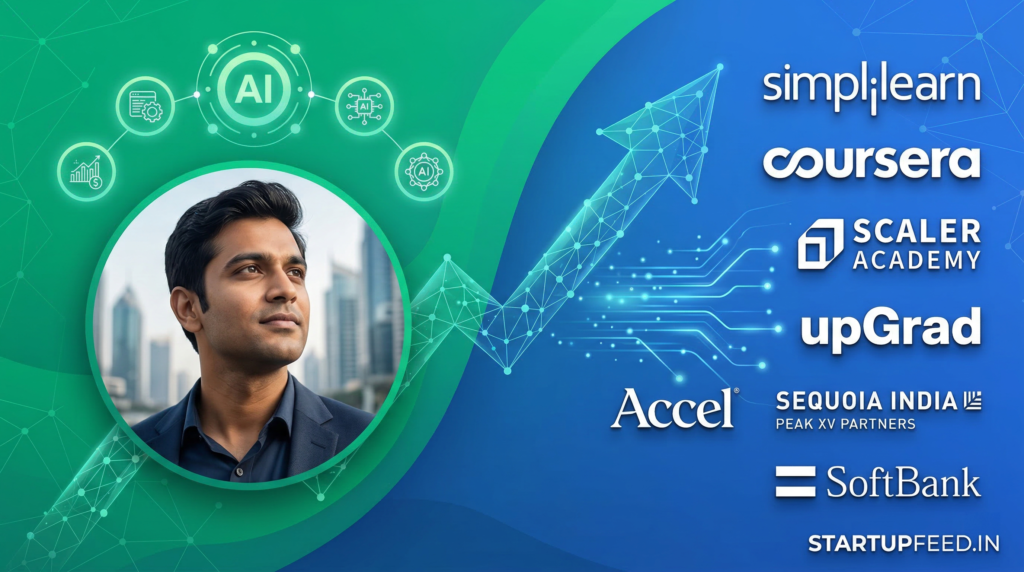
India has become the world’s largest classroom for AI education — and the edtech platforms that saw their growth stall after the pandemic are now riding the most powerful tailwind the sector has ever seen. India recorded 3.6 Mn GenAI enrollments in 2025, the highest of any country globally, according to Coursera. With 1 Mn AI professional roles needing to be filled by 2026 and only 16% of India’s IT workforce currently AI-skilled, the demand-supply gap is the most profitable structural problem India’s edtech sector has ever faced. Simplilearn, Coursera, Scaler, and upGrad are all pivoting their AI offerings — and their monetisation strategies — at precisely the right moment.
But beneath the enrollment numbers lies a more complex story. This isn’t a single wave — it’s a stratification of the AI learning market into three distinct price tiers, each with different economics and different winners. The platforms that understand the difference between selling an AI certificate and building an AI career are the ones that will print revenue. The ones that don’t will find themselves flooded with low-margin traffic and hemorrhaging high-value learners to competitors.
StartupFeed Insight
| The real story the numbers tell: India’s 53% AI talent gap is not a crisis for edtech — it is a permanently renewing market. Every AI job created requires new skills; every new AI tool (GPT-5, Gemini 2.0, Claude 4, new Indian LLMs) obsoletes 30% of the skills taught last year. Unlike engineering fundamentals that stay stable for decades, AI upskilling has a 12-18 month half-life. This means learners come back. Course catalogs must refresh constantly. And the platform with the deepest industry partnerships and fastest curriculum update cycle wins. The three-tier market:
What this means for investors: The edtech platforms that are profitable (upGrad’s EBITDA+, Scaler’s 98% loss reduction) are the ones that have successfully shifted revenue weight to Tier 3. Self-paced certificates are a feature, not a business. The real monetisation is in the Rs 1L-5L PG programs targeting India’s 54 Lakh+ IT professionals. Our prediction: By FY28, AI upskilling will contribute 40%+ of total edtech revenue in India — up from approximately 15-20% today. The first platform to cross Rs 500 Cr in AI-specific revenue will be upGrad, driven by its IIT/IIIT-backed programs and enterprise B2B channel. Scaler will be the dark horse — its Rs 50 Cr PGP in Business & AI investment signals a serious expansion into the management-plus-AI segment. |
The Numbers Behind India’s AI Upskilling Boom
| Indicator | Value | Source |
|---|---|---|
| India GenAI enrollments (2025) | 3.6 Mn — #1 globally | Coursera Learner Trends 2025 |
| Speed of AI enrollment (India 2026) | 1 enrollment every 20 seconds | Coursera CTO, Mar 2026 |
| GenAI enrollment growth YoY (Coursera India) | 107% in 2025 | Coursera Global Skills Report |
| AI course enrollment growth 2023-2025 (Coursera) | 450% | Whalesbook / Coursera data |
| India Coursera learner base | 32.8 Mn (#2 globally after US) | Coursera 2025 Report |
| AI professionals needed in India by 2026 | 1 Mn+ (NASSCOM) | NASSCOM / McKinsey |
| Current AI-skilled IT professionals | ~16% of workforce | MeitY |
| AI talent gap by 2026 | 53% | TeamLease Digital / NASSCOM |
| Supply-demand ratio for GenAI roles | 1 qualified engineer per 10 openings | TeamLease Digital |
| Senior AI/GenAI/MLOps salary (India) | Up to Rs 60 Lakh/year | TeamLease Digital |
| AI/ML salary CAGR (3 years) | 18% | TeamLease Digital |
| GenAI job postings growth 2021-2025 | ~10,000x | Scaler / industry data |
| EY estimate: GenAI’s potential GDP add to India | $1.5 Tn by 2030 | EY India |
| Enterprises using AI at work (India) | 88% of employees use AI | EY Work Reimagined 2025 |
Platform-by-Platform: How Each Giant Is Monetising AI
| #1 Simplilearn + SkillUp From self-paced decline to live AI bootcamps — Blackstone’s edtech bet is pivoting hard toward premium learning
Simplilearn’s FY25 financials tell the most important strategy story in India’s edtech sector. Operating revenue fell 26% to Rs 556 Cr from Rs 750 Cr — but that headline obscures a structural transformation happening underneath. Revenue from online self-learning courses collapsed 95% to just Rs 23 Cr. Meanwhile, income from live learning programs surged 65% to Rs 565 Cr. Simplilearn is not shrinking — it is deliberately abandoning the low-margin self-paced model in favour of premium live instruction. SkillUp — Simplilearn’s free/low-cost platform — now serves primarily as a top-of-funnel lead generation tool, feeding learners into higher-margin paid programs. The AI monetisation strategy is built on premium partnerships: the AI & ML Bootcamp co-developed with Purdue University and IBM, AI-focused programs with Oxford University’s Said Business School (launched Dec 2025), and a partnership with the India AI Mission to upskill 10 Mn citizens. CEO Krishna Kumar confirmed AI program demand grew 60%+ in one year, with over half of that demand from India.
Investor note: Simplilearn’s strategic clarity is commendable — but the 95% collapse of self-learning revenue signals a painful transition. The live learning model requires instructors, infrastructure, and time zone management that self-paced never did. The premium partnership strategy with Purdue, IBM, Oxford, and IIT Madras is the right call, but it narrows the addressable market significantly. At Rs 556 Cr revenue on Blackstone’s balance sheet, the pressure to show AI-led growth in FY26 is acute. |
| #2 Coursera India is Coursera’s second-largest market and its fastest-growing AI lab — 4 Mn AI enrollments and an enrollment every 20 seconds
Coursera’s India numbers are structurally different from every other platform on this list: most of its AI enrollment growth is free or low-cost. India’s 3.6 Mn GenAI enrollments in 2025 — the highest globally, 107% YoY growth — are primarily driven by beginner-level courses like Google AI Essentials and Generative AI for Everyone that cost nothing or carry Coursera Plus subscription fees. The monetisation play is not the enrollment; it is the Professional Certificate upsell. Professional Certificate enrollments grew 23% YoY to 3.3 Mn in India — and those carry structured fees. Coursera’s CTO Mustafa Furniturewala made clear in March 2026 that India’s pace of AI learning is the fastest globally, with an enrollment every 20 seconds. The platform has doubled its GenAI course catalog (2,700+ new courses), added AI governance certifications (March 2025), and is leveraging its 3,500+ India-developed learning modules to deepen local content relevance. Crucially, 50%+ of India’s Coursera enrollments happen on mobile — making it structurally the most accessible AI education platform in the country.
Outcome data (unique to Coursera): 95% of Indian learners report positive career results; 55% report a salary increase; 96% report greater confidence. These numbers are Coursera’s strongest commercial argument to enterprise buyers and government procurement teams — and they explain why the Coursera for Campus and Coursera for Government channels are growing faster than individual subscriptions. |
| #3 Scaler Academy From coding bootcamp to AI business school — Anshuman Singh and Abhimanyu Saxena’s Rs 50 Cr bet on PGP in Business & AI
Scaler’s FY25 story is arguably the most impressive financial turnaround in Indian edtech: revenue roughly flat at Rs 366 Cr, but losses cut by 98%. The company has quietly achieved near-breakeven while maintaining the premium live mentorship model that defines it. Now, with a Rs 50 Cr investment in its new PGP in Business & AI (launched December 2025 / March 2026), Scaler is making its most ambitious product bet: expanding from tech professionals into the management layer of the AI economy. The PGP in Business & AI is explicitly designed for the gap that every traditional B-school is missing: combining AI fluency with business fundamentals for professionals aged 25-40 who can’t do a 2-year MBA but need to lead AI-driven teams. Co-founder Abhimanyu Saxena’s framing — ‘the definition of a management leader has undergone a seismic shift’ — is the sharpest articulation of why this product exists. Scaler has also secured IIM Tiruchirappalli and IIT Roorkee partnerships for AI management and AI engineering programs respectively.
The 1:10 AI supply-demand ratio is Scaler’s most powerful sales argument: Scaler’s placement-guaranteed model gives it credibility with learners precisely because the market is so tightly supply-constrained. When there are 10 GenAI job openings for every qualified candidate, a verified placement outcome is not just a marketing claim — it is a structural near-certainty. |
| #4 upGrad India’s largest edtech by revenue — now EBITDA-positive and using AI program demand to power its next growth cycle
upGrad is the only player on this list that is EBITDA-positive (Rs 15 Cr in FY25) — and the AI wave is arriving at exactly the right moment to sustain that profitability as it navigates its planned acquisition of Unacademy. upGrad’s AI upskilling monetisation is anchored on two distinct customer segments that most platforms ignore: mid- and senior-level professionals who need AI strategy fluency (not just coding skills), and enterprise B2B — corporate contracts with IT companies reskilling their benched developers for AI roles. upGrad’s PG Program in AI & ML, co-developed with IIIT Bangalore (India’s top ML research institution), positions it with the strongest academic anchor of any platform targeting the premium segment. The company has also been explicit about what it observes in the market: mid- and senior-level professionals seeking AI strategy, system scaling, and build-vs-buy decision-making — a fundamentally different product brief than ‘teach me Python.’ With Rs 1,569 Cr in consolidated revenue and a stated 30% CAGR target over the next 2-3 years, AI programs are the clearest growth lever available.
Note on Unacademy acquisition: If the upGrad-Unacademy all-stock deal closes, upGrad gains Unacademy’s strong test-prep audience of 60 Mn+ registered learners — a massive top-of-funnel for AI upskilling conversion. The combined entity’s AI monetisation potential would be significantly larger than either company’s standalone position. |
Head-to-Head: The AI Upskilling Competitive Matrix
| Platform | FY25 Revenue | AI Program Type | Price Range | Key Differentiator | Audience |
|---|---|---|---|---|---|
| Simplilearn / SkillUp | Rs 556 Cr | Live bootcamp + free certs | Rs 0-2.5L | IBM/Purdue/Oxford partnerships; India AI Mission B2G | IT professionals + corporate |
| Coursera | Global (India: 32.8 Mn users) | Self-paced + Professional Certs | Rs 0-50K | Global Big Tech certs (Google, IBM, Meta); mobile-first access | Students, freshers, self-learners |
| Scaler Academy | Rs 366 Cr | Mentorship-led PG programs | Rs 1.5-3L | Placement guarantee; IIM/IIT partnerships; PGP in Business & AI | Mid-career tech professionals |
| upGrad | Rs 1,569 Cr | Executive + enterprise B2B | Rs 1-5L+ | Largest revenue; IIIT-B partnership; enterprise AI strategy | Senior pros, C-suite, corporates |
The AI Course Pricing Landscape: From Free to Rs 5 Lakh+
| Tier | Price Range | Format | Who Offers | Best For |
|---|---|---|---|---|
| Free / Freemium | Rs 0-5K | Self-paced online | Coursera, SkillUp, PW Skills | Students, beginners, curiosity learning |
| Certificate Programs | Rs 5K-30K | Self-paced with certificate | Coursera Plus, Simplilearn, Udemy | Freshers, skill add-ons |
| Bootcamp / PG Cert | Rs 30K-1L | Live/mentor-led, 3-6 months | Simplilearn, Great Learning | Working professionals, career pivot entry |
| Advanced PG Programs | Rs 1L-2.5L | Live + project-based, 6-12 months | Scaler, upGrad, Great Learning | Serious career changers, mid-career |
| Premium PG + MBA-equiv. | Rs 2.5L-5L+ | Full PGP; IIT/IIM-backed | upGrad-IIITB, Scaler PGP, Simplilearn-Oxford | Senior professionals, business leaders |
What’s Next: The Battleground That Will Decide India’s AI Upskilling Winner
Three shifts will determine which platform wins the next phase. First, enterprise and B2B AI contracts — the real money is not in individual learners but in corporate deals where IT companies send 5,000 employees through AI reskilling programs. upGrad’s enterprise channel and Simplilearn’s India AI Mission government contract are early movers. Second, agentic AI and LLM-specific curricula — every platform’s current AI catalog is already becoming outdated as LangChain, LangGraph, Sarvam AI, and agentic workflows enter production. The platform that updates its content fastest wins learner loyalty. Third, outcome credentialing — Coursera’s 95% positive career outcome data and Scaler’s placement guarantees are becoming the primary purchase driver. Platforms that cannot prove salary outcomes will lose the premium segment.
The macro tailwind will not slow down. EY estimates GenAI could add $1.5 Tn to India’s GDP by 2030 and reshape 38 Mn jobs. With 88% of Indian employees already using AI at work and only 3% of organisations having the talent to fully harness it, the upskilling gap is structural, not cyclical. India’s edtech platforms are not just beneficiaries of the AI wave — they are building the infrastructure that determines whether India can actually capture its $1.5 Tn AI opportunity.
Liked this story? Follow StartupFeed on Google so our reporting reaches you first.