

Published: October 21, 2026
StartupFeed Quick Take
- A satcom security device would sit between Indian users and foreign satellite networks, on top of 29 conditions set on May 5, 2025.
- Starlink has held its India licence for 502 days, counted to October 21, 2026, with no commercial service.
- Public sector labs would build the device. No specifications and no timeline have been set.
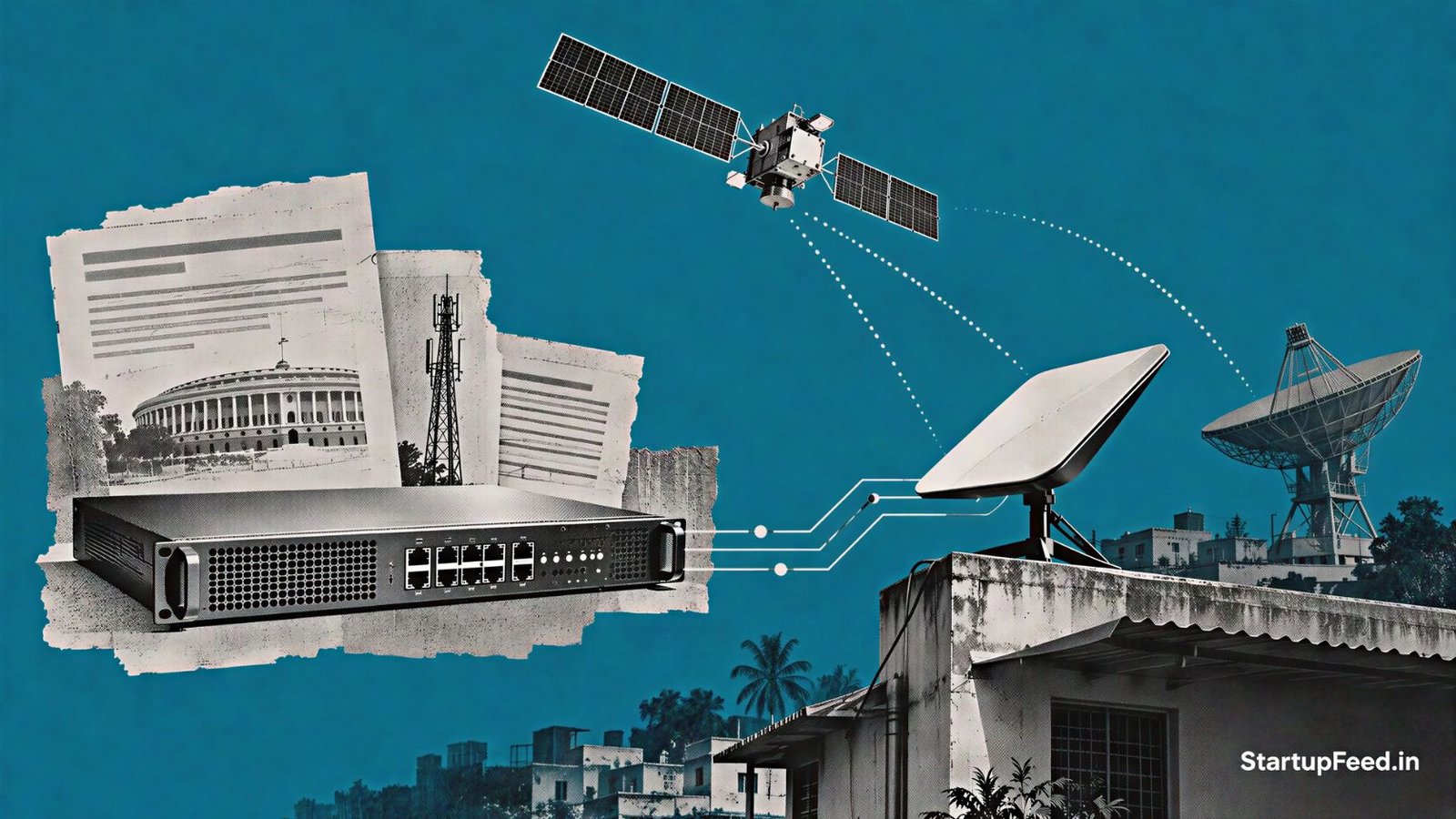
New Delhi is weighing a hardware box that would sit between Indian users and Starlink, with all satellite traffic routed through it.
The Economic Times reported the plan on October 20, 2026, citing people close to the talks. The box could go at a subscriber’s premises or at one of Starlink’s 20 gateway sites in India.
Starlink has waited 502 days. Its licence was recorded on June 6, 2025, and the space regulator cleared it in July 2025. Commercial service has not started.
Minister of State for Communications Chandra Sekhar Pemmasani named the hold-up on October 8.


“Now the issue is pending with MHA for security clearance.”
Chandra Sekhar Pemmasani, Minister of State for Communications. From his remarks to reporters at the India Mobile Congress, October 8, 2026.
What the satcom security device would do
The device would act as a control layer between an Indian user and a network like Starlink’s. Every data packet would pass through it.
An official quoted in the report called foreign satellite operators untrusted transport carriers. Public sector research units would build the device, with some private firms allowed to join.
Two other licensees are in the same queue. Jio Satellite Communications and Eutelsat OneWeb hold the same licence and have not launched either.
Why the 502-day wait matters for Indian suppliers
A licence is not permission to sell. Licences and provisional spectrum have both been issued to all three, and the pending step sits with the Ministry of Home Affairs.
India set 29 security conditions for satellite licensees on May 5, 2025, under file number 60-1/IMC/GMPCS/2024-SAT. Starlink agreed to them before its licence was issued. Each condition tells an operator what to build.
Two of them point at Indian factories. At least 20% of the ground segment must be made in India within five years, and NavIC positioning is due by 2029.
The device would be the first piece of hardware the state specifies itself. India has three licensed operators, Starlink among them. For this box there is no scheme, no budget line and no named agency.



What this means for you: If you sell telecom security hardware, interception systems or satellite terminals in India, this is the earliest signal of a new government-specified box. Get your lawful interception and NavIC compliance documented now, because the 20% domestic ground segment rule already bites within five years.
Have a tip? Write to us at editorial@startupfeed.in.
Liked this story? Follow StartupFeed on Google so our reporting reaches you first.