Quick Take
- Sunbird Straws won a Rs 25 lakh grant under Namma Bengaluru Challenge ’26 in January 2026.
- The startup makes the world’s first drinking straw from naturally fallen coconut leaves.
- It received Grassroots Innovator Recognition from the President of India on July 31, 2026.
A Bengaluru startup that turns fallen coconut leaves into drinking straws has won a Rs 25 lakh government-backed grant. Sunbird Straws was one of five climate-tech winners named under Namma Bengaluru Challenge ’26 on January 26, 2026.
The five winners came from nearly 600 applications across India, per the challenge organiser UnboxingBLR. The grant lets Sunbird pilot its solution on real streets in Bengaluru over six months.
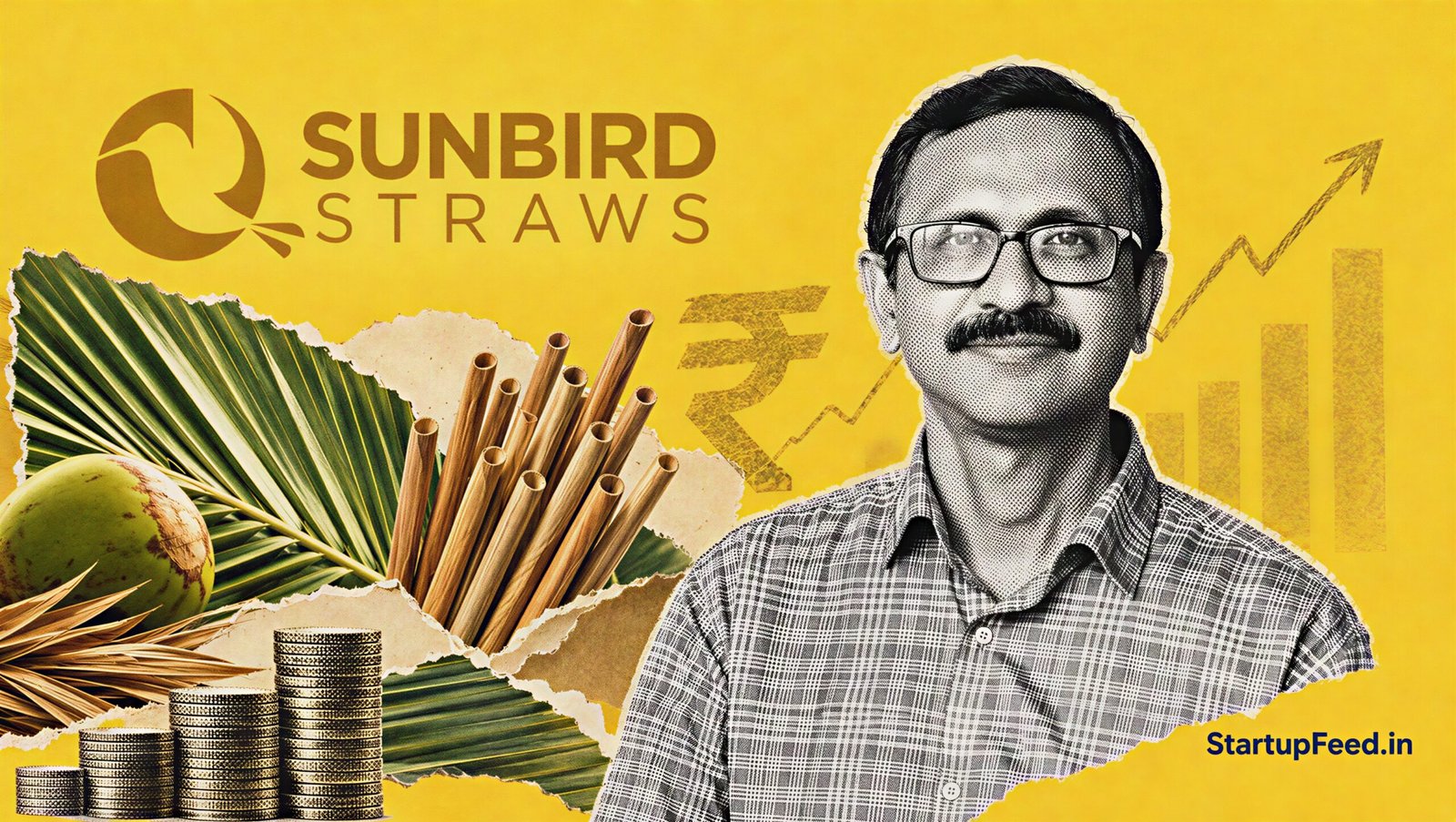
Sunbird Straws was founded in 2020 by Saji Varghese, an associate professor of English at Christ University, Bengaluru. He co-founded it with his students. Chirag M G, a space engineering graduate, is the chief executive.
The idea began on a campus walk. In October 2017 Varghese saw a pile of dried, curled coconut leaves on the ground. A day earlier he had discussed the harm single-use plastic straws cause to marine life.
“It just happened; it struck me,” Varghese told the World Intellectual Property Organization, recalling the moment the idea came.

How does a fallen leaf become a straw?
A coconut tree sheds up to six leaves a year, and in rural areas these are usually burnt as waste. Sunbird collects them instead. The process is fully chemical-free, according to the innovation database GIAN.
A simple cleaning and steaming step draws the leaf’s natural wax to the surface. That wax is rich in phenolic compounds. It makes the straw antifungal and water-repellent, so the straw stays firm in a drink for more than six hours.
Roughly 200 straws can be made from one fallen coconut leaf. Each straw has a shelf life of about nine months. The team built its own machinery, cutting production time from 45 seconds a straw to just three.
The design earned a patent. The Better India reported it was India’s fastest-ever patent approval for a product of its kind. Varghese was granted the patent in 2020.
Why does this matter for nature?
The straw fixes two problems at once. It replaces single-use plastic. It also stops the open burning of coconut leaves, which adds to air pollution in rural areas.
Sunbird makes fully compostable straws that are strong for hours of use, yet break down completely, per ETV Bharat’s report on the NBC ’26 win. There is no industrial composting plant needed. The straw returns to the soil.
India generates a large volume of plastic waste each year, and only a small share is recycled. Sunbird has replaced over 20 lakh single-use plastic straws since 2020, according to a September 2024 report by 30Stades. The count keeps rising.

The model also carries a social payload. Sunbird provides a livelihood to rural women in South India. The World Wildlife Fund funded a production centre at Kanniyakumari, the founder told 30Stades.
How far has Sunbird reached?
The straws now travel well beyond India. Sunbird has sold over 20 million pieces worldwide, The Better India reported. It exports to markets including the Netherlands, Spain and Canada.
The recognition has been international too. Sunbird won Best Innovation for Social Impact at the Climate Launchpad in the Netherlands, competing against entries from 45 countries, per GIAN. That award first brought the company global attention.
In 2023 Sunbird was the only team from India selected for the Youth Ecopreneur Award. The International Trade Centre and the UN organised it in Mongolia. The startup was also a MassChallenge Switzerland 2023 finalist.
The Honey Bee Network chose Sunbird as one of five winners from 1,000 entries in 2024. That link helped connect the team to the United Nations and to state governments in the Andaman and Nicobar Islands and Lakshadweep.
What does the founder say comes next?
Varghese is already testing a second raw material. He has developed straws from Pandanus leaves, known as Annapoorna leaves. He sees this as a way to encourage plants that prevent soil erosion on coastlines.
His stated target is ambitious. “Our goal is to reach a production of one lakh straws per day with employment to 500 women in the next year,” Varghese wrote in a company update.
The Presidential recognition in July 2026 was a milestone. Sunbird was honoured for “exceptional ingenuity, resilience, and commitment to solving real-world challenges,” according to the citation shared by the company. Co-founder Chirag M G received it at Rashtrapati Bhavan.
The event was organised by the Atal Innovation Mission under NITI Aayog. For a product that started with a burnt leaf on a campus lawn, the journey to Rashtrapati Bhavan is a long one. The order book, and the awards, did the talking.
What this means for you: If you run a cafe, an events business or a D2C food brand, a compostable straw that lasts six hours in a drink is now a proven, exportable option, not an experiment.
StartupFeed Insight
Sunbird’s real edge is not the straw. It is the raw material cost, which is close to zero, because a fallen leaf is free and would otherwise be burnt. That is a moat no plastic maker or bagasse rival can copy on price. The move to Pandanus leaves shows the same playbook: find a waste stream, add machinery, add rural labour. Watch whether Sunbird can hit its one lakh straws a day target by late 2027. If it does, the Bengaluru pilot grant will look like the cheapest marketing any climate startup bought this year. The livelihood angle is what will keep the state governments interested.
— Harshvardhan Kothari, Technology and Policy Correspondent
Have a tip? Write to us at editorial@startupfeed.in.
Liked this story? Follow StartupFeed on Google so our reporting reaches you first.