QUICK TAKE (30-second read)
|
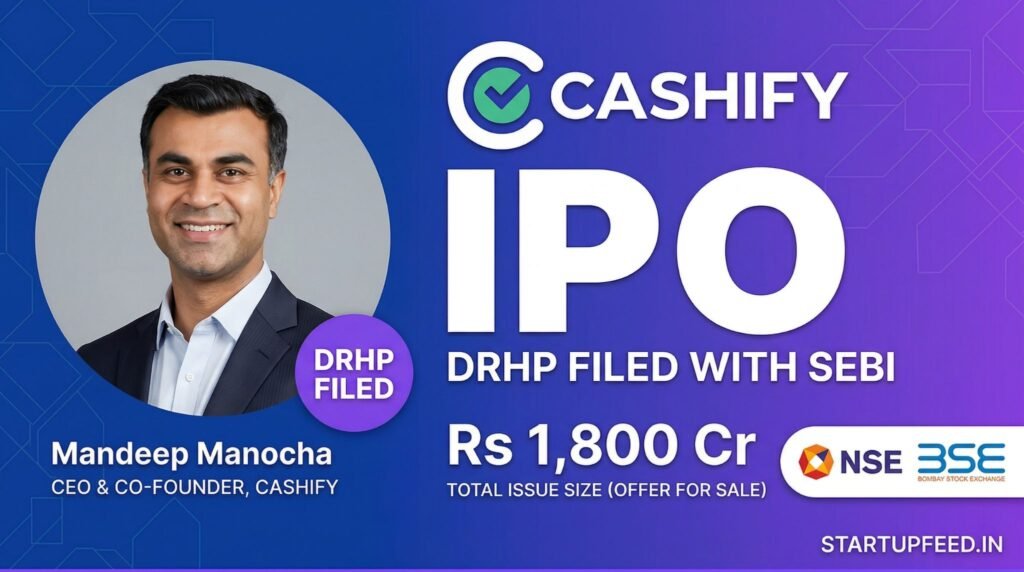
Prosus-backed recommerce startup Cashify has appointed ICICI Securities, JM Financial, and Nomura as bankers for an IPO targeting Rs 1,500–1,800 Cr (approximately $180–215 Mn), with a listing on Indian exchanges targeted for early 2027, according to a Moneycontrol report. The Gurugram-based platform — which lets Indians sell, buy, and repair used phones, laptops, and gadgets — plans to file its draft papers with SEBI confidentially by June or July 2026, completing India’s most significant exit in the recommerce category to date.
The IPO comes on the back of Cashify’s strongest financial year — FY25 revenue crossed Rs 1,000 Cr for the first time and net losses narrowed by 80% to just Rs 10.6 Cr. The timing tests investor appetite for a near-profitable, asset-light marketplace in a macro environment rattled by the West Asia conflict — the same headwind that recently pushed PhonePe to pause its own IPO. Whether Cashify pushes through or waits will depend on how Indian markets stabilise by Q2 FY27.
STARTUPFEED INSIGHT
|
IPO Structure
| Component | Amount (Rs Cr) | % of Total |
| Fresh Issue | TBD (part of Rs 1,500–1,800 Cr) | TBD |
| Offer for Sale (OFS) | TBD (part of Rs 1,500–1,800 Cr) | TBD |
| Total IPO Size | Rs 1,500–1,800 Cr (~$180–215 Mn) | 100% |
Note: The split between fresh issue and OFS has not been finalised. The fresh issue proceeds will flow to Cashify for growth and working capital; OFS proceeds go directly to selling shareholders. For investors, the fresh issue ratio is the critical metric — a higher OFS share means the company is raising less for itself.
Who’s Selling?
| Shareholder | Type | Strategic Context |
| Bessemer Venture Partners (BVP) | VC (US) | Invested since ~2015 seed round; 11+ year hold — one of the longest VC holds in Indian recommerce; partial exit expected |
| Olympus Capital Asia | PE (Series D lead) | Led Rs 15 Mn Series D (Feb 2021); sustainability-focused arm AEPim also invested; likely looking for partial liquidity |
| Blume Ventures | Indian VC | Early investor from 2015; co-led Series E extension (2022) with Amazon; 11-year investor relationship |
| NewQuest Capital Partners | PE — largest external (19.5%) | Co-led $90 Mn Series E (Jun 2022); single largest external shareholder — most likely to have significant OFS component |
| Prosus / MIH Ecommerce Holdings | Strategic (Series E) | Invested in Series E alongside NewQuest; Naspers/Prosus has a track record of partial IPO exits in Indian tech (Meesho, Swiggy) |
Amazon and NewQuest are not listed among confirmed OFS sellers in the current reports. Amazon’s strategic stake may be retained as part of its supply chain partnership with Cashify, which powers exchange programs on Amazon India.
Valuation Analysis
| Metric | Cashify IPO (est.) | Cars24 (listed peer, est.) | OLX / Quikr (private) |
| Revenue (FY25) | Rs 1,096 Cr | Rs 14,000+ Cr (est.) | Not disclosed |
| Net Loss (FY25) | Rs 10.6 Cr (–80% YoY) | Narrowing | — |
| Implied Mkt Cap (upper band) | ~Rs 5,000–6,000 Cr* | — | — |
| P/S Multiple (implied) | ~4.5–5.5x FY25 revenue | — | — |
| Last Private Valuation | Rs 1,980 Cr (Sep 2022) | ~$8.5 Bn (est.) | N/A |
| Valuation Jump vs Last Round | ~2.5–3x from Rs 1,980 Cr | — | — |
* Estimated at Rs 5,000–6,000 Cr market cap based on typical 30–35% float for an Rs 1,800 Cr IPO. At a 4.5–5.5x revenue multiple, this is conservative relative to comparable Indian consumer marketplaces, suggesting meaningful listing-day upside if FY26 profitability is confirmed before pricing.
Financial Snapshot
| Metric | FY22 | FY23 | FY24 | FY25 |
| Revenue from Ops (Rs Cr) | Rs 498 Cr | Rs 816 Cr | Rs 935 Cr | Rs 1,096 Cr |
| YoY Revenue Growth | — | +63.9% | +14.4% | +17.2% |
| Net Loss (Rs Cr) | — | ~Rs 79 Cr (est.) | Rs 53.3 Cr | Rs 10.6 Cr |
| Loss Change YoY | — | Widened +50% | Narrowed –33% | Narrowed –80% |
| Total Expenses (Rs Cr) | — | — | Rs 1,008 Cr | Rs 1,133 Cr (+12%) |
| Cash & Equivalents | — | — | Rs 91 Cr | Rs 68 Cr |
The FY25 story is compelling: revenue 2.2x since FY22 while losses have compressed from Rs 79 Cr (estimated FY23 peak) to just Rs 10.6 Cr in FY25 — an 87% improvement in absolute loss over two years. Mandeep Manocha has publicly guided for full-year profitability in FY26. At current trajectory — improving margins each fiscal — the company appears on track to enter the IPO process as a profitable entity, which would be a powerful narrative for public market investors.
Cash of Rs 68 Cr at March 2025 is relatively lean — only 6 weeks of current expense coverage approximately — making the fresh issue component of the IPO essential for balance sheet fortification, not just growth investment.
Use of IPO Proceeds
| Purpose | Est. Amount | Strategic Rationale |
| Balance Sheet Strengthening | Rs 300–400 Cr (est.) | Cash position of Rs 68 Cr is thin for a Rs 1,000+ Cr revenue business; IPO proceeds provide buffer for working capital cycles |
| Offline Store Expansion | Rs 200–300 Cr (est.) | Cashify operates 103+ stores in Tier-1 cities; expanding to Tier-2 and Tier-3 cities requires capex for store setup and inventory |
| Technology & Platform Investment | Rs 100–150 Cr (est.) | AI-driven pricing, quality grading automation, and logistics optimisation for the repair services vertical |
| General Corporate Purposes | Remaining | Working capital, potential bolt-on acquisitions in refurbishment supply chain (Cashify has acquired 3 companies historically) |
Note: Exact use of proceeds will be disclosed in the DRHP when filed. The above is StartupFeed.in’s estimate based on Cashify’s stated expansion plans and current balance sheet position.
Risk Factors — 5 Key Concerns for Investors
- West Asia conflict & market timing: PhonePe has already paused its IPO amid geopolitical headwinds. Indian markets have seen volatility; Cashify’s H1 2027 listing window is contingent on sentiment recovery by Q3 FY27
- Thin cash buffer pre-IPO: Rs 68 Cr cash at March 2025 means Cashify needs strong FY26 operating cash flow to avoid a bridge financing requirement before the IPO — a risk if FY26 revenue growth slows
- OFS-heavy risk: If the final IPO structure has OFS component exceeding fresh issue, public market investors will interpret it as early investors exiting rather than the company raising growth capital — historically a negative signal in Indian tech IPOs (see: Paytm, Nykaa)
- Competitive intensity: Amazon-owned 2GUD and Flipkart (which acquired Yaantra for $40 Mn) are formidable horizontal platform competitors; a public Cashify without a strong moat narrative could face P/E compression if these platforms scale recommerce aggressively
- Sector unit economics: Recommerce margins are thin — procurement, refurbishment, logistics, and returns create a complex cost structure. Investors will scrutinize gross margins closely; sub-10% gross margin would be a red flag at any price band
Key Questions for Investors
| Question | StartupFeed Assessment |
| Is valuation justified? | At 4.5–5.5x FY25 revenue, yes — this is conservative for a near-profitable marketplace with 17%+ revenue CAGR and strong brand recall in urban India |
| Path to profitability? | On track — CEO has guided FY26 full-year profitability; Rs 10.6 Cr loss in FY25 makes this achievable with 10–12% revenue growth and stable margins |
| Competitive moat? | Moderate — Cashify has brand, OEM partnerships (Xiaomi Mi Recycle, Samsung, OnePlus), Amazon/Flipkart marketplace integrations, and 103+ offline stores; moat is distribution and trust, not technology |
| Growth runway? | Strong — India’s used smartphone market is 150 Mn+ units annually; formal recommerce penetration is under 10%; massive formalisation opportunity ahead |
| Insider selling? | Significant OFS component expected from BVP, Olympus, Blume (10+ year holds). This is normal at this stage but investors should verify fresh issue:OFS ratio before subscribing |
Funding Journey
| Round | Date | Amount | Key Investors | Notes |
| Seed | Apr 2015 | Undisclosed | Bessemer Venture Partners, Blume Ventures | First institutional round |
| Series A | Jul 2017 | Undisclosed | Shunwei Capital, Bessemer, Blume | Chinese VC entry |
| Series B | Jun 2018 | $12 Mn | CDH Investments, Morningside, AiHuiShou | Strategic Chinese entry |
| Series D | Mar 2021 | $15 Mn | Olympus Capital Asia / AEPim | Sustainability-focused PE |
| Series E | Jun 2022 | $90 Mn | NewQuest Capital Partners, Prosus | Largest round; $250 Mn valuation |
| Series E Ext. | Aug 2022 | ~Rs 52 Cr | Amazon, Blume Ventures | Strategic deepening |
| IPO (planned) | Early 2027 | Rs 1,500–1,800 Cr | Public markets | Confidential SEBI filing |
Total raised (pre-IPO): ~$130–140 Mn (Rs 1,100–1,175 Cr) across 8 rounds from 15+ investors
IPO Timeline
| Event | Expected Date | Notes |
| Bankers appointed | March 2026 (done) | ICICI Securities, JM Financial, Nomura |
| DRHP filing with SEBI | June–July 2026 | Confidential (pre-filing) route |
| SEBI observations | Q3 FY27 (est.) | Typically 30–75 days post DRHP filing |
| RHP / Price band announcement | Q4 FY27 (est.) | After SEBI clearance |
| IPO open–close | Early 2027 (Q4 FY27) | 3-day subscription window |
| Listing on BSE/NSE | Q4 FY27 / Q1 FY28 | 6 days post closure |
Broader Context — India’s Startup IPO Wave
Cashify’s IPO announcement arrives as 40+ new-age tech companies are at various stages of India’s public market journey. The recommerce category has no pure-play listed peer yet — Cashify would be the first formally organised refurbished electronics marketplace to list in India, establishing pricing benchmarks for the entire sector.
The macro backdrop is mixed. The West Asia conflict has introduced volatility into Indian equity markets, and PhonePe recently paused its IPO plans despite having regulatory clearances — a stark reminder that timing matters as much as fundamentals. Cashify’s bankers will need markets to stabilise by mid-2026 for the June–July DRHP filing to hold.
What Cashify has going for it that most new-age IPOs did not: a clear path to profitability, tangible physical assets (103+ stores, repair infrastructure), OEM and marketplace partnerships that create switching costs, and a sector — refurbished electronics — that benefits from both ESG tailwinds and India’s upgrade cycle. The question is whether public market investors will value those attributes at a premium — or apply the same discount they applied to Paytm and Nykaa post-listing.
Liked this story? Follow StartupFeed on Google so our reporting reaches you first.