
Quick Take:
|
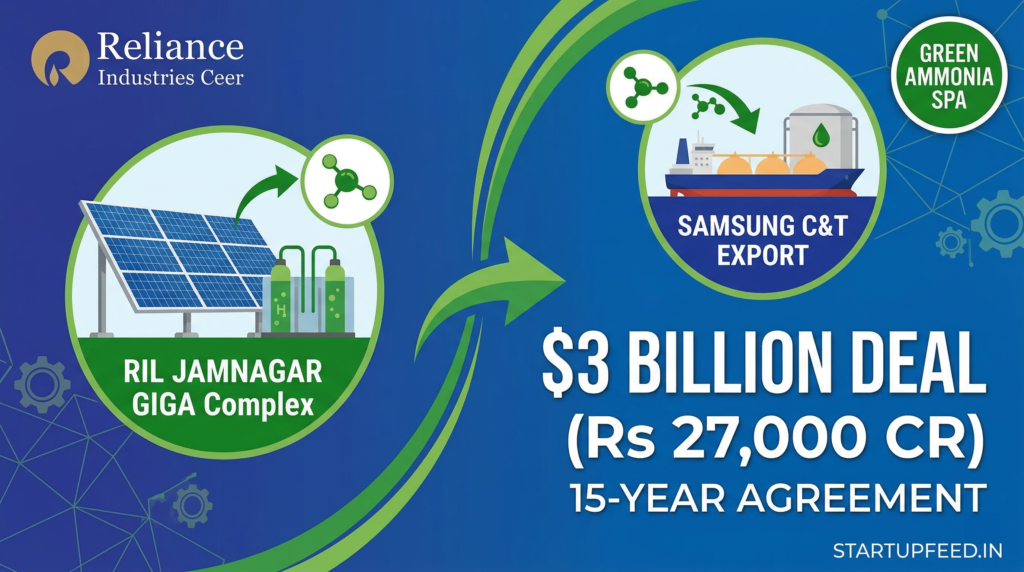
Reliance Industries Limited (RIL) has signed a binding, long-term Supply and Purchase Agreement (SPA) with South Korea’s Samsung C&T Corporation to supply green ammonia for 15 years in a deal valued at more than $3 Bn (Rs ~27,000 Cr) — making it one of the largest binding long-term green ammonia offtake agreements ever signed globally. Announced on March 16, 2026, the deal positions Reliance as India’s first major green fuel exporter and marks Mukesh Ambani’s New Energy unit achieving its first transformational commercial milestone before its Jamnagar gigafactories even begin full operations.
This is not a press-release deal — it is a project-finance anchor. By securing a $3 Bn binding revenue commitment three years before first delivery, Reliance has de-risked the Rs 75,000 Cr ($10 Bn) Jamnagar giga complex in a single stroke. The deal gives lenders a clear revenue roadmap, gives Reliance’s capex discipline a commercial rationale, and signals to every other potential buyer globally that India’s green hydrogen supply chain is no longer theoretical — it has a named counterparty, a signed contract, and a delivery date.
StartupFeed Insight
| What the numbers say: $3 Bn over 15 years implies approximately $200 Mn/year in green ammonia revenue for Reliance from this single contract — a meaningful revenue stream for a new business that has yet to generate its first dollar. Annualised at current contracted rates, this single deal covers roughly 15-20% of what analysts expect Reliance New Energy’s total annual revenue to be at maturity. And Anant Ambani confirmed this is ‘the first in a series of partnerships’ — meaning more offtake contracts are in the pipeline. What this means for you:
Our prediction: Reliance announces 2 additional green ammonia offtake contracts (one European buyer, one Japanese trading house) by end of FY27, bringing its total contracted green fuel revenue to $8-10 Bn. The Jamnagar complex becomes India’s first internationally recognised green hydrogen export hub by 2030 — ahead of the government’s National Green Hydrogen Mission 2030 target. |
Deal Breakdown
| Parameter | Details |
|---|---|
| Agreement Type | Binding Supply and Purchase Agreement (SPA) |
| Supplier | Reliance Industries Limited (RIL) |
| Buyer | Samsung C&T Corporation — Trading & Investment Division |
| Deal Value | $3 Bn+ (Rs ~27,000 Cr) |
| Contract Duration | 15 years |
| Delivery Start | Second half of FY2029 (H2 2029; some reports: October 2028) |
| End Buyers | Undisclosed (confidentiality clauses); global industrial customers |
| Production Location | Dhirubhai Ambani Green Energy Giga Complex, Jamnagar, Gujarat |
| Announcement Date | March 16, 2026 (post-market) |
| Global Significance | Described by Reliance as one of the largest binding long-term green ammonia offtake deals globally |
| Facilitated By | Long-standing Ambani-Samsung relationship; Samsung C&T’s expanding hydrogen trading strategy (began with Petronas H2 pact, 2022) |
What Is Green Ammonia and Why Does It Matter?
Conventional ammonia — the backbone of global fertilisers and industrial chemicals — is produced using fossil fuels via the Haber-Bosch process, accounting for approximately 1.8% of global CO₂ emissions annually. Green ammonia uses renewable energy to split water into hydrogen (green hydrogen), then combines that hydrogen with nitrogen from the air — producing NH₃ with zero direct carbon emissions.
Its strategic value extends beyond fertilisers. Green ammonia has emerged as the most practical hydrogen carrier for international shipping — pure hydrogen is cryogenic, explosive, and extremely difficult to transport at scale. Ammonia can be liquefied at -33°C (vs hydrogen’s -253°C), loaded onto existing LPG tankers with modifications, and cracked back into hydrogen at the destination. The Korean maritime industry — which Samsung C&T’s industrial customers include — has made green ammonia its primary decarbonisation fuel for vessel propulsion. The global green ammonia market is projected to grow at 60%+ CAGR to $38.5 Bn by 2033.
The Jamnagar Stack: How Reliance Makes the Green Ammonia
The Dhirubhai Ambani Green Energy Giga Complex is the most ambitious integrated energy manufacturing project in India’s history — and possibly the world’s. Mukesh Ambani committed Rs 75,000 Cr ($10 Bn) to this complex, which spans 5,000 acres in Jamnagar, Gujarat — four times the size of Tesla’s Gigafactory. The green ammonia that Reliance will supply to Samsung C&T flows through five interlocking layers, all located on the same campus:
| Step | Layer | What It Does | Status |
|---|---|---|---|
| 1 | Solar PV Modules (HJT) | Generates renewable electricity; 20 GWp capacity target; first 200 MW already produced | Operational (first phase) |
| 2 | Battery Energy Storage (BESS) | Stores solar/wind energy for 24/7 continuous supply to electrolysers (40 GWh → 100 GWh target) | Launch 2026 |
| 3 | Electrolyser Gigafactory | Splits water using renewable electricity to produce green hydrogen; 3 GW/yr capacity target (Nel ASA tech + in-house) | Operational end-2026 |
| 4 | Green Ammonia Synthesis | Combines green hydrogen + nitrogen → NH₃ (green ammonia); production at Jamnagar + Kutch sites | 2029 (export scale) |
| 5 | Marine Export Infrastructure | Jamnagar & Kandla ports for ammonia tanker loading; direct sea routes to South Korea/Japan/Europe | Existing + upgrade |
Anant Ambani, Executive Director of Reliance, described the complex as building ‘from sand to electrons to green molecules.’ The solar module gigafactory is already producing India’s first HJT modules with 10% higher energy yield and 25% lower degradation than conventional panels. By 2032, Reliance targets 3 million metric tonnes per annum of green hydrogen equivalent — enough to make India a net green fuel exporter at global scale.
The Jio Playbook Applied to Green Energy
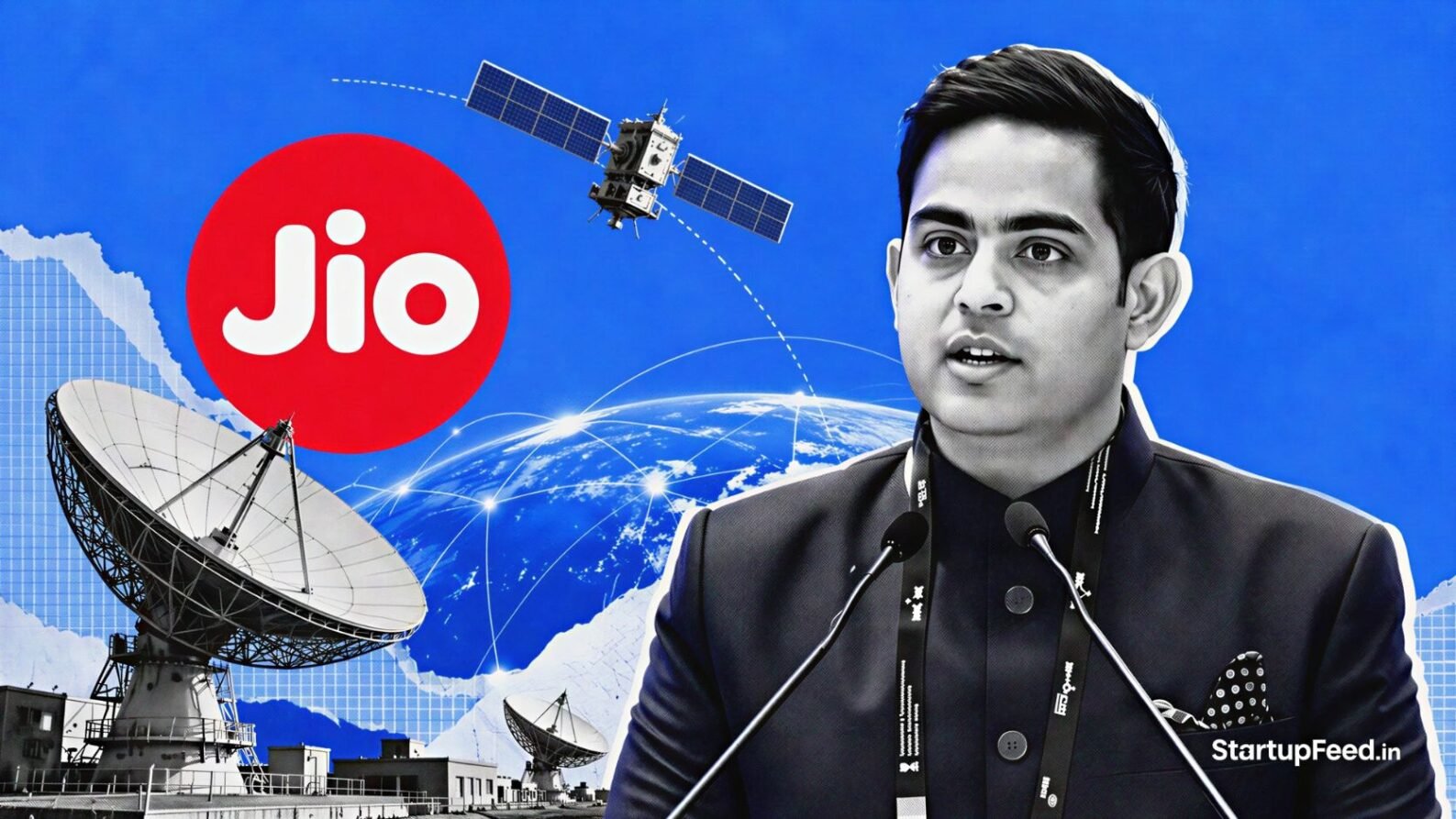
Market observers have drawn a direct parallel between Reliance’s energy strategy and its 2016 Jio telecommunications disruption. The pattern is identical. Jio: built the entire telecom stack — spectrum, towers, fibre, SIM manufacturing, apps — before launching; priced competition out of the market; became the default infrastructure. Reliance New Energy: building the entire green fuel stack — solar modules, batteries, electrolysers, ammonia synthesis, export ports — before first commercial delivery; using vertical integration to drive cost below any importer’s landed price.
| Strategic Layer | Jio (2016) | Reliance New Energy (2026) |
|---|---|---|
| The Stack | Spectrum + towers + fibre + apps | Solar PV + BESS + electrolysers + ammonia synthesis + ports |
| Indigenisation | No Chinese components dependency | In-house solar, batteries, electrolysers — no import dependency |
| Anchor Contract | Prelaunch government spectrum | $3 Bn Samsung C&T SPA before first delivery |
| Project Finance | Guaranteed cashflows → debt capacity | Binding offtake → lender visibility → capex de-risking |
| Cost Moat | Cheapest data in the world via scale | Cheapest green ammonia via integrated production + India solar |
| Scale Target | India’s largest telecom provider | India’s largest green hydrogen exporter (3 Mn MT by 2032) |
Who Is Samsung C&T and Why Did They Sign?
Samsung C&T Corporation is the construction and trading conglomerate of the Samsung Group — separate from Samsung Electronics. Its Trading & Investment Division has been building a global clean hydrogen and ammonia trading business since signing a hydrogen cooperation agreement with Malaysia’s Petronas in 2022 and completing a HyStation hydrogen refuelling station in 2024. The Reliance deal marks Samsung C&T’s full-scale entry into ammonia trading, giving it a long-term, price-predictable supply from one of the world’s most cost-competitive green ammonia producers to resell to its industrial customers in South Korea, Japan, and beyond.
South Korea’s industrial decarbonisation is structurally dependent on imported green ammonia. Korea has virtually no domestic renewable resource to produce green hydrogen at scale, and its steelmakers (POSCO), petrochemical companies, and shipping operators are all legally required to hit net-zero targets by 2050 — with interim milestones from 2030. Samsung C&T’s 15-year purchase commitment is effectively Korean industrial decarbonisation insurance, contracted at a fixed supply price from the world’s most integrated green ammonia producer.
Competitive Landscape: Who Else Is Watching
| Player | Why This Deal Changes Their Calculus |
|---|---|
| Adani Green Energy | India’s other gigawatt-scale renewable player; no green ammonia export contract yet. Reliance’s first-mover advantage in contracted offtake is now a benchmark Adani must match to attract comparable project finance |
| NTPC / Indian PSUs | Government’s National Green Hydrogen Mission targets 5 Mn MT by 2030; Reliance’s private-sector deal proves commercial viability — adds pressure on PSUs to accelerate their own offtake deals |
| POSCO, Hyundai, LG Chem (Korea) | South Korean industrials have been monitoring global green ammonia supply development; Samsung C&T’s 15-year lock-in signals the supply is real — expect more Korean corporate buyers to seek similar deals in 2026-27 |
| European Importers (BASF, Yara) | Europe’s REPowerEU targets require 10 Mn MT of green hydrogen imports by 2030; Reliance’s India cost-structure ($1.5-2/kg vs European $5-7/kg) makes it a natural supplier — expect EU offtake discussions |
| Chinese Green Ammonia Producers | China is also building green ammonia export capacity; India’s advantage is geographic proximity to South Asia/MENA/Europe and no Hormuz Strait risk — Reliance’s Kandla port route is strategically safer |
What the Leaders Say
| “This partnership marks an important step in India’s clean-energy journey and is one of the largest binding long-term green ammonia offtake agreements globally. It underscores our commitment to making India a leading global hub for green energy.” — Anant Ambani, Executive Director, Reliance Industries “This contract will help ensure a stable supply of green ammonia in the global clean hydrogen market and provide momentum to expand the company’s hydrogen trading base.” — Samsung C&T Official, via Korea Herald Analysis: Anant Ambani’s framing of the deal as India’s national interest story (‘India’s clean-energy journey’) is deliberate. Reliance is positioning itself not as a commercial exporter but as the executing arm of India’s National Green Hydrogen Mission. This narrative protects the project from regulatory friction, qualifies it for government support, and makes it structurally immune to political risk in ways that a purely commercial framing would not. |
What’s Next
The delivery clock starts in H2 2029 — which gives Reliance approximately 3 years to bring the electrolyser gigafactory to scale, build out the ammonia synthesis units, and certify the marine export infrastructure at Jamnagar and Kandla. The milestones to watch: battery gigafactory launch in 2026, electrolyser gigafactory commissioning by end-2026, and Reliance’s own announcement of its first green ammonia production run — expected in 2027-28 as the integration testing phase before commercial deliveries begin.
Anant Ambani called the Samsung deal ‘the first in a series of partnerships’ supporting Reliance New Energy’s expansion. Expect offtake discussions with European industrial buyers (BASF, Yara, shipping companies) and Japanese trading houses (Marubeni, Itochu) to be the next publicly announced contracts. India’s National Green Hydrogen Mission targets 5 Mn MT per year by 2030; Reliance alone is targeting 3 Mn MT. The question is no longer whether India can produce green ammonia at scale — it is whether the supply can outpace the contracted demand Reliance is now systematically locking in.


What do you think — will Reliance’s Jamnagar complex become the Jio of India’s energy transition, or is the 2029 delivery timeline a risk the market is underpricing? @StartupFeed_official
Liked this story? Follow StartupFeed on Google so our reporting reaches you first.