Quick Take: | |
|---|---|
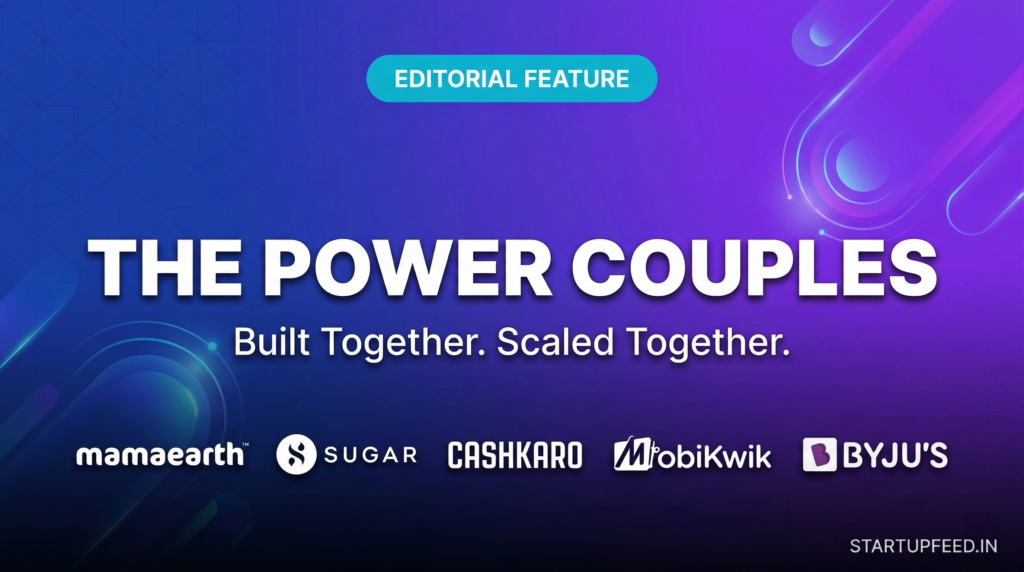
| The Premise | Behind India’s biggest startups is not just a founder — but a power couple. These five husband-wife teams turned shared vision and mutual trust into companies worth tens of thousands of crore. |
| Mamaearth | Varun & Ghazal Alagh · Founded 2016 after baby Agastya’s skin reacted to every product in India · FY24 revenue Rs 1,900+ Cr · BSE-listed · Honasa Consumer unicorn at $1.2 Bn |
| SUGAR | Vineeta Singh & Kaushik Mukherjee · IIT Madras + IIM-A batchmates · Married 2011 · Founded 2015 · Vineeta rejected Rs 1 Cr campus placement for entrepreneurship · Rs 4,100 Cr valuation · 50,000+ retail outlets |
| CashKaro | Swati & Rohan Bhargava · Both LSE alumni · Honeymoon cashback savings sparked the idea · Launched Pouring Pounds UK (2011) then CashKaro India (2013) · Backed by late Ratan Tata · FY25 revenue Rs 350 Cr |
| MobiKwik | Bipin Preet Singh & Upasana Taku · Founded 2009 · Upasana left PayPal USA Silicon Valley to co-found · India’s first independent mobile wallet · 140 Mn+ users · IPO December 2024 on BSE + NSE |
| BYJU’S | Byju Raveendran & Divya Gokulnath · Divya was Byju’s coaching student, became co-founder and wife · Founded 2011 · Peak valuation $22 Bn (2022) · World’s most valued EdTech company ever · Now in insolvency proceedings |
Building a startup is hard enough. Building it with your life partner — sharing a home, a cap table, a board room, and a vision — is a different category of difficulty altogether. And yet some of India’s most enduring startup success stories have been built not by solo founders, not by college roommates, but by couples who chose to risk everything together.
Behind Mamaearth’s toxin-free baby oil is a mother who could not find safe products for her newborn. Behind SUGAR Cosmetics is a woman who turned down a Rs 1 crore campus placement to build makeup for brown skin. Behind CashKaro is a honeymoon flight booked through a UK cashback site that sparked an idea. Behind MobiKwik is a woman who left a PayPal Silicon Valley salary to build mobile payments in India before UPI existed. And behind BYJU’s is a student who became a co-founder, a wife, and ultimately the person who stayed when everything fell apart.
These are the five Indian startup power couples whose stories define the archetype — and what it costs.
The Scoreboard: Five Couples, Five Companies
| Couple | Brand | Founded | Peak / Current Metric | Status |
|---|---|---|---|---|
| Varun & Ghazal Alagh | Mamaearth (Honasa) | 2016 | Rs 1,900+ Cr revenue FY24 | BSE-listed · Unicorn · $1.2 Bn |
| Vineeta Singh & Kaushik Mukherjee | SUGAR Cosmetics | 2015 | Rs 4,100 Cr valuation | Series D · IPO planned |
| Swati & Rohan Bhargava | CashKaro | 2013 | Rs 350 Cr revenue FY25 | Series C · Ratan Tata backed |
| Bipin Preet Singh & Upasana Taku | MobiKwik | 2009 | 140 Mn+ registered users | IPO Dec 2024 · Listed BSE+NSE |
| Byju Raveendran & Divya Gokulnath | BYJU’S | 2011 | $22 Bn peak valuation (2022) | Insolvency proceedings ongoing |
StartupFeed Insight | |
|---|---|
| Why couples build differently | Two-founder companies statistically outperform solo founders. But husband-wife founding teams have a distinct structural advantage: they share an equity philosophy before the term sheet, they do not need external alignment meetings for major decisions, and they have a default trust baseline that most co-founder pairs spend 12–18 months building. Every couple on this list deployed this trust advantage to survive a phase that would have split less-aligned founding teams. |
| The complementarity pattern | Each couple in this list deployed a clear role split that maps to the same formula: one founder owns the product + brand (creative, customer-facing) and one owns the operations + strategy (analytical, systems-facing). Ghazal owns brand storytelling; Varun owns FMCG distribution. Vineeta owns marketing and investor relations; Kaushik owns supply chain and operations. Swati owns partnerships and PR; Rohan owns finance and data. This complementarity is not accidental — it is the structural secret behind every long-running couple-founded company. |
| The survivor’s lens | The BYJU’s story in this list is not included as a cautionary tale but as the clearest evidence that even the best founding duo cannot insulate a company from governance failure at scale. Byju and Divya built the most valuable EdTech company in history — a genuinely astonishing achievement. What unravelled it was not the couple’s vision but the decision to prioritise valuation growth over organisational rigour post-pandemic. The couple’s story is incomplete; the restructuring process continues and Divya Gokulnath has remained publicly committed to the organisation’s revival. |
| Who’s next | The next Indian startup power couple to watch: Radhika Ghai and Sandeep Aggarwal (Shopo/Droom), Nikhil and Aditi Aggarwal (Pepper Content), and at least three stealth-mode couples currently building in AI infrastructure and D2C health tech who have not yet taken external funding. The couple-founder archetype in India is not a historical phenomenon — it is an accelerating one. |
1. Varun Alagh & Ghazal Alagh — Mamaearth
A Baby’s Skin Condition. A Couple’s Mission. Asia’s First MadeSafe-Certified Brand.
| Brand / Entity | Mamaearth — parent company Honasa Consumer Limited |
| Founded | 2016 — Gurugram, Haryana |
| Varun Alagh | B.E. Electrical Engineering (Delhi College of Engineering) + PGDBM Finance & Marketing (XLRI Jamshedpur) · Former Senior Brand Manager, Coca-Cola India · CEO & Co-Founder, Honasa Consumer |
| Ghazal Alagh | BCA (Punjab University) + Modern Art studies (New York Academy of Art) · Former corporate trainer · ‘Chief Mama’ & Co-Founder · Shark Tank India judge (Season 1 onwards) |
| How they met | Neighbours in Gurugram — Varun lived next door to Ghazal’s relative; they met through the neighbourhood and built a relationship before marrying in 2011 |
| What started it | After their son Agastya was born, every product available in India caused skin rashes on his sensitive skin. Ghazal began ordering products from abroad — the absence of Indian toxin-free baby care was the market insight. |
| Revenue FY24 | Rs 1,900+ Cr (~$238 Mn) — Honasa Consumer Limited · Revenue FY22: Rs 964 Cr (109% YoY growth) |
| IPO | Honasa Consumer Limited IPO: October 31, 2023 · Rs 1,701 Cr raised · BSE + NSE listed |
| Valuation | $1.2 Bn unicorn · Market cap Rs 7,800+ Cr (at IPO, 2023) |
| Sub-brands | Mamaearth (hero brand) · The Derma Co. · Aqualogica · Dr. Sheth’s · BBlunt · Staze |
| Impact | Plant Goodness initiative: 3 Mn+ trees planted · 1,000+ metric tons of plastic recycled annually · Asia’s first MadeSafe-certified brand |
| Role split | Varun owns distribution strategy, FMCG operations, investor relations, and business scaling. Ghazal owns brand storytelling, product philosophy, consumer insight, and D2C marketing. |
The Alaugh couple’s founding insight was the combination of Varun’s FMCG career at Coca-Cola — which gave him the distribution and brand-building playbook — and Ghazal’s consumer empathy as a new mother who actually felt the problem. Neither founder could have built Mamaearth without the other — Ghazal without Varun would have had the insight but not the scale playbook; Varun without Ghazal would have had the playbook but not the authentic founding story that made Mamaearth a movement rather than a product line.
“When we could not find toxin-free products for Agastya in India, we realised this was not just our problem — it was every new Indian parent’s problem. We decided to make it ourselves.”
— Varun Alagh and Ghazal Alagh, co-founders, Mamaearth
2. Vineeta Singh & Kaushik Mukherjee — SUGAR Cosmetics
Three Failed Startups. One Rs 1 Cr Job Rejection. Two IIM-A Batchmates Who Built a Beauty Empire for Indian Skin.
| Brand / Entity | SUGAR Cosmetics — founded as SUGAR (rebranded from FAB BAG pivot in 2015) |
| Founded | 2015 — Mumbai, Maharashtra (FAB BAG subscription service: 2012) |
| Vineeta Singh | B.Tech Electrical Engineering (IIT Madras, 2005) + MBA (IIM Ahmedabad, 2007) · Rejected Rs 1 Cr campus placement at a multinational investment bank · Co-Founder & CEO, SUGAR Cosmetics · Shark Tank India judge (Season 1 onwards) · IronMan triathlete + ultramarathon runner |
| Kaushik Mukherjee | B.E. (BITS Pilani) + MBA (IIM Ahmedabad) · Former Applications Engineer at Oracle · Former Analyst at Goldman Sachs · Former Associate at McKinsey & Company · Co-Founder & COO, SUGAR Cosmetics · TEDx speaker · IronMan triathlete |
| How they met | IIM Ahmedabad MBA classmates — both completed their MBA in 2007; met during the programme, built their personal and professional relationship through shared entrepreneurial ambitions. Married 2011. |
| What started it | FAB BAG (2012) — monthly beauty subscription box — gave the couple data from 2 lakh Indian women about what products worked on Indian skin in Indian weather. The data revealed that global makeup brands were formulated for Western climates and lighter skin tones. SUGAR was built to fill that gap. |
| Revenue FY25 | Rs 415 Cr (FY25) — down from Rs 500 Cr peak (FY24 pressure from D2C headwinds) · Rs 52 lakh in first year (2015) |
| Valuation | Rs 4,100 Cr (~$500 Mn) · Total raised: $96.3 Mn across 16 rounds · Investors: L Catterton, A91 Partners, India Quotient, Elevation Capital, Anicut Capital (Series D, Aug 2025) |
| Distribution | 50,000+ retail outlets across 550+ cities in India · Direct-to-consumer website + Nykaa + Amazon · Offline retail: Shoppers Stop, Lifestyle, Central |
| Role split | Vineeta owns brand marketing, investor relations, media + Shark Tank visibility, consumer storytelling. Kaushik owns supply chain, operations, technology, and product development. |
| Interesting fact | Vineeta ran a 100 km ultramarathon while pregnant — a fact that became a symbol of SUGAR’s relentless brand philosophy. The brand’s hustle ethic comes directly from its founders’ personal operating style. |
The SUGAR story is also a story of persistence through failure. Before SUGAR, Vineeta and Kaushik attempted two other ventures — a fashion e-commerce company (2010) and a consulting firm (2011) — both of which closed. FAB BAG was their third attempt, and SUGAR was their pivot from FAB BAG. They were on their last Rs 25–30 lakh when they decided to move from subscription boxes to building a cosmetics brand — a decision that required returning subscriber deposits before they could even start building the new product line.
“When we decided to pivot from FAB BAG to SUGAR, we literally had the last Rs 25–30 lakh in our bank account, which we had to keep aside to refund subscriptions we had already taken money from.”
— Vineeta Singh, Co-Founder & CEO, SUGAR Cosmetics
3. Swati & Rohan Bhargava — CashKaro
A Honeymoon Flight Booked Through a Cashback Site. And Ratan Tata’s Phone Call.
| Brand / Entity | CashKaro.com — operated by RStore Technologies Private Limited, Gurugram |
| Founded | April 2011 (Pouring Pounds, UK) · March 2013 (CashKaro, India) |
| Swati Bhargava | Class 10 topper, Haryana · Scholarship for Class 11 & 12 in Singapore · BSc Mathematics & Economics (London School of Economics) · Investment Banker at Goldman Sachs, London (2005–2010) · Co-Founder & CEO, CashKaro · TEDx speaker · Keynote speaker at IITs, ISB, ET Women Empowerment Summit |
| Rohan Bhargava | BA Economics (Franklin & Marshall College, Pennsylvania, USA) + BSc Economics (London School of Economics) · CFA charterholder · Former investment analyst: Aladdin Capital + Washington Square Capital (hedge funds, $1 Bn portfolio) · Co-Founder, CashKaro |
| How they met | Friends first — relationship evolved gradually into marriage in 2009. Both were working in London’s financial sector when they married. |
| What started it | Their honeymoon travel planning. When booking flights for their honeymoon, they used a UK cashback website and saved a substantial amount of money. Both were struck by the simplicity and power of the model. Within two years they had built their own version — Pouring Pounds in the UK — and sold it before relocating to India in 2013 to launch CashKaro. |
| Revenue FY25 | Rs 350 Cr (FY25) — up 20.7% from Rs 290 Cr FY24 · Rs 302 Cr in FY24 · Rs 248 Cr in FY23 · Rs 100 Cr crossed in FY21 |
| GMV FY25 | Rs 6,000+ Cr gross merchandise value across CashKaro + EarnKaro combined · 36 Mn+ transactions · 1,500+ e-commerce brand partners including Amazon, Flipkart, Nykaa, Tata 1mg, Myntra |
| Users | 25 Mn+ registered users · 90%+ consumer retention rate · 18 Mn+ app downloads |
| Ratan Tata link | Ratan Tata personally invested in CashKaro in 2016 — in his personal capacity — at a time when the cashback affiliate model had no clear Indian precedent. He later re-invested as the company scaled. It was one of the late industrialist’s most publicised personal startup investments. |
| Ecosystem | CashKaro (cashback + coupons) · EarnKaro (social affiliate marketing, launched 2018) · BankKaro (credit card recommendations, 2023) · BuyKaro (D2C marketplace, 2023) |
| Role split | Swati owns partnerships, PR, media, consumer community, and brand positioning. Rohan owns technology, finance, data analytics, and investor relations. |
The Bhargava couple built India’s cashback economy from a personal saving on a honeymoon flight — one of the most literal ‘founder lived the problem’ origin stories in Indian startup history. That they had already built and operated a successful version of the model in the UK before bringing it to India gave them an unfair advantage that pure-play Indian founders did not have: they knew exactly what the second-order problems would be, and had already solved them once.
“For brands, the rising cost of customer acquisition via platforms like Google and Meta has made performance-driven, ROI-positive channels like ours more valuable than ever.”
— Swati Bhargava, Co-Founder & CEO, CashKaro (FY25 results announcement)
4. Bipin Preet Singh & Upasana Taku — MobiKwik
She Left PayPal Silicon Valley. He Had the Technical Architecture. Together They Built India’s First Independent Mobile Wallet.
| Brand / Entity | MobiKwik Systems Limited — Gurugram, Haryana |
| Founded | 2009 — before UPI, before Paytm’s mass market pivot, before India’s smartphone penetration inflection |
| Bipin Preet Singh | B.Tech (IIT Delhi) · Built the original MobiKwik technical architecture · CEO & Co-Founder, MobiKwik · Named to Hurun India’s Fintech leaders list |
| Upasana Taku | B.Tech (NIT Jalandhar) + MBA (Northwestern University Kellogg School) · Former Product Manager at PayPal, Silicon Valley · Left PayPal US to co-found MobiKwik · COO & Co-Founder · One of India’s most referenced fintech women leaders |
| How they met | Met through professional and personal circles; married before founding MobiKwik together in 2009 |
| What started it | Bipin’s technical insight that mobile phones would become the primary payment device in India — at a time when feature phones still dominated, UPI did not exist, and India’s banking penetration was low. Upasana’s product experience at PayPal gave MobiKwik the consumer-facing payment UX credibility that pure Indian founders lacked. |
| Users | 140 Mn+ registered users across India · Core user base: semi-urban and tier 2/3 India · Strong penetration in offline merchant payments |
| Products | MobiKwik Wallet (legacy UPI-linked payments) · Zip (BNPL — Buy Now Pay Later) · Boost (investments and savings) · Insurance products |
| IPO | IPO: December 2024 · Listed on BSE + NSE · First listed Indian consumer fintech company that remained founder-led after going public · 15-year journey from founding to listing |
| Competition context | Founded in 2009 — before Paytm’s mass market pivot (2014), before UPI (2016), before Google Pay and PhonePe entered India. MobiKwik built the consumer behaviour and merchant network that the UPI wave later rode. |
| Role split | Bipin owns product architecture, technical vision, and engineering. Upasana owns consumer product experience, operations, regulatory relationships, and investor communications. |
The MobiKwik story is defined by Upasana Taku’s decision to leave a high-paying, high-prestige role at PayPal in Silicon Valley to co-found a payments startup in Gurugram when India’s digital payment ecosystem was almost non-existent. Most people would have called it irrational. Fifteen years later it was an IPO. The couple survived the UPI wave — which could have eliminated every pre-existing mobile wallet — by pivoting into lending (Zip BNPL) and expanding the product range beyond simple payments. That strategic flexibility under existential competitive pressure is the mark of a founding team with deep mutual alignment on long-term objectives.
5. Byju Raveendran & Divya Gokulnath — BYJU’S
Teacher and Student. Life Partners. The Most Valuable EdTech Company Ever Built — and the Most Complex Story in Indian Startup History.

| Brand / Entity | Think and Learn Private Limited — operating brand: BYJU’S · Bengaluru, Karnataka |
| Founded | 2011 — though Byju was running informal coaching classes and workshops from 2007 onwards |
| Byju Raveendran | B.Tech + M.Tech (Government Engineering College Kannur, Kerala) · Engineering and shipping professional before entrepreneurship · Started tutoring friends who kept asking him for help in CAT prep · Founder & CEO, BYJU’S · World Economic Forum Young Global Leader |
| Divya Gokulnath | B.Tech Biotechnology (R.V. College of Engineering, Bengaluru) · Was Byju’s student at his coaching workshop in Bengaluru · Persuaded by Byju to attempt CAT after she met him; became one of his top-scoring students · Co-Founder & Director, BYJU’S · One of India’s most prominent women EdTech leaders |
| How they met | Divya enrolled in Byju’s CAT preparation workshop in Bengaluru. She became one of his most exceptional students — scoring in the 99.97th percentile. The two married in 2012. Divya went on to become co-founder of the company that Byju was building. |
| What started it | Byju began helping friends prepare for competitive entrance exams — CAT, GMAT — while working in the shipping industry. Word spread. He moved from informal tutoring to structured workshops to online content. The 2015 launch of the BYJU’S Learning App marked the transition from education services to technology-first EdTech. |
| Revenue (peak) | Rs 5,000+ Cr (FY22, reported) — though the company’s financial reporting has been subject to significant scrutiny and restatement |
| Valuation | $22 Bn peak valuation (2022) — the most valuable EdTech company in the world at peak · Investors included Sequoia Capital, General Atlantic, Chan Zuckerberg Initiative, Tiger Global, QIA (Qatar Investment Authority), Silver Lake |
| Acquisitions | Aakash Educational Services (Rs 7,300 Cr, 2021) · WhiteHat Jr (Rs 2,670 Cr, 2020) · Osmo · Great Learning · Epic Books (USA) — the most aggressive acquisition programme in Indian EdTech history |
| Current status | Insolvency proceedings initiated under IBC (2024) · BYJU’S US subsidiary filed for Chapter 11 bankruptcy (2024) · Board reconstituted by NCLT · Byju Raveendran removed as Director in NCLT proceedings · Restructuring and resolution process ongoing as of March 2026 |
| Divya’s position | Divya Gokulnath has remained publicly committed to BYJU’S revival through the restructuring process. She has continued to represent the organisation in external communications and has spoken about the need to preserve the brand’s educational mission even through the financial restructuring. |
| Role split | Byju owned the vision, the pedagogy philosophy, the acquisition strategy, and the fundraising. Divya owned content quality, curriculum development, educator relationships, and the brand’s educational credibility. |
The BYJU’S story requires two parallel readings to understand it. The first reading: Byju and Divya built the world’s most valuable EdTech company from a Kerala classroom and a Bengaluru coaching workshop — a genuinely extraordinary achievement that improved the educational access of hundreds of millions of Indian students who could not afford the physical Kota coaching experience.
The second reading: the decision to pursue aggressive inorganic growth through Rs 10,000+ crore in acquisitions — funded by offshore debt structures and deferred audit filings — created a governance gap that neither the couple nor the board could close once the post-pandemic EdTech valuation correction arrived. The company that was worth $22 billion in 2022 entered insolvency proceedings in 2024.
Neither reading is complete without the other. The couple built something genuinely historic. The manner in which the scale was pursued created liabilities that the historic thing could not survive. Divya Gokulnath’s decision to stay — to represent the brand through restructuring and advocate for resolution rather than walk away — is a chapter in the story that is still being written.
“The vision was always to make quality education accessible to every child in India, regardless of geography or economic background. That mission remains true, regardless of what has happened to the company’s financial structure.”
— Divya Gokulnath, Co-Founder, BYJU’S
What All Five Couples Share
Strip away the sectors, the revenue numbers, and the IPO timelines, and five structural patterns emerge across every couple on this list.
First: they all identified a personal problem as a market gap. Ghazal could not find safe baby products. Vineeta could not find makeup built for her skin tone. Swati saved money on a honeymoon flight and knew every traveller could do the same. Upasana watched India’s payment system from PayPal and saw the infrastructure gap. Byju’s students kept failing exams that better teaching could fix.
Second: they deployed complementary skills, not identical ones. Every couple split the operational and creative domains clearly — one founder owned the customer-facing emotional work, one owned the systems and scale work. This role clarity prevented the co-founder equity conflict that destroys most two-founder companies.
Third: they survived a near-death moment. Mamaearth survived the early years with zero traction. SUGAR survived its Rs 25 lakh bank balance moment. CashKaro survived building an entire category from scratch before Ratan Tata provided external validation. MobiKwik survived the UPI disruption. BYJU’s is surviving its most existential moment now.
Fourth: the marriage was not the strength — the trust was. These couples do not describe their success in romantic terms. They describe it in operational terms: faster decision-making, shared values, default alignment, zero need for equity renegotiation when things got hard. The marriage provided the trust infrastructure. The trust infrastructure enabled the startup.
StartupFeed Insight | |
|---|---|
| Why couples build differently | Two-founder companies statistically outperform solo founders. But husband-wife founding teams have a distinct structural advantage: they share an equity philosophy before the term sheet, they do not need external alignment meetings for major decisions, and they have a default trust baseline that most co-founder pairs spend 12–18 months building. Every couple on this list deployed this trust advantage to survive a phase that would have split less-aligned founding teams. |
| The complementarity pattern | Each couple in this list deployed a clear role split that maps to the same formula: one founder owns the product + brand (creative, customer-facing) and one owns the operations + strategy (analytical, systems-facing). Ghazal owns brand storytelling; Varun owns FMCG distribution. Vineeta owns marketing and investor relations; Kaushik owns supply chain and operations. Swati owns partnerships and PR; Rohan owns finance and data. This complementarity is not accidental — it is the structural secret behind every long-running couple-founded company. |
| The survivor’s lens | The BYJU’s story in this list is not included as a cautionary tale but as the clearest evidence that even the best founding duo cannot insulate a company from governance failure at scale. Byju and Divya built the most valuable EdTech company in history — a genuinely astonishing achievement. What unravelled it was not the couple’s vision but the decision to prioritise valuation growth over organisational rigour post-pandemic. The couple’s story is incomplete; the restructuring process continues and Divya Gokulnath has remained publicly committed to the organisation’s revival. |
| Who’s next | The next Indian startup power couple to watch: Radhika Ghai and Sandeep Aggarwal (Shopo/Droom), Nikhil and Aditi Aggarwal (Pepper Content), and at least three stealth-mode couples currently building in AI infrastructure and D2C health tech who have not yet taken external funding. The couple-founder archetype in India is not a historical phenomenon — it is an accelerating one. |
Liked this story? Follow StartupFeed on Google so our reporting reaches you first.