⚡ QUICK TAKE (30-Second Read)
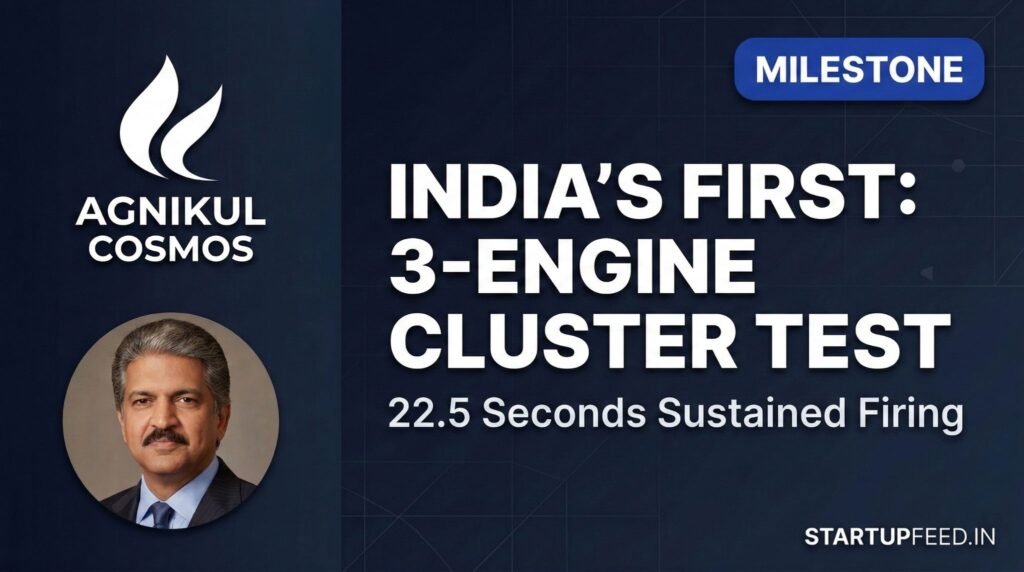
- What Happened: Agnikul Cosmos successfully test-fired 3 semi-cryogenic rocket engines simultaneously as a cluster — India’s first such test
- When: February 23, 2026 (announced); test conducted at Rocket Factory-1, Chennai (IIT Madras campus)
- Duration: 22.5 seconds of sustained cluster firing
- How Built: All 3 engines 3D-printed as single pieces of hardware — entirely in-house at Rocket Factory-1
- Tech: Electric motor-driven pump-fed engines (not turbopumps) — 6 pumps + 6 motors + 6 speed-control algorithms synchronised
- Anand Mahindra: “I am a proud investor in this ambitious startup. The returns go far beyond financial rewards.” (Feb 28, 2026)
- Funding: Series C Rs 150 Cr (~$17 Mn) raised November 2025; valuation $500 Mn+; investors include HDFC Bank, Advenza Global
- Next: Full Agnibaan first-stage static fire by mid-2026; first orbital launch attempt later in 2026
Chennai-based space startup Agnikul Cosmos — incubated at IIT Madras — has achieved India’s first successful simultaneous test-firing of three semi-cryogenic rocket engines in a clustered configuration, marking a landmark moment for India’s private space sector and one of the most technically complex propulsion milestones achieved by any Indian startup.
The three engines, each 3D-printed as a single piece of hardware at Agnikul’s Rocket Factory-1 in Chennai, were fired simultaneously for 22.5 seconds as an integrated cluster — requiring the precise synchronisation of six electric pumps, six motors, and six independent speed-control algorithms working in perfect unison. The test was announced by the company on February 23, 2026, and was followed five days later by a public endorsement from Mahindra Group Chairman Anand Mahindra, who revealed for the first time that he is a personal investor in the company.
This is not just a test-firing milestone — it is the technical gate that unlocks Agnikul’s path to orbital launch. Clustered engines are what power a rocket’s first stage; without the ability to fire multiple engines simultaneously in synchronisation, you cannot launch an orbital vehicle. Agnikul has now cleared that gate. Combine this with Anand Mahindra publicly naming himself as an investor, and this becomes the most credibility-dense news Agnikul has generated since its Agnibaan SOrTeD suborbital flight in May 2024.
StartupFeed Insight
The biggest non-obvious detail: The engines use electric motor-driven pumps instead of conventional turbopumps. This is a fundamental design choice — not a minor engineering tweak. Turbopumps are among the most complex components in rocket engineering, requiring extreme precision and generating significant failure risk. Agnikul’s electric pump architecture eliminates turbopumps entirely, replacing them with battery-powered electric motors. The result: simpler hardware, better throttle control, lower production cost, and faster iteration — all at 3D-printed single-piece construction taking roughly 75 hours per engine vs 10–12 weeks conventionally.
Why the cluster test is harder than it looks:
Firing one engine is a solved problem for Agnikul. Firing three simultaneously requires that all engines ignite together, sustain equal thrust, and shut down together — or the rocket will veer off course. In the February 2026 test, Agnikul calibrated 6 pumps and 6 motors and tuned 6 speed-control algorithms to run in synchronisation. Any deviation in individual engine performance cascades into system instability. The fact that Agnikul achieved uniform startup, steady state and shutdown across all three is the technical proof that their clustered architecture works.
Why Anand Mahindra’s disclosure matters:
Mahindra did not invest through Mahindra Group — he invested in a personal capacity. This signals conviction in Agnikul’s technology as an individual bet, not a corporate strategic play. For a Chairman of one of India’s largest industrial conglomerates to back a space startup personally — and then publicly announce it with a statement about ‘watching the literal take-off of Indian talent’ — is a reputational endorsement that no press release can buy. Expect this to accelerate Agnikul’s Series D conversations.
Our prediction:

Agnikul will complete the full Agnibaan first-stage static fire by August 2026 and attempt its first orbital launch by Q3–Q4 2026. A Series D round at $700 Mn–$1 Bn valuation is likely before or immediately after the orbital attempt. If the orbital launch succeeds, Agnikul enters unicorn territory on commercial metrics, not just investor optimism.
What Happened: The Technical Breakdown
| Element | Detail |
| Test Name | 3-Engine Semi-Cryogenic Cluster Hot-Fire Test |
| Date | Announced February 23, 2026; test conducted at Rocket Factory-1, Chennai |
| Duration | 22.5 seconds of sustained cluster operation |
| Number of Engines | 3 semi-cryogenic engines (Agnilet-variant) fired simultaneously as a cluster |
| Engine Construction | Each engine 3D-printed as a single monolithic piece of hardware — no multi-part assembly |
| Manufacturing Location | In-house at Agnikul Cosmos Rocket Factory-1, IIT Madras campus, Chennai |
| Fuel Type | Semi-cryogenic: Liquid Oxygen (LOX) as oxidiser + aviation-grade kerosene as fuel |
| Pump Technology | Electric motor-driven pumps — NOT conventional turbopumps; 6 pumps + 6 electric motors |
| Control Complexity | 6 independent speed-control algorithms synchronised for uniform ignition, steady state & shutdown |
| India First? | Yes — first time in India that semi-cryogenic engines have been cluster hot-fire tested |
| Previous Cluster Test | October 2025: 2-engine cluster test (dual configuration) — the 3-engine test builds on this |
| ISRO Support | Conducted with institutional backing from ISRO and IN-SPACe |
Why This Milestone Matters
1. The Path to Orbital Launch Requires Cluster Firing
Agnikul’s Agnibaan orbital launch vehicle is designed to use clustered engines on its first stage. Without proving that multiple engines can fire together in synchronisation, an orbital launch attempt would be premature and dangerous. The February 2026 cluster test is the key technical prerequisite — it de-risks the Agnibaan first stage and clears the path for full stage static fires, then flight.
2. Electric Pump-Fed Architecture Is a Global Differentiator
Most semi-cryogenic and cryogenic engines globally — including ISRO’s own VIKAS engine and SpaceX’s Merlin — use turbopumps to pressurise propellants. Agnikul’s decision to use electric motor-driven pumps instead is unconventional and commercially strategic. Electric pumps offer: (a) simpler manufacturing, (b) better throttle control enabling throttleability to lower thrust levels, (c) higher reliability from removing the most failure-prone component in conventional rocket engines, and (d) alignment with Agnikul’s all-3D-printed, in-house philosophy. If this architecture scales, it becomes a competitive moat — not just a technical curiosity.
3. Single-Piece 3D Printing at Scale
Each engine is 3D-printed as a single monolithic piece — eliminating hundreds of individual components and their associated joints, seals, and failure points. Agnikul builds one engine in approximately 75 hours vs the 10–12 weeks required using conventional manufacturing. At three engines per cluster and plans for multiple first-stage clusters on Agnibaan, this speed and cost advantage is the commercial engine of the entire business model.
‘I Am a Proud Investor’: Anand Mahindra’s Endorsement
“I am a proud investor in this ambitious startup. The returns from this investment go far beyond financial rewards. It’s about getting a ringside seat to watch the literal ‘take-off’ of Indian talent.”
— Anand Mahindra, Chairman, Mahindra Group — X (Twitter), February 28, 2026
Mahindra’s February 28 post on X marked the first time he publicly confirmed his personal investment in Agnikul Cosmos — an investment he had made in an individual capacity, separate from the Mahindra Group’s corporate investment activities. The amount has not been disclosed. His statement does three things simultaneously: it validates Agnikul’s technology to a broader business audience, signals to other large Indian industrialists that space tech is investable at the individual level, and adds another credibility layer ahead of what will likely be Agnikul’s Series D fundraise later in 2026.
The phrase “ringside seat to watch the literal take-off” is more than rhetoric — Mahindra is positioning himself as a participant in India’s space narrative, not just a financial backer. For Agnikul, the public endorsement from a figure of Mahindra’s stature is the kind of brand validation that a $500 Mn-valued space startup would struggle to manufacture through any other means.
Agnikul’s Propulsion Milestone Journey
| Date | Milestone | Significance |
| 2021 | First static fire of Agnilet semi-cryogenic engine | Proof of concept — India’s first private semi-cryogenic engine test |
| May 2024 | Agnibaan SOrTeD suborbital flight — world’s first 3D-printed semi-cryogenic engine in flight | Validated flight-readiness of single-piece 3D-printed engine; first launch from India’s first private launchpad at Sriharikota |
| May 2025 | India’s first electric motor-driven semi-cryogenic engine static fire | Validated the electric pump architecture as a production-ready propulsion approach |
| September 2025 | Inaugurated Large Format Additive Manufacturing (LFAM) facility — India’s largest rocket 3D printing hub | Enables single-piece components up to 1 metre tall; scales production capacity for multi-engine builds |
| October 2025 | 2-engine cluster test (dual configuration) | First step toward clustered architecture; proved synchronisation concept for two engines |
| November 2025 | Series C — Rs 150 Cr (~$17 Mn) raised; valuation $500 Mn+ | Investors: Advenza Global, Atharva Green Ecotech, HDFC Bank, Pratithi Investments |
| February 2026 | Neevcloud partnership — space-based AI data centre aboard Agnibaan | Demonstrates commercial payload strategy beyond government/research launches |
| February 23, 2026 | 3-Engine semi-cryogenic cluster test — 22.5 seconds — India’s FIRST | THIS MILESTONE: Proves clustered architecture for Agnibaan first stage; clears path to orbital launch |
| Mid-2026 (planned) | Full Agnibaan first-stage static fire | Final ground test before orbital launch attempt |
| 2026 (planned) | First Agnibaan orbital launch attempt | 100 kg payload to 700 km orbit; booster ocean landing attempt |
Company Snapshot: Agnikul Cosmos
| Parameter | Detail |
| Full Name | Agnikul Cosmos Private Limited |
| Founded | 2017 |
| Base | IIT Madras campus, Chennai (NCCRD — National Centre for Combustion Research and Development) |
| Founders | Srinath Ravichandran (CEO), Moin SPM (CTO), Prof. Satyanarayanan Chakravarthy, Janardhana Raju |
| Mission | Develop and commercialise small-lift launch vehicles for small satellite customers globally |
| Flagship Vehicle | Agnibaan — 18m tall, 1.3m diameter, 14,000 kg liftoff mass; 100 kg to 700 km orbit |
| Engine | Agnilet — single-piece 3D-printed semi-cryogenic (LOX + Kerosene); electric pump-fed |
| Manufacturing | Rocket Factory-1, IIT Madras — India’s largest rocket 3D printing facility |
| Private Launch Pad | Agnikul Launch Pad (ALP), Satish Dhawan Space Centre, Sriharikota — India’s first private launchpad |
| Total Funding | ~$30 Mn+ (seed through Series C); last round: Rs 150 Cr Series C (Nov 2025) |
| Valuation | $500 Mn+ (post Series C, November 2025) |
| Key Investors | Anand Mahindra (personal), HDFC Bank, Advenza Global, Atharva Green Ecotech, Pratithi Investments |
| ISRO / Govt Support | IN-SPACe framework agreement; access to ISRO facilities and technical expertise since 2021 |
| Latest Partnership | NeevCloud — space-based AI data centre to be launched aboard Agnibaan (February 2026) |
India’s Private Space Sector: Where Agnikul Stands
| Company | Vehicle | Stage | Key Tech | Agnikul vs |
| Agnikul Cosmos | Agnibaan (100 kg to 700 km) | 3-engine cluster test done; orbital launch 2026 | 3D-printed single-piece; electric pump-fed semi-cryo | — |
| Skyroot Aerospace | Vikram series (small-lift) | Vikram-1 first orbital attempt; multiple engine tests done | Solid + cryogenic upper stage; conventional manufacturing | Agnikul differentiates on 3D printing speed and electric pumps; Skyroot uses conventional solid-stage approach |
| ISRO (SSLV / PSLV) | SSLV (500 kg), PSLV (1.75 t) | Operational, multiple missions flown | Multi-stage solid + liquid; turbopumps | Agnikul is commercially faster, cheaper per-engine; ISRO unmatched in reliability and payload capacity |
| Global: Rocket Lab (NZ) | Electron (300 kg to 500 km) | Operational; 50+ launches; Neutron in development | Rutherford electric pump-fed engines — same concept as Agnikul’s | Agnikul and Rocket Lab share the electric pump architecture — validating Agnikul’s approach globally |
The Rocket Lab comparison is the most instructive: Rocket Lab’s Rutherford engine also uses electric pump-fed architecture — and Rocket Lab is now a publicly traded company with a $4 Bn+ market cap. Agnikul has independently arrived at the same fundamental propulsion architecture for the small-lift commercial launch market. If execution continues on track, the valuation trajectory is visible.
What’s Next for Agnikul in 2026
Full First-Stage Static Fire (Mid-2026): The cluster test validates individual cluster performance. The full first-stage static fire will test all engines firing together with the complete stage plumbing, structural loads, and flight software — the last major ground test before orbital flight.
First Orbital Launch Attempt (H2 2026): Agnibaan’s first orbital mission will target 100 kg payload to 700 km orbit. The booster will attempt an ocean landing — India’s first attempt at a reusable launch vehicle first stage.
Series D Fundraise (Pre- or Post-Orbital Launch): With the cluster test validated, Mahindra’s endorsement public, and orbital launch imminent, Agnikul’s Series D will likely target $700 Mn–$1 Bn valuation. Global aerospace strategic investors and sovereign funds are the most probable lead investors.
NeevCloud AI Data Centre Launch: Agnikul’s February 2026 partnership with NeevCloud for a proof-of-concept space-based AI data centre — to be launched aboard Agnibaan — demonstrates commercial payload strategy. This is the first time an Indian launch startup has anchored a commercial AI payload agreement pre-launch.
Liked this story? Follow StartupFeed on Google so our reporting reaches you first.