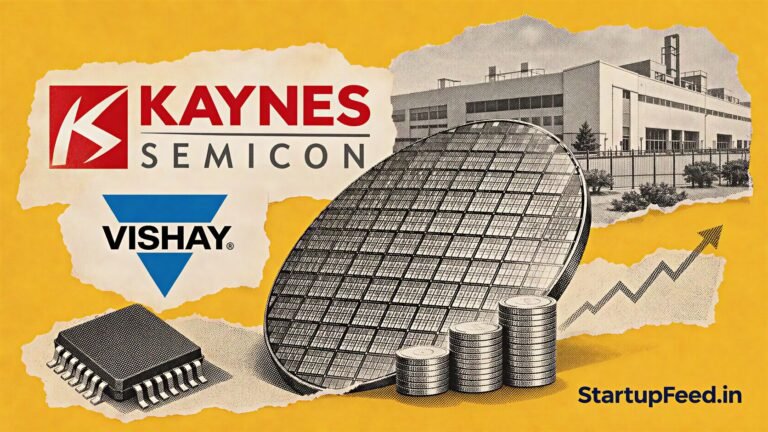
Kaynes Semicon Gets $56.4 Mn From Vishay for 49% Stake
Kaynes Semicon will take $56.4 Mn from Vishay for a 49% stake and plans to quadruple its OSAT output to 4.6 billion devices a year under ISM 2.0.
4 min read
Quick Take
- Vishay will invest $56.4 Mn for a 49% stake in Kaynes Semicon, the Sanand chip unit.
- Kaynes wants to roughly quadruple output, adding 2.3 billion devices a year to its current 2.3 billion.
- The deal lands the same quarter Kaynes Technology’s net profit fell 65.6% to Rs 39.8 crore.
In this story3 sections
Kaynes Semicon will take $56.4 Mn from US firm Vishay Intertechnology for a 49% stake, and use the tie-up to roughly quadruple its chip output in Sanand, Gujarat.
The Sanand-based unit can make close to 2.3 billion devices a year now. It plans to add about 2.3 billion more. A binding term sheet signed on November 12 sets the terms. Kaynes Technology keeps 51% of the business.
The deal comes in a hard quarter. Kaynes Technology’s net profit fell 65.6% to Rs 39.8 crore in the three months to September. A year earlier it was Rs 115.7 crore. Revenue rose just 4.4% to Rs 952.5 crore. The semiconductor bet is a long game against weak near-term numbers.
What Vishay gets, and what Kaynes gets
Vishay will put money into an existing Kaynes arm and run a captive line inside it. A captive line makes parts for one buyer. Here that buyer is Vishay.
Also read
Kaynes Technology said so in its filing to the stock exchanges on November 12. The joint venture will do post-fab wafer processing, assembly, test and packaging. That bundle is called OSAT. It is the back end of chip-making, after the wafer is cut.
Vishay will also take the bulk of the new capacity. On the earnings call, management said Vishay would buy 75% to 90% of the line’s output. That gives Kaynes a guaranteed customer, and gives Vishay a plant in India outside its China supply chain. The rest of the capacity stays for Kaynes’ own clients.
Raghu Panicker runs Kaynes Semicon as its managing director and chief executive. He will also lead the joint venture entity day to day, the filing said.
The third unit and ISM 2.0 money
The Vishay cash will help pay for Kaynes Semicon’s third unit, including buildings, utilities and tools. Panicker told the Economic Times the first unit is now near 90% complete, and the second is close behind.
Kaynes also plans to seek government support under India Semiconductor Mission 2.0, the second phase of the central chip scheme worth about Rs 1.28 lakh crore. Its first Sanand plant was built for Rs 3,307 crore with central and state subsidies under ISM 1.0.
Panicker set a profit target for the expanded business. He told the Economic Times that Kaynes Semicon is aiming for an EBITDA margin near 25%. For the whole group, the EBITDA margin was 13.2% last quarter, down from 16.4% a year earlier.
“We are now 100%-plus overbooked.”
Raghu Panicker, managing director and chief executive, Kaynes Semicon. From the Economic Times report, November 27, 2026.
Still only a term sheet
The deal is not closed yet. It rests on definitive agreements, regulatory approvals and other normal closing steps, the filing said. On the earnings call, management expected a final agreement within two to three months, in the third quarter of this financial year. The exact subsidiary structure is not decided.
Also read
So the $56.4 Mn is committed on paper, not yet paid. The capacity jump depends on the money arriving and the third unit coming up.
| Item | Now | After expansion |
|---|---|---|
| Annual device output | ~2.3 billion | ~4.6 billion |
| Vishay stake in Kaynes Semicon | 0% | 49% |
| Vishay share of new output | None | 75% to 90% |
What this means for you
If you supply, sell to, or compete with India’s OSAT units, a second big foreign anchor customer is now locked into Sanand. Watch for the definitive agreement in the next two to three months, which decides whether the capacity doubling is real.
StartupFeed Insight
The Vishay deal is a demand signal, not a profit fix. Kaynes’ group margin fell to 13.2% while it spends on three chip units, so near-term numbers will stay soft. The real prize is the captive line: a foreign partner taking 75% to 90% of output turns a risky capacity bet into booked orders, which is how an OSAT unit actually earns back its build cost. If the definitive agreement is signed by the end of the March quarter, expect Kaynes Semicon revenue guidance to move up before the third unit even runs.
By Saraswati Chaubey, Writer
Have a tip? Write to us at editorial@startupfeed.in.
Disclaimer: This article is for information only and is not investment advice. StartupFeed and its authors are not SEBI-registered investment advisors. Please speak to a SEBI-registered advisor before investing.