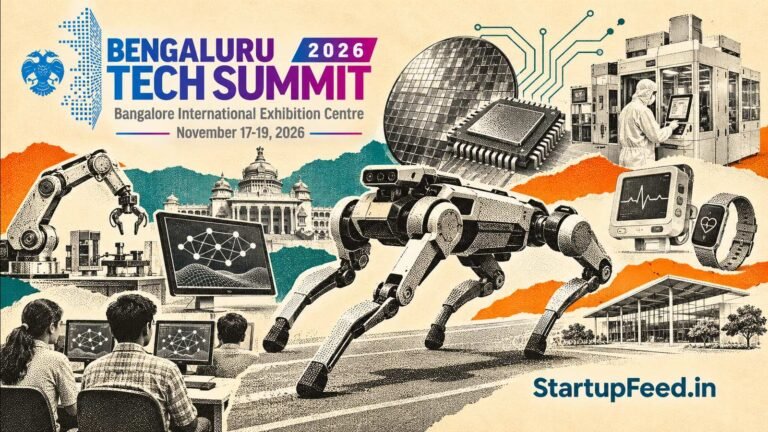
Bengaluru Tech Summit 2026 Day 1: Six Deeptech Initiatives and AI Skilling for 63,200
Bengaluru Tech Summit 2026 Day 1: Karnataka unveiled six deeptech initiatives, AI skilling for 63,200, startup grants, a robot race and a startup museum.
By Dr. Mayank Raj, Contributing Editor
11 min read
Quick Take
- Chief Minister D.K. Shivakumar opened the 29th Bengaluru Tech Summit at BIEC on 17 November. It runs till 19 November under the theme “AI & Beyond”.
- Karnataka unveiled six initiatives: the Karnataka AI Hub, BRAINZ, the 2D Innovation Hub, INFIfab, K-HEAL and Innoverse.
- Google, Salesforce, Pega Systems, Sarvam AI and Gnani.ai will help train 63,200 engineering and diploma students and professionals in AI.
- For startups, the Chief Minister cited ₹1 crore ELEVATE NxT grants, a ₹25 crore Government First allocation to buy startup products, and Innoverse support for 35 growth-stage ventures.
- General Autonomy’s robot Param won the opening day’s quadruped race, and the design of a museum for India’s startup story was unveiled.
In this story12 sections
Karnataka Chief Minister D.K. Shivakumar opened the 29th Bengaluru Tech Summit at the Bangalore International Exhibition Centre (BIEC) on Tuesday, 17 November, and the state used the opening day to unveil six research and deeptech initiatives, an AI skilling plan for 63,200 people and the design of a museum for India’s startup story. Bengaluru Tech Summit 2026 Day 1 also saw a quadruped robot race, a main stage debate on sovereign AI and a call to bring pension money into Indian startups.
The three-day summit, themed “AI & Beyond”, runs till 19 November. It is organised by the Karnataka government’s Department of Electronics, IT and Biotechnology and co-hosted by Software Technology Parks of India (STPI). On the eve of the summit, Home, IT and Biotechnology Minister Priyank Kharge said it would bring together more than 10,000 delegates, 700 speakers and 1,000 startups from about 100 Indian cities, with over 140 sessions across 16 tracks and 13 stages. In his address, the Chief Minister said more than 75 countries are taking part this year, up from 57 last year. Our preview of the summit has the full programme, and the official BTS 2026 website carries the schedule.
Six Initiatives Unveiled on Bengaluru Tech Summit 2026 Day 1
The state presented a package of six initiatives that links university labs with startups and industry. The Chief Minister unveiled them at the opening session:
- Karnataka AI Hub: Set up at IIIT-Bangalore as the first step towards the state’s proposed AI University, with a focus on AI skilling, research, entrepreneurship and capacity building. The state Cabinet approved the hub with a ₹35 crore outlay in September.
- BRAINZ (Bengaluru Robotics and AI Innovation Zone): A nine-acre hub for robotics, AI and deeptech, being developed with ARTPARK at IISc. It aims to draw ₹1,000 crore of investment over five years, and Day 1 reports put the funding behind it at ₹100 crore.
- 2D Innovation Hub: The state is supporting IISc in proposing a national 200 mm (8-inch) semiconductor research fab and pilot line, with a 100,000 sq ft technology building, a 15,000 sq ft cleanroom and 80 to 90 process, metrology and testing tools.
- INFIfab: A national semiconductor facility of about 96,284 sq ft, including a 20,000 sq ft cleanroom, being developed with the Centre for Nano Science and Engineering (CeNSE) at IISc. It will cover fabrication, advanced packaging, MEMS, photonics, quantum technologies and neuromorphic computing, and the Chief Minister described it as India’s first microfabrication translation centre.
- K-HEAL (Karnataka Health Engineering and Advanced Lifesciences): A Centre of Excellence of the Department of Electronics, IT and Biotechnology for HealthTech, MedTech and assistive technology.
- Innoverse: A deeptech accelerator for startups with proven technologies, from autonomous systems to underwater and space applications. The Chief Minister said it will support 35 growth-stage ventures over the next five years as they move from product development to industrial scale.
AI Skilling for 63,200 Students and Professionals
The government announced industry partnerships with Google, Salesforce, Pega Systems, Sarvam AI and Gnani.ai to train 63,200 engineering and diploma students and professionals. The programmes cover generative AI, agentic AI, voice AI, cloud computing, data analytics and responsible AI, through hands-on projects, capstones and industry certifications. No split by company was given.
Gnani.ai has signed an agreement with the department to train 1,000 engineering and science students across the state to build multilingual voice agents and other AI agents. Students will learn speech recognition, text to speech, language models, retrieval-augmented generation and multi-agent systems through graded labs and capstone projects, with access to Gnani’s models, tools and computing resources and mentoring from its engineers.
Also read
The new tie-ups add to Nipuna Karnataka, the state’s ₹300 crore reskilling mission, which the Chief Minister said has already made more than 33,000 people industry-ready, including women returning after career breaks.
What the Chief Minister Told Investors
Shivakumar invited global investors, innovators and industry leaders to partner with Karnataka, and said the state would bring talent, policies and partnership to the table. He said Karnataka wants to move beyond being a technology services hub towards advanced research and AI-led innovation. The numbers he put on the table:
- Karnataka earns about two of every five dollars of India’s software and services exports, about $173 billion last year.
- The state drew $9.4 billion of FDI equity in the first half of FY2025-26, or 26.7% of India’s total.
- More than 1,000 Global Capability Centres are based in Bengaluru, and over 30 new GCCs brought in more than $1 billion of investment in 2025.
- Karnataka has more than 24,000 recognised startups and nearly two of every five Indian unicorns.
- Bengaluru attracted $4.4 billion in technology funding, close to the $4.8 billion raised by the next five Indian cities combined. Karnataka startups have raised about $79 billion in all, and women founders in Bengaluru have raised $13.4 billion.
- Bengaluru has nearly half of India’s AI and machine learning talent.
He also spoke of the AI University, with the AI Hub at its centre, and a new Centre of Excellence at IIIT Raichur that will take AI to 13 districts of North Karnataka for farming, healthcare, education and small businesses. On the eve of the summit, Kharge said Karnataka accounted for 43% of India’s technology investments in the first nine months of 2026.
Grants and a First Customer for Startups
For founders, the most useful part of the speech was the list of state support already on offer:
- ELEVATE: Nearly 1,500 startups have received equity-free grants worth $41 million in all over a decade.
- ELEVATE NxT: Grants of ₹1 crore for deeptech startups. Since last year, 33 deeptech startups have received ₹30 crore in equity-free funding under it.
- Government First: The state will act as the first customer for startups, with ₹25 crore set aside to buy their solutions.
- Innoverse: Support for 35 growth-stage deeptech ventures over five years.
ELEVATE completes 10 years this year, and the Future Makers Conclave on Day 3 will mark the milestone. Founders looking for support closer home can also compare incubators across Karnataka in StartupFeed’s directory.
Chips and Biotech in the State’s Pitch
The Chief Minister said Karnataka has more than 100 fabless chip companies, and three of every five engineers in India’s semiconductor capability centres work in Bengaluru. The state accounts for one-fifth of India’s electronics exports, and global companies are investing more than ₹23,000 crore in semiconductor research and manufacturing in Bengaluru and Mysuru. Four electronics manufacturing clusters, from Dharwad to Mysuru, will offer land, power and talent with incentives under the state’s ESDM Policy.
A semiconductor panel with speakers from IESA, Tata Electronics and Applied Materials India noted that India imports about 90% of its passive components and bare PCBs, which make up 15 to 20% of electronics manufacturing. The discussion centred on building local suppliers under MeitY’s Electronics Component Manufacturing Scheme.
Also read
On biotechnology, Shivakumar said Karnataka accounts for one-fifth of India’s bioeconomy, which was valued at $39.2 billion last year, and that 11 new incubators will help turn research into companies.
A Museum for India’s Startup Story
The approved design of the Museum of Innovation, Startup and Technology (MIST) was unveiled on the opening day. It will come up in a repurposed switchgear factory shed on the 105-acre New Government Electric Factory (NGEF) campus in Byappanahalli, Bengaluru, which has 65 acres of green cover. The shed’s footprint of 10,061 square metres will grow to nearly 24,000 square metres, with about 12,325 square metres for the museum.
MIST is a public-private partnership between UnboxingBLR, which holds 51%, and the state’s Department of Electronics, IT and Biotechnology, which holds 49% through the Karnataka Technology Innovation Museum Foundation (KTIMF). A consortium led by Heneghan Peng Architects, the firm behind the Grand Egyptian Museum, with Bengaluru-based Cadence Architects and DROO Da Costa Mahindroo Architects, won the two-stage design competition, which drew 13 consortiums. Exhibits will cover Digital Public Infrastructure, biotechnology, space research, startups, AI and deeptech. The first phase, along with the Innoverse incubator, is targeted for completion by 2028.
KTIMF chairperson Prashanth Prakash, who also co-founded UnboxingBLR, said much of India’s innovation story remains undocumented and that MIST is meant to change that.
Robots Take the Track
Ahead of the inaugural session, the Chief Minister flagged off a quadruped robot race, billed by the organisers as India’s first quadrupedal athletic showcase. Robots from General Autonomy, Strider Robotics and xTerra Robotics took part, and General Autonomy’s Param won, reaching a top speed of 4.3 metres per second.
The race was held at the 50,000 sq ft AI and Robotics Pavilion, co-curated by Bharat1.ai, where more than 100 startups are showing humanoid robots, drones, autonomous systems and industrial robots. The pavilion also hosts AI buildathons with ₹15 lakh in prize money, ₹15 lakh worth of Sarvam AI credits and a residency at Bharat1.ai for the winners.
On the Main Stage: AI, Sovereignty and Patient Capital
The day closed with a panel titled “AI & Beyond: The Emerging India”, moderated by Lingaraju Sawkar. Kharge spoke of how the state is already using AI across departments, including in cyber security. Infosys co-founder Kris Gopalakrishnan said AI opens the door to new ideas and products, and Biocon’s Kiran Mazumdar-Shaw said it could speed up drug discovery and make diagnostics more accurate. Accel’s Prashanth Prakash said AI can make services more affordable, but access to data remains a major hurdle. The panel agreed that the biggest population-scale uses of AI are still ahead.
Sovereign AI ran through the day’s conversations, with EAC-PM member Sanjeev Sanyal and Sarvam AI co-founder Vivek Raghavan among the speakers. The focus was on Indian control over data, compute and foundation models built for Indian languages and public services.
In a session on domestic capital, PFRDA chairperson Sivasubramanian Ramann and Ideaspring Capital’s Naganand Doraswamy argued that patient Indian money, especially pension funds, should back startups so the ecosystem relies less on foreign venture capital. They pointed to the government’s ₹10,000 crore commitment in 2016, which they said brought in ₹65,000 to 70,000 crore of private investment.
A space panel with Speciale Invest, VyomIC, Inbound Aerospace and SkyServe looked at India’s shift from launch-led missions to a commercial orbital economy, from Earth observation to in-orbit manufacturing.
Who Was at the Opening
Deputy Chief Minister G. Parameshwara, Kharge and Science and Technology Minister Dr Ajay Dharam Singh attended the inauguration. International guests included Valérie Pécresse, President of the Regional Council of Île-de-France, and Seung-hwan Mok, Deputy Minister of Startups, Venture and Innovation at South Korea’s Ministry of SMEs and Startups.
Microsoft India and South Asia President Puneet Chandok and Pécresse gave addresses, and plenary keynotes came from Micron India’s Anand Ramamoorthy, NXP’s Maulin Patel and KEONICS chairperson Sharath Kumar Bachegowda. Chief Secretary Shalini Rajneesh, STPI Director General Arvind Kumar, KDEM chairman B.V. Naidu and the chairpersons of the state’s Vision Groups were also present. Sweden is this year’s country partner, with Italy, Australia and Poland as supporting countries, according to the organisers.
What to Watch on Day 2 and Day 3
- Day 2, Wednesday, 18 November: The India-US Tech Conclave, covering quantum technology, critical minerals, safe AI, cybersecurity and technology partnerships.
- Day 3, Thursday, 19 November: The Future Makers Conclave, themed “Dream, Dare, Disrupt”, marks 10 years of ELEVATE. It will feature deeptech investment announcements, a conversation between Kharge and unicorn founders, and the felicitation of unicorns Juspay and Sarvam AI and listed companies Wakefit Innovations, e2E Rail, Amagi Media Labs and Zetwerk.
- Through the summit: A Mentor-Mentee Connect for 400 startups with more than 80 mentors, and over 60 investor pitching sessions.
Bengaluru Tech Summit 2026 Day 1 at a Glance
| Detail | What happened |
|---|---|
| Edition | 29th |
| Dates | 17 to 19 November 2026 |
| Venue | Bangalore International Exhibition Centre (BIEC), Tumkur Road, Bengaluru |
| Theme | AI & Beyond |
| Inaugurated by | Chief Minister D.K. Shivakumar |
| Six initiatives | Karnataka AI Hub, BRAINZ, 2D Innovation Hub, INFIfab, K-HEAL, Innoverse |
| AI skilling | 63,200 students and professionals, with Google, Salesforce, Pega Systems, Sarvam AI and Gnani.ai |
| Startup support cited | ELEVATE NxT grants of ₹1 crore, ₹25 crore Government First allocation, Innoverse for 35 ventures |
| Museum | MIST at the NGEF campus, first phase by 2028 |
| Robot race winner | General Autonomy’s Param |
| Countries | More than 75, as per the Chief Minister (57 last year) |
| Coming up | India-US Tech Conclave (18 November), Future Makers Conclave (19 November) |
What this means for you
If you are building in AI, robotics, chips or health tech in Karnataka, Day 1 gave you three things to act on. Keep an eye on ELEVATE NxT and Government First, since both put state money behind startups without taking equity. Look at BRAINZ, INFIfab and the 2D Innovation Hub as places to prototype as they come up. And if you are hiring, the 63,200-person skilling push should widen the AI talent pool. If you are at BIEC this week, look out for the summit’s mentor and investor pitching sessions.
Frequently Asked Questions
When and where is Bengaluru Tech Summit 2026?
The 29th Bengaluru Tech Summit runs from 17 to 19 November 2026 at the Bangalore International Exhibition Centre (BIEC) in Bengaluru. The theme is “AI & Beyond”. It is organised by the Karnataka government’s Department of Electronics, IT and Biotechnology and co-hosted by STPI.
What did Karnataka announce on Bengaluru Tech Summit 2026 Day 1?
Chief Minister D.K. Shivakumar unveiled six initiatives (the Karnataka AI Hub, BRAINZ, the 2D Innovation Hub, INFIfab, K-HEAL and Innoverse), AI training for 63,200 students and professionals with Google, Salesforce, Pega Systems, Sarvam AI and Gnani.ai, and the approved design of the Museum of Innovation, Startup and Technology.
What is BRAINZ?
BRAINZ, the Bengaluru Robotics and AI Innovation Zone, is a nine-acre hub for robotics, AI and deeptech being developed with ARTPARK at IISc. It aims to draw ₹1,000 crore of investment over five years.
What support for startups did the Chief Minister mention?
He cited ELEVATE, under which nearly 1,500 startups have received equity-free grants worth $41 million over a decade; ELEVATE NxT grants of ₹1 crore for deeptech startups; a ₹25 crore Government First allocation for the state to buy startup solutions; and Innoverse, which will support 35 growth-stage ventures over five years.
What happens on Day 2 and Day 3?
Day 2 (18 November) hosts the India-US Tech Conclave. Day 3 (19 November) hosts the Future Makers Conclave, which marks 10 years of ELEVATE, with deeptech investment announcements and the felicitation of Juspay, Sarvam AI and recently listed startups.
Have a tip? Write to us at editorial@startupfeed.in.