Razorpay Launches Multi-Currency EEFC Account for Exporters
Razorpay's Multi-Currency EEFC Account lets Indian exporters hold foreign earnings in USD, EUR, GBP, AED and SGD, and convert only when they need to.

By Avinash, Business Correspondent
4 min read
Quick Take
- Razorpay’s Multi-Currency EEFC Account went live on August 20, 2026, settling exports in USD, EUR, GBP, AED and SGD.
- Exporters can hold foreign earnings and skip the double conversion back into and out of rupees.
- It builds on Razorpay’s cross-border licence from the RBI, won on December 2, 2025.
In this story5 sections
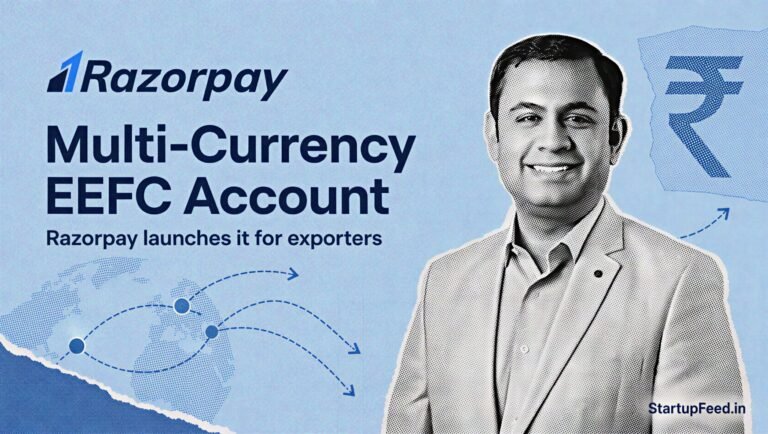
Razorpay has launched a Multi-Currency EEFC Account for Indian exporters, live from August 20, 2026. It lets businesses get export settlements in the original currency. That means USD, EUR, GBP, AED and SGD, paid straight into an EEFC account.
EEFC stands for Exchange Earners’ Foreign Currency, a foreign currency account held with an RBI-authorised bank. Until now Razorpay settled most international payments in rupees, so exporters with dollar costs then had to buy dollars back. Each conversion leg costs money.
What does Razorpay’s EEFC account do?
Razorpay says the new account removes that double conversion, letting merchants hold foreign earnings and convert only when they need to. The settlements flow through Razorpay’s banking partner network. No separate onboarding is needed, according to the company.
Razorpay listed five benefits at launch:
- Direct foreign currency settlement, without forced conversion into rupees.
- Lower foreign exchange leakage from repeated conversion cycles.
- Control over the timing of each conversion.
- Works inside Razorpay’s existing dashboard, settlement engine and reconciliation.
- No extra setup on a current account.
Why the timing matters for exporters
The launch matters because of scale. Indian businesses sold a record USD 860 billion to the world in FY26, a figure cited by Rahul Kothari, chief operating officer at Razorpay. Every avoidable conversion on that base is a direct cost to exporters.
Also read
The move builds on Razorpay’s cross-border push. On December 2, 2025, Razorpay won the Payment Aggregator Cross-Border licence from the Reserve Bank of India. That licence lets it handle both inward and outward cross-border payments under full supervision. Its international stack accepts more than 130 currencies through cards, wallets and local transfers.
How big is Razorpay’s export business?
Razorpay also serves exporters on Amazon’s Global Selling platform. In March 2025 it said it was targeting over 1.5 lakh sellers there. It has served more than 1 lakh exporters to date. The company offers zero forex markup on such transactions.
Who is behind Razorpay?
Razorpay was founded in 2014 by Shashank Kumar and Harshil Mathur, both alumni of IIT Roorkee. The Bengaluru firm has raised about USD 742 million across its funding history. It is preparing a confidential IPO filing, StartupFeed reported in April 2026.
What this means for you
if your startup earns in dollars and spends in dollars, an EEFC settlement can stop you paying twice. You convert once, on your own schedule.
StartupFeed Insight
This is a margin product, not a headline one. Razorpay is not chasing new payment volume here. It is defending the cents that leak on every round-trip conversion, and for a services exporter billing in dollars while paying AWS in dollars, those cents add up fast. The bigger signal is sequencing. The cross-border licence came in December 2025, and the EEFC settlement layer sits on top of it now. Expect Razorpay to close the loop next with foreign-currency payouts, so a dollar earned never has to touch a rupee at all. Watch for that launch before FY27 ends.
— Avinash Mishra, Business Correspondent
Frequently Asked Questions
What is Razorpay’s Multi-Currency EEFC Account?
It is a product that settles export payments into an Exchange Earners’ Foreign Currency account in the original currency. Merchants can get USD, EUR, GBP, AED and SGD without forced conversion into rupees. Razorpay launched it on August 20, 2026.
Who can use the EEFC settlement feature?
Any resident business in India that earns foreign exchange can use it, including exporters, SaaS firms and service exporters. The business needs an active EEFC account with an RBI-authorised bank. Razorpay says no separate onboarding is required on its side.
How does it cut foreign exchange costs?
It removes the double conversion many exporters face today. Without it, dollars are converted to rupees on settlement, then back to dollars to pay overseas costs. Each leg carries a foreign exchange charge. Holding funds in the original currency skips one or both legs.
How does this link to Razorpay’s cross-border licence?
Razorpay won the Payment Aggregator Cross-Border licence from the Reserve Bank of India on December 2, 2025. That licence lets it handle inward and outward cross-border payments under full supervision. The EEFC settlement feature is a new layer built on that base.
Have a tip? Write to us at editorial@startupfeed.in.