
Quick Take
- Chennai startup Aheesa passed first-pass silicon on its VIHAAN chip on August 15, 2026.
- The chip runs on the C-DAC VEGA core, an Indian RISC-V processor, on a 28nm process.
- Production tape-out is targeted for 2027. Aheesa raised about Rs 40 crore earlier this year.
A Chennai chip startup has hit a milestone few Indian firms reach. Aheesa Digital Innovations passed first-pass silicon on its VIHAAN chip on August 15, 2026, the Ministry of Electronics and IT said. First-pass silicon means the chip worked on the very first manufacturing run.
That is rare. Most chips need two or three costly runs to fix bugs. Getting it right first time saves months and crores.
VIHAAN is a broadband networking chip. It sits inside the box that brings fibre internet into homes and offices. The full name for that part is a System-on-Chip, or SoC, which packs compute, network access and control onto one piece of silicon.
The timing was deliberate. Aheesa taped out VIHAAN on Republic Day, January 26, 2026. It cleared first-pass silicon on Independence Day, August 15. A tape-out is when a finished design is sent to the factory to be made.
What makes VIHAAN different?
VIHAAN runs on an Indian processor core. It uses the VEGA core built by C-DAC, the Centre for Development of Advanced Computing, a government research body. VEGA is based on RISC-V, an open chip design anyone can use without paying a licence fee.


This matters for cost and control. A royalty-free core means Aheesa pays no per-chip fee to a foreign owner. It also means the design can be changed freely for years.
The chip is built on a 28-nanometre process. It supports fibre standards called GPON and EPON, plus Gigabit Ethernet, DDR4 memory and eMMC storage. In plain terms, it can run a fast, secure home router built in India.
The chips inside most Indian fibre routers today are imported. VIHAAN is built to replace them. That is the core of Aheesa’s pitch.
Who is behind Aheesa?
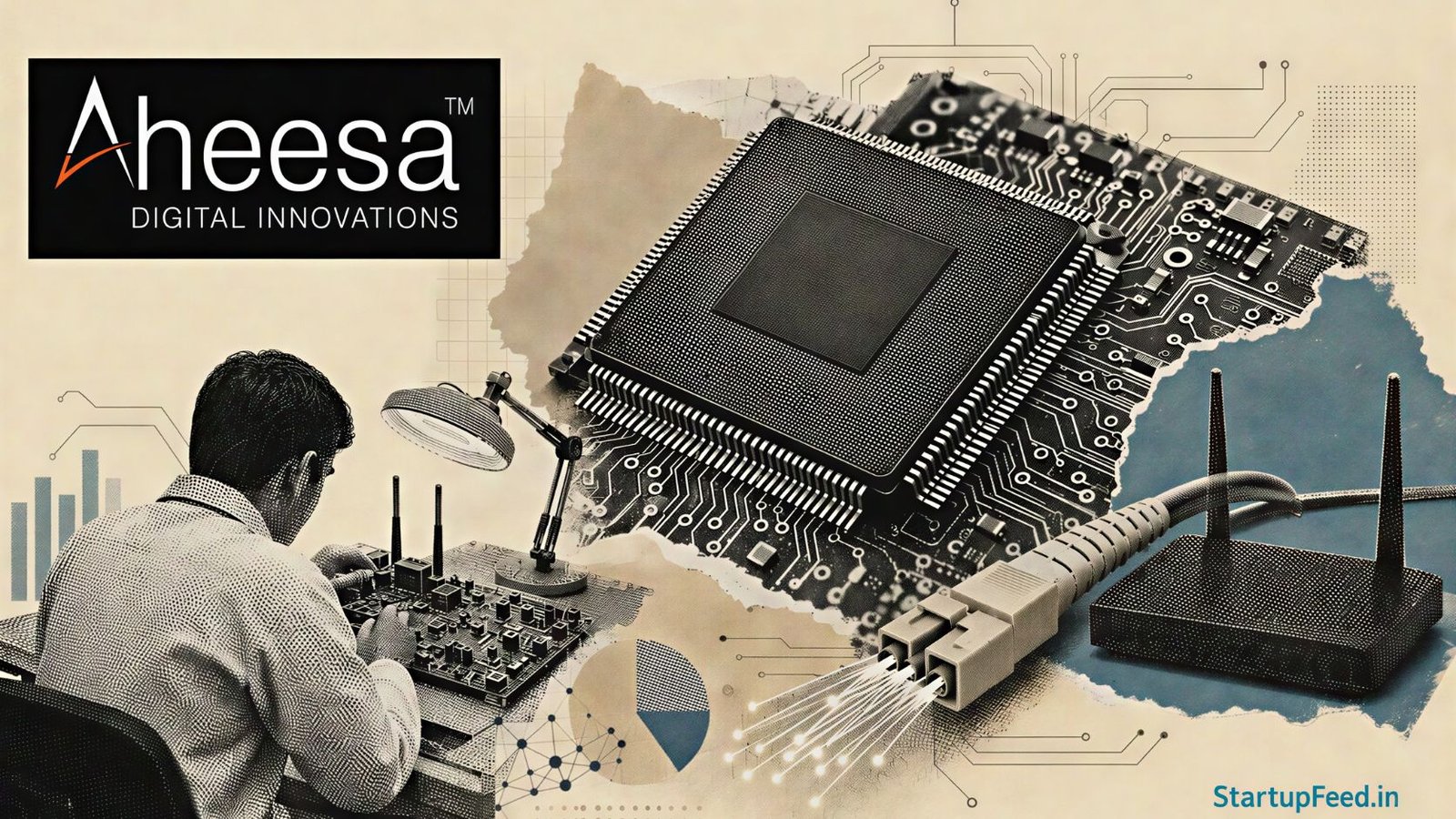
Aheesa Digital Innovations is a fabless semiconductor startup based in Chennai. Fabless means it designs chips but does not own a factory. Manufacturing is done by United Microelectronics Corporation, a Taiwan foundry.
The company was founded in 2021. Its founders are Sridharan Mani, Sukha R Ghosh and Anil Raj Thulasi Das. Sridharan Mani is founder and chief executive.
Each founder brings over 25 years in semiconductors and technology, according to the fund that backed them. Their past employers include Amazon, Microchip Technology and American Megatrends.
Aheesa raised about Rs 40 crore earlier this year, MeitY said. Part of that, Rs 20 crore, came from the Tamil Nadu Emerging Sector Seed Fund, run by the state fund manager TNIFMC. The rest came from private investors.



How does the DLI scheme fit in?
Aheesa is backed by the Design Linked Incentive scheme, or DLI. The DLI scheme is a central government programme that funds Indian firms to design chips. It was approved in 2023.
The scheme is starting to show results. Firms supported under it have taped out more than 30 chip designs across various foundries, MeitY said. Together they have raised over $100 Mn (Rs 878 Cr) in venture funding.
The wider push is bigger still. Chip-design tools have been given to 455 organisations, including 350 colleges and 105 startups, according to the ministry. A linked programme called Chips to Startup has produced 245 tape-outs from 71 institutions.
Aheesa is also expanding on the ground. On August 13, 2026, it signed an agreement with the Tamil Nadu government for a design and engineering centre in Chennai. That project carries a planned investment of Rs 250 crore and is expected to create about 300 jobs.
What happens next?
VIHAAN now moves toward production tape-out. Aheesa is targeting 2027 for that step. Production tape-out is the final version sent for mass manufacturing.
The chip will ship as part of Aheesa’s Seshnag reference platform. That platform lets Indian device makers build routers around VIHAAN. It comes with an OpenWRT-based software stack called AROS.
First-pass silicon is a technical win, not a market one yet. The chip still has to prove itself in real routers, at volume, against cheaper imports. Getting there is the hard part.
What this means for you: If you build hardware in India, an Indian broadband SoC on a royalty-free core is worth tracking as a supply option for 2027.
StartupFeed Insight
The number to watch is not the chip. It is the gap between design and shipment. India now has more than 30 DLI tape-outs, but a tape-out is a prototype, not a product on a shelf. VIHAAN’s real test is 2027, when it must beat imported silicon on price, not just on origin. A royalty-free VEGA core helps, because it strips out the licence fee that usually makes a first Indian chip costlier than the foreign part it copies. StartupFeed expects at least one Indian fibre-router maker to announce a VIHAAN-based product before the end of 2027. If none does, the design win stays a lab story.
— Harshvardhan Kothari, Technology and Policy Correspondent
Have a tip? Write to us at editorial@startupfeed.in.
Liked this story? Follow StartupFeed on Google so our reporting reaches you first.