
QUICK TAKE (30-second read)
|
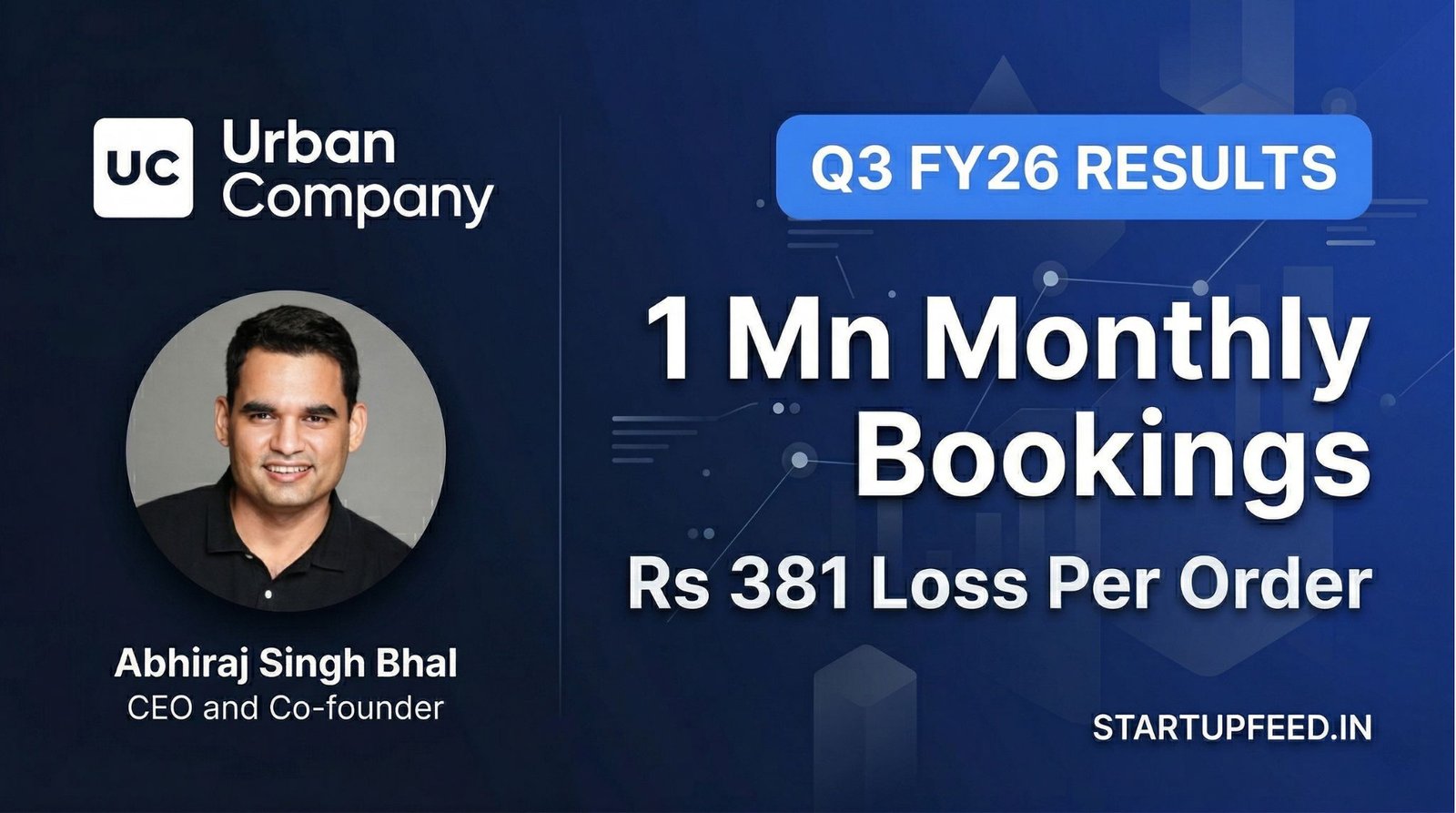
Urban Company (NSE: URBANCO) announced that its quick-service housekeeping vertical InstaHelp crossed 1 million monthly delivered bookings in March 2026 — with three days still remaining — marking what the company calls the fastest-scaling business unit in its 12-year history. The milestone comes just weeks after InstaHelp reported 50,000+ daily bookings on February 22, and positions Urban Company as the clear segment leader with a 49.2% market share in India’s nascent instant home services category, ahead of Snabbit (36.4%) and Pronto (14.3%).
The 1 million booking milestone matters — but so does what it costs. InstaHelp’s unit economics reveal a classic quick-commerce-style land grab: an estimated Rs 381 loss per order against an average order value of Rs 172–200, requiring Urban Company to absorb heavy losses in exchange for market share dominance. With Snabbit reportedly raising $50–60 Mn at a $450 Mn valuation and Pronto already closing a $25 Mn Series B, the instant housekeeping sector is now where quick commerce was in 2022 — a well-funded, high-stakes race that will likely consolidate around 1–2 players in 18–24 months.
STARTUPFEED INSIGHT
|
InstaHelp’s Growth Trajectory — From Pilot to 1 Mn Bookings
| Period | Monthly Bookings | Context |
| Mar 2025 (launch) | ~0 (pilot) | Pilot launched in Mumbai — first micro-markets only, limited availability |
| Oct 2025 (Q2 FY26) | 4.7 Lakh (470K) | Scaled to multiple micro-markets across 5 metros; losses of Rs 44 Cr adj. EBITDA in Q2 FY26 |
| Dec 2025 (Q3 FY26) | 5.4 Lakh (540K) | Q3 FY26 quarter total: 1.61 Mn (implies ~537K/month avg); Rs 21 Cr net loss attributed to InstaHelp |
| Feb 22, 2026 | 51,520 (daily peak) | Daily peak — NSE filing confirmed; implies ~840K–1 Mn monthly run rate |
| Feb 2026 (full month) | 840,000 | Per The Ken data; InstaHelp led segment; Snabbit ~830K, Pronto ~340K in same month |
| Mar 2026 (milestone) | 1 Mn+ (with 3 days left) | Fastest Business Unit in Urban Company’s 12-year history; reached milestone UC’s core business took 6 years to reach |
For context: Urban Company’s core India Consumer Services business (cleaning, appliance repair, salon) took approximately 6 years to reach 50,000 daily bookings. InstaHelp reached the same milestone in under 12 months — a trajectory that validates both the demand thesis and Urban Company’s distribution advantage in executing a new vertical.
What InstaHelp Is — and Why It’s Different
InstaHelp is not Urban Company’s traditional marketplace model. The distinction matters:
| Dimension | Urban Company (Core) | InstaHelp |
| Service Type | Occasional: plumber, AC repair, salon | Daily: cleaning, dishwashing, laundry, cooking |
| Booking Lead Time | Hours to days in advance | 10–15 minutes from booking |
| Frequency | Monthly / bi-monthly | Daily / multiple times per week |
| AOV | Rs 500–2,000+ (skilled work) | Rs 172–200 (commodity service) |
| Model | Marketplace (agent model) | On-demand deployment (managed supply) |
| Revenue Logic | Platform fee + professional tools | Volume-led: high frequency compensates low AOV |
| Competition | Traditional offline operators, Justdial | Snabbit, Pronto — purpose-built instant housekeeping apps |
The strategic rationale for Urban Company investing heavily in InstaHelp: daily-use services dramatically increase app engagement and retention. A customer who books a maid daily through InstaHelp is far more likely to also book an electrician, a salon professional, or a Native-brand appliance through Urban Company’s core platform. InstaHelp is, in Abhiraj Bhal’s own framing, “a long-term investment that deepens customer engagement with our app.”


What the Founder Says
“InstaHelp’s trajectory reflects the growing trust consumers place in the platform for their everyday and immediate needs.”
— Abhiraj Singh Bhal, CEO & Co-founder, Urban Company
Bhal’s framing — “trust” — is deliberate. InstaHelp is not competing purely on price; it is competing on reliability of a vetted, uniformed professional showing up within 15 minutes. That reliability, built on Urban Company’s 12-year infrastructure of training, auditing, and professional onboarding, is the moat that Snabbit and Pronto cannot easily replicate at the pace they are scaling. What Bhal is not saying: InstaHelp’s Rs 381 loss per order at current scale and the Rs 52+ Cr cumulative EBITDA losses this financial year. The growth narrative is real; so is the cash burn.
The Three-Way Race — Market Share Snapshot
| Player | Feb 2026 Orders | Market Share | Strategic Position |
| InstaHelp (Urban Company) | ~840,000 | 49.2% | Segment leader; trust moat from 12-yr brand; listed company (NSE: URBANCO); market cap Rs 16,103 Cr |
| Snabbit | ~480,000–500,000 | 36.4% | Bengaluru-founded; launched Sept 2024; raised $56 Mn in 18 months; in talks for $50–60 Mn more at $450 Mn valuation; hyper-dense micro-market focus |
| Pronto | ~340,000 | 14.3% | Gurugram-based; Rs 1/first visit pricing; raised $25 Mn Series B; aggressive discounting strategy; fastest downloads per Asolytics |
| Total Market | ~1.66 Mn/mo | 100% | Entire segment grew to ~2 Mn+ monthly orders across players by Feb 2026 — zero to meaningful scale in 18 months |
The market structure is striking in its speed. In September 2024, Snabbit launched and was the first mover. By December 2024, Urban Company entered with InstaHelp, and by March 2025, Pronto joined. Within 18 months of the category’s first signal, there are 3 funded, operationally active players with combined monthly order volume crossing 2 Mn. The trajectory mirrors early quick commerce in 2021.
Urban Company Financial Snapshot — The Cost of Scale
| Metric | FY23 | FY24 | FY25 | Q3 FY26 |
| Revenue from Ops (Rs Cr) | Rs 637 Cr | Rs 828 Cr | Rs 1,144 Cr (+38% YoY) | — |
| Net Profit / (Loss) | (Rs 312 Cr) | — | Rs 239 Cr* | (Rs 21 Cr) |
| Adj. EBITDA Margin (ICS) | -9.72% of NTV | — | +3.30% of NTV | — |
| InstaHelp Adj. EBITDA Loss | — | — | — | Rs 17 Cr (Q3) |
| InstaHelp cumul. EBITDA loss | — | — | — | Rs 52+ Cr (9M FY26) |
| Share Price (URBANCO) | — | — | Listed Sept 2025 | Rs 114.56 |
| Market Cap | — | — | Rs 14,790 Cr (IPO) | Rs 16,103 Cr |
* FY25 net profit of Rs 239 Cr included a Rs 211 Cr one-time deferred tax credit — underlying operating profit was ~Rs 28 Cr. The company is listed on NSE (URBANCO) and the stock has traded between Rs 100.70 (52-week low) and Rs 201.18 (52-week high) since its September 2025 IPO.
InstaHelp’s unit economics at current scale: AOV of Rs 172–200 against an estimated loss of Rs 381 per order implies that the platform collects less than half of what it spends to deliver each booking. The path to profitability requires either AOV expansion (subscriptions, bundled services, premium tiers), cost reduction (worker productivity per micro-market, lower onboarding subsidies), or volume-driven fixed cost leverage as worker density increases in each micro-market.
What’s Next
The 1.5 Mn monthly bookings mark is the next natural milestone — at the February daily booking rate of 51,520, InstaHelp should cross 1.5 Mn sometime in April or May 2026. The more important milestone for investors: any disclosure that InstaHelp’s loss per order is declining month-on-month. That would signal that operating leverage is kicking in as worker utilisation per micro-market improves.
On the competitive side, Snabbit’s anticipated $50–60 Mn raise at $450 Mn — led by Mirae Asset Venture Investments — will accelerate its micro-market expansion. Snabbit founder Aayush Agarwal has positioned the company around hyper-dense area concentration to keep logistics and promotional costs low, a philosophy that is the structural opposite of InstaHelp’s broader 5-city presence. Both strategies will be tested as AOVs compress under competitive pricing pressure — Pronto’s Re 1 first-visit pricing being the most extreme data point.



For Urban Company as a listed company, the equation is clear: InstaHelp must demonstrate a credible path to adj. EBITDA breakeven — not full-year profitability, just unit-level improvement — within the next 2–3 quarters to justify continued investment. At its September 2025 IPO, the company sold the InstaHelp story as a long-term bet on high-frequency engagement. Public market investors gave it the benefit of the doubt at listing. With the stock 44% below its 52-week high, that patience is not unlimited.
Liked this story? Follow StartupFeed on Google so our reporting reaches you first.