Quick Take: | |
|---|---|
| The Company | Neeru’s Ensembles Pvt. Ltd. — Hyderabad-founded women’s ethnic wear brand; founded 1971; 100% promoter-held; zero VC funding; bootstrapped 54 years |
| Revenue | Rs 193 Cr — FY25 (MCA filing, Tracxn). Pre-Covid run rate: Rs 100–150 Cr. Covid trough: ~50% revenue decline. Target: Rs 500 Cr in 2–3 years. |
| Omnichannel | 100+ EBOs and MBOs across 25+ cities · 2.5 lakh sq ft retail space · Online: 25–30% of revenue and climbing · Website ARR target: Rs 7–8 Cr/month |
| Leadership | Avnish Kumar — CMD / CEO (third generation) · Neeru Kumar — Director (co-founder, brand namesake) · Late Harish Kumar — Founder |
| What’s Next | Expand to Tier 2/3 cities, Middle East and USA stores, new formats (ELITE couture, Express affordable), Neeru’s Silks sub-brand rollout |
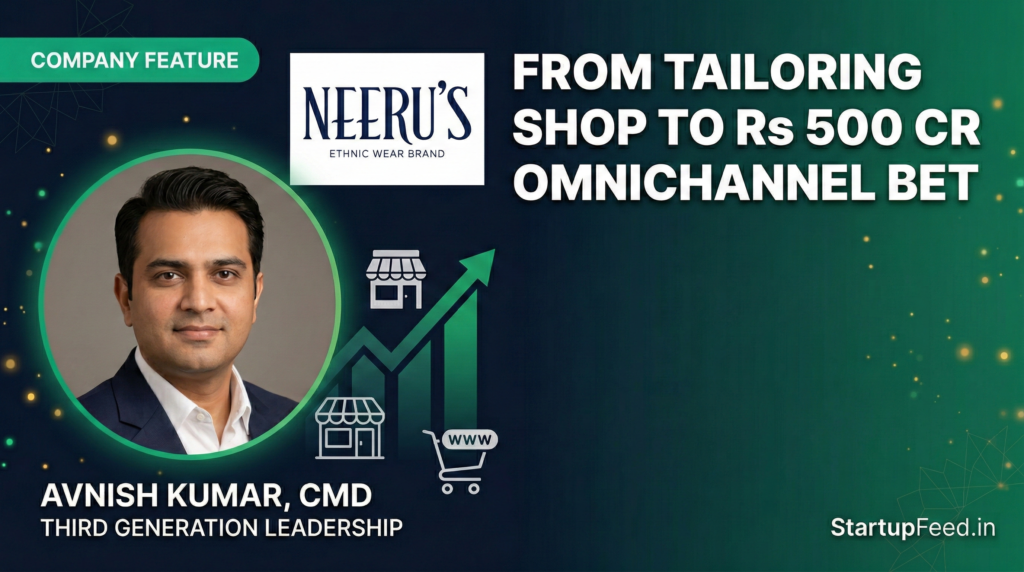
In 2020, Hyderabad-based Neeru’s was running at Rs 100–150 crore annually and growing 30–40% year-on-year. Then Covid-19 arrived. Stores shut. Revenue fell by nearly 50%. Avnish Kumar, the brand’s third-generation CMD, described it plainly: ‘We had zero sales.’ — Avnish Kumar
Five years later, Neeru’s has 100+ stores across 25+ cities, Rs 193 crore in FY25 revenue, and a stated target of Rs 500 crore within two to three years. The path runs through a channel the brand barely touched before the pandemic: the internet.
That transition — from a 54-year-old brick-and-mortar ethnic wear institution to an omnichannel brand with 25–30% of sales now online and a Rs 7–8 crore monthly website target — is the story the numbers behind the Rs 500 crore ambition are telling.
Neeru’s is one of India’s largest bootstrapped fashion brands — 54 years old, zero VC funding, Rs 102 crore in bank debt, and a 2.6x revenue growth target. The Covid pivot from a website with no commerce engine to a platform contributing 25–30% of revenue proves the model can cross channels. The Rs 500 crore question is whether it can do so at the pace the target demands — and whether it needs outside capital to get there.
StartupFeed Insight | |
|---|---|
| What the numbers say | Neeru’s Rs 193 Cr FY25 revenue against a Rs 500 Cr target means a 2.6x growth requirement in 2–3 years — a 40–60% CAGR. That is ambitious for a 54-year-old retailer with Rs 102 Cr in outstanding debt. The path is not impossible: it requires accelerating online (currently 25–30% of revenue) to 40%+ while opening 50+ new stores via franchise. The digital channel is the margin-efficient lever — it does not require incremental rent, fit-out cost, or new headcount at the pace brick-and-mortar does. |
| For founders | Neeru’s chose bootstrapping over VC funding for 54 years. That decision preserved control and margins but also limits the speed of capital deployment for the Rs 500 Cr sprint. The franchise and dealership expansion model — already in use — is the most capital-efficient path to national scale without dilution. If Neeru’s can convert 30–40 franchise locations in Tier 2 cities by FY28 while growing online to Rs 7–8 Cr/month, the Rs 500 Cr target is achievable on internal capital. A PE round, if taken, would turbocharge store network expansion. |
| For investors | Neeru’s is one of India’s largest bootstrapped ethnic wear brands at Rs 193 Cr revenue with zero VC backing. It has Rs 102 Cr in bank debt but a 100% promoter-held cap table. A PE or strategic investment would provide the growth capital for store expansion and technology without requiring an IPO. At Rs 193 Cr revenue and likely 12–15% EBITDA margins for a mature ethnic wear retailer, a Rs 300–400 Cr PE round at 2–2.5x revenue multiple implies Rs 400–500 Cr valuation — the most capital-efficient entry into India’s Rs 2.5 lakh Cr fashion market. |
| For employees | Neeru’s has 560 employees managing 100+ stores and growing. The omnichannel expansion — particularly the digital channel push and new store formats — will drive structured hiring in technology, e-commerce operations, category management, and franchise support. With manufacturing facilities in Hyderabad, Mumbai, and Delhi, design and merchandising roles are core. A Rs 500 Cr brand requires a 2x headcount growth from 560 to ~1,000–1,200 over the target period. |
| Our prediction | Neeru’s will reach Rs 280–320 Cr in FY27 and Rs 400–450 Cr in FY28 — not Rs 500 Cr in two years, but on a credible glide path to the target by FY29. The catalyst that accelerates or delays the Rs 500 Cr milestone will be the online channel: if website revenue reaches Rs 7–8 Cr/month by FY27 as Avnish Kumar projects, and franchise stores add 30 new locations, the Rs 500 Cr run rate becomes visible. A PE announcement between FY26 and FY28 is the most likely capital event that compresses the timeline. |
The Origin: Three Generations, One City, 54 Years
| Year | Event | Significance |
|---|---|---|
| 1971 | Basant Kaur opens 150 sq ft tailoring shop, King Koti, Hyderabad | Foundation year; embroidery + tailoring; zero retail infrastructure |
| 1979 | Harish Kumar renames the business ‘Neeru’s’ after his wife; opens first salwar kameez EBO | One of India’s first exclusive ready-to-wear ethnic boutiques |
| 1983 | Launches Neeru Textiles — manufacturing + wholesale to 1,000+ retailers | B2B revenue layer; first manufacturing infrastructure in Hyderabad |
| 1996 | First proper retail outlet — 3,000 sq ft | Retail format established; 25 years after founding |
| 2005 | Neeru’s Ensembles Pvt. Ltd. incorporated | Corporate entity formalised; CIN: U18101TG2005PTC046798 |
| 2012 | Neeru’s Emporio flagship — 30,000 sq ft, Jubilee Hills, Hyderabad | Largest single ethnic wear store in South India at launch |
| 2015 | Dubai store opened — Meena Bazaar Market | First international footprint; NRI + Gulf diaspora customer base |
| 2020 (pre-Covid) | Rs 100–150 Cr annual run rate; 30–40% YoY growth projected | Pre-pandemic high water mark; scaling via new store openings |
| 2020 (Covid) | Revenue falls ~50%; ‘We had zero sales’ — Avnish Kumar | Existential crisis; no e-commerce engine; website not set up for sales |
| 2021 | Launches e-commerce; website rebuilt as sales engine | Post-Covid digital pivot; began omnichannel architecture |
| 2025 (FY25) | Rs 193 Cr revenue (MCA filing) · 100+ stores · 25+ cities | Post-Covid recovery complete; digital contributing 25–30% |
| 2025–26 | Rs 7–8 Cr/month website ARR target · Rs 500 Cr 2–3 year ambition | Omnichannel era; third-generation leadership driving national scale |
The King Koti address in Hyderabad is both the beginning and the still-registered headquarters of Neeru’s Ensembles. Basant Kaur — Avnish Kumar’s grandmother — opened the 150 sq ft tailoring shop there in 1971 when ready-made ethnic wear was almost nonexistent in South India. Her son Harish saw the gap in ready-to-wear ethnic — the kind of salwar kameez popularised by Bollywood that women wanted but could only get tailored — and built a retail identity around it.
The 1983 manufacturing pivot was the business model’s second inflection: from bespoke retail to scaled wholesale, supplying over 1,000 retailers across India. It built the sourcing, quality, and logistics infrastructure that every subsequent store would rest on. The 2012 Emporio — 30,000 sq ft of ethnic wear under one roof in Jubilee Hills — was the proof of concept that Neeru’s could compete at luxury scale. The pandemic was the proof of vulnerability that came with being entirely dependent on walk-in footfall.


The Covid Reset: Zero Sales, and the Decision That Changed Everything
“Many of our stores were shut down, and we had zero sales. I never imagined days like that would come. But somehow, we found the strength to get through it, keep the business afloat and move forward.”
— Avnish Kumar, CMD and CEO, Neeru’s
The framing matters. Neeru’s had the infrastructure for digital commerce — warehouses, inventory systems, a loyal customer base. What it lacked was the digital front end. The website existed for brand awareness, not transactions. The pandemic forced a triage question: was the brand’s loyalty with the store, or with the customer? The answer determined the omnichannel strategy.
Rebuilding the website as a genuine sales engine — not just a catalogue — was the first decision. Listing on Myntra, Nykaa Fashion, Amazon, and Flipkart came next. The combination of D2C website and marketplace presence meant the Rs 100–150 crore brand that had been built entirely on footfall could now be accessed by customers in cities that had no Neeru’s store.
Company Profile
| Parameter | Detail |
|---|---|
| Legal entity | Neeru’s Ensembles Private Limited (CIN: U18101TG2005PTC046798) |
| Headquarters | Rekha House, King Koti, Hyderabad, Telangana — same address as founding 150 sq ft shop |
| Incorporated | December 8, 2005 (private limited entity; operating as partnership firm since 1979) |
| Founding family | Basant Kaur (matriarch, 1971) → Late Harish Kumar (son, scaled business) + Neeru Kumar (wife, brand namesake) → Avnish Kumar (grandson/son, current CMD) |
| Current leadership | Avnish Kumar — Chairman and Managing Director (CEO) · Neeru Kumar — Director |
| Revenue (FY25) | Rs 193 Cr — per Tracxn/MCA filing (March 31, 2025) |
| Revenue (FY24) | Rs 100–500 Cr range (Tofler; exact figure not disclosed; EBITDA up 17.35% YoY, book networth up 65.36%) |
| Revenue target | Rs 500 Cr in 2–3 years from 2026 (Avnish Kumar, Inc42) |
| Employees | 560 (August 2025); 593 as of April 2024 — slight rationalisation |
| Institutional funding | Zero — 100% promoter-held; no VC or PE investment disclosed |
| Bank debt | Rs 102 Cr total disclosed borrowings — Tata Capital, SBI, HDFC Bank, Karnataka Bank, Axis Bank (settled) |
| Manufacturing | Three facilities: Hyderabad (primary), Mumbai, Delhi |
| Retail footprint | 100+ EBOs and MBOs · 25+ cities · 2.5 lakh sq ft total retail space · Dubai (since 2015) |
| Global shipping | UK, USA, Canada, Middle East, Australia |
The Omnichannel Architecture: What It Actually Looks Like
| Digital Parameter | Detail |
|---|---|
| Pre-Covid online status | Website existed for brand awareness — not set up as sales engine; ‘The domain was not up there for building brand awareness; it was not a sales engine’ — Avnish Kumar |
| Post-Covid pivot (2021) | Website rebuilt with e-commerce engine; payment gateway, product catalogue, delivery infrastructure activated |
| Online revenue share (2026) | 25–30% of total revenue — approximately Rs 48–58 Cr of Rs 193 Cr FY25 base |
| Website ARR target | Rs 7–8 Cr/month = Rs 84–96 Cr annual — within 12–18 months from early 2026 |
| Marketplaces | Presence on Amazon, Flipkart, Myntra, Nykaa Fashion, and direct website; multi-platform distribution |
| Digital strategy | Phased integration of store and product layers; goal: not to displace store-first DNA but expand reach to customers who cannot visit physical stores |
| Technology | Inventory management, omnichannel order management, CRM — being upgraded; franchise store tech standardisation in progress |
| D2C vs marketplace split | Not disclosed — website push (Rs 7–8 Cr/month target) implies deliberate shift toward owned D2C channel over marketplace |
| Global e-commerce | Ships to UK, USA, Canada, Middle East, Australia — NRI community is core early-adopter digital customer |
“We are looking at an average run rate of at least INR 7–8 Cr just from our website in the next 12–18 months.”
— Avnish Kumar, CMD and CEO, Neeru’s
The Rs 7–8 crore monthly website target translates to Rs 84–96 crore annual D2C revenue — roughly 45–50% of Neeru’s total FY25 revenue of Rs 193 crore. That is an enormous share for a brand that had a non-commerce website as recently as 2020. The target assumes that Neeru’s D2C website captures a large portion of the online sales that currently flow through Myntra and Nykaa Fashion at platform commission costs of 25–35%.
The omnichannel model is phased: stores anchor discovery and trust; the website captures the transaction for customers who are already brand-aware but not geographically proximate. For Neeru’s bridal and occasion wear — where a customer spends Rs 15,000–3,00,000 and researches extensively before buying — the online-to-offline journey (browse online, buy in-store) and the offline-to-online journey (discover in-store, reorder online) are both active customer paths.
Store Architecture: Five Formats, One Brand
| Format | Details |
|---|---|
| Flagship Emporio | 30,000 sq ft — Jubilee Hills, Hyderabad (opened 2012); wedding + occasion + silk sarees + designer lehengas; Neeru’s largest format |
| Standard EBO | 15,000 sq ft — full product range; women’s, men’s, kids’; typical of metro and Tier 1 cities |
| Franchise EBO | 1,500–4,500 sq ft — franchise requirement; full Neeru’s range in smaller footprint |
| Neeru’s Silks | Dedicated silk sarees format — recently launched in Secunderabad; targets the Rs 8,000–50,000 premium saree buyer |
| Neeru’s Privé Room | Boutique couture format — Jubilee Hills, Hyderabad; high-fashion ethnic + fusion at premium price points; limited edition |
| Be Desi by Neeru’s | Fast fashion sub-brand — 500–800 sq ft; affordable everyday ethnic; Tier 2/3 city and younger demographic focus |
| ELITE (planned) | Couture-inspired luxury format — announced for expansion; positioned above Emporio on price point |
| Express (planned) | Affordable accessible format — mass market ethnic; maximising geographic reach in smaller towns |
| Multi-Brand Outlets | 74 MBOs (LinkedIn data) — Neeru’s products stocked in partner retail stores; reach without capex |
The multi-format strategy is Neeru’s answer to a market segmentation challenge. India’s ethnic wear buyer spans a Rs 500 kurti and a Rs 5,00,000 wedding lehenga — and Neeru’s wants to serve both. Be Desi by Neeru’s captures the affordable mass-market buyer. Neeru’s Privé captures the high-fashion buyer. The core Neeru’s stores serve the Rs 3,000–50,000 occasion and festive buyer in between.
The franchise format — requiring 1,500–4,500 sq ft — is the most important vehicle for reaching the 65%+ of India’s population in Tier 2 and Tier 3 cities where Neeru’s has no company-owned presence. New franchise EBOs are planned in Hyderabad, Bengaluru, Chennai, Tirupati, Hubli, Raipur, Nagpur, Pune, and several Tier 2 AP/Telangana towns. Internationally, a second Dubai store has been announced, and US presence is on the roadmap.
Sub-Brand Portfolio
| Sub-Brand / Line | Category and Range |
|---|---|
| Neeru’s (core) | Women’s ethnic wear — sarees, lehengas, salwar suits, kurtis, half sarees, blouses, tunics, mix & match; ready-to-wear + unstitched |
| Neeru’s Mix & Match | Tunics, kurtis, and bottoms — mix-and-match separates; led by Neeru Kumar’s Signature Collection; everyday ethnic for working women |
| Neeru’s Menz | Men’s ethnic — kurta pyjamas, sherwanis, Indo-western, shirts; expanding from women’s DNA |
| Little Neeru’s | Kids’ ethnic wear — occasion and festive wear for children |
| Yuva by Neeru’s | Youth-focused sub-brand — contemporary ethnic for 18–30 demographic; fusion silhouettes |
| Neeru’s Privé | Premium-limited edition collection — high fashion ethnic + fusion; runway-inspired; Rs 15,000–1,00,000+ price range |
| Neeru’s Silks | Dedicated saree collection — silk, Kanjivaram, Banarasi, handloom; standalone store format |
| Be Desi by Neeru’s | Fast fashion ethnic — affordable Rs 499–2,999 range; street-ready ethnic for Tier 2 buyers |
| Accessories + Jewellery | Add-on category — ethnic accessories, statement jewellery, clutches, potli bags; cross-sell within store visits |
The sub-brand strategy reflects a deliberate attempt to capture the full family wallet across occasions, generations, and price points. Neeru Kumar’s own Signature Collection — part of the Mix & Match line — is one of the brand’s highest-margin products because it carries the co-founder’s personal design authority. Neeru’s Privé, launched as a limited-edition premium line, tests whether the brand can command Rs 25,000–1,00,000 price points that Aza Fashions and designer multi-brand boutiques currently own.

Financial Snapshot: The Numbers Behind the Rs 500 Cr Target
| Metric | Pre-Covid FY20 | Covid FY21 | FY25 |
|---|---|---|---|
| Revenue (Rs Cr) | 100–150 (run rate) | ~50–75 (est. −50%) | 193 |
| EBITDA growth (YoY FY24) | — | — | +17.35% (Tofler) |
| Net worth growth (FY24) | — | — | +65.36% (Tofler) |
| Online share | 0% (website not a sales engine) | Minimal | 25–30% |
| Stores (EBO+MBO) | ~57–70 (pre-Covid) | Shut during lockdown | 100+ |
| Bank debt (disclosed) | N/D | N/D | Rs 102 Cr |
| Employees | N/D | N/D | 560 (Aug 2025) |
| Revenue target | — | — | Rs 500 Cr (2–3 years) |
Three numbers define Neeru’s financial position in 2026. First: Rs 193 crore FY25 revenue — a full recovery from the Covid trough and a meaningful step up from the pre-pandemic run rate. Second: Rs 102 crore in bank debt — not unusual for a retailer of this scale financing store buildouts and working capital, but a constraint on how aggressively it can fund new capex without an equity raise. Third: Zero VC or PE funding — Neeru’s has compounded 54 years of growth entirely on bank debt and retained earnings.
The FY24 EBITDA growth of 17.35% and net worth growth of 65.36% (Tofler) suggest margins are expanding as the brand matures and online channels improve the revenue mix. The Rs 500 crore target requires compounding at 40–60% CAGR — achievable only if both online and offline channels fire simultaneously.
The Market Neeru’s Is Playing In
| Market Parameter | Data / Context |
|---|---|
| India women’s ethnic wear market (2025) | ~Rs 1,65,000 Cr (~$20 Bn) — fastest growing segment of Indian fashion; includes sarees, salwar suits, lehengas, kurtis |
| India occasion / wedding ethnic wear | ~Rs 35,000 Cr — Manyavar-Mohey, Meena Bazaar, Neeru’s primary segment; bridal wear commands Rs 5,000–5,00,000 per outfit |
| India ethnic wear CAGR (2025–2030) | 12–15% annually — driven by rising disposable income, festive/wedding seasonality, global NRI demand |
| Online ethnic fashion penetration | ~18–22% of total ethnic wear purchases now online (FY25); growing at 25–30% annually vs 10–12% offline growth |
| Tier 2/3 city ethnic wear opportunity | 65%+ of India’s population in Tier 2–4 towns; organised ethnic retail penetration <10% in most; Neeru’s franchise model designed for this gap |
| India ethnic wear export market | Indian diaspora (30 Mn+) in USA, UK, UAE, Canada — NRI ethnic wear imports growing 20%+ annually; Neeru’s global shipping + Dubai store capture this |
| Key demand drivers FY26+ | Rising wedding count post-Covid backlog, South India jewellery + saree culture, Gen-Z fusion ethnic trend, Bollywood + OTT fashion influence |
Competitive Landscape
| Brand | Revenue (est.) | Model | vs Neeru’s |
|---|---|---|---|
| Manyavar-Mohey (Vedant Fashions) | Rs 1,300 Cr+ (FY25, listed) | Occasion ethnic — men + women; EBO model | Listed; national reach; male-skewed; Neeru’s more women-centric with deeper saree/lehenga range |
| Fabindia (listed) | Rs 1,800 Cr+ (FY25) | Ethnic + craft; online + offline; listed | Craft/handloom positioning; listed company; broader home + lifestyle; Neeru’s deeper in occasion/bridal |
| Indya (FabAlley) | ~Rs 200–250 Cr (est.) | Online-first fusion ethnic; VC-backed | Digital-first; 18–30 demographic; fashion-forward fusion; Neeru’s more heritage + occasion-anchored |
| Aza Fashions | ~Rs 150–200 Cr (est.) | Designer ethnic; luxury-leaning | Premium designer curation; narrower mass reach; Neeru’s broader price range with larger store network |
| Biba | ~Rs 850–900 Cr (est.) | Mass-market ethnic ready-to-wear | Listed; national; kurti-heavy; lower price point than Neeru’s occasion focus; directly competitive in everyday ethnic |
| Meena Bazaar | ~Rs 300–400 Cr (est.) | Traditional ethnic multi-brand | Delhi-NCR strong; Neeru’s stronger in South India; both target the Rs 2,000–10,000 ethnic occasion buyer |
Neeru’s positioning — occasion-anchored, South India-rooted, multi-price-point, family-focused — does not map cleanly onto any single competitor. Manyavar-Mohey is the most instructive benchmark: a similarly heritage-anchored Indian ethnic brand that crossed Rs 1,300 crore revenue on a franchise-heavy expansion model. The Manyavar playbook — focus on bridal occasion, expand via franchise, list on public markets — is the closest publicly available template for what Neeru’s Rs 500 crore path could look like. The difference: Manyavar skews male; Neeru’s is women-first.
Online-first competitors like Indya and the FabIndia digital channel represent the digital threat. Both are growing faster in the 18–30 demographic on fusion ethnic. Neeru’s Yuva and Be Desi sub-brands are its direct response — but they are early-stage, and Indya has a significant digital marketing head start.
What’s Next
Three milestones define the next 24 months. First: whether website revenue reaches Rs 7–8 crore/month. This is the most visible leading indicator of whether the omnichannel bet is working at scale. Second: how many franchise stores open in Tier 2 cities. Each franchise location adds Rs 3–6 crore in annual revenue without incremental capex for Neeru’s. Third: whether a PE round is raised. At Rs 193 crore revenue and strong EBITDA growth, a Rs 300–400 crore investment at Rs 400–500 crore valuation would fund the 50-store expansion required to reach the Rs 500 crore target on a compressed timeline.
The Rs 500 crore target, assessed against the Rs 193 crore FY25 base and a 2–3 year timeline, requires 40–60% CAGR — the fastest growth rate in Neeru’s 54-year history. That acceleration is not impossible for a brand with 54 years of equity, a loyal multigenerational customer base, and a franchise model that requires less capital per new store than a company-owned rollout. But it will require either a PE catalyst or an extraordinary organic acceleration in both online and offline channels simultaneously.
The Rs 500 crore number is ambitious. The 54-year foundation under it is not.
Know something about Neeru’s next capital event or store expansion? Write to tips@startupfeed.official
Liked this story? Follow StartupFeed on Google so our reporting reaches you first.