
WITCH Stocks Explained: India’s Big 5 IT Companies in 2026
WITCH stocks are India's biggest IT firms: Wipro, Infosys, TCS, Cognizant, HCLTech. Here is what the acronym means, who is in it, and how they rank in 2026. (152)

6 min read
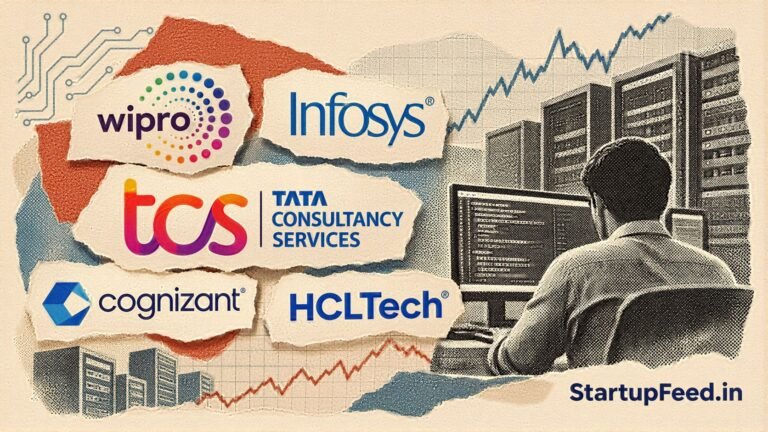
WITCH stocks are the five biggest Indian IT services firms: Wipro, Infosys, TCS, Cognizant and HCLTech. The word is an acronym built from the first letter of each name.
Quick Take
- WITCH stands for Wipro, Infosys, TCS, Cognizant and HCLTech.
- TCS is the largest, worth about ₹11 lakh crore in market value.
- The Nifty IT index is down about 18% in 2026, so these stocks have had a hard year.
In this story6 sections
What does WITCH stand for?
WITCH is made from five company names. W is Wipro, I is Infosys, T is TCS, C is Cognizant, and H is HCLTech.
All five are Indian IT services firms. They write software, run computer systems and handle back-office work for large companies abroad, mostly in the United States and Europe.
One point confuses people. Cognizant is run from the United States, not India. It stays in the group because most of its staff work in India, so analysts still count it with the Indian firms.
Also read
In the Indian stock market, people often drop Cognizant, because it does not trade on Indian exchanges. It is listed in the United States. So a market version of the list is really four names: Wipro, Infosys, TCS and HCLTech.
Where the WITCH acronym came from
The word started as SWITCH, not WITCH. The research firm Gartner coined SWITCH in the 2000s for the six largest Indian IT firms: Satyam, Wipro, Infosys, TCS, Cognizant and HCL.
Gartner used it to show how fast these firms were growing. A 2006 Gartner report found the SWITCH companies grew about 42% that year, against 4.3% for IBM, the global leader at the time.
Then one letter fell away. In 2009, Satyam collapsed in a large accounting fraud. Tech Mahindra bought the wreck and merged it in 2013, and the Satyam name went out of use.
With the S gone, SWITCH became WITCH. Some writers added Tech Mahindra back and called it TWITCH. The research firm HFS Research marked that shift in 2016.
“Welcome to the TWITCH family, Tech Mahindra. Tech Mahindra has quietly accelerated to a formidable position in the IT services industry.”
Phil Fersht, chief executive, HFS Research. From the HFS Research note, 1 July 2016.
How the WITCH companies rank in 2026
TCS is the giant of the group. It is worth about ₹11 lakh crore in market value, more than the other three listed names put together.
Infosys comes second, then HCLTech, then Wipro. The table below shows where the four listed WITCH firms stood in a recent trading session, with Tech Mahindra added for comparison.
Also read
| Company | Market value (₹ crore) | Share price (₹) |
|---|---|---|
| TCS | 11,07,840 | 3,028 |
| Infosys | 6,27,065 | 1,515 |
| HCLTech | 4,03,359 | 1,496 |
| Wipro | 2,58,215 | 249 |
| Tech Mahindra | 1,51,636 | – |
Cognizant is not in the table because it does not trade in India. It is listed in the United States, where it is worth about $38 billion.
Size is only half the picture. The next thing to know is how these firms compare with the US tech names they are often set against.
WITCH versus FANG and the US giants
FANG is the American version of the idea. It stands for Facebook, Amazon, Netflix and Google, the big US tech names. MANGO is a newer tag for a similar US group.
The two groups do very different work. FANG firms own products that billions of people use: search, shopping, video. They keep most of the value they create.
WITCH firms sell services, not products. They are paid by the hour and by the project to run technology for other companies. That is a steadier business, but a lower-margin one.
The gap shows in scale. A single FANG firm can be worth more than all the WITCH firms combined. The Indian firms win on people and cost, not on market value.
About WITCH stocks
WITCH stocks are the shares of India’s largest IT services exporters, grouped under one acronym for easy reference. They earn most of their money abroad, employ hundreds of thousands of people, and are among the most widely held stocks in Indian mutual funds. Their fortunes track US client spending, the rupee-dollar rate, and now the pace of AI change in software work.
Why WITCH stocks struggled in 2026
2026 has been a weak year for the group. The Nifty IT index, which tracks these firms, is down about 18% so far this year, according to NSE data.
Growth is the core problem. In the September quarter, sales barely rose from the quarter before. TCS grew 0.5%, Wipro was flat, Infosys grew 1.2%, and HCLTech’s services arm grew 2.3%.
Infosys then cut its full-year revenue growth guidance to 1-2%. That signalled the slowdown was not a one-quarter blip, and the market took it badly.
AI sits under all of it. Clients are spending on AI, but some older projects now need fewer billed hours, and the new AI work has not yet grown enough to fill the gap. Until it does, the WITCH group stays under pressure.
Quick checklist: what to know about WITCH stocks
- WITCH is Wipro, Infosys, TCS, Cognizant, HCLTech.
- In the Indian market, Cognizant is usually dropped, leaving four names.
- TCS is the largest by far, at about ₹11 lakh crore.
- The group earns most of its money from US and European clients.
- They are service firms, paid by project, not product owners like FANG.
- The Nifty IT index is the easiest way to track them as a basket.
StartupFeed Insight
The WITCH label has survived every change to the group it names, from Satyam’s fall to Tech Mahindra’s rise, because it captures one durable fact: five Indian firms built a global services business on cost and scale. That edge is now being tested by AI, which threatens the billed-hour model the whole group rests on. Watch who turns AI into revenue first. The firm that does will decide whether WITCH stays a growth story or becomes a value one. My read: the group that leads the next cycle may not carry the same five letters.
By Saraswati Chaubey, Writer
Frequently Asked Questions
What does WITCH stand for in the stock market?
WITCH stands for Wipro, Infosys, TCS, Cognizant and HCLTech, the five biggest Indian IT services firms. The word is built from the first letter of each name. In the Indian market, Cognizant is often dropped because it trades in the United States, leaving four names.
Is Tech Mahindra a WITCH stock?
Not in the original acronym. Some analysts add Tech Mahindra and call the group TWITCH instead. Tech Mahindra joined the big league after it bought and merged the collapsed Satyam, whose S was the first letter of the older SWITCH acronym.
Which is the biggest WITCH company?
TCS is the largest by far. It is worth about ₹11 lakh crore in market value, more than Infosys, HCLTech and Wipro combined. Infosys is second, followed by HCLTech and then Wipro among the listed Indian names.
How is WITCH different from FANG?
FANG firms, such as Facebook, Amazon, Netflix and Google, own products that billions of people use, and keep most of the value. WITCH firms sell services by the project to other companies. That is a steadier but lower-margin business, and a single FANG firm can be worth more than all WITCH firms together.
Why did WITCH stocks fall in 2026?
Growth slowed sharply. In the September quarter, sales barely rose over the prior quarter, and Infosys cut its full-year growth guidance to 1-2%. The bigger worry is AI, which is cutting billed hours on older projects faster than new AI work can replace them. The Nifty IT index is down about 18% in 2026.
Have a tip? Write to us at editorial@startupfeed.in.