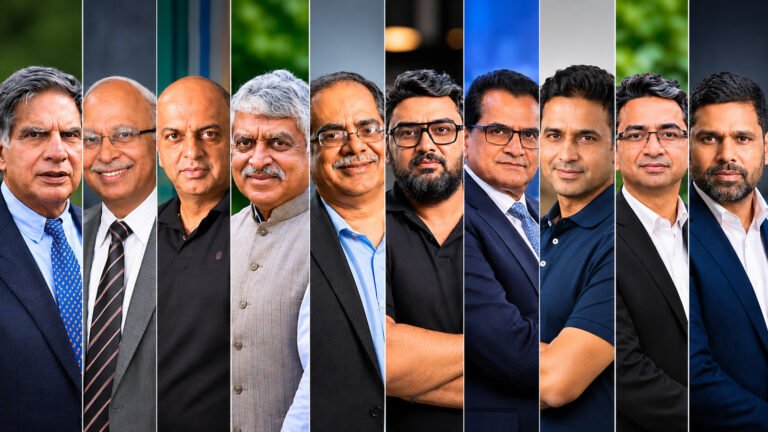
International Men’s Day: Saluting 10 Men Who Helped Build the Indian Startup Ecosystem
Indian startup ecosystem builders we salute on International Men's Day 2026, from Nandan Nilekani and Ratan Tata to Nithin Kamath and Kunal Shah.
By Dr. Mayank Raj, Editor-in-Chief
9 min read
Quick Take
- On International Men’s Day, 19 November 2026, StartupFeed salutes 10 men who helped build the Indian startup ecosystem.
- They include Nandan Nilekani, who led Aadhaar, the late Ratan Tata, Zerodha’s Nithin Kamath, CRED founder Kunal Shah and Freshworks founder Girish Mathrubootham.
- We chose them for what they built for other founders: public digital rails, policy, angel networks, early capital and shared wealth. Each entry ends with a lesson for founders.
In this story12 sections
On International Men’s Day, 19 November 2026, StartupFeed is saluting ten men who helped build the Indian startup ecosystem. Each of them did more than build a company. They built something other founders could use: public digital rails, startup policy, angel networks, early cheques and communities that share what they know.
The International Men’s Day organisers picked “The Future Is Everyone” as the 2026 global theme. It suits this list. What these men built is open to every founder, and many women and men beyond these ten deserve the same salute.
How We Chose 10 Builders of the Indian Startup Ecosystem
We did not rank by net worth or valuation. We asked one question: whose work made it easier for others to start, fund or grow a company in India? The ten are listed roughly in the order their contribution began, from 1988 to 2021. The list is not exhaustive, so tell us whom we missed at editorial@startupfeed.in.
1. Saurabh Srivastava: The Institution Builder
Srivastava co-founded and chaired four institutions that Indian founders still lean on: NASSCOM, the Indian Venture Capital Association, TiE Delhi NCR and the Indian Angel Network, according to IIT Kanpur, where he studied engineering. NASSCOM was set up in 1988. The government awarded him the Padma Shri in 2016.
The Indian Angel Network brings individual investors together to back early-stage startups. In an interview with Indian Startup Times, he said that in his view the founder accounts for half of what makes a startup investable. He has also argued for a hub and spoke model of angel networks, so that experienced investors can mentor founders in smaller cities.
Also read
Lesson for founders: Half of an early investor’s decision is about you. Show clearly why you are the right person to solve this problem.
2. Sanjeev Bikhchandani: The Founder Who Backed Founders
The Naukri.com founder turned Info Edge into an early backer of Indian startups. Info Edge invested in Policybazaar in 2008 and in Zomato in 2010, he told Entrepreneur India. When Zomato listed in 2021, that 11-year-old bet had returned more than 1,000 times, YourStory reported.
Taken together, Info Edge’s long-term startup investments have returned nearly 10 times, with an estimated gross internal rate of return of 36%, according to its FY25 annual report, Outlook Business reported. Zomato’s listed parent is now called Eternal, and Policybazaar’s is PB Fintech. Bikhchandani received the Padma Shri in 2020.
Lesson for founders: Pick investors who can wait. Info Edge stayed with Zomato for 11 years before the listing.
3. Nandan Nilekani: The Rails Startups Run On
In 2009, the Infosys co-founder became the founding chairman of the Unique Identification Authority of India, which built Aadhaar. Aadhaar became the base of India Stack, reusable digital infrastructure on which startups, banks and fintech firms build, Business Today noted. UPI, the payments layer that many startups now depend on, is part of that stack.
He has backed founders directly too. In 2017 he co-founded Fundamentum Partnership with Sanjeev Aggarwal, a growth fund whose portfolio includes Spinny, PharmEasy, Kuku and Stable Money. In July 2026 it launched a third fund with a target corpus of ₹2,200 crore, with Nilekani as the anchor investor, YourStory reported.
Lesson for founders: Build on public rails instead of rebuilding them. UPI and the wider India Stack can cut the cost of payments and paperwork for a young company.
Also read
4. Sharad Sharma: The Volunteer Who Pushed for a Product Nation
Sharma co-founded iSPIRT, the Indian Software Product Industry Roundtable, with Vishnu Dusad, Bharat Goenka and Avinash Raghava. The volunteer movement behind it began in 2009 and iSPIRT launched formally in 2013. ThePrint, looking back on its first decade, summed up that work in two words: India Stack.
iSPIRT says it builds public goods for product founders: technology building blocks such as India Stack, startup-friendly policies, market access programmes and playbooks. Sharma earlier headed Yahoo’s India R&D centre, chaired the NASSCOM Product Forum and co-founded Teltier, now part of Cisco.
Lesson for founders: Some problems are bigger than one company. Shared rails and better rules come from founders working together, often as volunteers.
5. Ratan Tata: The Industrialist Who Became an Angel
After stepping back from the Tata Group, Tata became known as a prominent investor in Indian startups. Snapdeal, in 2014, was his first ecommerce investment, and he went on to back companies such as Ola, Paytm, Urban Company and FirstCry, Business Today reported. He invested in his personal capacity through his firm RNT Associates, BloombergQuint reported, and once said he had become a startup investor partly by accident.
By December 2021, Business Today counted more than 30 startups in his portfolio. Several companies he backed, including Paytm and FirstCry, have since listed on the stock market. Tata died in October 2024.
Lesson for founders: The right investor brings more than money. A respected name on your cap table can open doors that a bigger cheque cannot.
6. Kunal Shah: The Angel With the Longest List
After selling FreeCharge, the CRED founder became one of India’s most active angel investors. Tracxn lists 312 companies in his portfolio, including Razorpay and Shiprocket. He also topped StartupFeed’s 2026 ranking of India’s most active angels, with 190 startups backed between 2021 and July 2026, based on Outlook Business and Tracxn data.
In June 2026, Meta agreed to invest $900 million in CRED for a stake of about 20%, and Shah stepped down as CRED’s chief executive to lead WhatsApp globally, Business Today reported.
Lesson for founders: Prolific angels see hundreds of pitches. A sharp insight about your customer, put in a few lines, stands out more than a long deck.
7. Amitabh Kant: The Official Behind Startup India
As Secretary of the Department of Industrial Policy and Promotion (DIPP), Kant steered the Startup India action plan that Prime Minister Narendra Modi unveiled on 16 January 2016. Ahead of the launch, Kant said about 2,000 startups and 40 business leaders and venture capitalists would give inputs, Business Standard reported, and he met iSPIRT’s volunteers in Bengaluru to understand the technology and policy work they were doing.
He went on to serve as CEO of NITI Aayog from 2016 and later as India’s G20 Sherpa. YourStory credited him with an instrumental role in the government’s Startup India and Digital India policies.
Lesson for founders: If you qualify, apply for DPIIT recognition. It is the entry point to most Startup India benefits.
8. Nithin Kamath: The Bootstrapper Who Funds Others
Kamath built Zerodha from 2010 without outside investors. In 2016 he started Rainmatter with Zerodha CTO Kailash Nadh, first as a fintech incubator, YourStory reported at the time.
In April 2026, Kamath said Rainmatter had invested over ₹1,500 crore across more than 160 startups in fintech, climate, health, media and deep tech, Business Today reported. The fund invests with no exit mandates or board seat requirements, according to Business Today. In November 2026, it backed altM’s $10.3 million Series A alongside Mela Ventures.
Lesson for founders: Profit gives you choices. Zerodha’s profits now back more than 160 other startups through Rainmatter.
9. Rajan Anandan: The Mentor Behind First Cheques
Anandan led Google in India and Southeast Asia before joining Sequoia India, now Peak XV Partners, in 2019. He is a managing director there, advises on its early-stage investments and mentors founders at Surge, its seed programme, according to Peak XV. PitchBook lists 116 investments he has made as an angel.
Surge has backed more than 180 startups since 2019. In September 2026, Peak XV raised its Surge seed cheque ceiling to $5 million from $3 million and unveiled an 18-startup cohort, Startup Fortune reported. In June 2026, our seed investor ranking picked Surge as the India-focused seed backer most likely to enter Dealroom’s global top 50 by its 2028 edition.
Lesson for founders: Be honest about where you stand. On Peak XV’s website, Anandan says founders who have not yet found product market fit should simply say so.
10. Girish Mathrubootham: The Founder Who Shared the Wealth
Mathrubootham started Freshdesk, later Freshworks, in Chennai in 2010 with Shan Krishnasamy. In September 2021 it became the first Indian SaaS company to list on Nasdaq, and more than 500 of its employees in India became crorepatis, at least 70 of them under 30, YourStory reported.
“Wealth has to be shared with the people who helped create it.”
Girish Mathrubootham, at the time of the listing, as quoted by The News Minute.
He also founded SaaSBOOMi, a community where SaaS founders share what they have learned, and co-founded Together Fund, which backs Indian startups building for global markets, Entrepreneur India reported. In September 2025, Freshworks said he would retire as executive chairman on 1 December 2025 to work full time on Together Fund, Outlook Business reported.
Lesson for founders: Give your team real ownership. When the company wins, your people should win too.
What this means for you
Much of what these men built is open to you. UPI and the wider India Stack handle payments and paperwork, DPIIT recognition unlocks Startup India benefits, and angel networks and seed programmes back first-time founders. If you have already had a win, the list shows what comes next: write a cheque, mentor someone or share what you learned.
StartupFeed Insight
Look closely and the ten share one habit: each turned a personal win into something other founders could use. Nilekani and Sharma built shared rails. Srivastava built institutions. Bikhchandani, Kamath and Shah put their gains back into new companies, and Mathrubootham shared his with his team before funding others. That is how an ecosystem compounds. The next decade needs the same habit outside the big metros. Srivastava’s idea of hub and spoke angel networks points the way: many of India’s next founders are in tier 2 and tier 3 cities, and they need mentors and first cheques close to home. The best salute to these ten is to pass the favour on.
By Dr. Mayank Raj, Editor-in-Chief
Frequently Asked Questions
When is International Men’s Day 2026 and what is its theme?
International Men’s Day is observed on 19 November every year, and in 2026 it falls on a Thursday. The global organisers announced “The Future Is Everyone” as the 2026 theme in March 2026.
Who helped build the Indian startup ecosystem?
Many people did. On International Men’s Day 2026, StartupFeed saluted ten men: Saurabh Srivastava, Sanjeev Bikhchandani, Nandan Nilekani, Sharad Sharma, Ratan Tata, Kunal Shah, Amitabh Kant, Nithin Kamath, Rajan Anandan and Girish Mathrubootham. Their work spans public digital infrastructure, policy, angel networks, early capital and founder communities.
When was Startup India launched?
Prime Minister Narendra Modi unveiled the Startup India action plan in New Delhi on 16 January 2016. Amitabh Kant, then Secretary of the Department of Industrial Policy and Promotion (DIPP), steered the plan.
Which Indian angel investor has backed the most startups?
CRED founder Kunal Shah is widely seen as India’s most active angel investor. Tracxn lists 312 companies in his portfolio, and StartupFeed’s 2026 ranking, based on Outlook Business and Tracxn data, counted 190 startups he backed between 2021 and July 2026.
How much has Zerodha’s Rainmatter invested in startups?
Zerodha founder Nithin Kamath said in April 2026 that Rainmatter had invested over ₹1,500 crore across more than 160 startups since it began in 2016, in sectors such as fintech, climate, health, media and deep tech.
How did StartupFeed choose these 10 men?
We did not rank by wealth or valuation. We picked men whose work made it easier for others to start, fund or grow a company in India, through public infrastructure, policy, institutions, early capital or shared wealth. They are listed roughly in the order their contribution began, and the list is not exhaustive.
Have a tip? Write to us at editorial@startupfeed.in.