Quick Take
- Takeda won DCGI approval on July 20, 2026, for Qdenga, India’s first dengue vaccine.
- Cleared for ages 4 to 60, given as two doses spaced three months apart.
- Private-market launch is targeted for early 2027, with local production via Biological E.
In This Article
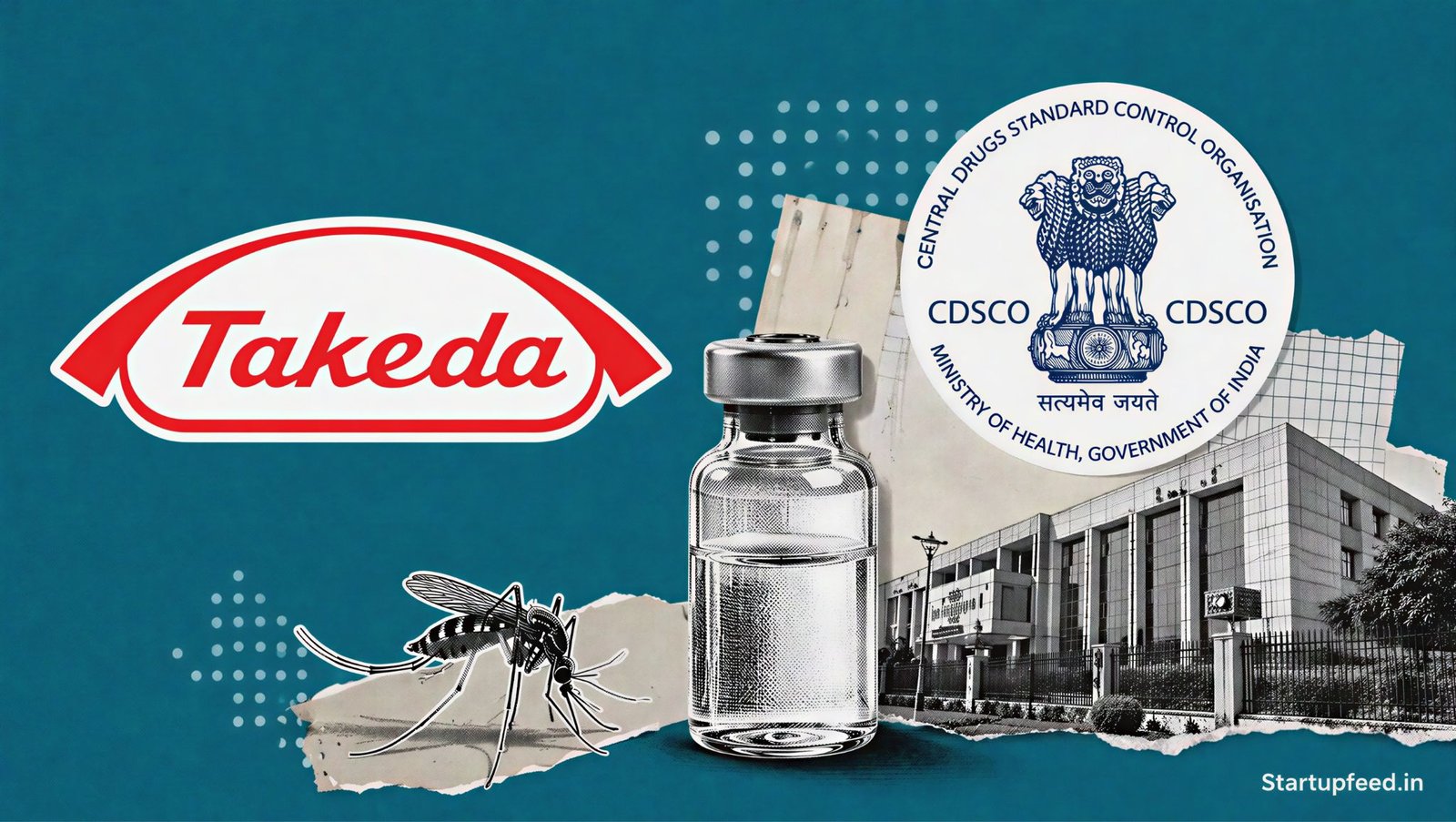
The Takeda Dengue Vaccine, sold as Qdenga, has won approval from the Drug Controller General of India (DCGI) on July 20, 2026, making it the first dengue vaccine cleared for use in the country. It is approved for people aged 4 to 60 years.
The nod covers all four dengue virus serotypes and needs no pre-vaccination screening, so people can take it whether or not they had dengue before. Japan’s Takeda Pharmaceutical is positioning the shot as a new growth pillar in India, alongside its oncology and plasma-derived therapy business.
StartupFeed Insight
The real prize here is not the private market, it is the National Immunisation Programme (NIP). A private-clinic launch reaches a thin slice of India’s demand, while state procurement is where volume lives. The Biological E tie-up to make up to 50 million doses a year signals Takeda is building for that scale before the deal is even signed. Watch state health departments in high-burden regions like Tamil Nadu and Kerala. StartupFeed expects at least one large state to run a public dengue vaccination pilot or issue a procurement inquiry within 18 months of the private launch. By Avinash.
Approval Details and Numbers
The DCGI cleared Qdenga on July 20, 2026, as a live-attenuated tetravalent vaccine for people aged 4 to 60 years, according to the company. The approval rests on a global programme of 19 Phase 1, 2, and 3 trials with more than 28,000 participants, plus a Phase 3 study run in India.
| Metric | Detail | Notes |
|---|---|---|
| Regulator | DCGI (CDSCO) | India’s central drug regulator |
| Approval Date | July 20, 2026 | First dengue vaccine cleared in India |
| Approved Age | 4 to 60 years | No pre-vaccination screening needed |
| Dosing | Two doses, 0.5 mL each | Second dose three months after first |
| Serotypes Covered | All four (DENV-1 to DENV-4) | Live-attenuated, tetravalent |
| Reported Efficacy | 80.2% (TIDES trial) | One year after the second dose |
The standout number is trial scale: the pivotal TIDES study enrolled over 20,000 participants across eight dengue-endemic countries, a large evidence base for a first-in-India vaccine.
About Takeda and Qdenga
Takeda Pharmaceutical is a global drugmaker headquartered in Osaka, Japan, listed on the Tokyo Stock Exchange (TSE:4502) and NYSE (TAK). Qdenga (TAK-003) is its live-attenuated dengue vaccine, first approved in Indonesia in 2022 and later cleared in the European Union. The vaccine received World Health Organization prequalification in 2024. It has since been authorized in dozens of countries as dengue cases climb worldwide.



How does the Takeda Dengue Vaccine work?
The Takeda Dengue Vaccine is a live-attenuated tetravalent shot, meaning it uses a weakened virus to protect against all four dengue serotypes at once. It is given under the skin (subcutaneous) as a 0.5 mL dose, in a two-dose schedule with the second dose three months after the first.
“The launch should be in the first half of next calendar year (2027),” Nayak said, according to ET, referring to India’s private-market rollout.
A wider protection window matters in India because all four serotypes now co-circulate. Government-linked research has found DENV-2 as the leading serotype, with several states recording all four types in the same season. A vaccine that covers every serotype reduces the risk of severe repeat infections.
When will India get the vaccine?
India’s rollout will start in private markets, with availability expected by early 2027 before any move into public procurement. Takeda plans a phased launch, beginning through private hospitals and clinics, then pursuing eventual inclusion in the National Immunisation Programme (NIP).
| Milestone | Status / Timeline |
|---|---|
| DCGI approval | Done (July 20, 2026) |
| Private-market launch | Targeted for first half of 2027 |
| Local manufacturing (Biological E) | Up to 50 million doses a year |
| Global capacity target | 100 million doses a year by 2030 |
Pricing has not been finalised, though the company has said it wants the shot to be affordable for Indians. The Hyderabad-based Biological E partnership to make up to 50 million doses a year is central to keeping supply and cost in check. What makes Qdenga different from earlier options is its single approval covering all ages 4 to 60 with no prior-infection test required, which simplifies rollout.
India’s Dengue Burden in Numbers
India carries close to one-third of the global dengue burden, according to health ministry data. Case counts have run into the lakhs each year, even as tighter surveillance has recently pulled the numbers down from their 2023 peak.
| Year | Dengue Cases | Deaths |
|---|---|---|
| 2023 | 2,89,235 | 485 |
| 2024 | 2,33,519 | 297 |
| 2025 (provisional) | 1,13,450 | 95 |
Figures are from the National Centre for Vector Borne Diseases Control (NCVBDC). Officials link the recent fall to stronger surveillance and source-reduction drives, but dengue still dominates India’s vector-borne disease picture, which is why a vaccine option carries weight. For public data on the disease, see the National Centre for Vector Borne Diseases Control and Takeda’s own company newsroom.
What’s Next
The next test is price. Takeda has promised affordability, and the market will judge the shot on the per-dose cost once the private launch lands in early 2027. After that, the bigger question is whether central and state governments begin any move toward public procurement. Will India’s high-burden southern states be first to run a public dengue vaccination pilot?



Frequently Asked Questions
Have a tip? Write to us at editorial@startupfeed.in.
Liked this story? Follow StartupFeed on Google so our reporting reaches you first.