
Quick Take: | |
|---|---|
| The Company | Fambo Innovation Pvt. Ltd. — Noida-based B2B semi-processed food supply chain for QSRs, cloud kitchens, and HoReCa; founded March 2022 |
| Total Raised | Rs 42.55 Cr (~$5 Mn) across 2 rounds: Rs 21 Cr (Jan 2025, EV2 Ventures) + Rs 21.55 Cr Series A (Oct 2025, AgriSURE Fund / NABVENTURES + EV2) |
| Traction | Rs 20.3 Cr revenue FY25 · 1,000+ restaurant clients · 50+ marquee brands · 40 SKUs · 12,000 tonnes produce/year · <1% waste claim |
| Profitability | Turned net profitable in November 2024. Targets Rs 50 Cr ARR by Q2 FY26 while maintaining profitability |
| What’s Next | National expansion from North + Central India base · New product lines · Export vertical · Tech stack upgrade · Deeper FPO/farmer integration |
India’s quick service restaurant industry wastes 4–10% of every ingredient it buys before a single dish is served. Multiply that across 50,000 QSR joints and a $27.80 Bn market, and you get a structural inefficiency large enough to build a company around.
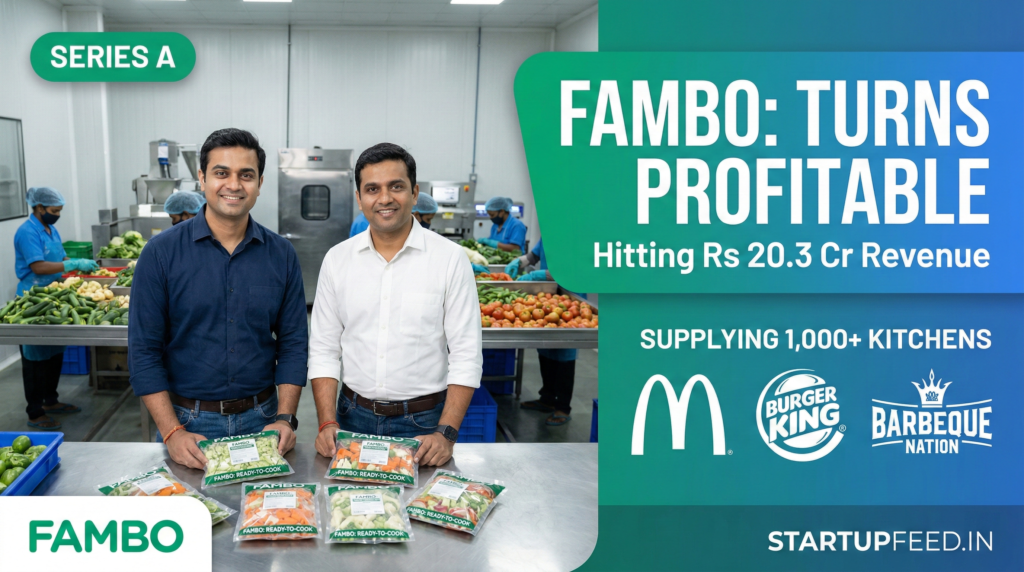
Fambo Innovation Private Limited is building that company. The Noida-based startup has raised Rs 42.55 Cr (~$5 Mn) across two funding rounds in 2025, serves over 1,000 QSR and cloud kitchen clients — including McDonald’s, Burger King, and Barbeque Nation — and turned net profitable in November 2024. Its FY25 revenue came in at Rs 20.3 Cr, and it targets Rs 50 Cr ARR by Q2 FY26.
What makes Fambo different from every other farm-to-fork startup is where it sits in the value chain: not between farms and retailers, but between farms and kitchens — delivering demand-linked, semi-processed ingredients that eliminate the prep waste, taste inconsistency, and labour cost that have long defined QSR kitchen economics.
Fambo’s profitable Rs 20 Cr business positions it as the infrastructure layer that India’s QSR boom is missing. With the $27.80 Bn market growing at 9.25% toward $47.28 Bn by 2031, and national QSR chains demanding consistent, standardised ingredients across hundreds of outlets, the demand for Fambo’s model only compounds. Competitors — Ninjacart, WayCool — should watch the unit economics closely.
StartupFeed Insight | |
|---|---|
| What the numbers say | Fambo turned profitable at Rs 20 Cr revenue — a remarkably lean profitability threshold for a physical-supply-chain business that handles perishables. Most agritech and food-tech companies require Rs 100 Cr+ before fixed cost leverage kicks in. The Rs 20 Cr profitable base means Fambo’s unit economics are structurally better than the category average — demand-linked manufacturing is genuinely eliminating the over-procurement waste that kills margins at competitors. |
| For founders | Fambo’s CoC (Chain of Custody) model — pre-agreed prices with farmers based on demand forecasts — solves the classic agritech double-sided marketplace problem. It gives farmers predictability and eliminates speculative inventory at the processing centre. If you are building in the agri or food service stack, this demand-first architecture is worth reverse-engineering. |
| For investors | India’s $27.80 Bn QSR market is growing at 9.25% CAGR toward $47.28 Bn by 2031. The Rs 42.55 Cr total raised values Fambo at a fraction of that market size — likely below Rs 100 Cr valuation. If the Rs 50 Cr ARR target is met in Q2 FY26 while profitable, a Series B at Rs 250–350 Cr valuation is the next logical round. The AgriSURE Fund (NABARD/MoA&FW anchor) participation signals government-backed agritech capital is available — a structural tailwind for the cap table. |
| For employees | Fambo has 31 employees handling Rs 20.3 Cr revenue — Rs 65.5 Lakh revenue per employee. At Rs 50 Cr target, if team doubles to 60, that ratio holds well above industry average. Noida-based food-tech and agri-supply-chain roles with strong unit economics at a profitable company are structurally less risky than the average B2B agritech startup. Watch for a hiring surge in FY26 Q2 as the national expansion begins. |
| Our prediction | Fambo will reach Rs 50 Cr ARR by Q3 FY26 (one quarter behind target) and file for Series B in Q4 FY26 at Rs 250–300 Cr valuation. The national expansion will prioritise Bengaluru and Mumbai — the two highest-density QSR markets after Delhi-NCR — by end of FY27. Within 24 months, Fambo will service at least one pan-India QSR chain’s complete raw material requirements for a specific category (onions, tomatoes, or potato-based products), making it category-exclusive for that chain. |
The Problem: Why India’s Farm-to-QSR Supply Chain Is Broken
| Problem | Detail |
|---|---|
| Farm-level losses | India loses 25–35% of agricultural produce at supply chain level — despite being a food-surplus country (Akshay Tripathi, Inc42) |
| QSR kitchen waste | 4–10% of all food purchased by QSRs is wasted before reaching the table globally · Prep waste (peeling, trimming, mis-estimation) is single largest contributor |
| Conventional supply chain | Ninjacart, WayCool, and most agritech peers move raw fresh produce — they do not process or standardise. QSR kitchens still do the prep work. |
| Kitchen labour problem | QSRs require skilled kitchen staff just for basic vegetable prep — cost-intensive, difficult to standardise across 100+ outlets |
| Taste inconsistency | Without standardised pre-processed inputs, taste varies outlet to outlet within the same QSR chain — a known brand quality problem at scale |
| Forecasting gap | Conventional supply chains process speculatively — produce is cut before orders are confirmed, driving over-inventory and spoilage |
| Fambo’s answer | Demand-linked manufacturing: Fambo processes only after demand signals are confirmed from partner QSRs, eliminating speculative overproduction at the processing stage |
The founders’ insight came from standing on both sides of the value chain. Akshay Tripathi brought automation and systems experience from Addverb, one of India’s leading robotics and warehouse automation companies. Sushanta Kumar brought 20+ years in food processing. Together, they identified a gap that neither pure-play cold chain companies nor agri-marketplace platforms were addressing.

“In India, conventional agricultural supply chains lose anywhere between 25% and 35% of produce. That is despite India being a food-surplus country with some of the most fertile land in the world. The problem was infrastructure.”
— Akshay Tripathi, Co-Founder and CEO, Fambo
The problem Tripathi describes is not a freshness or speed problem — cold chain startups have tried to solve that. It is a predictability problem. Conventional supply chains process speculatively: produce is cut and prepped before orders are confirmed. Fambo processes after demand confirmation from partner restaurants — a fundamental architectural difference that eliminates the over-inventory spoilage that accounts for most of the industry’s waste.
How Fambo Works: The Demand-Led Architecture
| Business Element | Detail |
|---|---|
| Core product | Semi-processed food ingredients — cut, chopped, trimmed, portioned vegetables and protein; ready-to-cook sauces, gravies, fried items; fresh whole produce |
| B2B customer segments | QSR chains 60% of revenue · Quick commerce platforms 30% · Food processors + standalone outlets 10% |
| Client base | 1,000+ restaurants and cloud kitchens across North and Central India · 50+ marquee clients: McDonald’s, Burger King, Barbeque Nation, California Burrito, Burger Singh, Nomad Pizza, Blue Tokai, Third Wave Coffee, Haldiram’s |
| SKUs | 40 active SKUs |
| Volume | 12,000 tonnes of fresh produce handled annually |
| Farm sourcing model | Chain of Custody (CoC) agreements with farmers — crops grown per demand forecast, purchased at pre-agreed prices · 5,000 farmers in network · 75+ acres GAP-certified farmland · Primarily via Farmer Producer Organisations (FPOs) |
| Processing facility | Noida micro-processing centre — automated cutting, chilling, portioning; FSSAI, ISO, NSF certified; in-house chefs for menu co-development with clients |
| Cold chain | Temperature-controlled supply chain for chilled and frozen delivery throughout last mile |
| Technology | AI-powered logistics planning + demand forecasting + farm management platform + complete traceability (farm to fork) |
| Waste claim | <1% waste rate vs QSR industry average of 4–10% pre-kitchen + 25–35% at conventional farm supply chain level |
| Co-development | In-house R&D kitchen with chefs: works with QSR clients to build new menu items around available seasonal produce — converting Fambo supply into menu IP |
The Chain of Custody model is the cornerstone. Fambo works with approximately 5,000 farmers — primarily through Farmer Producer Organisations — and signs CoC agreements that pre-determine crop volumes, quality standards, and purchase prices. The prices are set based on Fambo’s demand forecasts, which are themselves derived from restaurant order patterns on its AI platform.
The result: farmers grow what will be bought, at a price they know in advance. Fambo processes only what has been ordered. Restaurants receive standardised, portioned, ready-to-use ingredients. The entire chain is demand-linked from planting to plating. At 12,000 tonnes annually across 40 SKUs, the model is small but the unit economics at <1% waste vs 25–35% industry standard are demonstrably better.
The micro-processing centre in Noida adds an R&D dimension that competitors lack: an in-house kitchen staffed with chefs who co-develop new menu items with QSR clients. This sticky, consultative layer converts Fambo from a supplier into a menu development partner — a moat that is difficult to replicate at scale.
Deal Breakdown: Two Rounds, Rs 42.55 Crore, One Year
| Parameter | Detail |
|---|---|
| Legal name | Fambo Innovation Private Limited |
| Headquarters | Noida, Uttar Pradesh (UrbtechNPX Tower, Sector 153) |
| Founded | March 2022 by Akshay Tripathi (CEO), Sudarshan Satle (COO), Sushanta Kumar |
| Round 1 (Jan 2025) | Rs 21 Cr (~$2.5 Mn) — Seed / Pre-Series A · Led by EV2 Ventures + Rajesh Sawhney (GSF Accelerator) + UHNIs |
| Round 2 (Oct 2025) | Rs 21.55 Cr (~$2.6 Mn) — Series A · Led by AgriSURE Fund (NABVENTURES Ltd, anchored by MOA&FW + NABARD) + EV2 Ventures |
| Total funding raised | Rs 42.55 Cr (~$5 Mn) |
| Lead investors | EV2 Ventures (Karan Mittal, Managing Partner) · AgriSURE Fund via NABVENTURES (Vikas Bhatt, MD) — maiden AgriSURE investment |
| Use of funds (Series A) | Geographical expansion beyond Delhi-NCR · New product lines · Team hiring · Technology stack upgrade |
| Use of funds (Round 1) | Scale operations pan-India · Establish export vertical · Technology investment · Farmer network growth |
| Employees (Jul 2025) | 31 full-time employees · Revenue per employee: Rs 65.5 Lakh (FY25 basis) |
The Rs 21.55 Cr Series A in October 2025 was structurally significant for one reason: it was AgriSURE Fund’s maiden investment. AgriSURE is anchored by India’s Ministry of Agriculture and NABARD — the national bank for agriculture and rural development. Its participation signals that government-backed agritech capital, which historically flowed toward farm productivity and credit access, is now moving downstream into processing and supply chain infrastructure. For Fambo, the NABVENTURES partnership brings regulatory credibility, FPO network access, and policy-level visibility that no purely private VC can provide.
What Investors Say
“Fambo is playing a pivotal role in strengthening the B2B agri supply chain by working closely with farmers and FPOs, enabling seamless access to reliable, quality produce for the rapidly expanding QSR and HoReCa ecosystem.”
— Vikas Bhatt, Managing Director, NABVENTURES Limited (AgriSURE Fund)
“Resilient supply chains are vital for the HoReCa industry. Fambo’s automated processing and tech-enabled sourcing are redefining efficiency and transparency in a sector long plagued by fragmentation.”
— Karan Mittal, Managing Partner, EV2 Ventures / Caret Capital
Both quotes centre on the same thesis: India’s food service supply chain is fragmented, and the fragmentation is most damaging at the processing layer — the step between raw farm produce and kitchen-ready ingredients. Fambo’s bet is that owning that processing layer, with technology and demand-linking, creates a durable infrastructure position.

Financial Performance
| Metric | FY23 | FY24 | FY25 |
|---|---|---|---|
| Revenue (Rs Cr) | N/D | N/D | 20.3 |
| Net profit / (loss) | N/D | Loss | Profitable (from Nov 2024) |
| Revenue target FY26 (ARR) | — | — | Rs 50 Cr by Q2 FY26 |
| Total funding (cumulative) | — | — | Rs 42.55 Cr |
| Employees | N/D | ~27 | 31 |
| Restaurant clients | N/D | N/D | 1,000+ |
| Revenue per employee (FY25) | — | — | Rs 65.5 Lakh |
The Rs 20.3 Cr FY25 revenue with net profitability from November 2024 represents a clean benchmark for the model. Most agritech startups require Rs 80–150 Cr in revenue before achieving contribution-level profitability — the combination of cold chain logistics, processing overheads, and farm procurement costs typically creates a long loss-making runway. Fambo’s profitable Rs 20 Cr suggests its demand-linked model has materially compressed that cost structure.
The Rs 50 Cr ARR target by Q2 FY26 implies a 2.5x growth in 18 months from FY25 close. At current client base of 1,000 restaurants, that growth requires either deeper penetration per client (more SKUs per account) or geographic expansion beyond Delhi-NCR — or both.
The Market: India’s QSR Boom Creates a Supply Chain Imperative
| Market Metric | Data |
|---|---|
| India QSR market size (2025) | $27.80 Bn — across 50,000 organised and unorganised joints |
| India QSR projected size (2031) | $47.28 Bn — at 9.25% CAGR (6-year growth: $19.48 Bn addition) |
| QSR food waste (global average) | 4–10% of purchased food wasted before table — prep waste is #1 contributor |
| India farm supply chain waste | 25–35% of produce lost at conventional supply chain level |
| Largest QSR operators in India | McDonald’s (Westlife Dev + Connaught Plaza), Burger King India, Devyani Intl (KFC/Pizza Hut), Sapphire Foods |
| Cloud kitchen market | Rs 4,500 Cr+ (FY25) growing at 15%+ — high-density ingredient demand, low kitchen space for on-site prep |
| HoReCa addressable market | Rs 5.5 trillion ($65 Bn) total food service — QSR is fastest-growing organised segment |
| Fambo’s current market share | <0.1% of total HoReCa — early innings; large white space ahead |
Competitive Landscape
| Company | Revenue (FY25) | Model | Fambo Differentiation |
|---|---|---|---|
| Fambo | Rs 20.3 Cr (profitable) | Demand-led semi-processed supply chain for QSRs | Processes after demand confirmation; <1% waste; co-development |
| Jubilant Agri | Rs 449.6 Cr (+13.5% YoY) | Agri commodity and processing — listed | Scale leader but not QSR-specific; Fambo <1% of Jubilant rev |
| WayCool Foods | ~Rs 1,500 Cr (est.) | Raw produce distribution — B2B agri | Raw produce, not semi-processed; does not reduce kitchen labour |
| Ninjacart | ~Rs 2,000 Cr (est.) | Farm-to-retailer raw produce | Raw produce for retail/kirana; not demand-linked processing |
| FreshToHome (B2B) | ~Rs 600 Cr (est.) | Protein + produce — seafood/meat focus | Protein-first; different product focus; not QSR-centric |
Fambo’s positioning is deliberately downstream from Ninjacart and WayCool. Both move raw produce efficiently. Neither eliminates the kitchen prep step. Fambo competes with in-house procurement teams at large QSR chains — not with B2B agri marketplaces — because its value proposition is reducing kitchen complexity, not just improving produce freshness.
Jubilant Agri’s Rs 449.6 Cr revenue shows the scale ceiling for the category — but Jubilant serves a broader agri commodity market, not specifically the QSR semi-processed segment. Fambo’s Rs 20 Cr against Jubilant’s Rs 449 Cr shows the distance to travel, and the opportunity that distance represents.
Funding Journey
| Round | Date | Amount | Lead Investor | Valuation |
|---|---|---|---|---|
| Seed/Pre-A | Jan 2025 | Rs 21 Cr (~$2.5 Mn) | EV2 Ventures + Rajesh Sawhney (GSF) + UHNIs | Not disclosed |
| Series A | Oct 2025 | Rs 21.55 Cr (~$2.6 Mn) | AgriSURE Fund (NABVENTURES) + EV2 Ventures | Not disclosed |
| Total | — | Rs 42.55 Cr (~$5 Mn) | — | Est. Rs 80–120 Cr |
Who Should Be Watching
| Stakeholder | Why This Matters |
|---|---|
| McDonald’s, Burger King, Barbeque Nation | These 3 anchor clients together likely represent 30–40% of Fambo’s Rs 20 Cr FY25 revenue. Each has 100–500 India outlets. If Fambo secures expanded SKU penetration — from 3–4 SKUs per client to 10–12 — the revenue per client multiplies without adding new clients. The account management play is more powerful than the sales expansion play at this stage. |
| WayCool and Ninjacart | Both serve the raw produce segment and have raised $100–200 Mn+. Fambo’s semi-processed, demand-linked model is a direct competitive threat if it scales nationally — it takes QSR clients off the raw produce supply chain entirely for the categories Fambo serves. Watch for a larger player attempting to acquire or replicate Fambo’s processing layer. |
| QSR chains expanding to Tier 2 cities | Burger King India, Devyani International (KFC, Pizza Hut), and Sapphire Foods (KFC, Pizza Hut South) are all expanding to Tier 2 and 3 cities. These expansions create a new supply problem: local sourcing at QSR consistency standards is impossible in smaller cities. Fambo’s centralised processing + cold chain model is architecturally the right answer for Tier 2 QSR supply — whoever solves that geography first wins the next decade of QSR growth. |
| AgriSURE Fund / NABVENTURES portfolio | AgriSURE Fund’s maiden investment in Fambo signals that NABARD-anchored government agritech capital is now flowing to processing-layer startups, not just farm productivity plays. Other agritech founders building in the supply chain processing layer should apply to AgriSURE before the next allocation cycle. |
| Cloud kitchen operators (Rebel Foods, etc.) | Rebel Foods operates 45+ brands across 6,000+ cloud kitchen outlets. Its ingredient supply chain is fragmented across FMCG distributors and local vendors. A Fambo partnership at Rebel scale would 2x Fambo’s revenue in one deal. Watch for the Fambo × cloud kitchen mega-deal in FY27. |
What’s Next
The Rs 50 Cr ARR target by Q2 FY26 is Fambo’s most immediate public commitment. Achieving it while maintaining profitability would be the proof-of-concept for national expansion. The capital from the Series A is earmarked for geographic expansion — Bengaluru and Mumbai are the logical next markets — and for deepening the technology stack.
The export vertical announced as a use-of-funds item for Round 1 (Jan 2025) has not received public updates. If Fambo can standardise export-quality processing for select categories — pre-cut frozen vegetables, sauces — the $80 Bn opportunity in the global HoReCa supply chain becomes a distinct revenue line by FY28.
The Series B, when it comes, will be the institutional validation test. AgriSURE’s maiden investment at Series A gives Fambo a credible institutional anchor. A Rs 100–150 Cr Series B at Rs 250–350 Cr valuation — funding national rollout across 5 cities and the export vertical — is the most likely next chapter.
Building in QSR supply chain or agritech processing? Write to us at tips@startupfeed.official
Liked this story? Follow StartupFeed on Google so our reporting reaches you first.