
| Quick Take: | ||||||||||||||||||||||||||||||||||||||||||||||||||||||||||||||||||||||||||||||||||||||||||||||||||
| The Company | Coulomb Litech Pvt Ltd — Mumbai-based battery tech startup, founded 2020 by IIT Kanpur alumni | |||||||||||||||||||||||||||||||||||||||||||||||||||||||||||||||||||||||||||||||||||||||||||||||||
| The Round | ₹20 Crore (~$2.4 Mn) seed funding — Navi Mumbai manufacturing plant, R&D scale-up, OEM pilot expansion | |||||||||||||||||||||||||||||||||||||||||||||||||||||||||||||||||||||||||||||||||||||||||||||||||
| Tech Specs | 51V to 700V battery systems · Up to 80 kWh capacity · In-house BMS, liquid cooling, CCS charging, IoT analytics | |||||||||||||||||||||||||||||||||||||||||||||||||||||||||||||||||||||||||||||||||||||||||||||||||
| Target Markets | Electric tractors · Cranes · Material handling equipment · E-3W vehicles · Stationary energy storage | |||||||||||||||||||||||||||||||||||||||||||||||||||||||||||||||||||||||||||||||||||||||||||||||||
| Market Timing | India electric commercial vehicle market: $5 Bn (2024) → $38.6 Bn by 2033 at 25.6% CAGR | |||||||||||||||||||||||||||||||||||||||||||||||||||||||||||||||||||||||||||||||||||||||||||||||||
When India’s EV conversation began, everyone chased the same prize: the electric scooter. Cheap, visible, scalable. Billions of rupees flowed into two-wheelers, three-wheelers, and last-mile delivery. What almost nobody talked about was the machine that clears the land before a building goes up. The tractor that ploughs 600 million hectares of Indian farmland. The crane that lifts steel girders on a national highway project. The forklift moving 10,000 packages an hour inside an Amazon fulfilment centre.
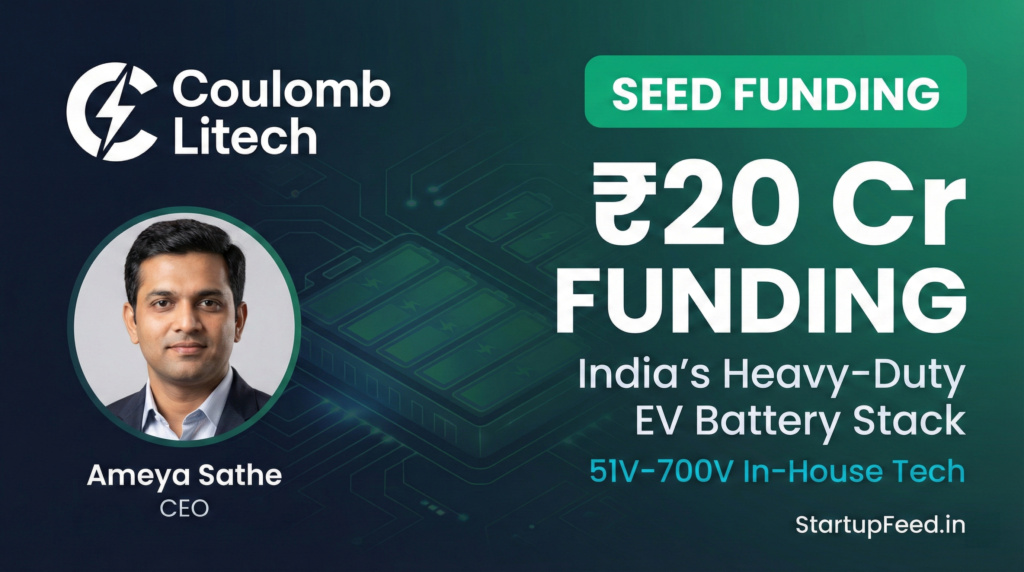
Coulomb Litech built its entire company on that gap. And on Monday, February 23, 2026, it raised ₹20 Crore (~$2.4 Mn) in seed funding to prove that India’s real electric vehicle revolution will not be won on urban roads. It will be won on construction sites, agricultural fields, and warehouse floors.
| StartupFeed Insight | ||||||||||||||||||||||||||||||||||||||||||||||||||||||||||||||||||||||||||||||||||||||||||||||||||
| Key Angle | India’s EV startup ecosystem poured capital into 2W and 3W segments for 5 years. Heavy-duty electrification — tractors, cranes, construction equipment — received a fraction of that attention despite representing a far larger diesel displacement opportunity. | |||||||||||||||||||||||||||||||||||||||||||||||||||||||||||||||||||||||||||||||||||||||||||||||||
| For Investors | The India eCV market grows at 25.6% CAGR to $38.6 Bn by 2033. Battery-as-a-component is the defensible B2B wedge: OEMs don’t want to build battery tech in-house. Coulomb’s fully integrated stack (hardware + BMS + cooling + IoT) is exactly what OEM partnerships require. | |||||||||||||||||||||||||||||||||||||||||||||||||||||||||||||||||||||||||||||||||||||||||||||||||
| For Industry | India currently has 1,70,326 heavy goods carriers registered (Apr–Nov 2025) — 419 were electric (0.25% penetration). That gap is the market. A reliable, high-voltage Indian battery supplier for this segment barely exists today. | |||||||||||||||||||||||||||||||||||||||||||||||||||||||||||||||||||||||||||||||||||||||||||||||||
| For Policy | PM E-DRIVE ($1.3 Bn) and FAME II specifically incentivise commercial EV electrification. Coulomb’s focus areas — tractors, construction equipment, E-3W — are politically visible, economically strategic, and subsidy-eligible. | |||||||||||||||||||||||||||||||||||||||||||||||||||||||||||||||||||||||||||||||||||||||||||||||||
| Prediction | By Q1 2028, Coulomb Litech will announce a Series A of ₹80–120 Cr led by a climate-tech or mobility fund, with at least 3 confirmed OEM supply agreements in tractor or construction equipment segments. | |||||||||||||||||||||||||||||||||||||||||||||||||||||||||||||||||||||||||||||||||||||||||||||||||
Company at a Glance
| Detail | Information |
|---|---|
| Company Name | Coulomb Litech Private Limited (CIN: U31909MH2020PTC346129) |
| Founded | 16 September 2020 |
| Founders | Ameya Suhas Sathe (CEO) & Darshil Atul Dharod — IIT Kanpur alumni |
| Headquarters | Mumbai, Maharashtra, India |
| Manufacturing | Panvel, Raigad (Kalamboli Node) — new facility being set up in Navi Mumbai with ₹20 Cr raise |
| Total Funding | ₹20 Crore (February 2026 seed round) + prior angel/institutional rounds |
| Investor Count | 36 investors across 2 rounds: 6 institutional investors, 30 angel investors |
| Notable Investors | Anikarth Ventures (Kanpur-based early-stage VC, 37-company portfolio) · Banyan Tree Facilities |
| Cap Table | Founders: 71.43% · Enterprises: 15.19% · Angels: 7.91% · Funds: 0.54% |
| Employees | 6 (as of July 2024) — lean team scaling post-raise |
| Website | coulomblitech.com |
Coulomb Litech was incorporated on September 16, 2020 — four years before its first institutional funding round in January 2024. That 4-year gap was not idle time. The founders spent those years building in-house: developing battery management systems, liquid cooling technology, CCS charging systems, and an IoT analytics platform without external capital. By the time investors came in, there were already commercial and pilot deployments with OEMs across India.
The Technology: What ’51V to 700V’ Actually Means
Most EV battery startups in India build for one use case: a two-wheeler pack at 48V–72V, optimised for low cost and light weight. Coulomb Litech’s voltage range — 51V to 700V — tells a fundamentally different product story.
| Specification | Value | Why It Matters for Heavy EV |
|---|---|---|
| Voltage Range | 51V to 700V | Covers everything from E-3W (51V) to heavy cranes and industrial machines (700V) |
| Capacity | Up to 80 kWh | High-energy density for extended heavy-duty cycles; modular for scalability |
| BMS | In-house developed | Automotive & industrial grade; 12V to 500V+ supported; manages safety + performance |
| Thermal System | Liquid Cooling | Critical for high-load commercial applications; prevents thermal runaway under sustained draw |
| Charging | CCS (In-house) | Fast-charging compatible; reduces downtime for fleet and OEM commercial operators |
| Analytics | IoT-enabled Platform | Real-time battery utilisation data; predictive insights for fleet operators and OEMs |
| Cell Sourcing | Tier-1 EV-grade cells | Rigorous quality control on procured cells; integrated into proprietary pack design |
| Platforms | Modular mid/high-volt | Designed for heavy-duty use; supports customisation across OEM vehicle categories |
The 700V ceiling is what separates Coulomb from 95% of Indian EV battery startups. At 700V, you can power a construction crane, a heavy-duty electric truck, or an industrial forklift — applications that require sustained high-current draw, thermal stability under extreme load, and battery packs that last a full commercial shift without degradation. That is a fundamentally harder engineering problem than a scooter pack, and it is why Coulomb’s fully in-house tech stack — rather than a bought BMS bolted onto commodity cells — is the core product moat.


The In-House Advantage
A key strength of Coulomb Litech lies in its in-house technology development. The company has built its complete battery technology stack internally — hardware, software, and algorithms — including Battery Management Systems (BMS), liquid cooling systems, CCS charging systems, and IoT-enabled analytics. This integrated approach allows Coulomb to support fast charging while extending battery life, an important requirement for commercial EV users who cannot afford multi-hour charging windows mid-shift.
For OEMs building electric tractors or construction equipment, this matters enormously. They do not want a battery supplier who assembles commodity cells into a generic pack. They want a partner who can engineer a custom solution for their specific duty cycle, torque requirements, and thermal environment — and who owns every layer of the stack to diagnose and fix problems quickly.
The Market: Why Heavy EV Is the Unplayed Hand
| Metric | Current (2024–2026) | Forecast / Context |
|---|---|---|
| India EV Market (Overall) | $8.49 Bn (2024) | $17.88 Bn by 2032 at 19.0% CAGR |
| India Electric Commercial Vehicles | $5.0 Bn (2024) | $38.6 Bn by 2033 at 25.6% CAGR |
| Heavy Goods Carrier EV Penetration | 419 units (N3 EVs, Apr–Nov 2025) | 1,70,326 total HCV registered — 0.25% EV share |
| E-LCV Penetration | 7,556 units (Apr–Nov 2025) | 2.1% EV share of 3,58,921 LCVs registered |
| India EV Charging Stations | 29,277 (July 2025) | CAGR of ~72% since FY22; PM E-DRIVE: Rs 2,000 Cr allocated |
| PM E-DRIVE Scheme | ₹10,900 Cr ($1.3 Bn) | Specifically incentivises commercial EV electrification |
| Electric Bus Stock (India) | 11,500+ (end 2024) | IEA: up from <3,000 in 2020 — rapid public fleet conversion |
| India EV Battery Mfg (PLI-ACC) | 35 GWh allocated | OLA Electric first PLI beneficiary (₹73.7 Cr, March 2025) |
The numbers tell the story starkly. From April to November 2025, India registered 1,70,326 heavy goods carriers (N3 class, GVW above 12 tons). Of those, 419 were electric — a penetration rate of 0.25%. For comparison, the EV share in light commercial vehicles was 2.1% in the same period. Heavy commercial vehicles are where electrification is furthest behind — and therefore where the battery supply opportunity is largest.
The India Electric Commercial Vehicles market was valued at $5.0 Bn in 2024 and is projected to reach $38.6 Bn by 2033 at a CAGR of 25.6%. The government’s ₹10,900 Crore PM E-DRIVE scheme specifically targets commercial EV electrification — creating demand-side pull for exactly the kind of battery technology Coulomb is building.
Globally, the trend is clear. UltraTech Cement has ordered 100 electric trucks for a 400 km route. Ashok Leyland increased production capacity after receiving orders for 180 electric trucks from Billion E-Mobility, including models at 55-tonne GVW. The heavy EV market is not emerging. It is arriving.
Use of ₹20 Crore Funds
| Use of ₹20 Crore Funds | Strategic Intent |
|---|---|
| Manufacturing Plant (Navi Mumbai) | State-of-the-art facility to scale battery pack production; stringent QC integration |
| R&D Enhancement | Improve product reliability, safety & performance consistency under demanding heavy-duty conditions |
| Pilot Program Expansion | Scale ongoing pilots in electric tractors, cranes, material handling equipment, E-3W vehicles |
| OEM Partnership Development | Deepen collaborations with OEM partners and fleet operators across commercial EV use cases |
| Business Expansion | Geographic and vertical coverage; positioning as preferred battery tech partner for OEM electrification programs |
The capital deployment strategy reflects a company at the inflection point between R&D-led and manufacturing-led growth. The Navi Mumbai facility is the central piece — translating Coulomb’s in-house technology into production-grade, quality-controlled battery packs at the volumes OEM partnerships require. Without manufacturing scale, the technology moat is an academic exercise.



Competitive Landscape
| Player | Focus Segment | Scale/Funding | Vs. Coulomb Litech |
|---|---|---|---|
| Coulomb Litech | Heavy EV (tractors, cranes, E-3W, construction) | In-house full stack | IIT Kanpur alumni; 51V–700V; modular |
| Battery Smart | 2W/3W urban last-mile (battery swapping) | $33 Mn+ raised | B2C swapping network; not heavy-duty |
| Exide Energy | Passenger + commercial (broad) | ₹299 Cr invested (Jan 2025) | Legacy; Hyundai/Kia MoU; not deep-tech B2B |
| Agratas (Tata) | Large-scale manufacturing (20 GWh plant, Gujarat) | Tata Group | Gigafactory scale; not startup-agile OEM partner |
| Geon (Battrixx) | EV batteries + energy storage | ₹300 Cr allocated | Broad positioning; Chakan, Pune facility |
| Propel Industries | Heavy off-road electric dump trucks | Revenue-stage | Truck OEM; different to battery-tech supplier play |
Coulomb’s differentiation is structural, not incremental. Battery Smart addresses urban 2W/3W swapping. Exide and Geon (Battrixx) are broad-base manufacturers without deep OEM customisation capability. Agratas and Reliance are gigafactory players operating at a different scale and business model entirely. The specific wedge — modular, high-voltage, fully integrated battery systems engineered for heavy-duty commercial OEM applications — is where Coulomb sits largely alone in the Indian startup ecosystem as of February 2026.
Who Should Be Watching
| Stakeholder | Why This Matters |
|---|---|
| Electric tractor OEMs(Sonalika, Mahindra, Escorts/Kubota) | India has 600M+ hectares of farmland. Electric tractors are nascent but strategically critical — the right battery partner for a major tractor OEM could define Coulomb’s Series A story. |
| Construction equipment majors(JCB India, CASE, Escorts Construction) | India’s infrastructure push — roads, ports, airports under PM Gati Shakti — requires fleets of cranes, excavators, and loaders. Diesel is expensive; electrification is inevitable; a reliable Indian battery supplier is the gap. |
| Material handling and warehousing(Amazon, Flipkart, Mahindra Logistics) | India’s e-commerce logistics boom has created massive demand for electric forklifts and pallet movers. These are exactly in Coulomb’s 51V–350V sweet spot with predictable charge cycles. |
| Government fleet programs(PM E-DRIVE, FAME II beneficiaries) | Any E-3W fleet operator or state transport authority accessing PM E-DRIVE incentives needs a compliant battery supplier. Coulomb’s deployments in E-3W make this the clearest near-term revenue channel. |
| Climate-tech VCs(Venture Catalysts, Avaana Capital, Acumen) | The Indian deep-tech EV battery space at Seed stage is underfunded relative to the market size. A ₹20 Cr raise with IIT Kanpur founders and OEM deployments already live is a compelling Series A prospect for sector-focused funds. |
Key Risks to Watch
| Risk Factor | Why It Matters |
|---|---|
| China supply chain dependency | India’s battery firms remain reliant on China for key cells and components. PLI-ACC disbursements have been slow — Coulomb sources tier-1 cells externally, creating cost and supply risk. |
| Heavy EV adoption is early-stage | N3 (HCV) EV penetration was 0.25% Apr–Nov 2025. Fleet buyers are cautious due to battery degradation fears, thermal performance in extreme conditions, and limited long-term performance data. |
| Thin team at scale | 6 employees (July 2024) building full-stack hardware, software, BMS, and cooling is ambitious. Post-raise hiring velocity will determine whether technical quality is maintained at manufacturing scale. |
| Long OEM sales cycles | Commercial EV OEM partnerships involve rigorous qualification, field trials, and extended procurement timelines. The gap between technology readiness and signed supply agreements can be 18–36 months. |
| Well-capitalised large-format rivals | Tata’s Agratas, Reliance’s gigafactory (30 GWh), and Exide’s energy division are all entering the space with orders-of-magnitude more capital. Coulomb’s moat is agility and OEM customisation, not scale. |
What’s Next
The ₹20 Crore raise buys Coulomb Litech 18–24 months of focused execution time. The Navi Mumbai manufacturing facility is the critical deliverable — without production-grade capacity, pilot programs cannot scale into commercial supply agreements. The company’s sequencing is correct: build the plant, deepen the OEM pilots, demonstrate performance data under real-world heavy-duty conditions, then raise a Series A with revenue and supply contracts to show.
India’s infrastructure story — roads, ports, airports, warehouses — is a decade-long capital allocation theme. Every tonne of material moved, every acre ploughed, every warehouse pallet shifted will increasingly be powered by electric systems. The question is not whether India’s heavy commercial sector electrifies. The question is who builds the batteries.
Coulomb Litech, with six employees, ₹20 Crore, and a fully in-house battery tech stack built by IIT Kanpur engineers, is making its answer very clear.
Is Coulomb Litech the dark horse of India’s commercial EV revolution? Tell us your take on Twitter @StartupFeed_in
Liked this story? Follow StartupFeed on Google so our reporting reaches you first.