Quick Take
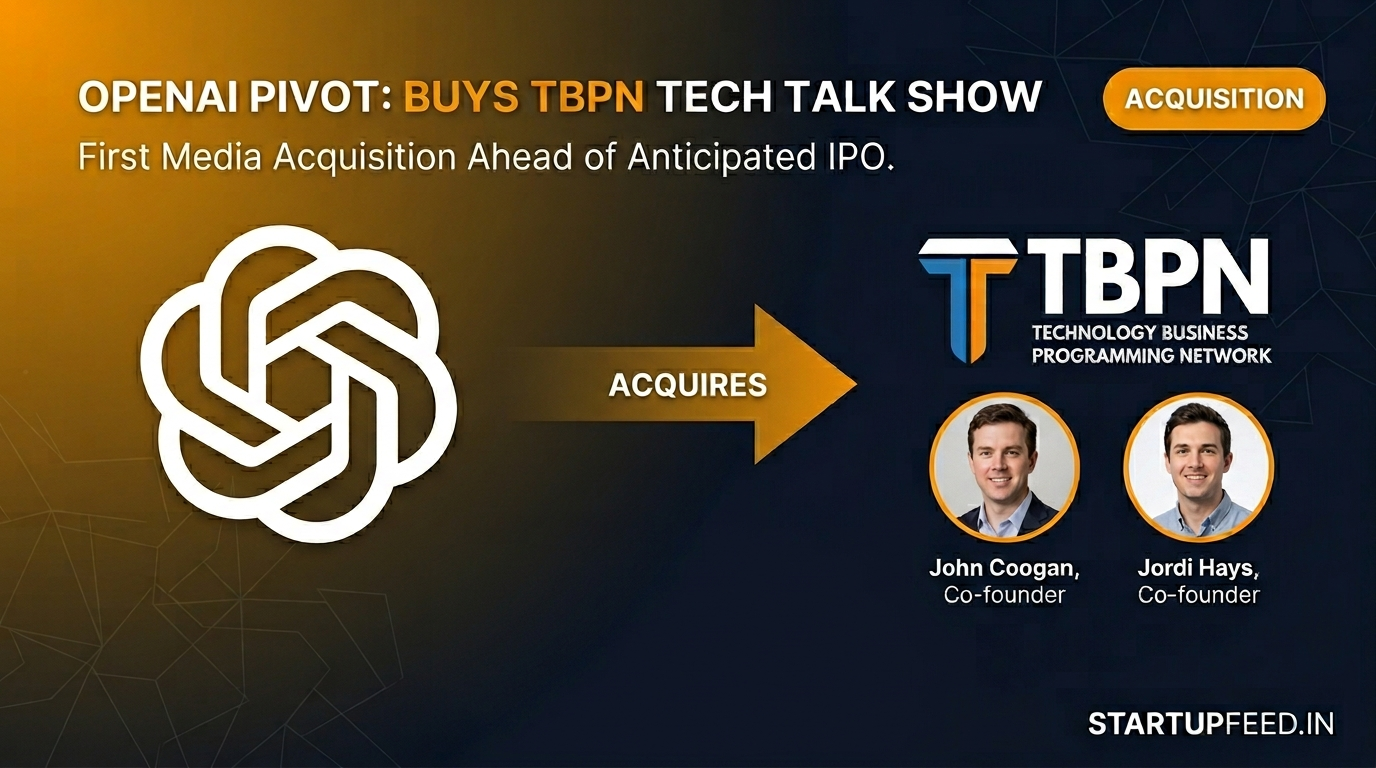
- Deal: OpenAI acquires TBPN (Technology Business Programming Network)
- Value: Low hundreds of millions (exact terms undisclosed), per Financial Times
- Revenue Multiple: ~10x on 2025 ad revenue of $5 Mn; ~3x on projected 2026 revenue of $30 Mn
- Rationale: Shape public conversation on AI; augment OpenAI’s communications strategy pre-IPO
- Closure: Deal announced April 2, 2026; financial close timeline not disclosed
OpenAI has acquired TBPN (Technology Business Programming Network), a daily Silicon Valley tech talk show hosted by former tech founders John Coogan and Jordi Hays, in a deal valued in the low hundreds of millions of dollars — marking the AI giant’s first-ever acquisition of a media company and a sharp pivot into narrative control ahead of its anticipated IPO.
This positions OpenAI to directly shape how artificial intelligence is discussed, debated, and understood — something neither a press release nor a PR firm can replicate. With TBPN averaging 70,000 viewers per daily episode among the most influential founders, investors, and executives in tech, OpenAI has effectively purchased a direct line to Silicon Valley’s decision-makers at a pivotal moment in the company’s history.
StartupFeed Insight
The real story: This is not a media investment — it’s a narrative infrastructure play by a company heading into an IPO while facing a high-profile lawsuit, regulatory scrutiny, and intensifying competition from Anthropic and Google.
Winner: OpenAI, which now owns a daily platform where the world’s most powerful tech executives speak candidly — and where OpenAI’s own story will be told day after day, 15 hours a week.
Loser: TBPN’s perceived editorial independence. The show sits inside OpenAI’s strategy organization, reporting directly to Chris Lehane — a veteran political operative described by critics as a master of “crisis communications” and the architect of the crypto industry super PAC Fairshake. Whatever the contractual guarantees, that reporting structure will raise questions with every TBPN broadcast.
What to watch: Whether TBPN’s first genuinely critical segment on OpenAI’s safety practices, model failures, or IPO valuation actually airs — and whether it does so with the same unfiltered sharpness the show had as an independent outlet.
Deal Structure
| Component | Amount |
|---|---|
| Cash / Stock | Undisclosed (reported: low hundreds of millions, per FT) |
| Earnout | Not disclosed |
| Total | Low hundreds of millions |
TBPN’s advertising business — which generated $5 Mn in 2025 and was projected to exceed $30 Mn in 2026 — will be wound down as part of the acquisition. The show’s 11-person team, led by Coogan, Hays, and president Dylan Abruscato, will remain intact. Law firm Eisner LLP represented TBPN in the transaction.
Strategic Rationale
OpenAI did not buy TBPN for its subscriber count. With 58,000 YouTube subscribers, the show is not a mass-media property. What it owns is something harder to build: credibility with the builders.
Fidji Simo, OpenAI’s CEO of Applications and the executive who announced the deal internally, was direct in her staff memo: “The standard communications playbook just doesn’t apply to us. We’re not a typical company. We’re driving a really big technological shift.” The acquisition, she argued, gives OpenAI a space for “real, constructive conversation about the changes AI creates – with builders and people using the technology at the center.”
Sam Altman, who has appeared on TBPN multiple times and called it his “favorite tech show” on X, framed it differently: “I don’t expect them to go any easier on us, am sure I’ll do my part to help enable that with occasional stupid decisions.” That self-deprecating framing is intentional — it signals to the market that the show’s independence will be protected, while also humanizing Altman ahead of one of the most watched IPOs in tech history.
Jordi Hays, TBPN’s co-founder, offered the clearest articulation of why the founders agreed to sell: “Moving from commentary to real impact in how this technology is distributed and understood globally is incredibly important to us.”
Target Snapshot
| Metric | Value |
|---|---|
| Founded | October 2024 |
| Live Streaming Debut | March 2025 |
| Employees | 11 |
| Daily Viewers (avg per episode) | ~70,000 across platforms |
| YouTube Subscribers | 58,000 |
| Ad Revenue (2025) | ~$5 Mn |
| Projected Revenue (2026) | $30 Mn+ |
| Profitability | Self-reported profitable |
| Sponsors | Ramp, Plaid, Google Gemini, New York Stock Exchange |
| Notable Guests | Mark Zuckerberg (Meta), Satya Nadella (Microsoft), Marc Benioff (Salesforce), Sam Altman (OpenAI) |
TBPN airs weekdays from 11 a.m. to 2 p.m. PT across YouTube, X, Spotify, and Apple Podcasts. The New York Times described it in an October 2025 profile as “Silicon Valley’s newest obsession.” The show originally launched as “Technology Brothers” — a self-aware nod to the “tech bro” put-down — before rebranding.
Valuation Analysis
A deal in the “low hundreds of millions” implies a multiple of roughly 3x–6x projected 2026 revenue of $30 Mn, depending on where in that range the deal landed. For context, traditional media companies trade at 1x–2x revenue. For a fast-growing, founder-led media brand with direct access to the most influential audience in tech, a premium is defensible — but only if editorial independence holds. The moment TBPN softens its coverage of OpenAI, that audience credibility — and therefore the asset’s value — begins to erode.
There is also a strategic optionality argument. TBPN’s hosts have demonstrated what OpenAI described as “amazing comms and marketing instincts.” Simo’s memo indicates OpenAI plans to tap that talent well beyond the show itself, deploying Coogan and Hays to help shape how AI products are launched and explained to the public.
Competitive Impact
| Competitor / Observer | Why This Matters |
|---|---|
| Anthropic | Loses neutral ground: TBPN was a venue where both OpenAI and Anthropic received airtime; future guest access may feel asymmetric |
| Google DeepMind | Similarly exposed — a key distribution channel for AI news is now inside a direct competitor |
| Bloomberg / CNBC | TBPN openly positions itself as a rival to traditional tech media; OpenAI’s backing could accelerate audience growth and threaten legacy business media’s tech credibility |
| Spotify / YouTube | As TBPN’s distributor-partners, they now have an OpenAI-owned show on their platforms — creating a novel conflict if OpenAI’s AI tools compete with their own discovery algorithms |
What’s Next
OpenAI is heading into a 2026 IPO and a high-profile lawsuit with Elon Musk going to trial this month. The timing of the TBPN acquisition is not coincidental. A daily show with 70,000 tech-native viewers, where OpenAI’s CEO is a frequent guest and the content is broadly favorable to the builder culture OpenAI embodies, is worth more than any advertising campaign in this environment.
The key question is not whether TBPN will keep its editorial independence in spirit — it’s whether the market will believe it. One genuinely critical segment that airs without interference would do more for TBPN’s long-term credibility than any contractual guarantee. Conversely, one pulled story or softened question would unwind years of trust in a news cycle.
OpenAI has bought the microphone. What it says into it — and what it lets TBPN say about it — will define whether this was a smart acquisition or a very expensive reputational liability.
What do you think? Can a media brand stay editorially independent once it’s owned by the company it covers? Share your view on X @StartupFeed_official