


QUICK TAKE (30-Second Read)
- Policy: PM Modi’s Budget 2026-27 Post-Budget Webinar — “Sustaining and Strengthening Economic Growth”
- Authority: Prime Minister’s Office — addressed second webinar of Budget 2026-27 series on March 3, 2026
- Affects: All Indian industry — particularly startups in manufacturing, biotech, cleantech, and MSMEs
- Effective: Policy signals operative from Budget 2026-27; schemes already announced and funded
- Key Change: R&D spending must scale; quality non-negotiable to exploit FTA opportunities
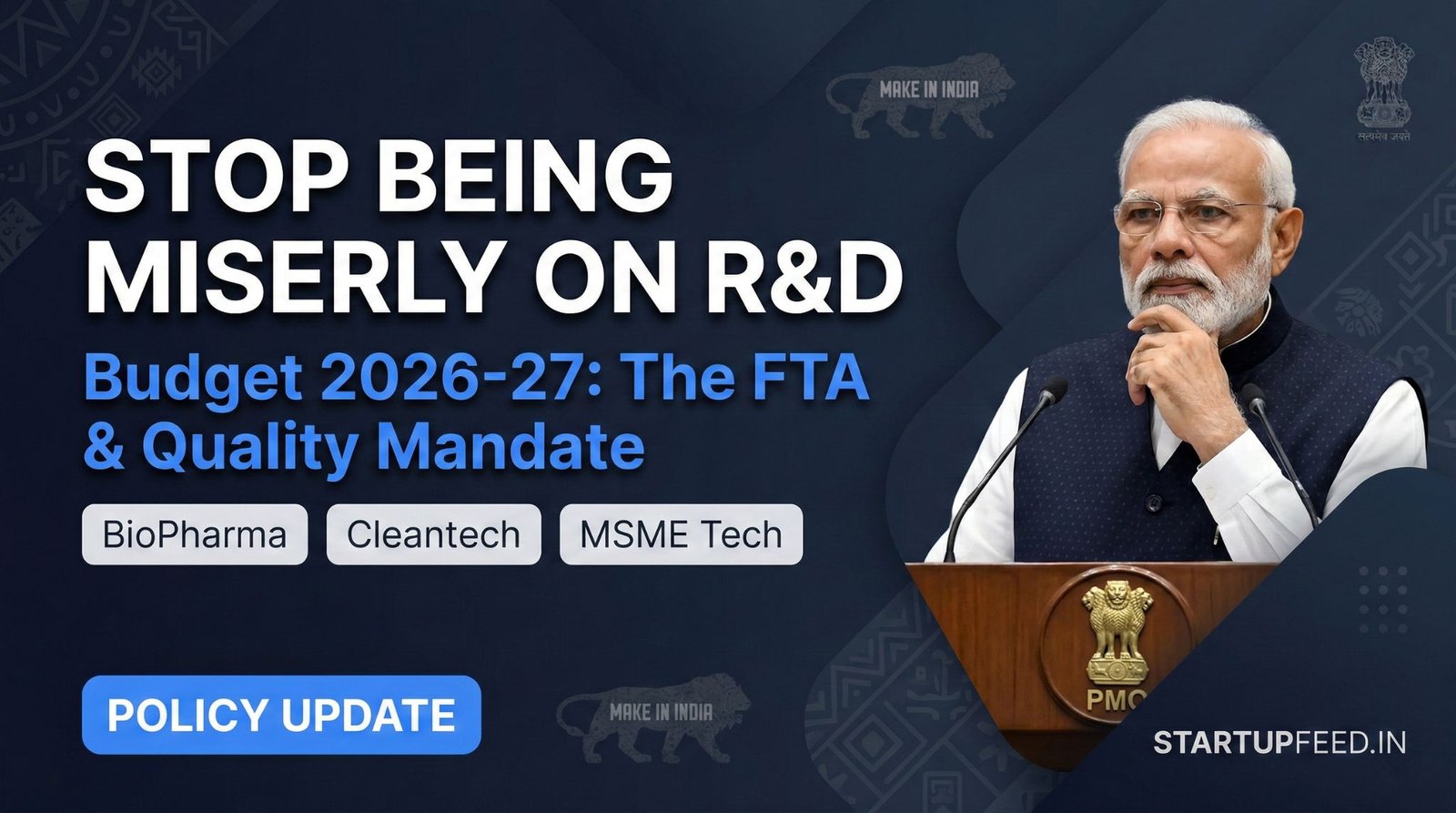
Prime Minister Narendra Modi delivered a sharp directive to Indian industry on March 3, addressing the second post-Budget 2026-27 webinar: the era of frugal R&D is over, free trade agreements have opened a window that will not stay open forever, and quality must become the non-negotiable standard — with his three-word mantra making the point with characteristic force: “Quality, Quality, Quality.”
The webinar signals a government pivot from infrastructure-first to exports-first thinking. With India having signed FTAs with the European Union and several other nations, the message to startups and MSMEs is unambiguous: the policy framework is in place, the markets are accessible — now execution, quality, and R&D investment are the only variables left under industry’s control.
StartupFeed Insight
What this means: Modi’s “stop being miserly on R&D” is not rhetorical — it is a direct response to India’s R&D-to-GDP ratio languishing at around 0.65%, compared to 2–4% in major manufacturing economies. The government is signalling it will not keep subsidising low-quality, volume-based production. The FTA window demands Indian products compete on quality in EU, UK, and emerging-market channels — or cede that ground to competitors.
Winners:
D2C and export-focused manufacturing startups that have already built quality-first supply chains — FTAs give them tariff-free access to 50+ countries
Biotech and biopharma startups aligned to the BioPharma Shakti Mission — government backing for biologics and next-gen therapies is now explicitly in the Budget
Cleantech ventures building carbon-capture or clean energy solutions — sustainability is now a stated market-access condition, not a CSR box
Losers:
Legacy manufacturers relying on cost arbitrage alone — FTA markets demand quality compliance that undercuts the cheap-but-low-quality playbook
MSMEs that remain informal and resisting digitalisation — Modi explicitly said results will only materialise when MSMEs “actively compete with the aim of winning”
Action required:
Startups in manufacturing and export sectors: Audit R&D spend vs revenue — close the gap to global benchmarks before FTA compliance and partner expectations force the issue
MSME-adjacent platforms and lenders: Credit and tech upgrade demand from small enterprises will accelerate — position products accordingly
Biotech founders: DPIIT and DBT registrations for BioPharma Shakti Mission benefits — move within Q1 FY27 before early-mover window closes
What’s New: Five Key Directives
The Budget 2026-27 webinar was not a legislative announcement — it is a strategic signal from the PM to industry. The five directives that matter most:
| Directive | Old Position | New Signal | Impact on Startups |
| R&D Investment | Low private sector R&D (0.65% of GDP); government-subsidised research dominant | Industry must self-fund R&D; days of being frugal are over | High: forces product-led differentiation; can no longer compete on cost alone |
| Quality Standards | “Good enough” domestic quality accepted; FTA compliance often bypassed | Global quality standards are mandatory — no compromises | High: compliance costs rise; but opens EU, UK, and ASEAN export markets |
| FTA Utilisation | Most FTAs underutilised due to rules-of-origin complexity and quality gaps | Industry must study consumer preferences in partner countries and build for them | Medium-High: consumer research and product localisation become strategic priorities |
| Sustainability / Cleantech | Sustainability as compliance or CSR only | Carbon Capture Mission launched; clean technology = market access lever | Medium: early-movers in cleantech gain preferential market access globally |
| MSME Modernisation | Classification reforms done; credit access improving | Now MSMEs must compete — productivity, digital, quality, global value chains | High for MSME-serving startups: B2B SaaS, fintech, logistics tech demand rises |
Budget 2026-27: Key Missions Highlighted
| Mission / Initiative | Objective | Sector Opportunity for Startups |
| BioPharma Shakti Mission | Position India as global hub for biologics and next-generation therapies; advance biopharma research and manufacturing | Biotech, drug discovery, clinical CROs, cold chain logistics, medtech |
| Carbon Capture, Utilisation and Storage Mission | Integrate sustainability into industrial strategy; enable India’s industries to access new markets via green credentials | Cleantech, carbon accounting SaaS, industrial AI, ESG reporting platforms |
| Dedicated Rare Earth Corridors | Strengthen domestic rare earth processing and trade ecosystem | Battery tech, EV supply chain, advanced materials, defence tech |
| Container Manufacturing Push | Reduce import dependency on shipping containers; boost logistics ecosystem | Port tech, logistics SaaS, supply chain optimisation, trade finance |
| Record Capital Expenditure (Infra) | High-speed rail corridors, multi-modal connectivity, ship repair, freight corridors, waterways | Logistics, construction tech, mobility, smart city platforms |
Who’s Affected and How
| Sector | Impact | Why |
| Biotech / Biopharma startups | Strongly Positive | BioPharma Shakti Mission provides direct Budget backing; government procurement and export support expected |
| Cleantech / Climate startups | Strongly Positive | Carbon Capture Mission + sustainability-as-market-access signal = government validation of the sector’s commercial case |
| D2C export brands | Positive | FTA-driven tariff reductions make Indian brands price-competitive abroad — but only if quality passes EU/UK standards |
| Manufacturing-tech / Industry 4.0 SaaS | Positive | R&D mandate means factories will need tech solutions to innovate; demand for automation, quality management, R&D tools rises |
| MSME-focused fintech and B2B SaaS | Positive | Modi’s MSME push — credit access, digital adoption, tech upgrades — means B2B spending in this segment will grow |
| Logistics and supply chain tech | Positive | Record capex on rail, ports, freight corridors creates infrastructure tailwind for logistics-layer startups |
| Legacy volume manufacturers (non-tech) | Negative | FTA quality mandates and R&D expectations directly challenge low-cost, low-quality business models |
| Informal / unregistered MSMEs | Neutral-Negative | Classification reforms help registered players; those outside the formal system remain excluded from FTA benefits |
What the PM Said — and What It Really Means
“The days of cutting corners in research are over. We must now make substantial investments in research and development and ensure that our products meet global quality standards.”
— PM Narendra Modi, Budget 2026-27 Webinar, March 3, 2026
Read between the lines: India’s current private R&D spend is a fraction of what China, South Korea, or Germany invest relative to GDP. This is a direct call-out of that shortfall. The phrase “cutting corners” is unusually blunt for a PM address — it signals that the government is no longer willing to absorb the cost of industry’s under-investment through subsidy and protection.
“Build more, produce more, connect more — and now the need is to export more.”
— PM Narendra Modi, Budget 2026-27 Webinar, March 3, 2026
The four-part mantra is a policy sequence: Build (manufacturing capacity) → Produce (scale output) → Connect (infrastructure and logistics) → Export (realise FTA value). Each stage has dedicated Budget allocations. For startups, “connect” and “export” are the two stages where technology can compress timelines significantly — logistics SaaS, trade finance, and export compliance platforms are the direct beneficiaries.
“Industries that invest in clean technologies in a timely manner will be able to build better access to new markets in the coming years.”
— PM Narendra Modi, Budget 2026-27 Webinar, March 3, 2026
“Timely manner” is the operative phrase — the EU Carbon Border Adjustment Mechanism is already live, and several FTA partners are moving toward mandatory carbon disclosure for imported goods. This is not aspirational sustainability talk; it is a commercial warning. Indian exporters that don’t adopt clean technology will face tariff penalties and market exclusion in the world’s richest trading blocs within 3–5 years.
Action Items for Startups and Founders
If you’re a manufacturing or D2C export startup:
☐ Audit your product’s quality certifications against EU, UK, and ASEAN import standards — identify gaps before FTA partners flag them (by Q2 FY27)
☐ Map your R&D spend as a % of revenue — if it’s below 3%, build a case for board approval to increase it (Q1 FY27)
☐ Register for DPIIT’s FTA utilisation support programmes and study tariff schedules for your top 3 target export markets (within 60 days)
If you’re a biotech or pharma startup:
☐ Apply for BioPharma Shakti Mission benefits through DBT/DPIIT — early cohort selection expected in Q2 FY27
☐ Align product pipeline with biologics or next-gen therapy categories that the mission prioritises for government procurement preferences
If you’re a cleantech or climate startup:
☐ Position Carbon Capture, Utilisation and Storage Mission alignment in investor decks and government BD conversations — Budget backing makes this a policy priority, not just an ESG theme
☐ Start EU CBAM compliance preparation if you serve industrial clients — January 2026 reporting obligations are already live for EU importers
If you’re an MSME-focused B2B startup:
☐ Modi’s explicit push for MSME digitalisation, credit access, and tech upgrades signals a budget-cycle demand surge — accelerate sales outreach to MSME clients in Q1 FY27
☐ Align your product messaging to the government’s “quality standards + global value chain integration” narrative — it resonates with MSME customers now more than ever
Industry Reaction
The webinar drew large-scale virtual participation from industry associations, founders, and state government representatives. The PM himself described it as “a very successful experiment” in collaborative governance. While no specific industry body statements were released at press time, the consensus from trade observers is that the combination of FTA tailwinds, record capex, and the BioPharma Shakti Mission represents the most comprehensive industrial policy signal from the PMO since the PLI scheme launches of 2021.
The R&D mandate, however, drew private scepticism from some MSME operators who note that access to patient capital for R&D remains limited outside Tier I cities and that “quality, quality, quality” is easier to mandate than to fund. The real test will be whether the Budget’s credit-access reforms translate into R&D-linked lending products from banks and NBFCs within FY27.
What’s Next
Our prediction: India’s biotech and cleantech funding rounds will reference BioPharma Shakti Mission and the Carbon Capture Mission as policy tailwinds in pitch decks within 90 days — and the first government-backed grants under these missions will be announced by Q2 FY27. The R&D mandate will take 18–24 months to show up meaningfully in private sector capex data, but the signals from large conglomerates (Tata, Reliance, Mahindra) will come faster.
The EU FTA — cited by Modi as a priority vehicle for MSMEs — will produce the sector’s sharpest test. Indian exporters that cannot meet EU product standards and sustainability disclosures will lose market share to Vietnamese and Bangladeshi competitors despite the tariff advantage. The government has opened the door; quality is the key.
The real question for India’s startup ecosystem is whether the R&D mandate triggers a structural shift in how VC and PE funds evaluate R&D intensity as a valuation driver — or whether it remains a PM-level aspiration that doesn’t reach startup board rooms