


Quick Take
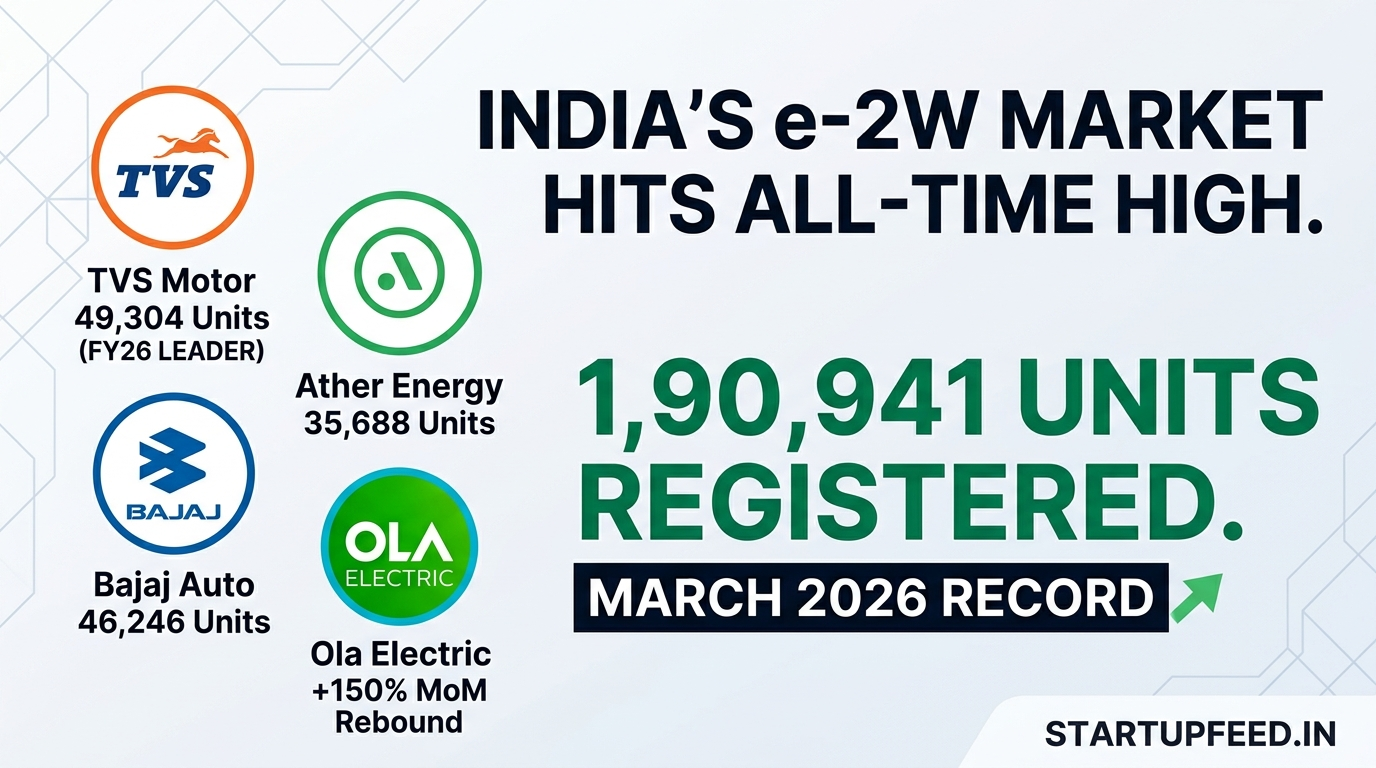
- Record:1,90,941 units registered in March 2026 — highest ever single month
- Leader:TVS Motor at 49,304 units (26% share) — its best month ever
- Fastest Riser:Ola Electric surges 150%+ MoM to 10,117 units after near-collapse
- Catalyst:PM E-Drive subsidy extension + Gudi Padwa demand + global oil crisis
- FY26 Total:1.4 million units — a new annual record, up 17.3% YoY
India’s electric two-wheeler market registered a record 1,90,941 units in March 2026, marking a 45% year-on-year surge over March 2025 — the segment’s highest-ever monthly tally and a milestone that closes FY2026 with 1.4 million cumulative units, up from 1.15 million in FY25.
This positions India’s e-2W segment at an inflection point. With legacy manufacturers TVS, Bajaj, Ather, and Vida each posting their best-ever monthly numbers, the market’s centre of gravity has decisively shifted from EV-native startups to established OEMs — a structural change that will define competitive dynamics for the next three years.
StartupFeed Insight
What the numbers say:Legacy OEMs now control over 85% of India’s EV 2-wheeler market — a complete reversal from 2022, when Ola Electric alone commanded 35%+ share. The consolidation happened faster than most analysts predicted.
What this means for you:
- If you’re a founder: The EV 2W window for new entrants is effectively closed — distribution depth and brand trust now outweigh product innovation alone
- If you’re an investor: Ather Energy’s 128% YoY growth with 40% unused production capacity signals the most compelling scale-up story in the segment right now
- If you’re an employee at Ola: The 150% MoM rebound is real, but FY26 annual sales fell 52% YoY — the recovery needs to sustain for 3+ consecutive months before it signals a true turnaround
Our prediction: TVS will cross 6 lakh annual EV units by FY27, cementing its position as India’s undisputed EV 2W leader. Ola Electric will stabilise between 12,000–15,000 units/month by Q2 FY27 but will not reclaim its FY25 market share position before FY28.
March 2026 Leaderboard
| Rank | OEM | March 2026 Units | YoY Change | Market Share |
| 1 | TVS Motor | 49,304 | +60% | 26% |
| 2 | Bajaj Auto | 46,246 | +31% | 24% |
| 3 | Ather Energy | 35,688 | +128% | 19% |
| 4 | Hero Vida | 21,434 | +128% | 11% |
| 5 | Ola Electric | 10,117 | -57% YoY / +150% MoM | 5.3% |
| 6 | Greaves Electric | 7,965 | +41% | 4.2% |
| 7 | River Mobility | 4,100+ | +417% | 2.1% |
| 8 | Bgauss Auto | ~3,700 | +42% | 1.9% |
| 9 | Simple Energy | 1,744 | +352% | 0.9% |
| 10 | E-Spring Green Energy | 1,744 | +727% | 0.9% |
| — | Top 10 Combined | 1,81,834 | — | 95% |
| — | Industry Total | 1,90,941 | +45% YoY | 100% |
What Drove the Record?
Three forces converged in March 2026 to produce the all-time high.
Fiscal year-end demandis always a tailwind, but March 2026 had amplifiers. Gudi Padwa and Ugadi — the Maharashtrian and South Indian new years — fell on March 19, driving a single-day surge in Maharashtra and Karnataka, India’s two largest EV markets. Dealers across brands offered limited-period discounts, exchange benefits, and zero-cost EMI schemes to clear inventory before FY-end.
The PM E-Drive extensionwas the policy catalyst. The government’s Rs 10,900 Cr EV incentive scheme was set to expire March 31, 2026. Four days before the deadline, the Ministry of Heavy Industries extended e-2W subsidies to July 31, 2026 — albeit with reduced incentive amounts. The announcement triggered a last-minute buying rush from fence-sitters who feared losing the subsidy entirely.
The global oil crisisprovided the macro tailwind. Ongoing geopolitical tensions in West Asia have disrupted crude oil supply chains, pushing petrol prices higher and accelerating the economic case for EV adoption. Consumers who had been evaluating EVs for 6–12 months finally pulled the trigger.
The TVS Story: How iQube Became India’s EV Juggernaut
TVS Motordelivered 49,304 e-scooters in March — comprising the iQube, X, and the newly launched Orbiter — beating its previous monthly best of 34,791 units set in January 2026 by 42%. The 60% YoY growth cements TVS as FY26’s annual leader with 3,30,145 units, overtaking Ola Electric which had led FY25.
The March surge was partly engineered. On March 12, TVS rolled out Battery-As-A-Service (BaaS) across its entire EV portfolio, offering a flexible ownership model that dramatically lowered the entry price. The new Orbiter V1 launched at Rs 49,999 under BaaS — making it one of the most affordable e-scooters in the market. TVS’s wide dealer network across Tier-2 and Tier-3 cities gave it a structural advantage that pure-play EV brands cannot easily replicate.
Bajaj’s Single-Product Dominance
Bajaj Autoachieved 46,246 units with a single product — the Chetak e-scooter — beating its previous monthly best of 35,215 units. The Chetak’s all-metal body and Bajaj’s 6,000+ dealer network have made it the default choice for buyers prioritising build quality and after-sales reliability. Bajaj recently launched the entry-levelChetak C2501at Rs 91,399, expanding its addressable market downward. FY26 annual sales stand at 2,76,518 units — a 43.2% YoY increase.
Ather’s Breakout and Vida’s Emergence
Ather Energyposted 35,688 units — its first-ever 30,000+ month — driven by the Rizta family scooter, which cracked the mass-market code that the 450X couldn’t. The 128% YoY growth is the most impressive in the top 5, and Ather’s 40% unused production capacity means it can scale further without capex. FY26 total: 2,29,565 units.
Hero Vidaat 21,434 units (+128% YoY) is the segment’s fastest-growing large player. The Vida VX2’s removable battery — a practical feature for apartment dwellers without dedicated charging — has resonated strongly in smaller cities where Hero’s distribution is unmatched.
Ola’s V-Shaped Rebound — Real or Temporary?
Ola Electric’sMarch story is the most complex. The 10,117 units represent a 150%+ month-on-month recovery from February’s 3,973 units — and Ola became the first EV brand in India to cross 1 million cumulative VAHAN registrations. Daily orders crossed 1,000 units in the last week of March, with the company citing operational fixes in service delivery as the key driver.
But the year-on-year picture tells a different story: March 2026’s 10,117 units is a 57% decline from March 2025’s 23,634 units. FY26 annual sales of 1,64,294 units represent a 52% YoY collapse from FY25’s market-leading position. Ola is the only OEM in the top 10 to register a YoY sales decline.
The service quality issues that plagued Ola through 2025 — long wait times, unresolved complaints, software glitches — appear to be improving. Over 80% of vehicles are now reportedly serviced same-day. Whether this operational fix translates into sustained demand recovery or was a one-month fiscal year-end blip will be answered by April and May 2026 numbers.
FY26 Annual Standings: The New Hierarchy
| OEM | FY26 Units | YoY Change | FY25 Rank → FY26 Rank |
| TVS Motor | 3,30,145 | +48.2% | #2 → #1 |
| Bajaj Auto | 2,76,518 | +43.2% | #3 → #2 |
| Ather Energy | 2,29,565 | +83.9% | #4 → #3 |
| Ola Electric | 1,64,294 | -52% | #1 → #4 |
| Hero Vida | ~1,20,000 | +140.7% | #5 → #5 |
Who Should Be Watching?
| Player | Why This Matters |
| Ola Electric | TVS’s BaaS model at Rs 49,999 directly undercuts Ola’s entry-level pricing — Ola must respond with a comparable ownership model or risk permanent share loss in the sub-Rs 1 lakh segment |
| Honda/Yamaha/Suzuki | Japanese OEMs have been slow to enter India’s EV 2W market; with TVS and Bajaj now at 50,000 units/month, the window to enter at scale is narrowing rapidly |
| Ather Energy investors | The IPO-bound company’s 128% YoY growth and 40% spare capacity make it the most attractive pure-play EV listing candidate in India — watch for DRHP filing in H1 FY27 |
| Petrol scooter makers | Honda Activa sold 5.49 lakh units in March 2026 — but the EV segment’s 45% YoY growth rate means e-2Ws could match ICE scooter volumes within 24–30 months |
What’s Next
The PM E-Drive subsidy extension to July 31, 2026 — with reduced incentive amounts — will test whether demand is genuinely organic or still subsidy-dependent. If April and May 2026 numbers hold above 1.5 lakh units without the fiscal year-end tailwind, it confirms that India’s EV 2W adoption has crossed the tipping point.
TVS’s BaaS rollout is the most strategically significant move of the quarter. If Battery-As-A-Service achieves mainstream adoption — as it has in China — it could compress the effective purchase price of EVs by 30–40%, making the ICE-to-EV switch a no-brainer for the 70 million annual two-wheeler buyers in India.

