


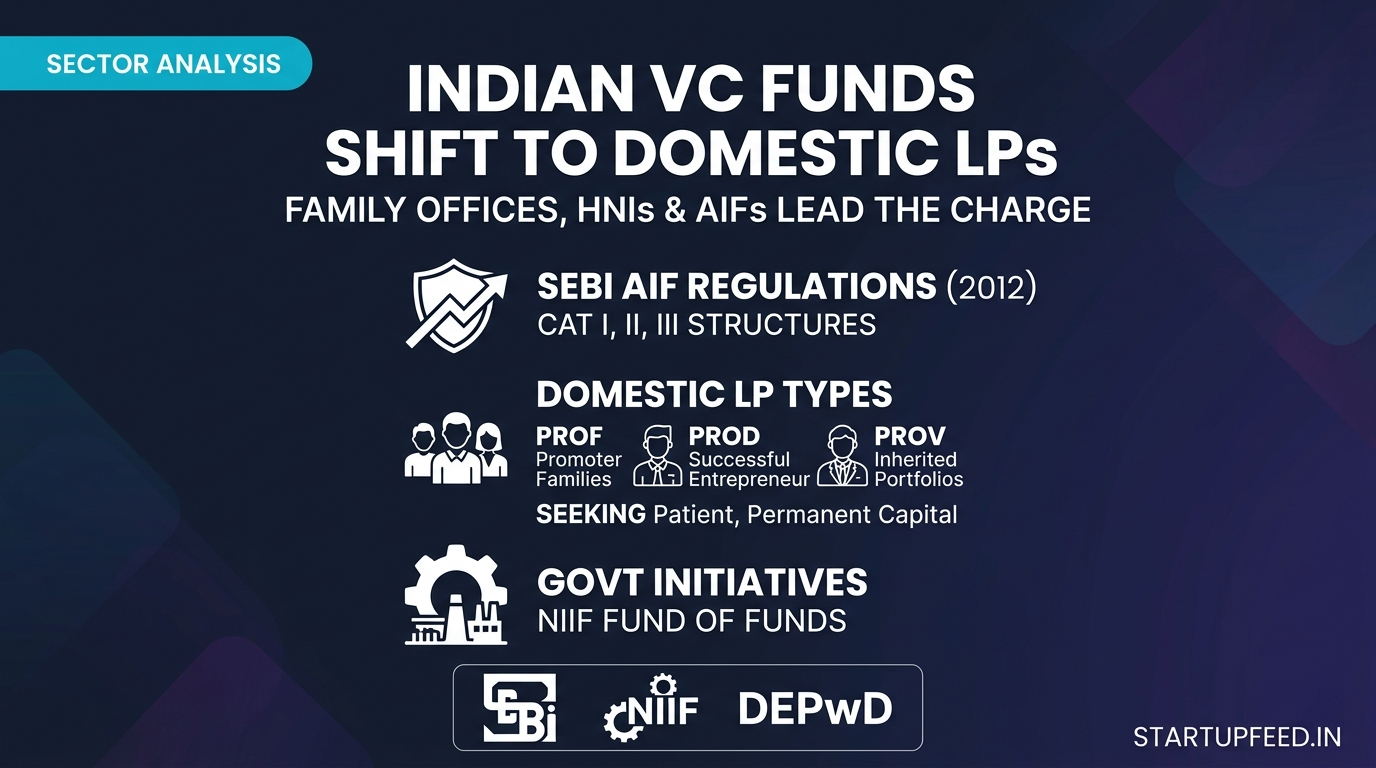

QUICK TAKE:
|
|
|
|
|
India’s venture capital fundraising environment is undergoing a structural reset. For fund managers who built their LP bases on foreign institutional commitments — US endowments, European pension funds, and sovereign wealth vehicles — the past two years have exposed the fragility of that dependency. The answer they are finding is closer to home: Indian family offices, high-net-worth individuals (HNIs), and domestic institutions are stepping in as the anchor LP base for a new generation of India-focused funds.
This is not a temporary workaround. Fund managers navigating global uncertainty are now treating a stronger domestic LP base as a strategic imperative — the difference between a fund that can close on schedule and one that misses its vintage entirely.
STARTUPFEED INSIGHT
| What the numbers say: When foreign LP commitment timelines stretch from 6 months to 18 months due to global uncertainty, a fund manager with 40% domestic LP coverage can still close and deploy — one with 5% domestic coverage cannot. The shift to domestic LPs is fundamentally about fundraising resilience, not just diversification. |
| What this means for you: |
|
|
|
| Our prediction: By FY28, at least 6 of India’s top 15 VC funds by AUM will report domestic LP commitments exceeding 35% of their total fund corpus — up from below 15% today. SEBI’s continued liberalisation of AIF investment norms will be the primary accelerator. |
Force 1: Global Disruption Making Foreign LPs Unreliable
Foreign institutional LPs — US university endowments, European pension funds, Middle Eastern sovereign wealth funds — have pulled back from emerging market commitments at a pace not seen since 2009. Rising interest rates in developed markets made domestic fixed-income more attractive for these institutions. Geopolitical risk premiums on Asia-Pacific allocations rose. And fund-of-fund vehicles that historically channelled Western capital into Indian VCs have faced their own redemption pressures.
The result: Indian fund managers who began their fundraises targeting 70–80% foreign LP coverage in 2023 are closing at 40–50% — and scrambling to fill the gap with domestic sources. Those who had already built domestic LP relationships filled that gap within months. Those who had not are still fundraising.
Force 2: Indian Family Offices and HNIs Seeking Portfolio Diversification
India’s domestic wealth creation has accelerated sharply over the past decade. The number of family offices managing over Rs 100 Cr in assets has more than doubled since 2018. These families — promoters who have listed businesses, first-generation entrepreneurs who have achieved exits, and inherited wealth portfolios that have outgrown traditional asset managers — are now looking beyond publicly listed equities and real estate for returns.
Private markets offer what public markets increasingly cannot: early entry into high-growth companies, illiquidity premium, and genuine portfolio diversification uncorrelated with Sensex movements. A family office that watched its listed equity portfolio fall 15% during the 2022 rate cycle while its AIF commitment to a growth fund delivered 2.3x over the same period has permanently recalibrated its asset allocation thinking.
HNIs present a parallel story. SEBI’s progressive reduction of minimum AIF investment thresholds — from Rs 1 Cr to category-specific structures that are more accessible — has expanded the addressable domestic LP pool beyond the ultra-wealthy tier.
Force 3: Government Policy as the Structural Enabler
The single most consequential catalyst for domestic LP growth was SEBI’s introduction of the Alternative Investment Fund (AIF) Regulations in 2012. Before 2012, there was no formal regulatory framework for pooled private market investment vehicles in India. Family offices and HNIs who wanted private market exposure had two options: invest informally through personal relationships, or route capital offshore through structures in Mauritius or Singapore.
The AIF framework changed this. It created three categories of regulated pooled vehicles — Category I (venture, social impact, SME), Category II (private equity, debt, real estate), and Category III (hedge funds, complex strategies) — each with defined investor protections, disclosure requirements, and SEBI oversight. This formal regulatory architecture gave domestic LPs the institutional confidence to commit capital to private market vehicles they could trust were governed properly.
Since 2012, the AIF industry has grown from near-zero to over Rs 11 Lakh Cr in total commitments raised, with domestic investors contributing an expanding share each year.
Key Regulations That Opened Domestic Capital
| Policy / Regulation | Year | What It Did | Impact on Domestic LPs |
|---|---|---|---|
| SEBI AIF Regulations | 2012 | Created formal regulatory framework for pooled private market vehicles | Gave family offices and HNIs a trusted, regulated structure to invest through |
| Category II AIF — PE / Debt | 2012+ | Allowed private equity, real estate, and debt funds to operate as regulated AIFs | Domestic capital could formally access private equity as an asset class |
| SEBI Accredited Investor Framework | 2021 | Introduced lower minimum investment thresholds for accredited investors | Expanded domestic LP pool beyond ultra-HNI tier |
| National Investment and Infrastructure Fund (NIIF) | 2015 | Govt-backed fund of funds to co-invest with private capital | Signalled government’s formal commitment to private market capital flows |
| SEBI AIF Reform Consultations | 2023–24 | Proposed further liberalisation of investment norms and co-investment frameworks | Pipeline of regulatory improvements that will deepen domestic LP participation |
| Union Budget FY25 / FY26 Announcements | 2024–25 | Encouraged domestic institutional investors (insurance, pension) to increase AIF allocations | Opens largest pools of domestic institutional capital to private markets |
Who Are the Domestic LPs Entering the Market?
| LP Type | Profile | What They Are Looking For |
|---|---|---|
| Family Offices (Rs 100 Cr+ AUM) | Promoter families, first-gen entrepreneur exits, inherited wealth | Portfolio diversification, illiquidity premium, co-investment rights |
| Ultra-HNIs (Rs 5 Cr+ investable) | Senior corporate professionals, second-gen business families | Private market access, wealth compounding beyond public equities |
| Listed Promoter Family Offices | Founders of mid / large cap listed companies | Early-stage access before public listing; strategic information advantage |
| Corporate Treasury (Limited) | Large Indian conglomerates with surplus treasury | Category II AIF exposure as treasury management tool |
| Domestic Insurance and Pension (Emerging) | LIC, NPS-linked vehicles, private insurance co-investments | Regulated private market exposure; infrastructure and growth fund mandates |
What This Means for Indian Founders
The shift from foreign to domestic LPs is not neutral for founders. It changes the character of the capital that reaches startups through the funds these LPs back.
Foreign institutional LPs typically impose return expectation timelines tied to their own fund cycles — 10-year fund lives with 3+2 extension mechanisms. When a US endowment faces domestic redemption pressure, its VC fund managers feel indirect pressure to exit portfolio companies faster. That pressure flows downstream to founders through board conversations about liquidity timelines.
Domestic family offices operate differently. Their capital is permanent — they are not managing against an institutional redemption clock. They are managing against a generational wealth creation mandate. A family office that commits to a 10-year VC fund is not checking for exit signals at year 7. This structural patience is meaningful for founders building companies that require longer gestation periods — deeptech, climate, biotech, or B2B SaaS with long enterprise sales cycles.
The second implication is network value. A fund backed by Mumbai, Delhi, and Bangalore family office LPs brings with it a relationship network directly relevant to Indian founders — potential customers, channel partners, regulatory navigators, and recruitment networks that are embedded in India’s business fabric in a way that a Boston-based endowment’s LP network simply is not.
What Fund Managers Must Do Now
- Map current LP concentration: If foreign LPs represent more than 60% of the current fund corpus, the next vintage requires active domestic LP development starting now — not at first close
- Engage SEBI-registered wealth managers and family office advisors: The gatekeepers to domestic HNI and family office capital are different from those who introduce foreign institutional LPs
- Build track record communication materials for domestic LPs: IRR tables and DPI metrics that work for foreign institutionals must be supplemented with narrative-driven impact and portfolio company storytelling that resonates with family office decision-makers
- Structure co-investment rights clearly in fund documents: Domestic family offices increasingly demand co-investment rights as a condition of LP commitment — this needs to be architected at fund formation, not retrofitted later
- Engage with NIIF and government-linked fund-of-fund vehicles: These provide both capital and a signal of government-backed credibility that helps with subsequent domestic LP conversations
The Regulatory Road Ahead
SEBI’s AIF reform consultations in 2023–24 signal further liberalisation ahead. Three specific proposals are worth tracking closely: the potential lowering of minimum investment thresholds for accredited investors, the proposed framework for AIF co-investment platforms, and the push to allow domestic insurance and pension funds to increase AIF allocations beyond current limits.
Each of these, if implemented, would materially expand the addressable domestic LP pool. The insurance and pension angle is the most consequential — LIC alone manages over Rs 50 Lakh Cr in assets, and even a 1% shift in allocation toward AIFs would dwarf the entire current domestic LP market.
Impact Analysis by Stakeholder
| Stakeholder | Impact | Why |
|---|---|---|
| Founders (deeptech, B2B SaaS, climate) | Positive | Access to patient capital with 10-year+ horizons; no foreign LP-driven exit pressure |
| Fund Managers (new vintage) | Positive — but requires effort | Domestic LP base provides resilience; building the network requires 12-18 months of relationship investment |
| Early-stage VC funds | Positive | Family offices and HNIs are most active in seed and Series A — aligns with early-stage fund mandates |
| Growth and late-stage PE funds | Mixed | Domestic institutional capital (insurance, pension) still limited for large-ticket LP commitments; foreign LPs still needed for Rs 5,000 Cr+ funds |
| Foreign LPs (US/EU/ME) | Neutral to Negative | India fund managers are actively de-risking LP concentration — foreign LP negotiating leverage on terms will reduce |
| HNIs and Family Offices | Positive | Access to private market returns previously available only to institutional capital; expected 15-20% IRR on quality VC fund commitments |
What’s Next
India’s domestic LP development is in its second chapter. The first chapter — written between 2012 and 2022 — was about regulatory foundation and early adoption by the most sophisticated family offices. The current chapter is about scale: more family offices, broader HNI participation, and the first meaningful flows from domestic institutional capital.
The third chapter — which begins when SEBI finalises its next round of AIF reforms and domestic insurance and pension capital starts flowing formally into private markets — will make India one of the few emerging market VC ecosystems in the world that is not structurally dependent on foreign LP capital for its health.
That is not a small thing. It means Indian startups will be funded by investors whose interests are aligned with the Indian economy’s long-term trajectory — and that alignment tends to produce better outcomes for founders, investors, and the companies built in between.

