


QUICK TAKE (30-Second Read)
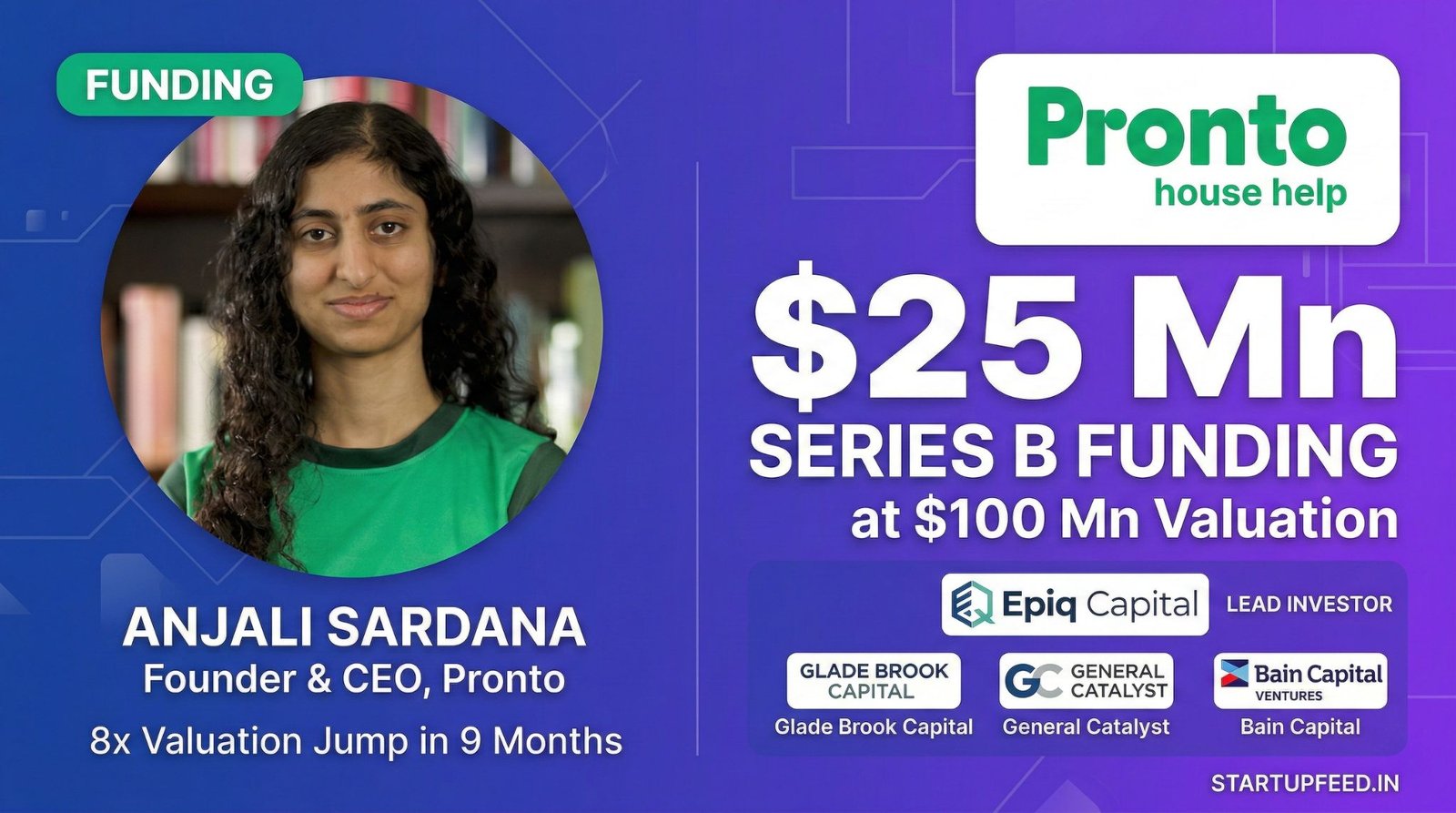
Funding: $25 Mn (Rs 210 Cr) at $100 Mn (Rs 840 Cr) valuation — 8x jump in 9 months
Lead Investor: Epiq Capital — New investor; Glade Brook, General Catalyst, Bain doubling down
Traction: 18,000 daily bookings — up 18x from ~1,000 in seven months
Use of Funds: Supply acquisition, city deepening, new service categories
What’s Next: 70,000 daily bookings by June 2026; cooking, car washing, dog walking pilots underway
Instant home services startup Pronto has raised $25 Mn (Rs 210 Cr) in a Series B round led by Epiq Capital, valuing the nine-month-old Bengaluru-based company at $100 Mn (Rs 840 Cr) — an 8x jump from its $12.5 Mn valuation at stealth exit in May 2025, marking one of the fastest valuation ramp-ups in India’s consumer services sector.
This positions Pronto to outpace rivals on supply acquisition before the instant home services market reaches its inflection point. With India’s online home services penetration still below 1% of a $57 Bn total addressable market, whoever captures the largest trained workforce first will own the category — something Snabbit and Urban Company are also racing to do.
StartupFeed Insight
What the numbers say: Pronto’s valuation has compounded at roughly 3x every 90 days since launch — faster than any consumer services startup in India’s recent history. Yet 18,000 daily bookings against a potential 50 Mn+ addressable households means it has captured less than 0.04% of its market. The runway is nearly infinite; the question is execution speed.
What this means for you:
If you’re a founder: Pronto’s growth signals that gig economy models with structured worker pay (not commission) attract both capital and talent faster
If you’re an investor: This sector will produce 2–3 unicorns by 2028; back supply-side moats, not just demand metrics
If you’re an employee at a home services startup: Worker retention above 70% monthly is the benchmark — anything below signals churn risk in your operations
Our prediction: Pronto will cross 70,000 daily bookings by August 2026 (two months behind its June target), raise a Series C of $50–70 Mn at $300–350 Mn valuation by Q1 2027, and launch a B2B workforce vertical by end of FY27.
Deal Breakdown
The Series B round saw participation from 4 investors:
| Investor | Role | Type | Status |
| Epiq Capital | Lead | Venture Capital | New |
| Glade Brook Capital | Participating | Venture Capital | Existing |
| General Catalyst | Participating | Venture Capital | Existing |
| Bain Capital Ventures | Participating | Venture Capital | Existing |
The entire $25 Mn appears to be a primary infusion (new shares issued to the company) — no secondary component has been disclosed. Founder Anjali Sardana holds approximately 40% in the company, while Glade Brook Capital is the largest external investor with ~15%. The round brings total funding to approximately $40 Mn (Rs 336 Cr) across all rounds to date.
Valuation Context
| Round | Date | Valuation | Total Raised | Change |
| Stealth Exit / Seed | May 2025 | $12.5 Mn (Rs 105 Cr) | ~$2 Mn | — |
| Series A | August 2025 | $45 Mn (Rs 378 Cr) | ~$15 Mn | +260% |
| Series B | March 2026 | $100 Mn (Rs 840 Cr) | $25 Mn | +122% |
| Total to Date | — | $100 Mn (Rs 840 Cr) | $40 Mn (Rs 336 Cr) | +700% from Seed |
Pronto is now valued at roughly 55x its stealth exit valuation from just nine months ago — the kind of velocity typically reserved for AI or deep-tech companies. For context, rival Snabbit is valued at $180 Mn after raising $30 Mn in October 2025 — nearly double Pronto’s current valuation, though Snabbit launched earlier and handles ~830,000 monthly orders (vs Pronto’s ~500,000 estimated).
What the Founder Says
“Excited to announce that Pronto, our instant house help platform, has just raised $25 million in a new round led by Epiq Capital. Nine months ago we had one hub in Sector 56, Gurgaon. We were sleeping on the floor to ensure customers who had made a booking received reliable service.”
— Anjali Sardana, Founder & CEO, Pronto (via X, March 3, 2026)
The “sleeping on the floor” framing is deliberate — it signals a founder building credibility through operational sacrifice, not venture-funded comfort. More revealing is what Sardana didn’t say: revenue figures, take rate, or gross margins. The company is in growth-over-profitability mode, and she’s being careful not to draw attention to unit economics that are still in early development outside Gurugram.
“I still believe that 99.99% of this market is completely offline. In aggregate, less than 100,000 people are using a service like this per day, while tens of millions of households rely on offline arrangements.”
— Anjali Sardana, Founder & CEO, Pronto (TechCrunch, March 2, 2026)
Use of Funds
The $25 Mn will be deployed across four priorities:
Supply Acquisition: Onboarding more trained and background-verified professionals — the single biggest constraint; current demand outpaces supply at 20% week-over-week booking growth
Market Deepening: Scaling micromarkets within existing 10 cities — NCR currently accounts for ~50% of all bookings; Bengaluru and Mumbai to be intensified
New City Expansion: Entering additional cities beyond the current 10, prioritising Tier I metro areas where Pronto’s hub-and-spoke model can achieve density
New Category Pilots: Cooking, car washing, dog walking, and salon services in active pilot; adjacencies that can double average order frequency per household
The emphasis on supply over marketing signals that Pronto is playing a workforce game, not a consumer acquisition game. Every Rs 100 spent on onboarding a well-trained professional generates recurring bookings without additional CAC — which is why Sardana calls the company “supply-constrained” rather than demand-constrained.
Traction Dashboard
| Metric | Then (May 2025) | Now (March 2026) | Change |
| Daily Bookings | ~1,000 | 18,000 | +1,700% |
| Cities | 1 (Gurugram) | 10 (Delhi NCR, Bengaluru, Mumbai + 7) | +900% |
| Micromarkets | 5 | 150+ | +2,900% |
| Active Professionals | ~150 | 4,500 | +2,900% |
| Valuation | $12.5 Mn | $100 Mn | +700% |
| Daily Active Users (late Feb) | — | ~1,01,000 | +37% in 30 days |
| Top 10% User Frequency | — | 9+ orders/month | — |
| Median Repeat Booking | — | 2 days | — |
| Monthly Burn (estimated) | — | ~Rs 6–7 Cr/month | ~$8 Mn total burned |
| Runway | — | ~24 months | Post Series B |
At approximately $8 Mn burned over ~10 months, Pronto has spent roughly $444K per city entered — highly capital-efficient for a marketplace model that also operates physical training hubs and deploys workers on e-bikes.
Who Should Be Watching?
| Player | Why This Matters |
| Snabbit | $180 Mn valuation, ~830K monthly orders in Feb — now sees Pronto’s 18K daily bookings closing the gap at 37% DAU growth vs Snabbit’s 30% |
| Urban Company | 50,000 daily bookings (Instahelp vertical) — a 3x lead today, but Pronto’s 18x growth in 7 months puts it on a trajectory to match by late 2026 |
| Blinkit / Zepto / Swiggy Instamart | Quick commerce giants are adjacent; if any pivot to verified home services, they bring existing delivery infrastructure — the biggest structural threat |
| Broomees / Other early-stage rivals | Pronto’s Series B at $100 Mn will accelerate investor attention to the sector; expect more seed deals in 2026 |
| Gig labour platforms (Apna, Kaam) | Pronto’s shift-based employment with guaranteed income and health insurance directly competes for the same labour pool |
Funding Journey
| Round | Date | Amount | Lead Investor | Valuation |
| Seed | May 2025 | $2 Mn (Rs 17 Cr) | Bain Capital Ventures | $12.5 Mn |
| Series A | August 2025 | ~$13 Mn (Rs 109 Cr) | Glade Brook Capital / General Catalyst | $45 Mn |
| Series B | March 2026 | $25 Mn (Rs 210 Cr) | Epiq Capital | $100 Mn |
| Total | — | $40 Mn (Rs 336 Cr) | — | $100 Mn |
What’s Next
Our prediction: Pronto will hit 70,000 daily bookings by August 2026 — two months behind its June target — as supply onboarding remains the binding constraint in newer markets. Contribution margin turning positive in Gurugram (its oldest market) suggests a clear profitability path: each market takes approximately 8–10 months to move from investment mode to positive contribution.
The B2B opportunity is the sleeper play. Sardana has pointed to retail, construction, and manufacturing as sectors that rely on informal labour — and where a verified, shift-based workforce platform could command 3–4x the revenue per worker vs. the B2C model. Watch for a B2B pilot announcement by Q3 2026.
The real question isn’t whether Pronto can grow — the data makes that clear. It’s whether a 23-year-old first-time founder can build the operational depth to manage 4,500+ workers across 10 cities while simultaneously entering new categories, training new professionals, and raising the next round. The next 12 months will answer that.