



Quick Take:
|
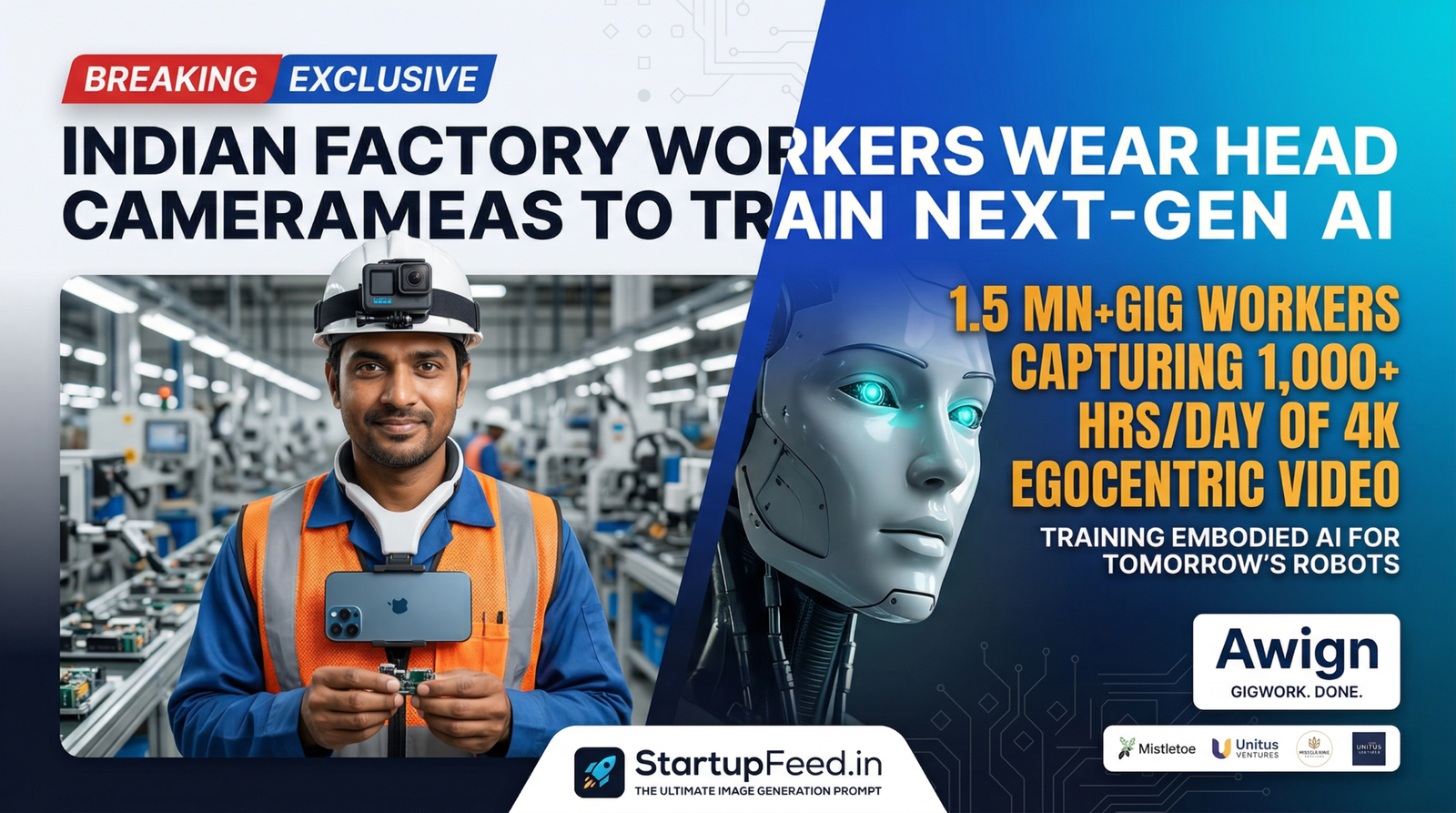
Across factory floors in Bengaluru, warehouses in Pune, and households across Delhi-NCR, a quiet but consequential shift is underway. Indian gig workers are strapping head-mounted cameras — GoPros, iPhones in ergonomic neck holders — to their bodies and going about their tasks: assembling components, picking and packing orders, cooking meals, cleaning surfaces. Every hand gesture, every object interaction, every micro-movement they make is being recorded in 4K first-person video. This footage is not for surveillance. It is the raw material for training the next generation of AI robots.
The technology driving this is called egocentric data collection — capturing the world from the perspective of the actor, not an observer. And India, with its vast gig workforce, cost efficiency, and geographic diversity, is emerging as the world’s most strategically significant source of this data. The companies building humanoid robots — and the AI systems that will run factories, warehouses, hospitals, and homes — need millions of hours of exactly this footage. India’s workers are providing it.
| StartupFeed Insight
What the numbers say: A robot that learns from CCTV footage sees a factory worker’s hands from 3 meters away. A robot that deploys in a factory sees its own hands from 30 centimetres. That perceptual mismatch — what AI researchers call the ‘perception-action gap’ — causes robots to fail in the real world even when they perform perfectly in the lab. Egocentric data closes that gap. India is the most cost-efficient and scale-efficient place in the world to generate it. What this means for you:
Our prediction: By FY28, India will generate 30%+ of the world’s egocentric training data for embodied AI — becoming the ‘data foundry’ of the global robotics industry the same way it became the ‘code factory’ of the global software industry in the 1990s. The gig worker with a head camera is this decade’s equivalent of the BPO agent with a headset. |
Why Egocentric Data — The Technical Case
The perception-action mismatch problem is at the heart of why traditional robot training datasets fail. Most early robotics datasets used CCTV cameras, overhead sensors, or third-person video — convenient to set up, but fundamentally misaligned with how a deployed robot actually sees the world.
| Data Type | Camera Position | What It Captures | Robot Deployment Match | Problem |
| Third-person (CCTV) | Fixed, overhead | Scene overview, actor movement | Mismatched | Robot sees from its own body, not from the room corner |
| Egocentric (Head-mounted) | On the actor’s head | Hand movements, object contact, gaze, task sequence | Matched | Robot trains on exactly the perspective it will use |
| Wrist-mounted camera | On the actor’s wrist | Fine hand-object interactions, grip details | Matched for manipulation | Best for precise manipulation tasks |
| Teleoperation data | Robot-mounted | Robot’s exact perception during human-controlled demos | Perfectly matched | Most expensive; requires hardware per data point |
The key insight: hand position, object contact points, natural gaze shifts, and fine-grained task sequencing are only visible from inside the task. A camera watching from the corner of a room misses the exact signals a robot needs to reliably grasp objects, use tools, and complete multi-step tasks. Egocentric video provides those signals at scale. And India’s gig workers — performing real tasks in real factories, real warehouses, and real homes — provide it at a quality and diversity impossible to replicate in a lab.
India’s Egocentric Data Advantage
| Factor | India’s Position | Global Significance |
| Workforce scale | 1.5 Mn+ trained gig workers (Awign alone) | No Western market has comparable deployable labour for data collection at this scale |
| Geographic coverage | 1,000+ cities, 19,000+ pin codes | Real-world environmental diversity critical for AI generalization |
| Cost efficiency | 4K egocentric video at fraction of US/EU cost | Robotics companies in US/EU pay 5-10x more per hour of data |
| Daily production | 1,000+ hours of egocentric video per day (Awign) | At this rate, generates more egocentric data monthly than most US competitors produce annually |
| Task diversity | Factory, warehouse, household, retail, outdoor | Broader task coverage = better model generalization across deployment environments |
| Annotation capability | 10 Mn+ data points labeled monthly, 98-99% accuracy | Quality matches Western providers at significantly lower cost |
Awign — The Indian Platform at the Centre of It All
Awign, founded in 2016 by Annanya Sarthak, Gurpreet Singh, and Praveen Sah, started as a gig workforce platform for traditional enterprise field work — auditing, last-mile delivery, background verification, exam proctoring. It has raised over $100 Mn and is now part of a leading Japanese conglomerate. But its strategic pivot in the last 18 months is what makes it central to this story.
Awign’s Egocentric AI Data Operation (2025-2026):
|
Co-founder Annanya Sarthak has described Awign’s vision at industry events: “We will make India one of the best places in the world to generate the real-world data that helps robots learn at scale — fast, reliably, and with some of the best cost efficiency across the globe.”
The Dataset Economy — What’s Being Built
| Dataset | Hours | Workers | Frames | Use Case | Status |
| Egocentric-100K (Build AI) | 100,000 hrs | 14,228 workers | 11 Bn frames | Manipulation, industrial robot training | Open-sourced on Hugging Face (2025) |
| Egocentric-10K | 10,000 hrs | 2,100+ workers | N/A | Factory-specific hand-tool-object interaction | Research use |
| Ego4D (Meta/Partners) | 3,670 hrs | 931 people, 74 locations | N/A | Embodied AI benchmark, general perception | Academic benchmark |
| Awign daily stream | 1,000 hrs/day | 1.5 Mn contributor network | N/A | Humanoid training, imitation learning | Ongoing commercial production |
| AoE System (Research) | Scalable | Distributed global contributors | N/A | Embodied foundation model pre-training | arXiv Feb 2026 — smartphone neck-mounted |
How It Works — The Technical Pipeline
- A gig worker in a Bengaluru warehouse or Pune factory is given a head-mounted camera rig — typically an iPhone in an ergonomic neck holder or a GoPro headband — and trained to perform specific tasks: picking and placing items, using specific tools, completing assembly sequences.
- The camera records continuous 4K first-person video — every movement from the worker’s eye level. The worker goes through pre-defined task sequences, capturing natural variation in how different people approach the same task (grip style, approach angle, error recovery).
- Raw video is uploaded to cloud infrastructure via edge-processing on the device itself — an on-device model filters for quality and relevance before upload, reducing bandwidth costs and data noise.
- Annotation teams label the video with structured metadata: bounding boxes around objects, keypoint tracking on hands, action segmentation tags (what task segment is being performed), depth data, and object interaction markers.
- Labeled datasets are packaged and delivered to robotics AI teams for training Vision-Language-Action (VLA) models — the AI architecture that allows robots to understand visual inputs, follow language instructions, and execute physical actions.
- The trained robot models are tested in simulation first, then deployed on actual hardware — where they demonstrate the task sequences learned from thousands of hours of Indian gig worker footage.
The Larger Picture — India as the World’s AI Data Foundry
India’s role in the global AI data economy is not new. For more than a decade, Indian data annotation companies have labeled images, transcribed audio, and categorized text for AI companies globally. But the egocentric data shift represents a qualitative upgrade: from passive labeling (tagging what is in an image) to active data generation (creating the training footage itself).
The global humanoid robotics market is projected to exceed $500 Bn by 2030 — driven by deployments in manufacturing, logistics, healthcare, and home services. Every humanoid robot sold will require continuous training data updates as it encounters new environments and tasks. That data needs to be captured from real humans performing real tasks. India’s combination of workforce scale, geographic diversity, cost efficiency, and established gig infrastructure positions it to become the primary data foundry for this market — a strategic asset comparable to what TSMC is to semiconductor manufacturing.
India’s AI Data Economy — Key Numbers:
|
The Questions That Need Answering
Consent and privacy: The workers wearing cameras are capturing footage in their homes, workplaces, and communities. Are they meaningfully consenting? Do they understand how their data will be used? What protections exist against biometric or behavioral data being used beyond the contracted purpose? These are not theoretical concerns — they are the same questions that haunted India’s early BPO boom, and they deserve clearer regulatory frameworks than currently exist.
Worker welfare: Head-mounted camera work is more demanding than traditional gig work — physical strain from wearing equipment, cognitive load of performing tasks ‘correctly’ under observation, and the psychological weight of knowing your every movement is being recorded. Equitable pay frameworks and health monitoring are urgently needed.
The displacement paradox: Indian workers are generating the training data that will teach robots to replace Indian workers. This is not a distant theoretical concern — it is the explicit commercial purpose of egocentric datasets for ‘assembly, line work, warehouse picking and packing.’ India needs a national policy framework for how it captures value from being the world’s robot training ground, not just the labour that gets displaced by the robots it trained.
What’s Next
The embodied AI data market is in its earliest innings. As humanoid robot deployments accelerate — NVIDIA, Tesla, Figure AI, Boston Dynamics, and India’s own Addverb and General Autonomy are all scaling production — the demand for high-quality egocentric training data will grow exponentially. India’s gig economy infrastructure is currently the most cost-efficient and scale-efficient mechanism globally for generating this data.
Watch for: India-specific regulatory frameworks on biometric data capture in gig work (likely Q3 2026 given the pace of deployment), the first public disclosure of a major global humanoid company’s Indian data partnership, and the emergence of Indian-built egocentric dataset companies competing directly with Western providers like Scale AI and Appen.

