



⚡ Quick Take:
|
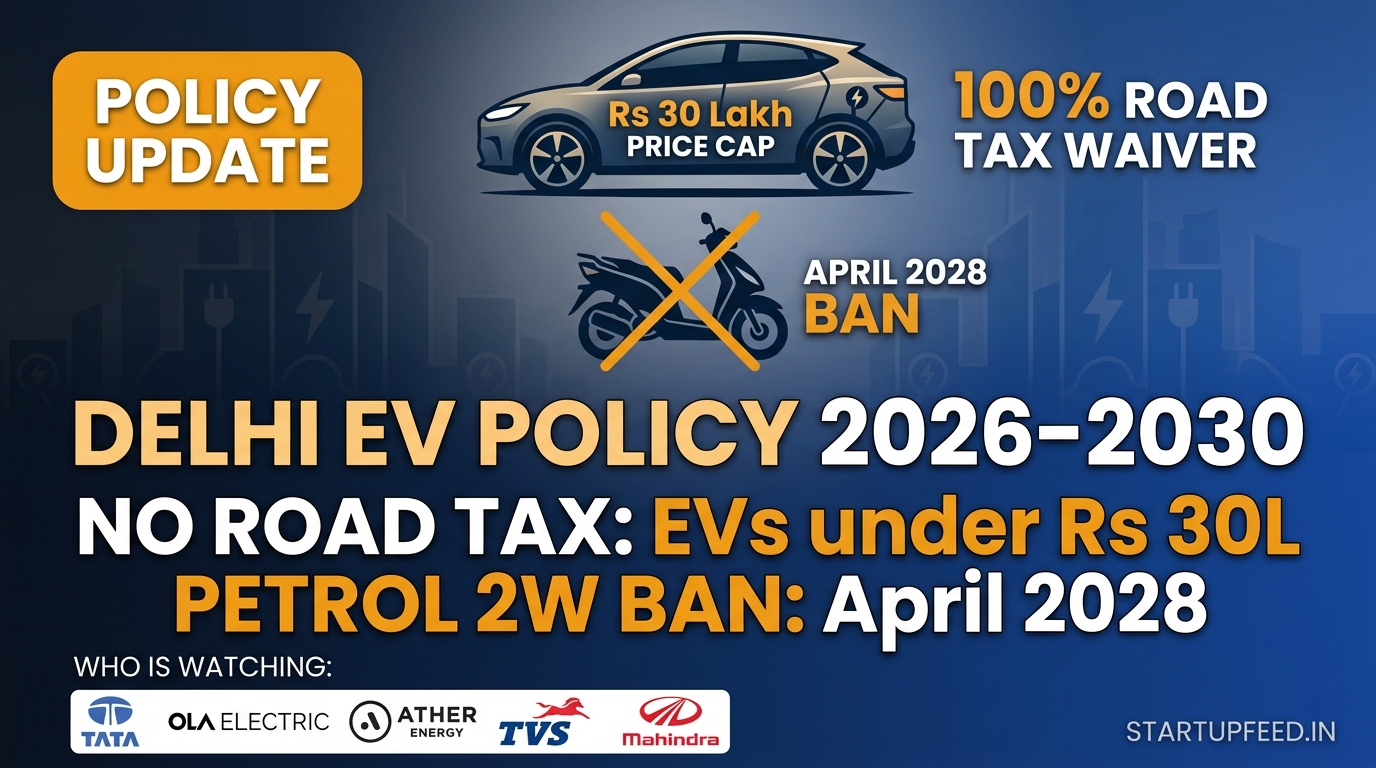
The Delhi Government has released the draft Electric Vehicle Policy 2026–2030, laying out a Rs 3,954 Cr roadmap to accelerate EV adoption across the national capital. Released by the transport department’s EV cell, the draft offers 100% road tax and registration fee exemptions for EVs priced up to Rs 30 Lakh, bans new non-electric two-wheeler registrations from April 1, 2028, and proposes 13,700 public charging stations by 2030. Public feedback is open for 30 days until May 1, 2026 via evpolicy2026@gmail.com.
This positions Delhi to extend its national EV leadership — already at 12% EV share in total sales, against India’s 4.2% average in FY26 — into a legally enforced mandate. For auto OEMs, fleet operators, and daily commuters, the policy signals an irreversible directional shift: Delhi is going fully electric by 2030, with or without industry consensus.
| StartupFeed Insight
What the numbers say: Delhi’s EV share quadrupled in five years under Policy 1.0 — from ~3% to 12%. Policy 2.0 raises the stakes dramatically by converting incentives into mandates from 2027 onward. The carrot is still there; the stick arrives January 1, 2027. What this means for you:
Our prediction: By Q4 2027, Delhi’s EV share in new registrations will cross 40% — driven by the 3-wheeler ban (effective Jan 2027) creating a sharp supply-demand signal. Tata Motors and Ola Electric will be the primary beneficiaries. The hybrid 50% tax break will trigger a Toyota/Maruti Suzuki lobbying counter-offensive that delays full BEV mandates at the national level. |
Full Policy Provisions
The draft covers six major areas. Here is every provision that matters:
- Road Tax & Registration Fee Exemptions
| Vehicle Type | Exemption | Condition |
| Battery Electric Cars (BEV) up to Rs 30 Lakh | 100% waiver — road tax + reg fees | Valid till March 31, 2030 |
| Battery Electric Cars above Rs 30 Lakh | ZERO exemption | Luxury segment excluded |
| Strong Hybrid EVs (SHEV/PHEV) | 50% waiver — road tax + reg fees | For vehicles below Rs 30 Lakh; pending MoHI/MoRTH definition |
| Electric 2-Wheelers | 100% waiver | Valid till March 31, 2030 |
| Electric 3-Wheelers (L5M autos) | 100% waiver | Valid till March 31, 2030 |
| Electric Goods Carriers (N1) | 100% waiver | Valid till March 31, 2030 |
- Purchase Incentives (Direct Benefit Transfer to Delhi-registered buyers)
| Vehicle | Year 1 | Year 2 | Year 3 | Condition |
| E-2W (general buyers) | Rs 30,000 (Rs 10K/kWh) | Rs 20,000 (Rs 6.6K/kWh) | Rs 10,000 (Rs 3.3K/kWh) | Vehicle price ≤ Rs 2.25 Lakh |
| E-2W (women buyers) | Rs 36,000 (Rs 12K/kWh) | Rs 24,000 | Rs 12,000 | First 10,000 women with valid DL |
| Electric Auto (L5M) | Rs 50,000 | Rs 40,000 | Rs 30,000 | DBT to buyer |
| Electric Goods Carrier (N1) | Rs 1,00,000 | Rs 75,000 | Rs 50,000 | DBT to buyer |
| School Bus (Electric) | Up to Rs 15 Lakh subsidy | — | — | 30% of fleet to be EV by 2030 |
- Scrappage-Linked Incentives (additional, on top of purchase incentives)
Buyers scrapping a BS-IV or older Delhi-registered vehicle and buying an EV within 6 months of the Certificate of Deposit (CoD):
| Scrapped Vehicle | Scrappage Incentive | Condition |
| 2-Wheeler (BS-IV or older) | Rs 10,000 | Buy new EV within 6 months of CoD |
| 3-Wheeler (BS-IV or older) | Rs 25,000 | Buy new EV within 6 months of CoD |
| Car (for EV purchase under Rs 30 Lakh) | Rs 1,00,000 | First 1 lakh eligible applicants only |
| Goods Carrier | Rs 50,000 | Buy new EV within 6 months of CoD |
- Registration Bans — The Non-Negotiable Timeline
| Date | Ban |
| January 1, 2027 | New non-electric 3-wheelers: registration prohibited in Delhi |
| April 1, 2028 | New non-electric 2-wheelers: registration prohibited in Delhi |
| From policy notification date | Fleet aggregators and delivery platforms: must stop adding petrol/diesel 2W and small vans (BS-6 2W exempt till Dec 31, 2026) |
| From policy notification date | All new Delhi Government vehicles: must be electric (with exceptions) |
| From policy notification date | All new DTC intra-state buses inducted: must be electric |
| March 31, 2030 | 30% of all school bus fleets must be electric |
- Charging Infrastructure Targets
| Infrastructure | Target | Subsidy |
| Public charging stations | 13,700 by 2030 (one every 5 km; one per 1 sq km grid) | Rs 15 Lakh per LT-level station; Rs 30 Lakh per HT hub |
| Battery swapping stations | First 1,000 stations | One-time subsidy up to Rs 1.2 Lakh per station |
| Semi-public AC charging points | — | 50% capital subsidy |
| DC fast-charging points | — | Up to Rs 20,000 per DC point |
| Nodal agency | Delhi Transco Limited | Dedicated digital portal for approvals and monitoring |
Who Should Be Watching?
| Stakeholder | Impact | Why |
| Tata Motors / Mahindra | Strongly Positive | Nexon EV, Tiago EV, BE 6e, BE 9e all under Rs 30 Lakh — full road tax waiver; ban on petrol 2W and 3W is their demand delivered |
| Ola Electric / Ather / TVS | Strongly Positive | E-2W ban from April 2028 creates a captive Delhi market; scrappage incentive of Rs 10,000 accelerates trade-ins |
| Toyota / Maruti Suzuki | Mixed | 50% hybrid tax break is a win they lobbied for; but Tata/Mahindra will counter-lobby nationally to prevent it spreading |
| Honda / Hero MotoCorp (ICE 2W) | Negative | April 2028 ban on new petrol 2W registrations in Delhi — their largest single urban market — is an existential signal |
| Charging Infra Startups (Tata Power EV, Statiq, Kazam) | Strongly Positive | Rs 15 Lakh per LT station subsidy + 13,700 station target = a Rs 2,000+ Cr infrastructure opportunity |
| Last-mile delivery platforms (Zomato, Swiggy, Zepto) | Mixed | Immediate mandate to stop adding petrol 2W to fleets — accelerates what they were already doing, but compresses timeline |
| Petrol/CNG auto-rickshaw drivers | Negative short-term | New CNG/petrol 3W registrations end Jan 2027; existing operators can continue, but resale value of ICE autos collapses |
How Delhi Policy 1.0 Performed
| Metric | 2020 (Policy 1.0 Launch) | 2024 (Before Policy 2.0) | Change |
| EV share in Delhi vehicle sales | ~3% | 12% | +4x |
| Annual EV registrations in Delhi | ~20,000 | 82,081 (2024) | +4x |
| Delhi EV share vs National avg | ~3% vs ~1% | 12% vs 4.2% | Delhi 3x national avg |
| Delhi EV policy duration | 3 years (2020–2023) | Extended multiple times | Now formalized 2026–2030 |
Policy 1.0 delivered results no other Indian state has matched: Delhi went from negligible EV share to 12% — 3x the national average — in four years, purely through incentives. Policy 2.0 replaces ‘incentive pull’ with ‘mandate push’ from 2027 onward. The trajectory is now no longer optional for Delhi’s auto market.
The Hybrid Controversy
The 50% tax exemption for strong hybrid vehicles has divided the auto industry. Toyota and Maruti Suzuki — who dominate the strong hybrid market with 80%+ share via Hyryder, Innova Hycross, and Camry — welcome it as validation of their technology bet. Tata Motors and Mahindra oppose it aggressively, arguing that any incentive for hybrids slows the transition to full BEVs and dilutes investment in India’s battery EV ecosystem.
The RBI’s own note in the draft is revealing: hybrid benefits will only activate once the Ministry of Heavy Industries formally defines SHEV/PHEV categories — a standard that doesn’t exist yet. The hybrid clause may be more political signalling than near-term policy.
What’s Next
Feedback deadline: May 1, 2026 via evpolicy2026@gmail.com. After the 30-day consultation window, the Delhi Transport Department will finalize and notify the policy. CM Rekha Gupta has already allocated Rs 200 Cr in the FY27 budget for EV Policy 2.0 — implementation money is committed before the policy is even finalized.
The January 1, 2027 3-wheeler ban is the nearest hard deadline. Auto-rickshaw permit holders, 3-wheeler fleet operators, and last-mile logistics companies have less than 9 months from policy notification to adapt their fleet planning.
Our prediction: The hybrid clause will be diluted or deferred under lobbying from Tata and Mahindra. The Rs 30 Lakh price cap will face pressure to be raised to Rs 40 Lakh by 2028 as EV prices normalize. But the 2-wheeler and 3-wheeler registration bans will hold — they are the policy’s structural spine and politically popular with Delhi’s air-quality-conscious electorate.
What do you think? Will Delhi’s EV mandate work — or will black markets for ICE 2W emerge? Share on X @StartupFeedbews

