

Quick Take (30-Second Read)
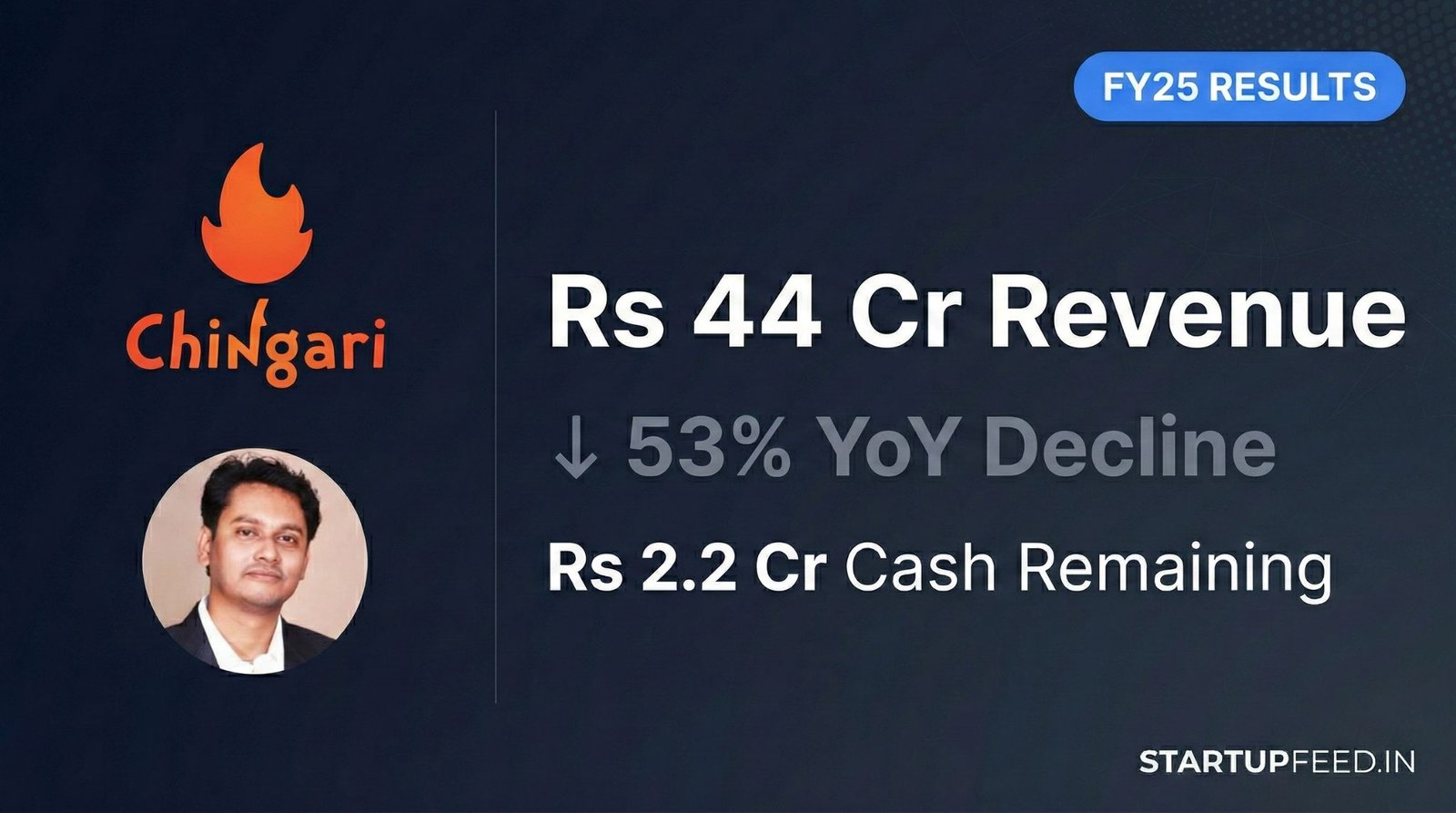
- Revenue: Rs 44 Cr in FY25 — down 52.7% from Rs 92 Cr in FY24; down 61% from Rs 113 Cr peak in FY23
- Net Loss: Rs 8.8 Cr in FY25 — narrowed 62% from Rs 23.3 Cr in FY24 (cost-cuts, not revenue recovery)
- Pivot: June 2023 — from TikTok-style short video to paid private live-streaming (1-on-1 video calls, virtual diamonds)
- Unit Economics: Rs 1.2 spent to earn Re 1 of operating revenue — still loss-making at unit level
- Cash: Rs 2.2 Cr cash and bank balance as of March 2025 — critically thin runway
- Signal: 72% of revenue from international users — domestic market has largely abandoned the platform
Bengaluru-based short video platform Chingari has reported a 53% year-on-year decline in operating revenue to Rs 44 Cr in FY25 — its second consecutive annual drop — as the company’s June 2023 pivot from short video to a paid private live-streaming model continues to shrink its scale rather than stabilise it, according to consolidated financial statements sourced from the Registrar of Companies.
Net losses narrowed sharply to Rs 8.8 Cr from Rs 23.3 Cr in FY24 — a 62% improvement — but the improvement is driven almost entirely by aggressive cost cuts, not revenue recovery. The company now has just Rs 2.2 Cr in cash on its balance sheet: a critical warning for a startup that has raised $61.6 Mn (Rs ~516 Cr) since 2018.
Chingari is the clearest data point yet on what happens to India’s post-TikTok-ban beneficiaries when they run out of both momentum and a coherent product strategy. Having ridden the 2020 ban wave to 10 Cr+ downloads and Rs 113 Cr in revenue by FY23, the platform has now shed 61% of that revenue peak in two years. The pivot to paid live streaming has not found a new audience large enough to replace the one it lost — and at Rs 2.2 Cr in cash, the clock is ticking.
StartupFeed Insight
What the numbers actually say: Chingari’s losses are shrinking — but that is the wrong metric to watch. The correct metric is revenue trajectory. A company going from Rs 113 Cr → Rs 92 Cr → Rs 44 Cr in three years is not stabilising; it is in structural decline. The loss narrowing is purely a function of cost containment: total expenditure fell 55% to Rs 52.4 Cr. When cost-cuts outpace revenue falls, the P&L looks better — but the business is smaller and the unit economics (Rs 1.2 to earn Re 1) haven’t improved.
The real alarm: Cash. With just Rs 2.2 Cr left, the company has roughly 2-4 weeks of operating runway at current spend rates. Unless Chingari has raised undisclosed bridge funding or pivots yet again, the clock has effectively run out.
Rs 2.2 Cr cash at March 2025 end means roughly 3–4 weeks of operating expenses at current spend rates (Rs 52.4 Cr annual = Rs 4.4 Cr/month). Unless Chingari has raised undisclosed bridge funding since March 2025, the company may already be in distress by the time this article publishes.
The international revenue story:
72% of FY25 revenue (Rs 31.3 Cr) came from foreign users. This is not a strength — it is a signal that India’s users have moved on. The 1-on-1 paid video call model resonates with Southeast Asian and MENA users more than Indian users, who have alternatives in Instagram Reels, YouTube Shorts, and ShareChat. Chingari has effectively become an export business for its pivot model, not a domestic consumer platform.
Our prediction:
Chingari raises a distress or bridge round by Q2 FY26, sells non-core assets, or shuts down consumer operations by end of FY27. The B2B / AI creator path the founders are exploring is a long-shot turnaround, not a pivot — but it may be the only one available.
FY25 Financial Snapshot
| Metric | FY23 | FY24 | FY25 | YoY Change (FY24→FY25) |
| Revenue from Operations | Rs 113 Cr | Rs 92 Cr | Rs 44 Cr | ▼ 52.7% |
| Net Loss | Rs 42 Cr | Rs 23.3 Cr | Rs 8.8 Cr | ▼ 62.2% (improved) |
| Total Expenditure | — | Rs 116.3 Cr | Rs 52.4 Cr | ▼ 54.9% |
| Ad & Promo Expenses | — | Rs 43.65 Cr | Rs 23.75 Cr | ▼ 45.6% |
| Employee Benefits Expenses | — | — | Rs 13.4 Cr | ▼ 58% YoY |
| IT / Technology Expenses | — | — | Rs 9 Cr | ▲ 8.4% YoY |
| Revenue — Domestic | — | — | Rs 12.2 Cr (28%) | — |
| Revenue — Export (International) | — | — | Rs 31.3 Cr (72%) | — |
| Unit Economics (spend per Re 1 earned) | — | — | Rs 1.2 | Still loss-making |
| Cash & Bank Balance | — | — | Rs 2.2 Cr | Critical — ~3–4 weeks cover |
| Current Assets | — | — | Rs 8 Cr | — |
The Pivot That Didn’t Work: A Timeline
| Period | What Happened | Revenue Impact |
| Nov 2018 | Founded by Sumit Ghosh, Biswatma Nayak, Deepak Salvi, Aditya Kothari as a WhatsApp Status creation platform | Pre-revenue |
| June 2020 | TikTok ban — Chingari explodes from 1 lakh to 1 Cr downloads; becomes India’s most visible short video alternative | Rapid user growth; ad revenue model |
| Oct 2021 | Launches $GARI crypto token and NFT marketplace on Solana blockchain; raises ~$32 Mn; valuation peaks at Rs 625 Cr (Feb 2022) | FY22: Net loss Rs 139.4 Cr on Rs 49.4 Cr revenue — heavy spend phase |
| FY23 | Revenue peaks at Rs 113 Cr; loss narrows to Rs 42 Cr — first signs of monetisation traction from advertising and gifts | Rs 113 Cr — peak revenue |
| May–June 2023 | Pivots to paid private live-streaming model: 1-on-1 video calls, virtual “diamonds” currency. Described by observers as “softer version of OnlyFans.” Company denies adult content allegations. | Revenue impact begins in FY24 |
| FY24 | Post-pivot revenue falls to Rs 92 Cr; losses narrow to Rs 23.3 Cr — cost-cuts begin aggressively | Rs 92 Cr (▼ 19% from FY23 peak) |
| Aug 2023 | CEO Sumit Ghosh claims operational profitability after 50%+ workforce layoffs; 68 employees remain by April 2025 | Losses narrow via headcount reduction |
| FY25 | Revenue collapses to Rs 44 Cr — down 61% from FY23 peak. Rs 2.2 Cr cash remaining. | Rs 44 Cr (▼ 61% from peak) |
Cost Structure: What’s Left After the Cuts
| Expense Head | FY24 | FY25 | Change | % of FY25 Revenue |
| Advertising & Promotional | Rs 43.65 Cr | Rs 23.75 Cr | ▼ 45.6% | 54% of revenue |
| Employee Benefits | — | Rs 13.4 Cr | ▼ 58% YoY | 30% of revenue |
| IT / Technology | — | Rs 9 Cr | ▲ 8.4% | 20% of revenue |
| Other Overheads (rent, legal, travel) | — | Included in Rs 52.4 Cr total | — | — |
| Total Expenditure | Rs 116.3 Cr | Rs 52.4 Cr | ▼ 54.9% | 119% of revenue |
Even after all cuts, Chingari spends Rs 1.2 for every Re 1 of revenue — meaning it still cannot fund itself from operations. Advertising remains the largest cost at 54% of revenue, which is a structural problem: a platform using more than half its revenue on user acquisition has not built organic retention. Meanwhile, IT costs actually rose 8.4% to Rs 9 Cr — suggesting the technical infrastructure for the live-streaming model is not cheap to maintain, even as the business around it shrinks.
The Business Model Problem
Chingari’s 1-on-1 paid private video call model, where users buy virtual “diamonds” to access personal interactions with creators, sits in uncomfortable territory. The company’s guidelines explicitly prohibit nudity and sexually explicit content — yet a review of the platform described it as a “softer version of OnlyFans.”
This creates a compound problem for the business. The model lacks scale without adult content (the explicit content is the primary monetisation driver for OnlyFans and its clones globally) — but enabling adult content introduces regulatory, reputational, and payment processing risks that have already damaged the brand among mainstream Indian users and advertisers.
The result is a product stuck in the middle: not explicit enough to compete with dedicated NSFW platforms, and not mainstream enough to re-attract the Indian short-video audience it originally built. The 72% export revenue share is a symptom of this: international users (primarily Southeast Asia and MENA) are willing to pay for this model, but at a volume that doesn’t sustain a business that once aspired to serve a billion users.
“The vision for Chingari was to build a social network for a billion people. To build a product like Reels or TikTok — we had already lost the race. Not just Chingari, but also Moj and Josh.”
— Sumit Ghosh, Co-Founder & CEO, Chingari (YourStory, June 2023)
Ghosh’s honesty here is notable — he had already accepted by June 2023 that Chingari could not win the short video war. The question was whether the pivot to paid live-streaming would find a different, viable market. Two years later, the Rs 44 Cr revenue and Rs 2.2 Cr cash balance suggest the answer is no — at least not at a scale that justifies continuing as a standalone consumer platform.
Competitive Context: What Went Wrong
| Platform | FY25 Status | What Chingari Couldn’t Do |
| Instagram Reels (Meta) | Dominant — largest short video platform in India by DAU; Meta’s India advertising revenue growing 15%+ YoY | Could not match content depth, creator tools, or advertising infrastructure of a $1T company |
| YouTube Shorts (Google) | Strong — integrated with YouTube creator economy; monetisation live for Indian creators | Could not compete with ad revenue sharing or YouTube’s search-driven discovery |
| ShareChat / Moj | Raised $16 Mn in Aug 2024; Bharat-first strategy intact; regional language moat | Chingari ceded the Bharat/regional language positioning it once owned |
| Josh (DailyHunt/VerSe) | Backed by Google and Microsoft; still operating at scale with regional content | Corporate backing and content licensing Chingari could not match post-funding crunch |
| Chamet / Tango (Global peers) | The apps Chingari explicitly modelled its paid live-streaming pivot on — growing internationally | These apps have no India reputational baggage; Chingari inherited user trust deficit from its short-video era controversies |
Company Snapshot
| Parameter | Details |
| Founded | November 2018 |
| Founders | Sumit Ghosh (CEO), Biswatma Nayak (CTO), Deepak Salvi (COO); Aditya Kothari (exited) |
| Registered Name | Tech4Billion Media Pvt Ltd, Bengaluru |
| Total Funding Raised | ~$61.6 Mn (Rs ~516 Cr) across 7+ rounds |
| Key Investors | OnMobile, Republic Capital, Galaxy, Aptos Labs, Solana Ventures, Roosh Ventures |
| Last Known Valuation | Rs 625 Cr (February 2022) — pre-pivot, pre-decline |
| Employees | ~68 (April 2025) — down from peak of 200+ |
| Downloads | 10 Cr+ (Android Play Store) |
| Current Model | Paid private live-streaming; 1-on-1 video calls; virtual diamonds currency |
| FY25 Cash Balance | Rs 2.2 Cr — estimated 3–4 weeks of operating cover |
What’s Next
CEO Sumit Ghosh has publicly floated the idea of AI-powered virtual creators as Chingari’s next direction — letting the platform generate synthetic content creators rather than relying on real-world supply. The concept has merit as a long-term play (several US and Asian platforms are exploring AI creator layers), but it requires both capital and time that Chingari’s balance sheet does not currently support.
Three scenarios for FY26:
Scenario 1 — Bridge and rebuild (20% probability): Chingari raises Rs 15–25 Cr in distress or bridge funding, pivots aggressively to AI creator tech, and attempts to monetise its 10 Cr download base in a new format
Scenario 2 — Acquisition or acqui-hire (50% probability): A larger platform (ShareChat, VerSe, or a Southeast Asian player) acquires Chingari’s tech stack and international user base, keeping the brand alive in a limited form
Scenario 3 — Gradual wind-down (30% probability): Unable to raise fresh capital, Chingari reduces operations to a skeleton team servicing its international paid live-stream users, effectively becoming a lifestyle business on the margins of India’s creator economy
The numbers make this clear: Chingari once symbolised India’s digital self-reliance moment in 2020. By 2025, it symbolises something more cautionary — what happens when a windfall moment isn’t backed by a sustainable product, and when the money runs out before the pivot pays off.

