



QUICK TAKE:
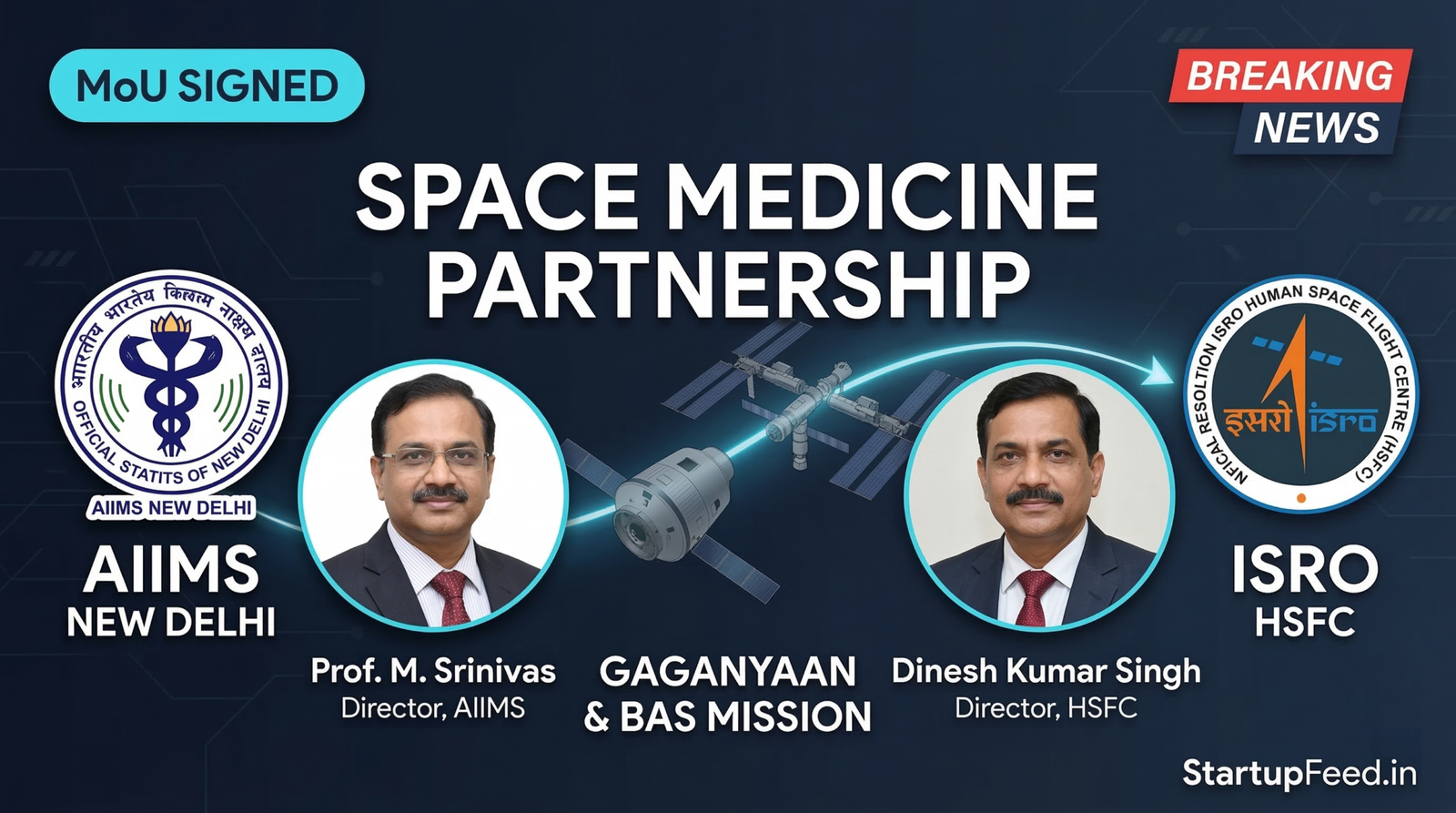
- Signatories: M. Srinivas, Director, AIIMS New Delhi + Dinesh Kumar Singh, Director, Human Space Flight Centre (HSFC), ISRO; witnessed by V. Narayanan, Chairman ISRO & Secretary, Dept of Space
- Research scope: 6 domains — human physiology, cardiovascular & autonomic regulation, musculoskeletal health in microgravity, microbiome & immunology, genomics & biomarkers, behavioural health
- Strategic link: Directly tied to Gaganyaan (India’s first crewed spaceflight programme; crewed mission targeted 2026) and the Bharatiya Antariksh Station (BAS) long-duration mission programme
- AIIMS angle: Both ground-based (bed-rest studies, lab simulations of microgravity) and space-based research planned; AIIMS’s Dept of Physiology (Prof. K.K. Deepak) is the academic anchor
- Terrestrial benefit: Bone density loss in space (1–2% per month) mirrors osteoporosis in elderly patients; cardiovascular data from astronauts could inform treatment of mobility-impaired ground patients
- Global context: India joins US (NASA/NIH collaborations), ESA (DLR Institute of Aerospace Medicine), and China (CMSA-PLA medical research) in institutionalising space medicine at national level
- Spinoff potential: Telemedicine, regenerative medicine, wearable health sensors, remote diagnostics — all identified as likely commercial spinoffs of space medicine research
AIIMS Director quote: “This MoU will give us the escape velocity to venture together into the field of space medicine. Collaborative research between AIIMS and ISRO will benefit patients, the nation, and ultimately humankind.”
On March , 2026, two of India’s most significant national institutions formalised a partnership that has been years in the making. AIIMS New Delhi — India’s premier public medical research and clinical institution — and ISRO’s Human Space Flight Centre signed a Memorandum of Understanding to build a joint framework for space medicine research, covering everything from how microgravity reshapes the cardiovascular system to how isolation and confinement affect the human mind.
The signing, attended by ISRO Chairman V. Narayanan and senior leadership from both organisations, is not merely a bilateral research pact. It is India’s formal declaration that the country intends to build an indigenous, institutional capability in space medicine — a discipline that will become mission-critical as India prepares for its first crewed Gaganyaan flight (targeted for 2026), and eventually, for long-duration missions to the planned Bharatiya Antariksh Station (BAS).
Space medicine is a young but high-stakes discipline. The physiological changes that the human body undergoes in microgravity — bone density loss at 1–2% per month, cardiovascular deconditioning, fluid redistribution that impairs vision, immune suppression, microbiome disruption — are not only threats to astronaut health. They are, as researchers have recognised for decades, compressed and accelerated versions of the very aging processes that drive chronic disease in the general population. The AIIMS-ISRO partnership is therefore simultaneously a space programme enabler and a potential breakthrough engine for mainstream healthcare.
The Signing: Who Was in the Room
| Role | Name | Institution | Significance |
|---|---|---|---|
| MoU Signatory (Medical side) | Prof. M. Srinivas | Director, AIIMS New Delhi | India’s most senior public medical administrator; AIIMS New Delhi is the apex institution of the 23-AIIMS national network |
| MoU Signatory (Space side) | Dinesh Kumar Singh | Director, Human Space Flight Centre (HSFC), ISRO, Bengaluru | HSFC is the nodal centre for Gaganyaan; responsible for astronaut training, crew systems, and space medicine protocols |
| Witness / Keynote | Dr. V. Narayanan | Chairman, ISRO & Secretary, Department of Space, Government of India | ISRO’s current chairman; his presence signals the MoU is a strategic institutional priority, not a routine research agreement |
| Academic Overview | Prof. K.K. Deepak | Former Head, Dept of Physiology, AIIMS New Delhi | Presented AIIMS New Delhi’s existing body of work in space medicine research — indicating the institution has prior domain expertise, not starting from scratch |
| Attending bodies | Deans, HoDs, Faculty, RDA, AIIMS Student Association (ASA), Society of Young Scientists (SYS) | AIIMS New Delhi | Broad institutional representation signals long-term faculty and student engagement — not a leadership-only commitment |
The Six Research Domains: What AIIMS and ISRO Will Actually Study
The MoU defines a cooperative framework for both ground-based (laboratory, clinical simulation) and space-based (orbital, onboard Gaganyaan or BAS) research across six domains. This is not a single project — it is an institutional architecture designed to generate a continuous stream of joint research over years and potentially decades.
| Research Domain | Key Questions Being Investigated | Why It Matters for Gaganyaan/BAS | Terrestrial Healthcare Spinoff |
|---|---|---|---|
| 1. Human Physiology | How does the body adapt to weightlessness across organ systems? What are the timelines of adaptation and re-adaptation on return to Earth? | Foundational to all other domains; required to establish baselines for Indian astronaut (Gaganauts) health monitoring protocols | Understanding adaptive physiology informs care for bedridden patients, ICU patients, and post-surgical recovery management |
| 2. Cardiovascular & Autonomic Regulation | How does microgravity disrupt blood pressure regulation, heart rate variability, and autonomic nervous system function? What causes orthostatic intolerance (blood pressure collapse) on re-entry? | Re-entry cardiovascular failure is a documented risk for all crewed missions; AIIMS cardiology + HSFC crew systems must jointly develop countermeasures | Autonomic dysfunction research could benefit patients with dysautonomia, heart failure, and post-COVID autonomic disorders — a significant patient population in India |
| 3. Musculoskeletal Health in Microgravity | Bone density loss (1–2% per month), muscle atrophy, joint degeneration — what are the mechanisms and what interventions (exercise, pharmacological, nutritional) are most effective? | Gaganauts on longer missions (BAS-duration) will require exercise and pharmacological countermeasures to maintain bone and muscle; AIIMS orthopaedics and physiology departments are natural research leads | Direct application to osteoporosis (India has 50 Mn+ osteoporosis patients), sarcopenia in the elderly, and immobilisation management in trauma patients |
| 4. Microbiome & Immunology | How does spaceflight — radiation, isolation, diet change, microgravity — alter gut microbiome composition and immune response? Does it increase infection risk? | Crew immune suppression in space is documented; long-duration missions like BAS require countermeasures and possibly microbiome-protective protocols | Gut microbiome research has explosive terrestrial relevance — metabolic disease, autoimmune conditions, and mental health all have microbiome linkages being actively researched globally |
| 5. Genomics & Biomarkers | Which genetic variants make individuals more vulnerable to spaceflight stressors? Can wearable sensors and biomarkers enable predictive health monitoring for crew? | Personalised medicine for crew selection (identifying who is physiologically most suited to long missions) and in-flight monitoring are critical for multi-crew missions | Genetic biomarker panels for cardiovascular risk, bone density, and immune function have broad applicability in preventive and precision medicine across AIIMS’s patient base |
| 6. Behavioural Health | How do isolation, confinement, circadian disruption, and high-stakes decision environments affect crew psychology, cognition, and interpersonal dynamics? | Behavioural health failures are the leading non-technical risk factor in long-duration space missions (documented in ISS and Mars analog studies); crew selection and in-flight psychological support protocols needed | AIIMS psychiatry’s space medicine research will have direct relevance to ICU psychosis, solitary confinement effects, remote worker mental health, and Antarctic/submarine crew management |
Why Now: Gaganyaan, BAS and the Medical Urgency of Human Spaceflight
ISRO’s Human Space Flight Centre was established specifically to manage India’s crewed spaceflight ambitions. The Gaganyaan programme — India’s first human spaceflight mission — has been in development since the late 2010s and has completed two unmanned test milestones (Crew Escape System test TV-D1, October 2023; G1 unmanned flight in 2024). A crewed Gaganyaan mission is now targeted for 2026 — making the AIIMS MoU timely rather than aspirational.
| Milestone | Date / Status | Medical Relevance |
|---|---|---|
| Gaganyaan Crew Escape System Test (TV-D1) | October 21, 2023 — Successful | Validated crew escape systems; now needs crew health monitoring systems to match |
| G1 Unmanned Mission | 2024 — Completed | Systems-level validation; human health monitoring systems not yet tested in Indian orbital conditions |
| Gaganauts selected & training | 4 Indian Air Force pilots; training at ISRO + Russia (Roscosmos) | Astronaut medical baselines need to be established; AIIMS is India’s most credible partner for pre-flight and post-flight medical evaluation |
| Crewed Gaganyaan mission (Targeted) | 2026 | Space medicine countermeasures (exercise protocols, dietary interventions, cardiovascular monitoring) need to be operationally ready before crew flies |
| Bharatiya Antariksh Station (BAS) | Phase 1: 2028 target; full operational by 2035 | BAS long-duration missions (months to potentially over a year) will require comprehensive space medicine protocols — the AIIMS partnership is building for this timeline |
| Chandrayaan-4 / Lunar Crewed Ambition | Post-2035 planning phase | Lunar surface medicine (radiation, partial gravity, lunar dust inhalation) is a further evolution of the AIIMS-ISRO research agenda |
ISRO Chairman V. Narayanan’s remarks at the signing ceremony grounded the partnership in ISRO’s larger journey — from the organisation’s early days when rockets and equipment were transported using bicycles and bullock carts to its current position as a global space leader. The implicit message: India has earned the right to now build the human spaceflight medical infrastructure that the next chapter demands.
StartupFeed Insight — Three Non-Obvious Reads on the AIIMS-ISRO MoU
- This is India’s first formal institutional answer to the NASA-NIH model — and it’s long overdue.
NASA has had formal collaboration frameworks with the US National Institutes of Health (NIH) for decades. ESA works with the DLR Institute of Aerospace Medicine. China’s CMSA works with PLA military medical research institutions. India — despite having both a world-class space programme and a world-class medical research institution — had no formal joint space medicine architecture until this MoU. The AIIMS-ISRO partnership is therefore not merely a research agreement; it is the institutional infrastructure that India’s space medicine ambitions have been missing. The question now is whether this MoU will move from framework to funded, published research faster than India’s historical MoU-to-outcome conversion rate would suggest.
- The terrestrial healthcare implications may ultimately be more economically significant than the space medicine outcomes.
Prof. K.K. Deepak’s observation — that microgravity induces biological changes resembling accelerated aging — is the key insight to hold onto. India has 50 Mn+ osteoporosis patients, a rapidly aging population with rising sarcopenia burden, growing cardiovascular disease prevalence, and one of the world’s largest autonomic dysfunction patient populations (including post-COVID autonomic disorders). Every domain of AIIMS-ISRO space medicine research has a direct, commercially scalable terrestrial application. The wearable health sensors developed for Gaganauts will reach consumer healthcare. The bone density countermeasure protocols will inform elderly care. The microbiome research will feed India’s growing precision nutrition and gut health market. Space medicine is, in effect, extreme medicine at accelerated timelines — and the insights compress decades of traditional clinical research into years.
- The startup and deep tech ecosystem has a commercial entry point here — and very few Indian founders have spotted it.
Space medicine is a technology commercialisation engine. Every research output from the AIIMS-ISRO framework is a potential IP asset, a potential product category, and a potential startup opportunity. Wearable biosensors with sub-millimetre precision for bone density tracking. Remote psychological assessment tools for isolated crews (and remote workers). Microbiome intervention protocols validated in space conditions. Telemedicine platforms designed for latency-heavy, resource-scarce environments (which also describes rural India). The US has produced a significant commercial space health sector (companies like KBR Wyle, BioServe Space Technologies, Space Tango) from NASA-NIH collaboration spinoffs. India has the institutional base — AIIMS, ISRO, IITs — to generate the same. The gap is the commercialisation pathway: incubation, IP licensing, and startup funding mechanisms that sit at the intersection of space and health. That gap is a $50–100 Mn opportunity waiting for the right operator to bridge it.
The caveat that must be stated:
India has a long history of high-profile institutional MoUs that produce press releases and little else. The AIIMS-ISRO pact is described by officials themselves as ‘a framework for future ground-based and space-based studies’ — meaning no specific experiments, no funding commitments, and no research timelines have been publicly announced yet. The real measure of this MoU’s success will be: (a) how many joint papers are published within 24 months, (b) whether a dedicated space medicine funding line appears in ISRO’s or DST’s annual budget, and (c) whether AIIMS establishes a standalone Space Medicine department or Centre of Excellence. Without those, this risks being a ceremonial milestone rather than a scientific one.
Global Space Medicine Landscape: Where India Now Sits
| Country / Agency | Space Medicine Infrastructure | Key Institutional Partner | India’s Position vs Peer |
|---|---|---|---|
| USA (NASA) | Human Research Program (HRP) — largest space medicine programme globally; decades of ISS data | NIH, Mayo Clinic, Baylor College of Medicine, Johns Hopkins | NASA’s HRP has a dedicated annual budget and 30+ years of peer-reviewed research output. AIIMS-ISRO is at Day 1 of building equivalent institutional depth. |
| Europe (ESA) | DLR Institute of Aerospace Medicine, Cologne; European Astronaut Centre (EAC) | University hospitals across Germany, France, Netherlands | ESA has deep aerospace medicine infrastructure embedded in the European university research system. India is building its first formal node. |
| Russia (Roscosmos) | Institute of Biomedical Problems (IBMP), Moscow — world’s longest-running space medicine research institute (1963–present) | Russian Academy of Sciences medical institutes; military medical research | IBMP has the world’s most extensive dataset on long-duration spaceflight effects (including Mir and ISS missions). India’s Gaganauts trained in Russia, giving AIIMS access to some of this knowledge base. |
| China (CMSA) | China Astronaut Research and Training Center (CARTC), Beijing | PLA General Hospital; Chinese Academy of Sciences | China has been building space medicine capability in parallel with its crewed programme since the early 2000s. India is approximately 15–20 years behind China’s institutional depth but moving faster now. |
| Japan (JAXA) | JAXA’s Space Medicine Research Project; collaboration with National Institutes of Biomedical Innovation, Health and Nutrition (NIBIOHN) | University of Tsukuba, Keio University Medical School | Japan has produced high-quality space medicine research from ISS missions (KIBO module). AIIMS-ISRO has the potential to reach JAXA’s level of institutional output within a decade. |
| India (ISRO/AIIMS) | AIIMS-ISRO MoU — March 9, 2026; HSFC as operational anchor; AIIMS Dept of Physiology as research anchor | AIIMS New Delhi; IIT campuses (future potential partners) | First formal institutional space medicine framework. Strong clinical and space engineering bases. Execution velocity and funding commitment are the key variables. |
What’s Next: Five Signals to Watch
First joint research announcement: Watch for a formal research proposal or published protocol paper from AIIMS and HSFC within the next 6–12 months. This is the first test of whether the MoU produces active science or remains a framework document.
Dedicated funding line: For the partnership to produce sustained research, either DST (Dept of Science & Technology), ISRO’s internal budget, or a new joint research fund needs to earmark capital for space medicine. An announcement in the 2026–27 Union Budget allocation cycle or ISRO’s annual plan would be a strong signal.
AIIMS Space Medicine Department / Centre of Excellence: AIIMS establishing a standalone Space Medicine CoE — on the model of NASA’s Human Research Programme or Germany’s DLR Institute of Aerospace Medicine — would transform this from a bilateral MoU into a permanent institutional capability. Watch for any restructuring within AIIMS’s Dept of Physiology or establishment of a new research unit.
Gaganyaan crewed flight (2026): If Gaganyaan’s crewed mission launches in 2026 as targeted, AIIMS will be involved in pre-flight and post-flight medical evaluation of the Gaganauts — producing real flight data that will become the foundation of India’s space medicine research base.
Startup and deep tech commercialisation pathway: Watch for any incubation programme, technology transfer office, or startup accelerator that connects AIIMS-ISRO space medicine research outputs to commercial ventures. ISRO’s technology transfer office and AIIMS’s research commercialisation wing are the logical entry points; a joint programme would signal India is serious about extracting economic value from this research.