
Quick Take:
|
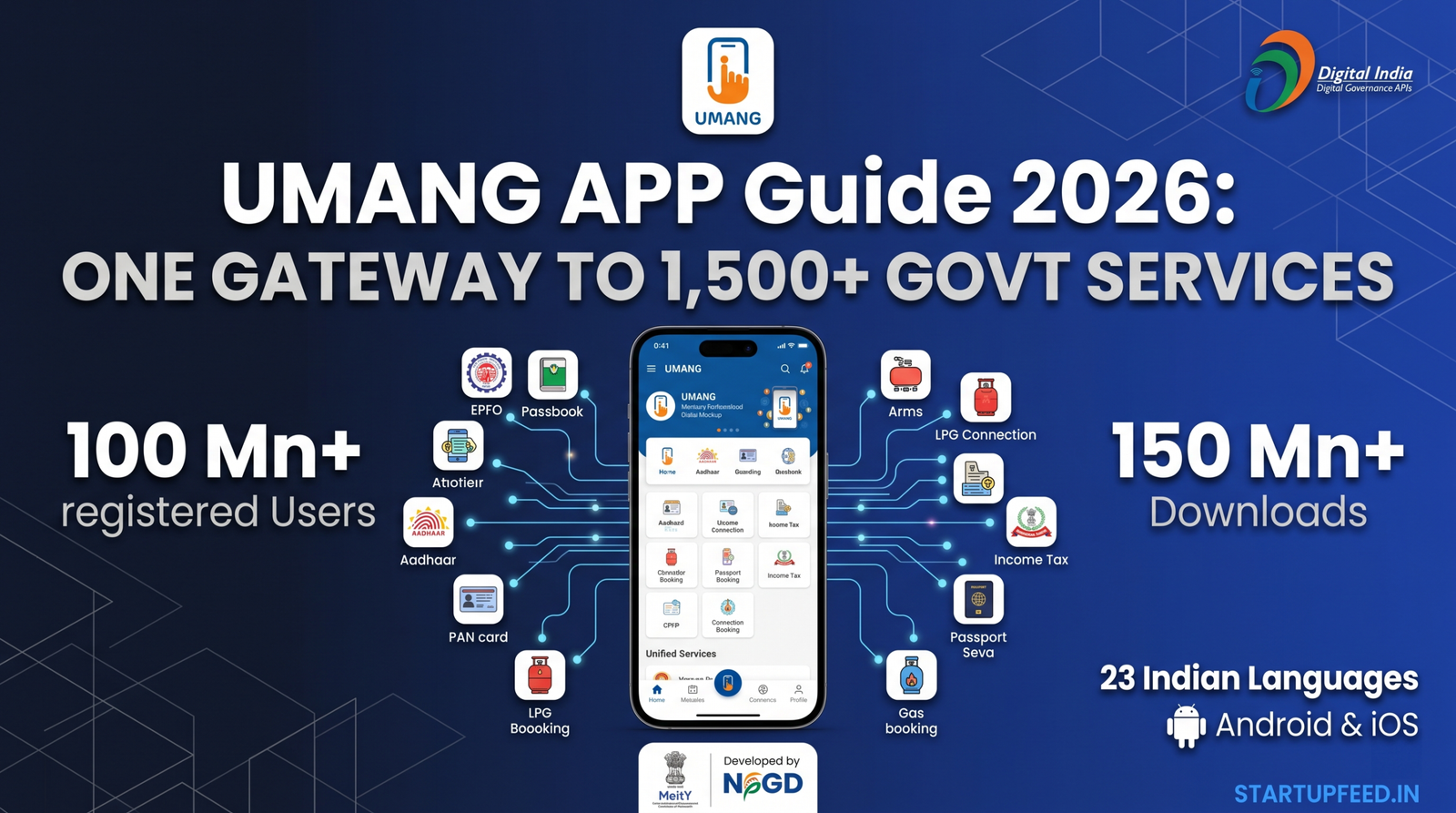
UMANG — Unified Mobile Application for New-age Governance — is India’s flagship e-governance app, developed by the Ministry of Electronics and Information Technology (MeitY) and the National e-Governance Division (NeGD). Launched on November 23, 2017, by Prime Minister Narendra Modi, it was designed with a single, radical purpose: replace hundreds of separate government portals and apps with one unified interface, accessible to every Indian on any device, in their own language, at any time.
In 2026, UMANG has delivered on that promise at extraordinary scale. With 150 million+ downloads, 100 million+ registered users, and over 1,500 services from 1,600+ government departments integrated into a single platform, UMANG is one of the most widely adopted government applications on earth. For India’s 1.4 billion citizens — from a farmer in Jharkhand checking PM-KISAN payment status to a Mumbai professional downloading a digital Aadhaar — UMANG is the single window to the Indian government.
| StartupFeed Insight What UMANG signals for GovTech: UMANG is the government’s answer to the fragmentation problem that every large organisation eventually faces: hundreds of departments, hundreds of portals, hundreds of apps — and a citizen who has to navigate all of them separately. The UMANG architecture — a single API layer sitting above all government services, with a unified identity (Aadhaar-based SSO) and a single UX — is the template for government digital transformation that other countries are actively studying and replicating. What this means for startups:
Our prediction: By FY28, UMANG will cross 300 million registered users as rural internet penetration deepens and the government mandates UMANG integration for state-level welfare delivery. The platform’s IVR and SMS fallback channels — which allow access without smartphones — are the critical feature that will drive rural adoption, making UMANG the most inclusive e-governance platform in history. |
What UMANG Stands For — The Full Story
UMANG is not just an acronym. In Hindi and Urdu, ‘umang’ means enthusiasm, zeal, and high spirits — a deliberate choice that signals the government’s intent: this is not another bureaucratic portal, but a platform designed to make citizens feel energised about engaging with government services, not frustrated by them.
The core problem UMANG was built to solve: Before UMANG, accessing government services digitally meant remembering different URLs, creating different accounts, remembering different passwords, and navigating different interfaces for every ministry and department. The average Indian had to use 10–20 different portals to manage their government interactions — income tax, EPF, Aadhaar, ration card, gas booking, railway tickets, pension, and more. UMANG replaced all of those with a single login, single interface, and single app.
| UMANG at a Glance | Details |
| Full Form | Unified Mobile Application for New-age Governance |
| Developed By | Ministry of Electronics and Information Technology (MeitY) + National e-Governance Division (NeGD) |
| Launched | November 23, 2017 — Global Conference on Cyberspace, New Delhi |
| Launched by | Prime Minister Narendra Modi |
| Total Downloads | 150 Mn+ (as of latest available data) |
| Registered Users | 100 Mn+ |
| Services Integrated | 1,500+ services across 1,600+ government departments and agencies |
| Languages Supported | 23 Indian languages (including English and Hindi) |
| Platforms | Android app, iOS app, Web portal (web.umang.gov.in), SMS, IVR |
| Cost | Free to download and use |
| App Rating | 4.64/5 (Google Play, based on 2.2 Mn+ ratings) |
| Monthly Downloads | ~7.4 Mn (recent 30-day data) |
| Architecture | Mobile Service Delivery Gateway (MSDG) | MeghRaj Cloud | Single Sign-On (SSO) |
| Customer Support | customercare@umang.gov.in | 10505 (toll-free, 10am–6pm) | 1800-11-5246 (iOS users) |
The 23 Languages — India’s Most Inclusive Government App
Language accessibility is UMANG’s most politically and socially significant feature. India has 22 constitutionally recognised languages and hundreds of dialects — a linguistic diversity that has historically made central government communication difficult to scale. UMANG’s support for 23 languages (including English) means a farmer in Assam can access the same PF balance, same PM-KISAN status, and same Aadhaar services in Assamese as a professional in Mumbai accesses in English or Hindi.


| Language Category | Languages Available | Coverage |
| Constitutional (Scheduled) | Hindi, Bengali, Telugu, Marathi, Tamil, Urdu, Gujarati, Kannada, Odia, Punjabi, Malayalam, Assamese, Maithili, Santali, Kashmiri, Nepali, Sindhi, Konkani, Dogri, Bodo, Manipuri, Sanskrit | 22 of India’s 22 Scheduled Languages + English |
| Official National Language | English, Hindi | Pan-India usage |
| Access for non-smartphone users | SMS + IVR in Hindi and English | Ensures rural and feature-phone users can still access core services |
The language-first design choice distinguishes UMANG from most government apps, which default to English and Hindi. For a country where 40%+ of internet users primarily use a language other than English or Hindi, multilingual access is the difference between a service that exists on paper and one that is genuinely used.
The Complete Services Directory — What You Can Do on UMANG
| Service Category | Key Services Available | Who Uses It Most |
| Finance & Tax | Income tax payment, self-assessment tax, challan tracking, PAN services | Salaried employees, self-employed professionals, small businesses |
| EPFO / Provident Fund | PF balance check, EPF passbook view, claim status tracking, Jeevan Pramaan digital life certificate | All 65 Mn+ EPFO subscribers; pensioners |
| Aadhaar Services | Download Aadhaar, verify Aadhaar, check linked services via DigiLocker | All Aadhaar holders (1.3 Bn+) |
| National Pension System (NPS) | Tier 1 and Tier 2 account balance, statement, contribution tracking via PRAN | Government employees, NPS subscribers |
| Passport Seva | Locate Passport Seva Kendra, fee calculation, application status tracking, appointment check | Passport applicants; international travellers |
| Gas and Energy | LPG cylinder booking (HP Gas, Bharat Gas, Indane), new connection, refill status, second connection | All LPG connection holders (~300 Mn+ homes) |
| Education — ePathshala | E-books, educational audio/video, curricular resources, NCERT content | Students (K-12); teachers |
| Agriculture / PM-KISAN | PM-KISAN payment status, farmer registration, beneficiary check | 140 Mn+ registered PM-KISAN farmers |
| Transport | Indian Railways booking/status, Delhi Metro, NHAI toll, vehicle registration, driving licence | All rail and road users |
| Healthcare | Vaccination records, ABHA health ID, Ayushman Bharat hospital locator, NHP schemes | All citizens, especially PM-JAY beneficiaries |
| Pension & Social Security | Pension application, grievance, Department of Pension & Pensioners’ Welfare services | Government pensioners, senior citizens |
| Employment | National Career Service (NCS), job listings, skill development programmes, NSSO services | Job seekers, graduates, blue-collar workers |
| Women, Children, Senior Citizens | Schemes for women empowerment, child protection, senior citizen welfare | Families, NGOs, social welfare workers |
| BFSI | Jan Dhan account services, insurance schemes, Pradhan Mantri Jeevan Jyoti Bima | Unbanked and under-banked citizens |
How UMANG Works — The Technical Architecture
UMANG operates on three technology pillars that make it one of the most sophisticated government app architectures in the world:
- Mobile Service Delivery Gateway (MSDG): The core API framework that connects UMANG’s front-end to the back-end systems of 1,600+ government departments. MSDG handles authentication, data routing, and response formatting — allowing departments to plug into UMANG without rebuilding their own apps
- MeghRaj Cloud: India’s national cloud infrastructure, hosted by the government, ensures UMANG is scalable and resilient. All UMANG data is stored on Indian government cloud infrastructure — addressing data sovereignty concerns that arise when citizen data is hosted on foreign clouds
- Single Sign-On (SSO) via Aadhaar: A citizen logs in to UMANG once using their mobile number + OTP or Aadhaar authentication. That single login provides access to all 1,500+ services without separate logins for each department — the same principle as ‘Login with Google’ but for the Indian government
- Open API Policy: UMANG follows India’s Open API policy, meaning new government departments and even private sector organisations can request integration into the platform — creating a continuously expanding ecosystem
- Multi-channel design: App → Web → IVR → SMS. This four-channel architecture ensures that citizens without smartphones can still access core services via IVR voice calls or SMS — the most inclusive design choice in Indian e-governance
How to Download, Register, and Use UMANG — Step by Step
Download:
- Android: Google Play Store → Search ‘UMANG’ → Install the app by ‘Ministry of Electronics and Information Technology, Government of India’ (74.56 MB, requires Android 8.0+)
- iOS: Apple App Store → Search ‘UMANG India’ → Install (App Store ID: 1544944177)
- Web: Visit web.umang.gov.in directly from any browser
- Without smartphone: Send SMS to +91 9718397183 to receive the app download link; or use IVR services for voice-based access
Registration (one-time, 2 minutes):
- Open the app and tap ‘New User’
- Enter your mobile number and proceed
- Verify via OTP sent to your number
- Create a 4 or 6-digit MPIN (Mobile PIN) for future logins
- Optionally: link Aadhaar number for additional service access and biometric login
- Create your profile — add name, optional email, family members’ profiles
Login options:

- MPIN: Your 4 or 6-digit pin — fastest for regular users
- OTP: Receive a one-time password on your registered mobile number
- Aadhaar biometric: Fingerprint or iris-based login where available
- NSSO login: New enhanced security login introduced in recent updates
UMANG vs Individual Government Portals — The Case for the Single App
| Metric | UMANG (Single App) | Multiple Individual Portals |
| Apps/portals to install | 1 | 10–25+ (EPFO, IT, Aadhaar, Passport, NPS, Gas, Railways, etc.) |
| Login credentials | 1 (Mobile number + MPIN/OTP) | 10–25 different username + password combinations |
| Language options | 23 Indian languages | Most portals: English and Hindi only |
| Offline access | SMS + IVR fallback | Most portals: no offline access |
| Service discovery | Single search across all services | User must know which portal hosts which service |
| Data security | MeghRaj cloud + Aadhaar SSO + encryption | Varies by department — some still HTTP, not HTTPS |
| Cost | Free | Free (but time cost of managing multiple accounts is significant) |
| Update burden | Single app update covers all services | 25+ separate app updates to manage |
Challenges UMANG Still Faces
UMANG’s scale is extraordinary, but its user reviews reveal persistent challenges:
- Server reliability: The EPFO integration — UMANG’s most-used service — frequently shows errors during peak usage hours. User reviews on Google Play consistently cite ‘server errors’ and ‘permission denied’ messages that appear and disappear unpredictably. This is primarily an EPFO server problem, not a UMANG problem — but it affects UMANG’s perception
- App performance: At 74 MB and growing, UMANG can be slow on older or entry-level Android devices that represent a significant portion of India’s smartphone base. Performance optimisation for low-RAM devices remains a priority
- Digital divide: Despite the SMS/IVR fallback channels, rural users with limited digital literacy still struggle to navigate the app’s architecture. The 150 Mn download figure represents approximately 11% of India’s population — adoption in rural India and among senior citizens is significantly lower than urban averages
- Interdepartmental inconsistency: Not all 1,600+ integrated departments offer equally complete services. Some show only basic information rather than transactional capabilities — a legacy of departments integrating at different levels of digital maturity
- Language completeness: While 23 languages are supported at the interface level, not all services within the app are available in all languages — particularly for state-specific services that may only be available in Hindi or English
UMANG in the Global Context — India’s Digital Public Infrastructure Advantage
UMANG is studied internationally as one of the most successful implementations of unified e-governance at population scale. Most developed countries have not achieved what UMANG has done: integrating central, state, and local government services into a single citizen-facing platform with multilingual support and offline fallback channels. The UK’s GOV.UK, Estonia’s X-Road, and Singapore’s Singpass are the closest comparisons — but none serves a population of 1.4 billion across the linguistic and socioeconomic diversity that India presents.
UMANG’s architecture is being exported: The MeitY and NeGD framework behind UMANG has been presented at international forums as a Digital Public Infrastructure model that developing countries can adapt. As the G20 presidency and India’s digital diplomacy expand, UMANG’s design philosophy — multilingual, multi-channel, built on open APIs, hosted on sovereign cloud — is becoming India’s contribution to the global conversation on e-governance design.
What’s Next for UMANG
- More state integration: Currently, UMANG coverage of state-level services varies significantly by state. The government’s roadmap includes deeper integration of state welfare portals, local body services, and panchayat-level schemes — which would make UMANG genuinely useful for India’s 650 Mn+ rural citizens
- AI-assisted navigation: With 1,500+ services, service discovery remains a challenge for new users. AI-powered chatbot assistance and natural language search (in multiple Indian languages) would dramatically improve the onboarding experience for first-time users
- Vernacular voice interface: An IVR upgrade to support natural language queries in all 23 supported languages — not just menu-based navigation — would be the single most impactful accessibility improvement for rural and semi-literate users
- Integration with DigiYatra and health stack: As India’s ABHA health ID and DigiYatra airport digital identity programmes scale, UMANG is positioned as the single interface aggregating all digital identity and benefit credentials for Indian citizens
What do you think? Has UMANG made government services meaningfully more accessible in your experience? Tell us on X @StartupFeednews
Liked this story? Follow StartupFeed on Google so our reporting reaches you first.