
QUICK TAKE
| Global Subscribers | 650 million (368M India + 179M Africa) |
| Global Rank | 2nd largest telecom operator worldwide (per GSMA) |
| Key Services | 5G Plus, FWA broadband, IPTV, Airtel Money (52M users) |
| Geographic Reach | India + 14 African countries; 2+ billion people within network reach |
| What This Means | Airtel’s scale now exceeds Reliance Jio globally despite Jio’s 500M India-only base |
| Competitive Reality | Still 2nd in India; growth anchored in Africa expansion & broadband |
The Milestone
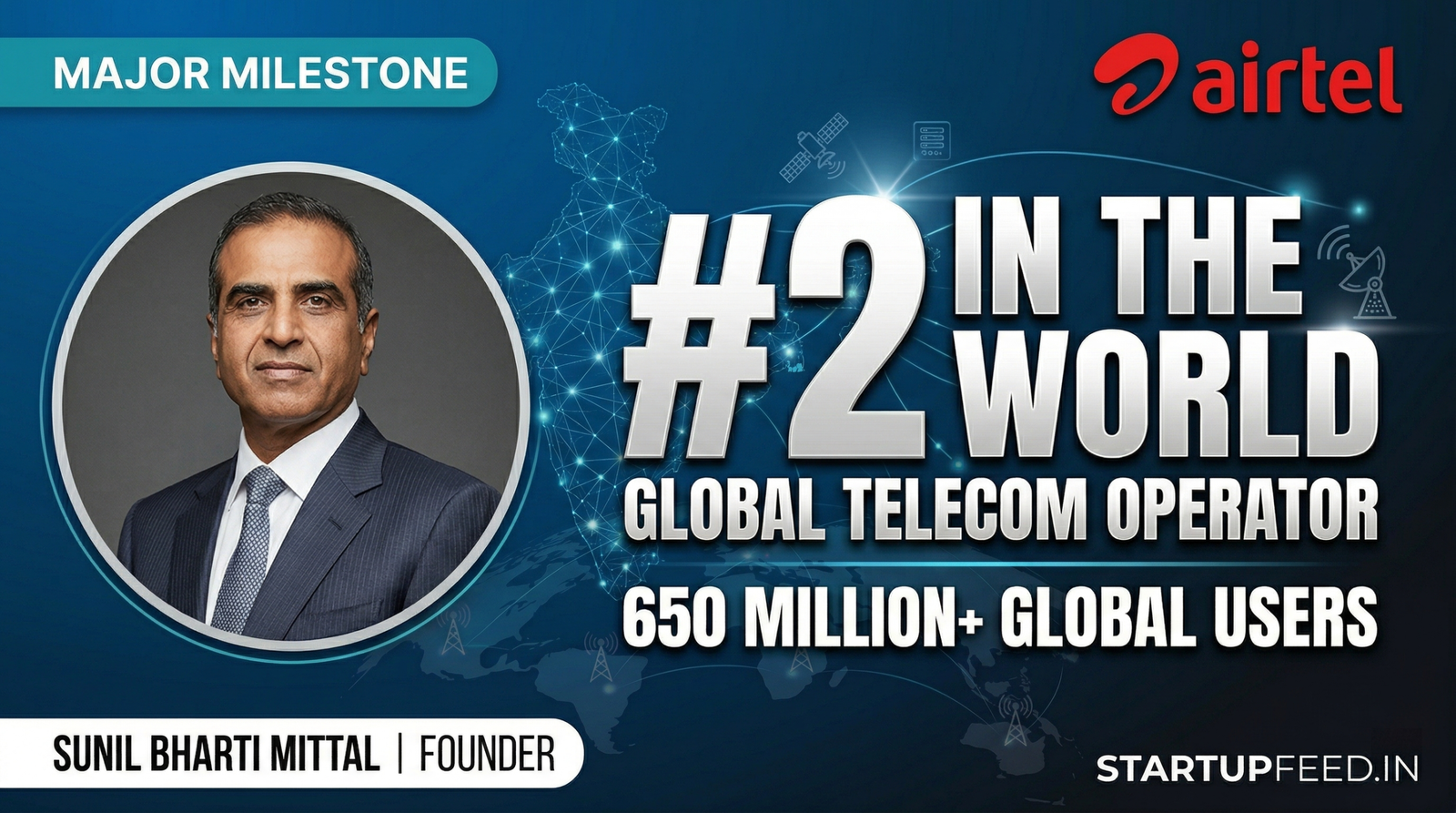
Bharti Airtel has crossed 650 million mobile subscribers globally, achieving a landmark milestone that positions the Sunil Mittal-led telecom giant as the world’s second-largest telecommunications operator by customer base. According to GSMA Intelligence data current as of March 31, 2026, Airtel’s subscriber count now spans 368 million users in India and 179 million across 14 African countries—a geographic split that reveals the company’s bold two-continent strategy. The milestone signals a fundamental shift in Airtel’s competitive positioning: on a global stage, it now outpaces India-only competitor Reliance Jio, which commands 500 million subscribers but operates exclusively within India.
Why This Matters
This positions Airtel as a truly global telecom player, not merely an Indian operator with overseas ventures. The scale unlocks three critical advantages: (1) negotiating power with equipment vendors and technology partners on unprecedented terms, (2) the ability to test innovations across diverse markets—5G in India, financial services expansion across Africa—and redeploy winning models, and (3) investor credibility as a multi-geography, multi-currency revenue engine. However, the growth trajectory matters more than the headline number. Airtel’s expansion is frontloaded in Africa, where margins remain thinner than India’s profitable domestic business.
StartupFeed Insight
| What the numbers reveal: | Airtel’s strategy is explicitly geographic arbitrage—leaning on high-margin India operations to fund Africa’s lower-ARPU (Average Revenue Per User) but scale-hungry expansion. |
| For competitors: | Reliance Jio now faces a unique problem: Airtel’s 650M global scale offers cost advantages India alone cannot match. Jio will need to either enter international markets (unlikely near-term) or double down on India’s profitability moat. |
| For investors: | Airtel’s leverage to acquire or partner with Africa-focused fintech/digital platforms has just strengthened. Expect accelerated deals in Airtel Money ecosystem and cross-border payments. |
| Our prediction: | By 2027, Airtel’s Africa subscriber base will cross 220 million—driven by aggressive Nigeria expansion (already targeting 100M+). India will stabilize at 370-375M as 4G/5G saturates, shifting focus to data and broadband. |
Where the 650 Million Comes From
| Geography | Mobile Subscribers | % of Total | Key Insight |
| India | 368 million | 56.6% | Mature, profitable; includes 13M broadband + 15M Digital TV customers |
| Africa (14 countries) | 179 million | 27.5% | High-growth, lower margins; Airtel Money (52M users) drives fintech expansion |
| Other / Unaccounted | 103 million | 15.8% | Likely includes legacy/deactivated accounts, MVNO arrangements, reconciliation items |
Airtel’s Africa footprint now represents a meaningful portion of global revenue, but profitability remains skewed toward India. The 15.8% gap suggests Airtel counts active + semi-dormant subscribers, or carries legacy data from prior periods.
Global Telecom Rankings: Where Airtel Stands
| Rank | Operator | Subscribers (Millions) |
| 1 | China Mobile (China) | 1,000+ (China only) |
| 2 | Bharti Airtel (India + Africa) | 650 (multi-geography) |
| 3 | Reliance Jio (India only) | 500 (single market) |
| 4 | Vodafone (Europe + Africa) | ~420 |
| 5 | Deutsche Telekom (Europe) | ~380 |
Key Context: Airtel’s 650M global base now exceeds single-market giants when measured by customer count. However, China Mobile generates higher revenue despite fewer customers (operator in wealthier market with higher ARPUs). Airtel’s competitive advantage lies in cost arbitrage and emerging-market scale, not unit economics parity with developed-market operators.
Inside India: Still #2 to Jio
Despite the global #2 milestone, Airtel remains India’s second-largest operator by subscriber count, behind Reliance Jio. With 368 million Indian mobile users, Airtel commands roughly 37.6% of India’s telecom market share (per TRAI data). However, Airtel has built a broader ecosystem: 13 million homes now have Airtel’s fixed broadband (Xstream AirFiber), and 15 million use its Digital TV (IPTV) service. This convergence play—bundling mobile, broadband, and video—differentiates Airtel from Jio’s pure telecom focus and positions it competitively in India’s fast-growing home broadband market.


One overlooked detail: 20% of Airtel’s India base still operates on 2G/3G networks. This represents significant upside opportunity. As these users graduate to 4G/5G, Airtel’s data ARPU should rise, improving margins. Kotak Equities estimates Airtel’s data subscriber base is growing at 9.7% annually—much faster than voice—signaling successful migration toward higher-value customers.
The Africa Story: Where Real Growth Is Happening
Airtel’s 179 million African subscribers span 14 countries, with Nigeria being the crown jewel. Nigeria alone accounts for an estimated 100+ million subscribers, making it Airtel Africa’s single-largest market. Beyond voice and data, Airtel Money has become critical to the Africa strategy—its 52 million users make it the continent’s second-largest mobile money platform (after M-Pesa in Kenya). In Q3 2026, Airtel Money processed over $210 billion in total transaction value, reflecting 36% year-over-year growth and establishing Airtel as a fintech-enabled telecom, not just a connectivity provider.
Why Africa matters strategically: (1) Subscribers are younger, more mobile-first, and less tethered to legacy voice minutes. (2) Data growth is explosive—Nigeria’s data subscribers are growing 15%+ annually. (3) Fintech penetration offers upsell opportunities Airtel’s mature India market cannot replicate. If Airtel can push each African user toward higher-value data + fintech bundles, Africa becomes a profit engine by 2027-2028, not just a volume play.
What Airtel Leadership Says
Achieving the milestone of 650 million customers to be the second largest operator globally is a great responsibility for us to serve our customers better every day. This is why we invest in state-of-the-art technologies to not only provide connectivity but to also deliver a safe network. Our purpose is clear: as we deepen and expand our presence, we will strive to raise the bar on innovation, reliability, and experience so that every customer interaction is an opportunity to earn trust and deliver value connection.”
— Gopal Vittal, Executive Vice Chairman, Bharti Airtel
Notably, Vittal’s statement pivots immediately to responsibility and innovation, not shareholder value. This signals Airtel’s messaging priority: scale must translate to better customer experience, not just higher profits. The emphasis on ‘safe network’ and ‘reliability’ also hints at a subtle dig at competitors (Jio, international players) on service quality—a perennial pain point for Airtel customers historically.
How Airtel Reached 650M: Key Strategic Moves
| Initiative | Geography | Impact |
| 5G Plus + Convergence (FWA + IPTV) | India | Attracts high-value customers, increases ARPU, locks in broadband subscribers |
| Airtel Money Expansion | Africa | 52M users; positions Airtel as fintech player, drives retention & cross-sell |
| AI-powered Spam Alert Service | Nigeria (Africa) | Blocked 205M spam messages in 6 months; differentiates on customer experience |
| Satellite Partnerships (Eutelsat OneWeb, SpaceX Starlink) | India + Africa | Reaches remote/rural areas, future-proofs against 5G limitations in dense markets |
What’s Next: Predictions for 2027
Africa to Cross 220M Subscribers: Nigeria expansion and data-driven growth will push Africa’s base beyond 220 million by end of 2027. Nigeria alone could hit 110-120M, driven by rural expansion and 4G uptake.
Broadband Bundling to Unlock Margins: Airtel’s fixed broadband + IPTV + mobile bundles will penetrate beyond the current 13-15M homes. Target: 25M+ bundled broadband homes by 2027. Each bundle user yields 30-40% higher ARPU than voice-only customers.



Airtel Money to Hit 100M Transacting Users: By 2027, Airtel Money will cross 100 million users, making it competitive with M-Pesa. This positions Airtel as a pan-African fintech, unlocking credit and insurance opportunities.
Possible M&A or JV in Broadband/Fintech: With 650M users and global credibility, Airtel will be an attractive acquirer or JV partner for fiber-first broadband companies in India and Africa-focused fintech platforms. Look for 1-2 strategic deals in 2026-2027.
The Challenges Airtel Won’t Mention
Africa’s Margin Squeeze: Despite 179M subscribers, Africa generates lower revenue and profit per customer. Airtel’s Africa ARPU is estimated at $2-3/month, vs. India’s $4-5+. Until Africa’s data ARPU rises or Airtel Money monetization accelerates, growth will remain volume-heavy, not profit-heavy.
Jio’s Domestic Moat: In India, Reliance Jio remains the market leader with superior spectrum, infrastructure, and margins. Airtel’s #2 position domestically is durable but not improving—India’s subscriber market is now mature. Airtel can only win at the margins (churn reduction, data ARPU growth).
Currency Risk in Africa: Airtel Africa earnings are denominated in Nigerian Naira, Kenyan Shilling, etc. Currency depreciation vs. INR/USD erodes reported profits and makes financial planning volatile. This is rarely discussed but material to shareholder returns.
Capex Intensity: Reaching 650M users required massive infrastructure investment. Maintaining quality across 15 countries strains capex budgets. Airtel’s ability to sustain 5G rollout in India while upgrading networks across Africa is a multi-year, multi-billion-dollar challenge.
Bharti Airtel was founded in 1995 and is led by Sunil Bharti Mittal (Chairman) and Gopal Vittal (Vice Chairman & MD). The company operates across 15 countries, with Airtel Africa established as a separate public company in 2019. Airtel has consistently invested in emerging technologies—5G in India, AI-powered security, satellite partnerships—positioning itself as a digitally-first telecom. The company’s shift from voice-centric to convergent (mobile + broadband + fintech) is among the most ambitious in global telecom.
Liked this story? Follow StartupFeed on Google so our reporting reaches you first.