

Quick Take:
|
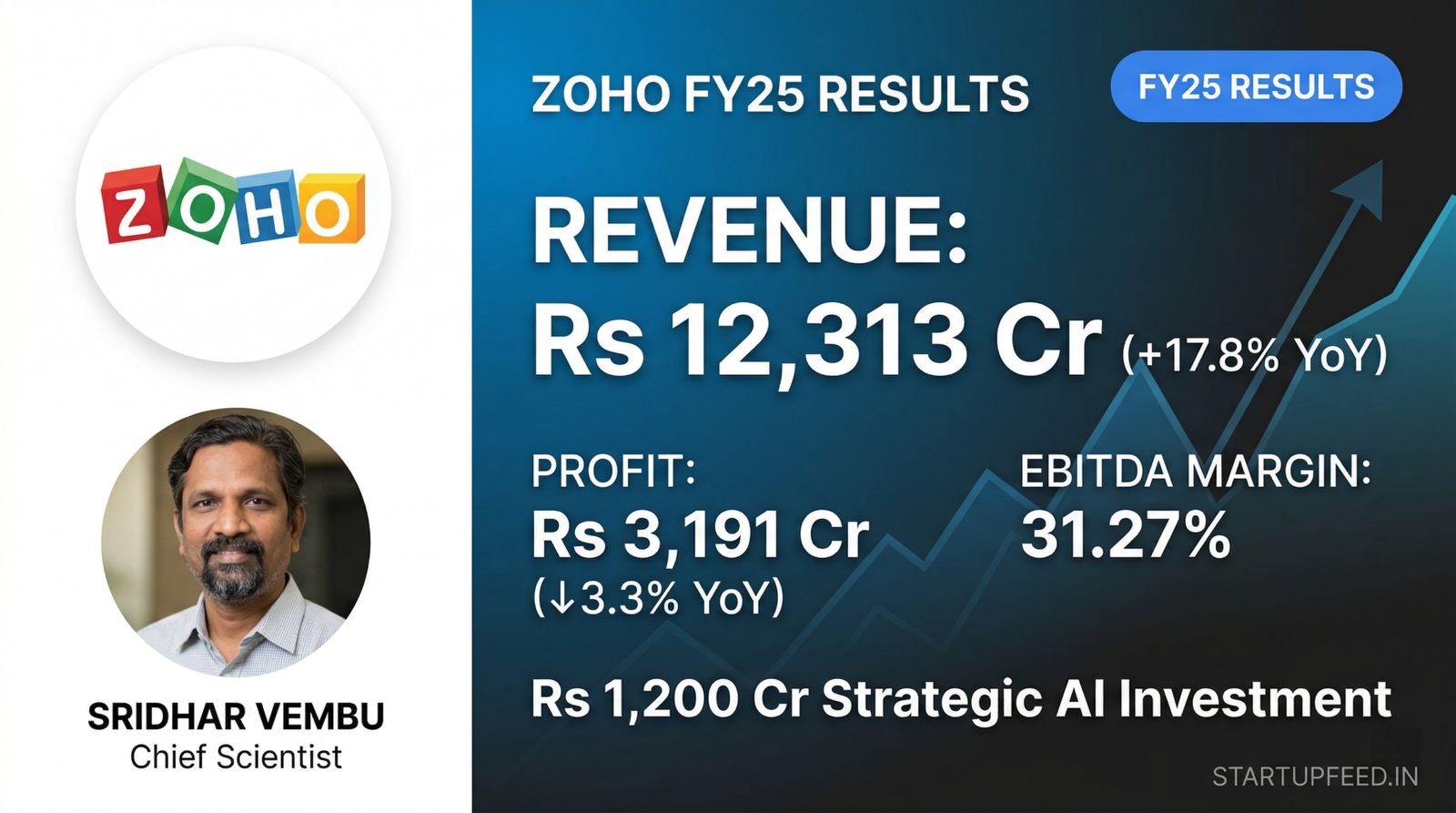
Zoho Corporation reported operating revenue of Rs 12,313 Cr in FY25, up 17.8% YoY from Rs 10,456 Cr in FY24 — making it the first bootstrapped startup in India to cross the Rs 12,000 Cr revenue mark. Net profit, however, dipped 3.3% to Rs 3,191 Cr from Rs 3,299 Cr, as total expenses surged 30.5% to Rs 9,216 Cr — a signal that Zoho is aggressively investing in AI infrastructure and its domestic market ambitions.
The numbers suggest Zoho is making a deliberate trade: margin compression today for technology moat tomorrow. With Rs 1,880 Cr in cash, zero external debt, and a profitable core business, the company can afford this strategy in a way no VC-backed competitor can — and that is exactly the point.
| StartupFeed Insight
The key number: Rs 0.75 — the cost to earn Re 1 of revenue in FY25, up from Rs 0.62 in FY23. Zoho is getting less efficient per rupee earned, but its absolute profit (Rs 3,191 Cr) is larger than most Indian unicorns’ total revenue. What’s improving:
What’s concerning:
Profitability math: At current revenue trajectory (+17–18% annually), Zoho will cross Rs 14,500 Cr in FY26. If expense growth moderates to match revenue growth, EBITDA margins will recover to 35–37% by FY27 — but only if AI capex plateaus. |
Revenue Breakdown
| Segment | FY25 Revenue | % of Total | YoY Est. |
| Zoho Suite (CRM, Mail, Books, etc.) | Rs 7,051 Cr | 57% | ~+15% |
| ManageEngine (IT Management) | Rs 4,863 Cr | 39% | ~+20% |
| Services | Rs 399 Cr | 3% | — |
| Total Operating Revenue | Rs 12,313 Cr | 100% | +17.8% |
| Other Income (Interest + Investments) | Rs 1,231 Cr | — | — |
| Total Income | Rs 13,544 Cr | — | — |
ManageEngine is Zoho’s fastest-scaling division, growing at an estimated 20%+ — its IT security and endpoint management tools are gaining ground against CrowdStrike and ServiceNow in mid-market enterprises globally. Zoho Suite at 57% remains the dominant revenue engine, with Zoho CRM competing directly against Salesforce in SMB and mid-market segments across 150 countries.
Expense Analysis
| Category | FY24 (Est.) | FY25 | Change | % of Revenue |
| Employee Benefit Expenses | ~Rs 3,800 Cr | ~Rs 4,500 Cr | +18% | ~36% |
| AI & Data Centre Capex | ~Rs 500 Cr | ~Rs 1,200 Cr | +140% | ~10% |
| Marketing & Advertising | ~Rs 600 Cr | ~Rs 750 Cr | +25% | ~6% |
| Legal, Professional & Other | ~Rs 200 Cr | ~Rs 250 Cr | +25% | ~2% |
| Tax Outgo | Rs 850 Cr | Rs 1,112 Cr | +31% | 9% |
| Total Expenses | Rs 7,062 Cr | Rs 9,216 Cr | +30.5% | 74.8% |
The stand-out cost driver is AI infrastructure: Zoho spent approximately Rs 1,200 Cr in FY25 rebuilding its entire product stack around generative AI. Zia — Zoho’s AI assistant — now integrates across all 55+ applications in Zoho One. That required GPU capacity, in-house model training, and ML engineering talent acquisition. The EBITDA margin erosion from 44.55% (FY23) to 31.27% (FY25) is almost entirely explained by this strategic AI bet.
Key Metrics
| Metric | FY23 | FY24 | FY25 | Direction |
| Revenue (Rs Cr) | 8,703 | 10,456 | 12,313 | ↑ |
| Net Profit (Rs Cr) | 2,836 | 3,299 | 3,191 | ↓ |
| EBITDA Margin | 44.55% | ~38% | 31.27% | ↓ |
| ROCE | 31.61% | ~22% | 16.85% | ↓ |
| Cost per Re 1 Revenue | Re 0.62 | Re 0.68 | Re 0.75 | ↑ (worse) |
| Cash Balance (Rs Cr) | ~500 | ~710 | 1,880 | ↑ |
| Loss as % of Revenue | — | — | — (profitable) | — |
Three-Year Trajectory
| Metric | FY22 | FY23 | FY24 | FY25 | CAGR |
| Revenue (Rs Cr) | 6,711 | 8,703 | 10,456 | 12,313 | +22.4% |
| Net Profit (Rs Cr) | 2,749 | 2,836 | 3,299 | 3,191 | +5% |
| Profit Margin | 41% | 32.6% | 31.5% | 25.9% | Compressing |
Revenue CAGR of 22.4% over three years is exceptional for a company of this scale — especially one that has never raised a single rupee of external capital. The profit margin compression, while notable, reflects a conscious strategy rather than operational distress.
Geographic Split
| Region | % of Revenue | FY25 (Rs Cr Est.) |
| North America | 41% | ~Rs 5,048 Cr |
| Asia | 30% | ~Rs 3,694 Cr |
| Europe | ~20% | ~Rs 2,463 Cr |
| Rest of World | ~9% | ~Rs 1,108 Cr |
North America at 41% reflects Zoho’s deepest enterprise penetration — ManageEngine’s IT management tools dominate in US mid-market IT departments. Asia at 30% marks a structural shift: for the first time, government contracts and domestic enterprise wins in India are material contributors to Zoho’s top line, not just a rounding error.
How It Compares
| Company | Revenue | Profit/Loss | Profit Margin | Status |
| Zoho (FY25) | Rs 12,313 Cr | Rs 3,191 Cr profit | 25.9% | Profitable, bootstrapped |
| Freshworks (FY25 est.) | ~Rs 5,800 Cr | ~Rs -350 Cr loss | Loss-making | NASDAQ-listed |
| Salesforce India (est.) | ~Rs 3,200 Cr | N/A | N/A | US MNC subsidiary |
| HubSpot India (est.) | ~Rs 1,100 Cr | N/A | N/A | US MNC subsidiary |
Zoho’s Rs 3,191 Cr net profit is more than double Freshworks’ total India revenue — a striking comparison given both are Chennai-headquartered SaaS companies. The difference: Zoho stayed bootstrapped, Freshworks raised $400 Mn+ and IPO’d. Two wildly different paths to scale.
Leadership Transition
| Sridhar Vembu → Chief Scientist (R&D and AI focus — steps back from day-to-day operations)
Shailesh Kumar Davey → Group CEO (operational continuity — long-time Zoho leader) Vembu’s move to Chief Scientist is the most strategically telling event of FY25. An internal note attributed to him reportedly stated: “If we do not own our AI stack end-to-end by 2027, we will be renting intelligence from Microsoft and Google forever.” The FY25 expense surge is the operational manifestation of that philosophy. |
What’s Next
Our prediction: Zoho will cross Rs 14,500 Cr in revenue in FY26 and begin margin recovery by FY27 as AI capex plateaus. The company’s government cloud push — already serving 16.68 lakh official email accounts — positions it for Rs 1,000+ Cr in Indian public sector contracts by FY27.
Watch for ZohoPay and the Arattai messaging app: Zoho’s first serious consumer-facing products. If ZohoPay gains traction among its 700,000+ business customers, it could add Rs 500–800 Cr in fintech revenue by FY28 — and change the company’s story entirely.
What do you think? Can Zoho defend its margins while building its own AI stack? Tell us on X @StartupFeed_in

