



QUICK TAKE:
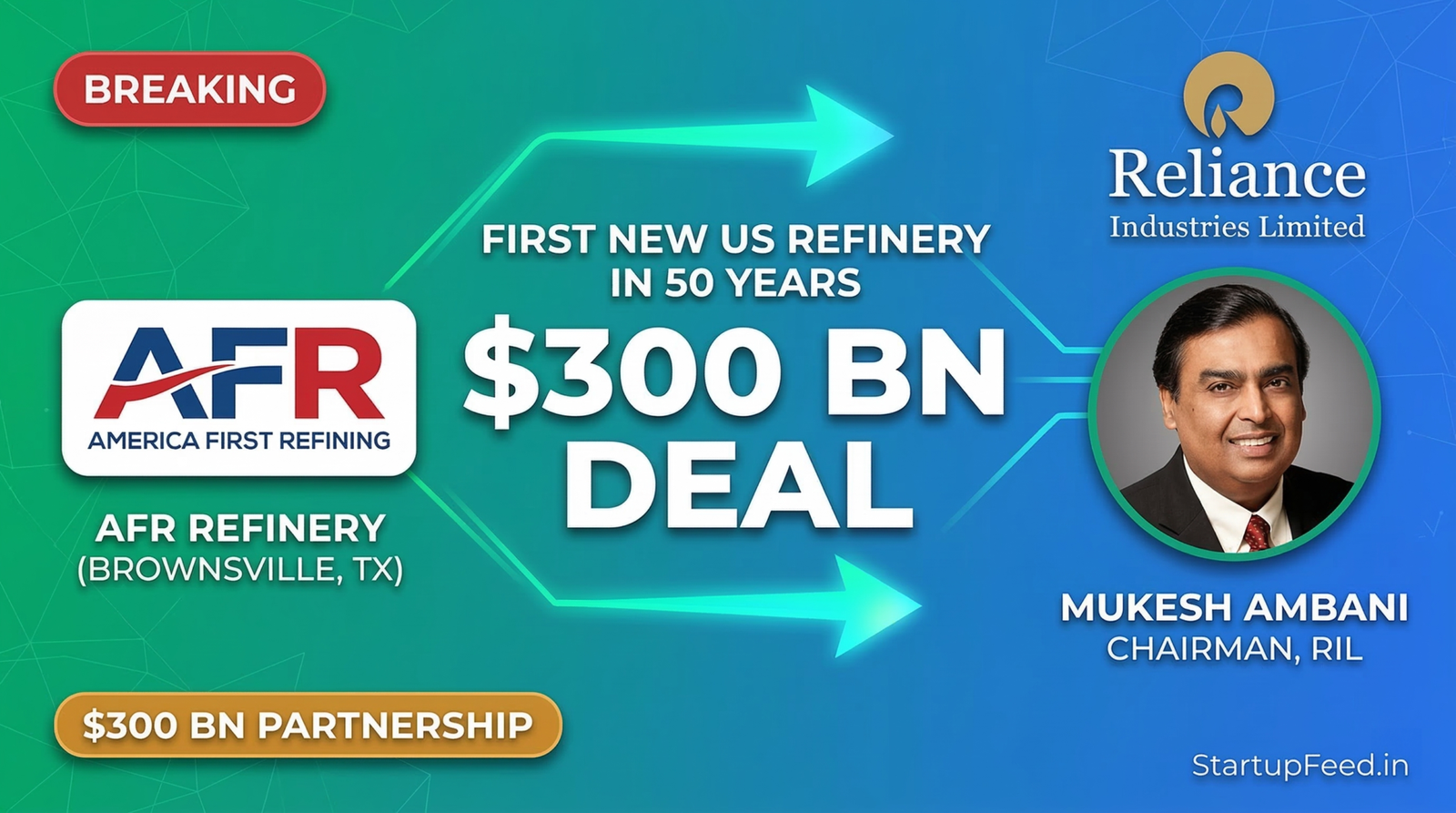
- Project: America First Refining (AFR) — first new US oil refinery in ~50 years; location: Port of Brownsville, South Texas (deep-water port)
- Deal size: $300 billion — described by Trump as ‘the biggest deal in US history’; the figure refers to the total economic value of the 20-year offtake (1.2 Bn barrels @ $125 Bn + 50 Bn gallons refined products @ $175 Bn)
- India angle: Reliance Industries (Mukesh Ambani) cited by Trump as the investment partner; AFR confirmed a nine-figure investment from a ‘global supermajor’; 20-year binding offtake signed
- Caveat: Reliance Industries has NOT filed a regulatory disclosure (SEBI/NSE) confirming its role as of March 11, 2026 morning. AFR’s press release names a ‘global supermajor’ without naming Reliance explicitly. Trump named Reliance on Truth Social.
- What it processes: 100% US light shale oil (47° API) from the Permian Basin — 60 Mn barrels/year capacity; none of the feedstock is imported crude
- Groundbreaking: Q2 2026 (originally stated as April 2026) — site already prepared under predecessor company Element Fuels (now rebranded America First Refining)
- RIL stock reaction: Surged up to +1.78% in early trade on NSE on March 11, 2026, touching Rs 1,434 — highest level in over a month; closed lower previous day at Rs 1,410.90
Strategic context: Announcement comes as West Asia war has disrupted Strait of Hormuz, spiked crude above $120/barrel, and put US energy policy squarely in the political spotlight
Project history: Traces to Element Fuels Holdings (Dallas-area startup) — announced June 2024 that it had completed site prep and secured permits for a ~160,000 bpd refinery; same site, now rebranded under America First Refining
Trump’s Truth Social Post: In His Own Words
🇺🇸 DONALD J. TRUMP — TRUTH SOCIAL | March 10, 2026
America is returning to REAL ENERGY DOMINANCE!
Today I am proud to announce that America First Refining is opening the FIRST new U.S. Oil Refinery in 50 YEARS in Brownsville, Texas.
THIS IS A HISTORIC $300 BILLION DOLLAR DEAL — THE BIGGEST IN U.S. HISTORY, A MASSIVE WIN for American Workers, Energy, and the GREAT People of South Texas!
It is because of our America First Agenda, streamlining Permits, and lowering Taxes, that have attracted Billions of Dollars in Deals coming back to our Nation.
A new Refinery at the Port of Brownsville, will fuel U.S. Markets, strengthen our National Security, boost American Energy production, deliver Billions of Dollars in Economic impact, and will be THE CLEANEST REFINERY IN THE WORLD.
It will power Global Exports, and bring THOUSANDS of long overdue Jobs and Growth to a Region that deserves it.
Thank you to our partners in India, and their largest privately held Energy Company, Reliance, for this tremendous Investment.
This is what AMERICAN ENERGY DOMINANCE looks like. AMERICA FIRST, ALWAYS!
— Donald J. Trump, Truth Social
In a single Truth Social post on the evening of March 10, 2026, US President Donald Trump announced what he called the biggest economic deal in American history — the construction of the first new oil refinery in the United States in approximately 50 years. The location: the Port of Brownsville, at the southern tip of Texas, on the US-Mexico border. The developer: America First Refining (AFR). The named Indian partner: Reliance Industries, controlled by Mukesh Ambani.
The announcement arrived at a moment of maximum geopolitical and economic tension in global energy markets. Oil had briefly crossed $120 per barrel in the days preceding the announcement, driven by the Iran-Israel-US conflict that has severely disrupted Strait of Hormuz shipping. The AAA national average US gasoline price stood at $3.54 per gallon at the time of the announcement — up more than 20% from pre-conflict levels. Trump’s refinery announcement was simultaneously a piece of energy policy, a piece of political messaging, and a signal to global investors that the ‘America First’ energy agenda has teeth.
For India — and particularly for Reliance Industries investors — the announcement raises a question that Mukesh Ambani’s company has not yet officially answered: Is Reliance Industries, the operator of the world’s largest oil refinery complex in Jamnagar, Gujarat, now also the financial and offtake anchor of the first new US refinery in half a century?
The Deal: Complete Project Specifications
| Parameter | Details |
|---|---|
| Project name | America First Refining (AFR) — formerly known as Element Fuels Holdings |
| Location | Port of Brownsville, South Texas — a deep-water port enabling both domestic distribution and global exports |
| Project developer / operator | America First Refining (AFR); President: Trey Griggs; Executive team with collective 100+ years in chemical and refining industries, having managed ~$40 Bn in complex capital projects |
| Investment / deal value | $300 billion — Trump’s framing covers the full 20-year economic value of the project: $125 Bn in raw shale oil processed + $175 Bn in refined products produced = $300 Bn total trade impact |
| Investment partner (as named by Trump) | Reliance Industries Ltd. (Mukesh Ambani) — cited as a ‘nine-figure’ investment at a ‘ten-figure’ project valuation; AFR’s press release says ‘global supermajor’ without naming Reliance explicitly |
| 20-year offtake agreement | Binding 20-year agreement for the same ‘global supermajor’ to purchase, process, and distribute the refinery’s output — Bloomberg confirmed offtake counterparty is Reliance |
| Refinery type | Specifically engineered to process US light shale oil (47° API) — Permian Basin crude; does NOT require imported crude; designed for shale surplus |
| Annual throughput capacity | ~60 million barrels per year (~160,000 barrels per day) |
| 20-year total crude volume | 1.2 billion barrels of US light shale oil; valued at ~$125 billion at current prices |
| 20-year refined product output | ~50 billion gallons of refined products (gasoline, diesel, jet fuel); valued at ~$175 billion |
| Refinery design claim | “The cleanest refinery in the world” — Trump’s characterisation; AFR cites advanced emission-reduction technologies |
| Jobs impact | Thousands of construction and permanent jobs; wages described as exceeding market averages; educational and apprenticeship partnerships planned for South Texas region |
| US shale surplus context | From 2014–2024, the US exported ~10 Bn barrels of crude while importing ~28 Bn barrels (at cost of $1.8 trillion). Many US refineries are configured for heavier imported crude — not optimised for US light shale oil. AFR is purpose-built for the shale surplus. |
| Groundbreaking | Q2 2026 (April 2026 stated in some reports) |
| Site status | Site preparation and permits already completed under Element Fuels Holdings (announced June 2024); Element Fuels website now redirects to America First Refining |
| Previous comparable failure | Arizona Clean Fuels Yuma (mid-2000s) — attempted to build new US refinery south of Phoenix; failed to secure financing. AFR has the advantage of Trump administration permit streamlining and named institutional investment. |
Reliance Industries: The India Angle
Mukesh Ambani’s Reliance Industries is not a passive financial investor in energy projects. It operates the world’s largest oil refining complex at Jamnagar, Gujarat — a twin-refinery site with combined capacity of approximately 1.4 million barrels per day, producing gasoline, diesel, jet fuel, naphtha, and petrochemicals for export to over 100 countries. Reliance’s market capitalisation stands at approximately $206 billion (LSEG data), making it India’s most valuable publicly listed company.
The Brownsville investment — if confirmed in its full form by Reliance — would represent the most significant overseas energy infrastructure commitment by an Indian company in history. It would also be strategically logical: Reliance already understands complex refinery economics, already has buyer relationships globally, and the 20-year offtake agreement would give it a secure, long-term US shale oil supply chain at a time when Gulf supply routes are unpredictable.
| Aspect | Reliance Industries (India) | America First Refining (US) | Strategic Fit |
|---|---|---|---|
| Refining expertise | World’s largest refinery complex at Jamnagar, Gujarat (1.4 Mn bpd combined); processes both heavy and light crude | New facility designed exclusively for US light shale (47° API); 60 Mn bpd capacity | Reliance’s engineering and operational expertise in large-scale refinery operations is unmatched — directly applicable to AFR ramp-up |
| Market capitalisation | ~$206 billion (LSEG, March 2026) | Private; ten-figure project valuation | Reliance can absorb a nine-figure investment without structural balance-sheet strain |
| Investment size (confirmed) | Nine-figure (AFR press release) — specific amount undisclosed; Reliance has not filed SEBI/NSE regulatory disclosure as of March 11, 2026 AM | Nine-figure from ‘global supermajor’ | Pending official Reliance confirmation — key risk for investors currently buying the announcement |
| Offtake commitment | Bloomberg confirms 20-year offtake; Reliance would purchase, process and distribute US shale-derived refined products | 20-year binding offtake with same ‘global supermajor’ | For Reliance, this is a global product offtake play — its existing customer network in Europe, Asia and Middle East makes it well-positioned to distribute AFR’s output |
| Geopolitical positioning | Simultaneously announced on March 10: Reliance filed exchange intimation confirming it is maximising LPG output at Jamnagar to support India’s domestic gas supply — running refinery teams around the clock amid Middle East conflict | Brownsville refinery runs on 0% imported crude — insulated from Hormuz disruptions | Reliance is positioning itself on BOTH sides of the energy supply crisis: stabilising India’s domestic supply and investing in US energy independence infrastructure |
| Stock reaction (March 11, 2026) | RIL surged +1.78% in early trade to Rs 1,434 on NSE — highest level in over a month; YTD stock is -10.45% from Jan 1 highs | N/A (private) | Market is pricing in the announcement positively despite lack of Reliance’s own regulatory disclosure — risk: if RIL files a denial or clarification, reversal is possible |
| US-India trade context | US Treasury Secretary Bessent issued 30-day waiver on March 6, 2026 allowing Indian refiners (including Reliance) to purchase Russian crude stranded at sea amid Hormuz disruptions | US administration actively managing India energy relationship | The Brownsville investment fits within a broader US-India energy cooperation framework that has been strengthening under the Trump administration |
The one significant caveat that investors and journalists must hold onto: as of the morning of March 11, 2026, Reliance Industries Limited has NOT filed any regulatory disclosure with SEBI, NSE or BSE confirming its role in the Brownsville project. Trump named Reliance specifically on Truth Social; AFR’s own press release refers to a ‘global supermajor’ without naming Reliance. Bloomberg’s reporting confirms the offtake partner is Reliance. But India’s listed-company disclosure framework requires RIL to make a formal regulatory filing for a material transaction of this scale. That filing has not appeared. Investors are currently acting on Trump’s word + Bloomberg’s reporting, not on a confirmed corporate disclosure.
StartupFeed Insight — Five Things This Deal Reveals About Global Energy and the India-US Axis
- The $300 billion number is a 20-year economic value figure — not a construction cost or upfront investment.
Trump’s characterisation of this as a ‘$300 billion deal’ requires a precise reading. This is not $300 billion in construction capex or even upfront investment. It is the combined economic value of the 20-year programme: $125 billion in crude oil purchased (1.2 Bn barrels × ~$100/barrel) + $175 billion in refined products sold (50 Bn gallons × ~$3.50/gallon). The actual construction cost of a 160,000 bpd refinery typically runs $5–15 billion in 2024 cost terms. The nine-figure Reliance investment is likely in the $100–999 million range. The $300 billion is a political framing of the total project lifetime economic footprint — accurate in one sense, very different in another. Readers consuming this deal should understand the distinction.
- This is Reliance’s most consequential overseas investment — and it bets on US shale surplus lasting 20+ years.
A 20-year offtake commitment tied to US light shale oil is a macro energy bet. Reliance is implicitly forecasting that the Permian Basin will continue to produce at current or higher rates for the next two decades, that US shale economics will remain competitive with OPEC oil, and that the global demand for refined petroleum products (gasoline, diesel, jet fuel) will remain strong through 2046. All three of these assumptions are debatable. Peak oil demand forecasts from IEA suggest global oil consumption may plateau or decline in the 2030s due to EV adoption. Reliance itself has been investing in clean energy (green hydrogen, solar) through its new energy division. The Brownsville bet is a long-duration fossil fuel commitment at a moment when the energy transition narrative is directionally pointing the other way. It is a high-conviction, high-stakes macro call by Mukesh Ambani on the longevity of refined fuel demand.
- The timing is not coincidental — this is Ambani playing the US-India relationship at the highest level.
The Brownsville announcement comes within days of US Treasury Secretary Bessent issuing a 30-day Russian crude waiver specifically for Indian refiners. It comes as India is actively lobbying the US for energy supply relief amid the Hormuz crisis. It comes as PM Modi’s ‘Viksit Bharat by 2047’ narrative requires India’s largest private company to demonstrate global ambition. And it comes as Trump’s administration is actively using foreign investment announcements (Apple, Toyota, Masayoshi Son’s SoftBank) as political wins for the ‘America First’ agenda. Reliance’s willingness to be the named Indian partner in Trump’s biggest energy deal announcement gives both sides a politically useful headline: Trump gets ‘India is investing in America’; India gets ‘Ambani is at the table with the most powerful government in the world.’
- The missing Reliance regulatory disclosure is the biggest risk in this story right now.
Reliance Industries Limited is a SEBI-regulated listed company with a market cap above Rs 19 lakh crore. Any material investment, joint venture, or long-term commercial agreement of this scale — a nine-figure investment and a $300 billion 20-year offtake — would typically require a Regulation 30 (LODR) filing on BSE/NSE. As of March 11 morning, no such filing has been made. RIL’s most recent exchange filings relate to the Jamnagar LPG maximisation and an unrelated Pahadi Local brand acquisition. The absence of a regulatory filing means investors trading RIL on this news are taking on disclosure risk. The most likely outcome is that a filing appears during Indian market hours on March 11 or 12. But if the filing materially differs from Trump’s characterisation — or clarifies that Reliance’s role is more limited than implied — the stock reaction could reverse.
- For Indian startups in clean energy and energy tech: this deal signals that fossil fuel infrastructure is back at the centre of global energy investment.
In the 2021–2023 venture capital supercycle, clean energy, green hydrogen and EV startups attracted record funding. The narrative was that fossil fuel infrastructure was stranded asset territory. The Brownsville deal — combined with the Hormuz crisis, $120/barrel oil, and Trump’s explicit ‘America First’ energy agenda — signals a significant counter-narrative reassertion: refinery capacity, shale production, and conventional energy security are back as core investment priorities for the world’s largest energy companies and governments. For Indian energy tech startups, this creates a complex landscape: the long-term EV and clean energy transition thesis remains structurally intact, but the medium-term capital flows and government priorities (including India’s own push to maximise LPG output from Jamnagar amid the Hormuz crisis) are firmly back in conventional energy territory. Founders and investors in Indian clean energy need to navigate a 3–5 year window where the conventional energy counter-cycle is in full force.
Reliance’s Dual Position: Jamnagar Running at Maximum + Brownsville Investment
One of the most striking details of March 10, 2026, is that Reliance Industries was simultaneously in two very different postures on the same day:
| Action | What It Signals |
|---|---|
| Filed exchange intimation (March 10, 2026): Reliance is maximising LPG output at Jamnagar complex ‘around the clock’ to support India’s domestic gas supply amid the Middle East conflict | Reliance as India’s energy security backbone — responding to the domestic LPG crisis by running its Jamnagar refinery at maximum LPG production capacity to prevent further household supply disruption |
| Named by Trump (March 10, 2026) as the investment partner in America’s first new refinery in 50 years — a 20-year, $300 billion project built on US shale oil that requires zero imported crude | Reliance as a US energy independence enabler — investing in infrastructure specifically designed to reduce America’s import dependency, while simultaneously sitting on the world’s largest import-dependent refinery at Jamnagar |
| RIL stock +1.78% on March 11, 2026 NSE open | Market interpreting the Brownsville deal as a positive signal for Reliance’s future revenue diversification and global positioning, despite YTD stock weakness (-10.45%) |
| No SEBI/NSE regulatory disclosure filed as of March 11, 2026 AM | Either the deal is still being structured (disclosure pending), or Reliance’s role is different in scope from Trump’s characterisation (disclosure will clarify). Both scenarios are possible. |
What’s Next: Five Signals to Watch
- Reliance SEBI/NSE regulatory disclosure: The most important near-term signal. Watch for a Regulation 30 LODR filing from Reliance Industries on BSE/NSE — likely within 24–48 hours — that either confirms the investment and offtake terms or clarifies the exact scope of its role. This filing will set the factual record and determine whether the RIL stock move holds.
- AFR groundbreaking (Q2 2026): America First Refining has stated Q2 2026 (April) for groundbreaking. This is the first physical milestone that will test whether the announcement translates to actual construction. Large US refinery projects have historically stalled at permitting and financing stages.
- Oil price trajectory post-Hormuz: The Brownsville refinery is specifically designed for US shale oil — making it structurally independent of Gulf supply disruptions. But its economic viability depends on US light crude remaining competitively priced vs imported alternatives. Watch West Texas Intermediate (WTI) crack spreads and US shale production volumes as key viability indicators.
- US Congress and regulatory review: A new 160,000 bpd refinery requires significant environmental permits, NEPA review, and state regulatory approvals. Trump has explicitly cited ‘streamlining permits’ as the policy enabler. Watch for any environmental or community opposition from Brownsville-area groups or Texas state regulatory actions.
- India-US energy cooperation expansion: The Reliance-AFR deal sits within a broader India-US energy cooperation framework that already includes the Russian crude waiver (Bessent, March 6). Watch for whether this deal is formalised as part of a broader Modi-Trump bilateral energy agreement — or whether it remains a private sector transaction with government optics.

