

| Quick Take: |
|
|
|
|
|
|
India’s vegan leather market stood at Rs 31,396 Cr ($3.6 Bn) in 2024 and is on course to reach Rs 45,349 Cr ($5.2 Bn) by 2033 at a 4.03% CAGR — but that headline number hides a faster-moving sub-story: a three-tier ecosystem of D2C-native Indian startups, incoming global vegan brands, and legacy giants like Bata, Gucci, and Adidas is forming simultaneously, compressing what might have been a decade-long transition into a 3–5 year market reshaping.
This positions India uniquely — not just as a consumer market for vegan leather, but as a raw-material originator. Coconut water waste, banana crop fibre, sugarcane bagasse, and pineapple leaf extract are agricultural by-products India generates at industrial scale. Bio-materials startups like Malai and Banofi are converting waste streams into premium materials — something global luxury houses are beginning to source directly.
| StartupFeed Insight — What India’s Vegan Leather Boom Really Means |
| What the numbers say: India’s $5.2 Bn vegan leather market is not a niche play — it is a structural migration of a Rs 31,396 Cr (2024) synthetic leather industry toward bio-based materials, driven by ESG compliance pressure from the same luxury brands (Gucci, Hermès, BOSS) that once defined status through animal hide.
What this means for you: If you’re a founder: The raw material moat is India’s structural advantage — coconut water waste, banana crop waste, sugarcane bagasse are abundant and underpriced. A bio-materials company solving scalability wins the B2B supply contract before the D2C brand wins the consumer. If you’re an investor: Zouk’s $14.5 Mn raise at ~$50 Mn valuation is early-stage by global comps. The 4.03% CAGR understates bio-leather’s sub-segment which is growing at 8%+. A Series A into a material-science + brand hybrid is where the alpha sits. If you’re an employee in fashion retail: Allen Solly, Bata, and Hidesign now have vegan lines. This is not a pilot — it is a category shift. Upskilling in sustainable materials sourcing is no longer optional. Our prediction: By FY28, at least 3 Indian vegan leather D2C brands will cross Rs 200 Cr in revenue and one will file a DRHP. The consolidation will begin in bio-materials manufacturing — expect 2–3 acquisitions of Malai-type material companies by global luxury houses before 2030. |
The Market — Size, Structure, and Speed
The Rs 31,396 Cr (2024) figure covers India’s synthetic leather market broadly — PVC, PU, and emerging bio-based alternatives. The 4.03% CAGR is the composite rate. The bio-based sub-segment is growing at 8%+ CAGR globally, with India’s share accelerating as production costs decline and ESG procurement mandates from European luxury buyers force supply chain upgrades.
| Market Metric | Value | Source |
|---|---|---|
| India Synthetic Leather Market (2024) | Rs 31,396 Cr ($3.6 Bn) | IBEF |
| India Synthetic Leather Market (2033 proj.) | Rs 45,349 Cr ($5.2 Bn) | IBEF |
| CAGR (2025–2033) | 4.03% | IBEF |
| Global Plant-Based Leather Market (2024) | $79 Mn — growing to $125 Mn by 2030 | MarkNtel Advisors |
| Global Plant-Based CAGR | ~8% (2025–2030) | MarkNtel Advisors |
| India Leather Goods Market (2024) | $13.4 Bn → $20.1 Bn by 2033 | Industry reports |
| Traditional Leather CO2 per sq m | 110 kg CO2e | Environmental studies |
| Vegan Leather CO2 per sq m | 15.8 kg CO2e — 86% lower | Environmental studies |
India’s Three-Tier Vegan Leather Ecosystem
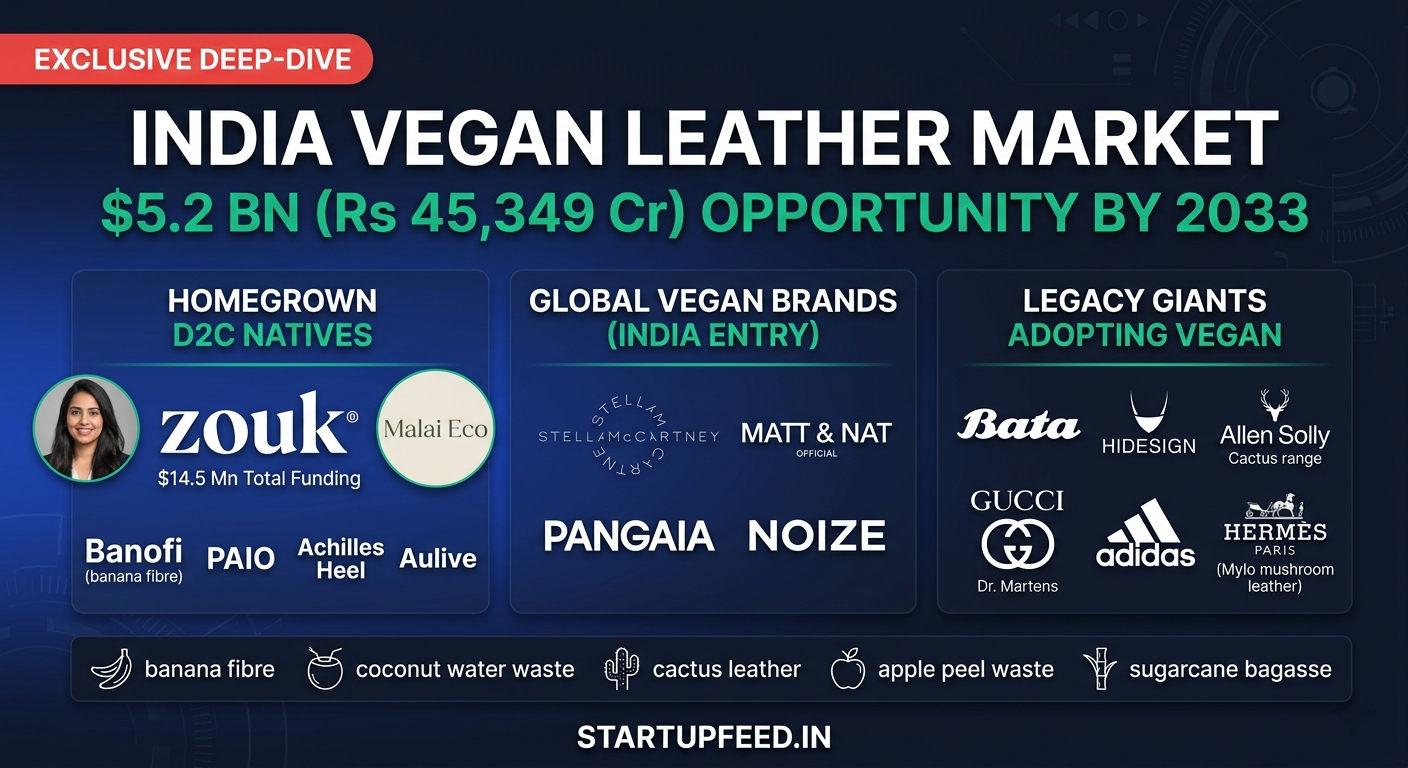
The infographic maps 20+ brands across three distinct categories — each with different business logic, consumer, and investor profile:
| Segment | Key Indian Brands | Business Model | Stage |
|---|---|---|---|
| New-Age D2C / Digital-First | Zouk, Achilles Heel, A Big Indian Story, Aulive, PAIO, Riti, Malai | DTC + marketplace (Myntra, Nykaa, own site) | Series A–B; Zouk most funded |
| Global Vegan Brands (India entry) | Pangaia, Matt & Nat, Will’s Vegan Store, Stella McCartney, Noize, Vessi, nae, BHAVA, Beyond Skin | Premium D2C + select multi-brand retail | Established global; India market entry phase |
| Legacy Brands Adding Vegan Lines | Bata, Hidesign, Allen Solly, BOSS, Gucci, New Balance, Adidas, Hermès, Dr. Martens | Retail + e-commerce; vegan as sub-range | Pilot to mainstream — validation complete |
Tier 1 — The D2C Natives: India’s Homegrown Vegan Leather Brands
Zouk is the standout funded player. Founded in 2015 by Disha Singh and Pradeep Krishnakumar, the Mumbai-based brand raised $10 Mn (Rs 840 Cr) in Series B led by Aavishkaar Capital, with participation from Stellaris Venture Partners, Titan Capital, and Sharrp Ventures — bringing total funding to $14.5 Mn. Post-round valuation: ~$50 Mn (Rs 420 Cr). All products use 100% vegan leather sourced locally in India.
| Brand | Founded | What They Make | Vegan Material | Funding Status |
|---|---|---|---|---|
| Zouk | 2015 | Bags, wallets, luggage | 100% vegan leather (local sourcing) | $14.5 Mn raised; Series B 2024 |
| Malai (Malai Eco) | 2018 | Biomaterial supplier (B2B) | Bacterial cellulose from coconut water | Bootstrapped; 20+ brand clients |
| A Big Indian Story | 2016 | Handbags, accessories | Vegan leather + ethical fabrics | D2C; undisclosed |
| Aulive | 2019 | Accessories, bags | Plant-based & cruelty-free | D2C; undisclosed |
| PAIO | 2020 | Footwear | Vegan leather shoes | D2C; undisclosed |
| Achilles Heel | 2019 | Footwear | Vegan leather | D2C; undisclosed |
| Riti | 2020 | Fashion accessories | Sustainable materials | D2C; undisclosed |
| Banofi | 2021 | Biomaterial (banana fibre) | Banana crop waste → leather | Early-stage; B2B material supplier |
Malai deserves special attention as a material-science play. Founded by Zuzana Gombosova and Susmith Suseelan, the Bangalore-based startup grows bacterial cellulose using coconut water waste from South Indian processing units. A single unit providing 4,000 litres of coconut water daily yields 320 sq metres of Malai material annually — currently supplying 20+ domestic and international brands. Malai is the kind of IP-heavy, supply-chain-upstream company that global luxury houses will eventually seek to acquire.
Tier 3 — Legacy Giants Move In: Validation or Disruption Risk?
When Gucci, Hermès, Adidas, BOSS, Bata, Allen Solly, New Balance, and Dr. Martens simultaneously add vegan leather lines, it is no longer a brand experiment. It is a category confirmation. For Indian D2C brands, this is simultaneously the strongest validation and the sharpest competitive warning they have received.
| Legacy Brand | Vegan Action | Strategic Signal | Risk for D2C |
|---|---|---|---|
| Bata | Vegan range across price points | Captures mass-market adoption early | D2C brands lose price-conscious segment |
| Hidesign | Vegan leather handbags (premium) | Validates premium Indian buyer appetite | Competes directly with Zouk, Sarjaa tier |
| Allen Solly | Apple peel + cactus leather range | ESG-led supply chain shift; established distribution | D2C loses retail shelf visibility |
| BOSS (Hugo Boss) | Plant-based pineapple leather shoes | Luxury validation of bio-materials | Global brand premium compresses D2C pricing |
| Gucci / Hermès | Active experimentation; Hermès Mylo mushroom leather | Sets global benchmark for bio-luxury | If they scale, independent D2C brands face legitimacy challenge |
| Adidas | Plant-based and recycled lines | Mass-market normalization of vegan | Price competition at D2C sweet spot |
| Dr. Martens | Vegan range (longstanding) | Youth + ethical consumer anchor | Established; direct D2C competition in footwear |
The Material Stack — India’s Bio-Leather Advantage
India is the world’s second-largest sugarcane producer, the world’s largest banana producer (with 4 tonnes of crop waste per 1 tonne of fruit), and a major coconut processor. These are not coincidences — they are the feedstock for an entirely new material economy:
| Material | Source | Indian Advantage | Startup / Product |
|---|---|---|---|
| Bacterial Cellulose Leather | Coconut water waste | South India coconut belt; 4,000 L/unit/day available | Malai (Malai Eco) |
| Banana Fibre Leather | Banana crop waste | India = world’s #1 banana producer; 4:1 waste ratio | Banofi |
| Sugarcane Leather (Vegan Virya) | Sugarcane bagasse | India = world’s #2 sugarcane producer; 95% plant-based | PA Footwear / NIIST |
| Pineapple Leaf Leather | Pineapple leaf fibre | North-East India pineapple cultivation | Used by A Big Indian Story, Allen Solly |
| Apple Peel Leather | Fruit juice industry waste | Himachal Pradesh apple processing waste | Allen Solly, Sarjaa, global brands |
| Cactus Leather | Nopal cactus (Desserto) | Mexico-origin; being adopted by Indian brands | PAIO, Allen Solly |
| Cork Leather | Cork oak bark | Portugal-sourced; low-impact harvest | A Big Indian Story (inner linings) |
Who Should Be Watching?
| Player | Why This Matters |
|---|---|
| Traditional leather goods brands (Hidesign, Baggit) | Both face existential choice: pivot to vegan or cede premium D2C to Zouk-tier brands within 5 years |
| PVC / PU synthetic leather manufacturers | Bio-based materials at scale will erode their market; EU regulations banning microplastic-shedding synthetics are the trigger |
| FMCG-to-fashion D2C investors | Vegan leather is the material-science equivalent of the plant-based food play — same ESG thesis, higher ticket size, longer hold |
| Global bio-material companies (Bolt Threads, MycoWorks) | India’s biomaterial startups (Malai, Banofi) offer lower-cost, agricultural-waste-fed production — acquisition targets before 2028 |
| Luxury fashion houses (Gucci, Hermès, LVMH) | Actively sourcing bio-leather supply; India’s material startups are now on their procurement radar |
Funding Signals — Where the Money Is Going
Zouk’s Series B ($10 Mn, 2024) is the clearest market signal: Aavishkaar Capital, known for impact-first investments, led the round — marking a shift from vegan leather as an ‘ethical niche’ to a mainstreamed impact investment category. The participation of Stellaris Venture Partners and Titan Capital (Ratan Tata’s family office vehicle) reinforces that India’s top-tier VC infrastructure now takes this sector seriously.
| Startup | Round | Amount | Lead Investor | Valuation |
|---|---|---|---|---|
| Zouk | Series B | $10 Mn (Rs 840 Cr) | Aavishkaar Capital | ~$50 Mn (Rs 4,200 Cr) |
| Zouk | Earlier rounds | $4.5 Mn | Stellaris Venture Partners | $7 Mn pre-Series B |
| Malai | Bootstrapped | — | Self-funded; B2B revenue | Undisclosed |
| Banofi | Early-stage | Undisclosed | Angel/Grants | Pre-seed stage |
| Sector total (est. D2C vegan fashion) | FY25 | Rs 500–700 Cr | Multiple VCs | Early innings |
What’s Next — The 2026–2030 Roadmap
Three inflection points will define India’s vegan leather trajectory in the next 5 years. First, EU deforestation and chemical regulations (effective 2026–27) will force Indian leather exporters to provide bio-based alternatives or lose European contracts — redirecting large-scale production capacity toward vegan materials. Second, D2C brand consolidation: Zouk’s 75-store expansion signals a move from digital to omni-channel; expect 1–2 more D2C brands to raise Series B rounds above $8 Mn by FY27.
Third, and most consequential: bio-material M&A. Global luxury houses are already experimenting with Malai-type materials. The window for independent Indian bio-material companies to scale before being acquired closes between 2027 and 2029. Founders who raise growth capital in this window and build manufacturing moat will capture the exit premium. Those who wait may find their IP absorbed at seed-stage valuations by better-capitalised global acquirers.

