
| Quick Take: | ||||||||||||||||||||||||||||||||||||||||||||||||||||||||||||||||||||||||||||||||||||||||||||||||||
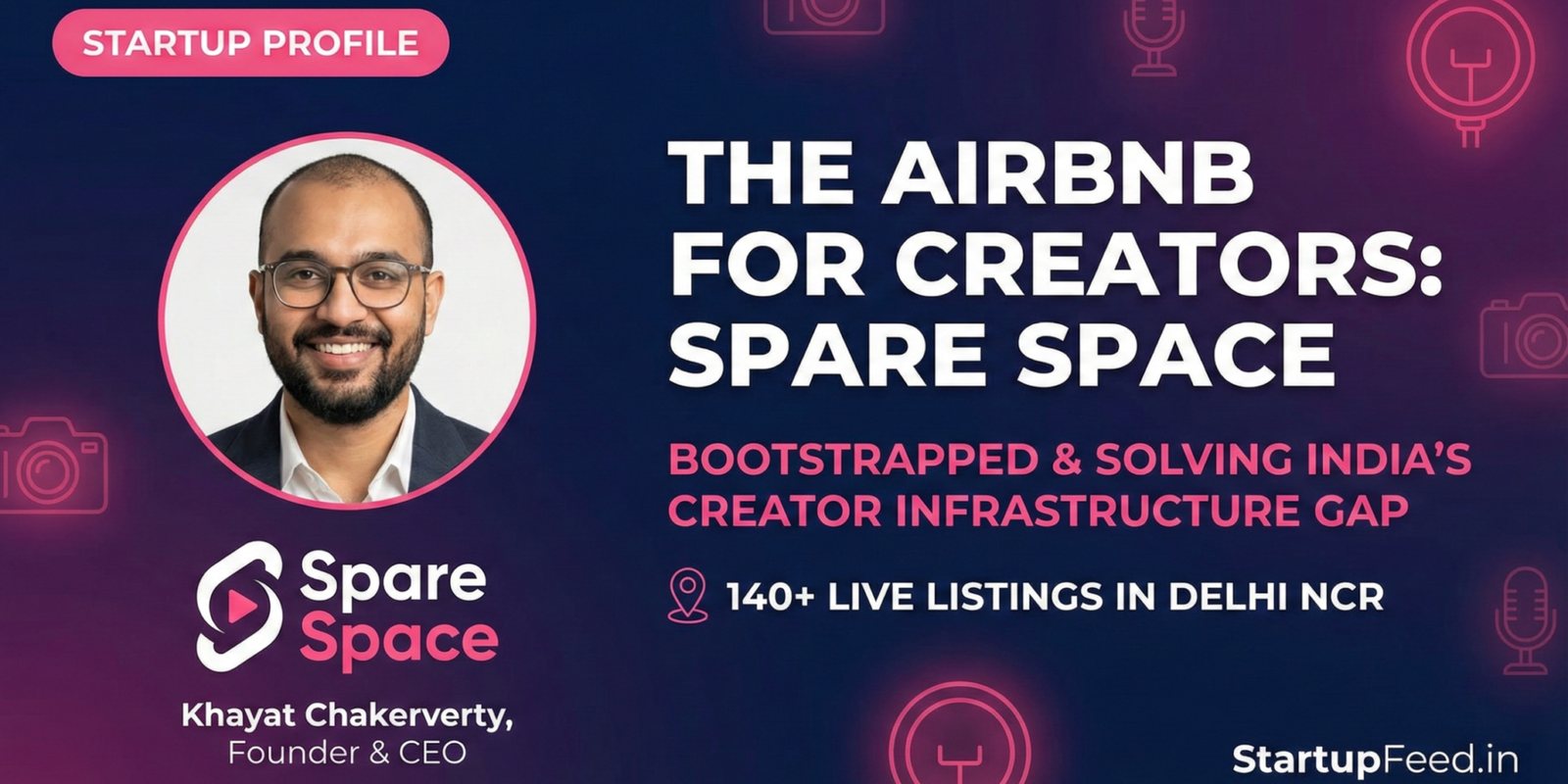
| The Startup | Spare Space — Delhi NCR’s bootstrapped ‘Airbnb for Creative Spaces’; founded by Khayat Chakerverty | |||||||||||||||||||||||||||||||||||||||||||||||||||||||||||||||||||||||||||||||||||||||||||||||||
| Traction | 140+ live listings across Delhi NCR; facilitated brand-level shoots including Typsy Beauty founder campaign | |||||||||||||||||||||||||||||||||||||||||||||||||||||||||||||||||||||||||||||||||||||||||||||||||
| Business Model | Two-sided marketplace: hourly booking fees from creators + idle-slot monetisation for space owners | |||||||||||||||||||||||||||||||||||||||||||||||||||||||||||||||||||||||||||||||||||||||||||||||||
| The Problem | India’s 2–2.5 Mn monetised creators rely on WhatsApp messages, phone calls & Instagram DMs to find studios | |||||||||||||||||||||||||||||||||||||||||||||||||||||||||||||||||||||||||||||||||||||||||||||||||
| What’s Next | Bengaluru & Mumbai expansion → equipment rentals → on-demand freelancers → full creator infrastructure OS | |||||||||||||||||||||||||||||||||||||||||||||||||||||||||||||||||||||||||||||||||||||||||||||||||
Finding a quiet, aesthetic place to shoot a video or record a podcast is a nightmare in Indian cities. Spare Space, a bootstrapped Delhi NCR startup, is betting that the solution is not a bigger studio but a smarter marketplace. The platform — already going viral for positioning itself as India’s first “Airbnb for creative hourly spaces” — allows independent cafés, empty studios, and even aesthetic living rooms to be rented out by the hour, specifically by the YouTubers, podcasters, photographers, and brand teams that form the backbone of India’s 100-million-strong creator economy.
The insight is deceptively simple: India does not lack creative spaces. It lacks a structured, transparent, tech-enabled way to find, price, and book them. That friction — the WhatsApp chain, the Instagram DM, the phone call, the negotiation, the wait for confirmation — is what Spare Space has set out to eliminate.
| StartupFeed Insight | ||||||||||||||||||||||||||||||||||||||||||||||||||||||||||||||||||||||||||||||||||||||||||||||||||
| Key Number | India has 2–2.5 million monetised creators but zero structured, India-built platforms to book a studio by the hour — Spare Space is solving a pain point that 100 million creators experience and nobody has formally digitised. | |||||||||||||||||||||||||||||||||||||||||||||||||||||||||||||||||||||||||||||||||||||||||||||||||
| Founders | The most defensible moat here is supply density, not technology — get to 500+ listings in Delhi NCR before a well-funded rival enters, then expand. First-mover advantage in a two-sided marketplace compounds fast. | |||||||||||||||||||||||||||||||||||||||||||||||||||||||||||||||||||||||||||||||||||||||||||||||||
| Investors | The India creator economy grows at 22.2% CAGR to $49.83 Bn by 2032. Infrastructure plays (tools, spaces, services for creators) are the under-funded layer — Peerspace raised $39.7M in the US; no equivalent exists in India. | |||||||||||||||||||||||||||||||||||||||||||||||||||||||||||||||||||||||||||||||||||||||||||||||||
| Creators | A transparent hourly booking with upfront pricing, instant confirmation and ID-verified hosts is the upgrade from “DM to check availability” that every Indian YouTuber and podcaster needs right now. | |||||||||||||||||||||||||||||||||||||||||||||||||||||||||||||||||||||||||||||||||||||||||||||||||
| Prediction | By Q2 2027, Spare Space will have 1,000+ listings across 3 cities and announce a Seed round. A strategic acquirer — likely a co-working platform or creator economy SaaS — will come calling within 24 months of that. | |||||||||||||||||||||||||||||||||||||||||||||||||||||||||||||||||||||||||||||||||||||||||||||||||
The Problem: India’s Creator Economy Has No Infrastructure Layer
India has crossed a defining milestone with over 100 million creators, making it one of the world’s largest and fastest-growing influencer ecosystems. Of these, 2–2.5 million are monetised digital creators who collectively influence more than $350 Bn in annual consumer spending — a figure BCG projects will exceed $1 trillion by 2030. YouTube alone contributed $1.8 Bn to India’s GDP in 2024 and created 930,000 jobs in the creative ecosystem.
Yet the physical infrastructure to support this creative class has not kept pace. For most Indian creators, booking a studio still involves messaging multiple venue owners, negotiating pricing manually, and waiting for confirmation. Real-time availability is rarely visible, and pricing details are often unclear. The result: hours of admin before a single frame is shot.
Before launching publicly, Spare Space spent nearly a year manually sorting enquiries, onboarding hosts, and studying behavioural patterns of both guests and space owners. A shared pain point kept resurfacing: discovery and management lacked structure. For a sector generating hundreds of billions in consumer influence, that is a category-scale infrastructure gap.
The Solution: What Spare Space Actually Does
Spare Space positions itself as a centralised discovery and booking ecosystem — not a listing directory. The platform enables bookings for photo shoots, film productions, workshops, auditions, rehearsals, and small creative events across studios, training rooms, and indoor venues, with real-time availability and transparent pricing.
| For Creators (Guests) | For Space Owners (Hosts) | Trust & Safety |
|---|---|---|
| Real-time availability calendar | Transparent hourly pricing | Instant or approval-based booking |
| Upfront digital payment processing | ID verification (hosts & guests) | Review & rating system |
| Activity-type filters (shoots, workshops, auditions) | Capacity & amenity search | Host dashboard + variable pricing |
| Location & map-based browsing | Secure payment, dispute protection | Brand-level project facilitation |
Bookings can be instant or approval-based depending on host preference — a design choice that reflects the platform’s understanding of host anxiety at launch stage. For space owners, the proposition is equally concrete: better visibility, a digital dashboard to manage availability and variable pricing, upfront payment processing, and access to a growing base of high-intent creative professionals booking in 2–4 hour blocks.
The platform has already facilitated brand-level shoots, including a founder brand shoot for Typsy Beauty founder Kairavi — adding early professional credibility to its network and signalling that the product works above the hobbyist tier.
The Founder: Who Is Khayat Chakerverty?
| Detail | Information |
|---|---|
| Full Name | Khayat Chakerverty |
| Co-Director | Anil Chakerverty |
| Registered Entity | Sparespace Private Limited |
| Registered Office | 79, LGF, World Trade Center, Barakhamba Road, New Delhi – 110001 |
| Background | 5+ years in creative production environments across India and abroad |
| Host-side Experience | Multi-year Airbnb host — direct exposure to rental yield optimisation, guest expectations, host-side operational challenges |
| Platform | sparespaceindia.com |
| Funding Status | Bootstrapped (no external funding disclosed as of February 2026) |
Chakerverty’s dual background is what makes the product coherent. Five years on the creator side gave him the guest’s perspective: the frustration of scattered searches, unclear pricing, and zero trust signals when booking a space from a stranger. Five years as an Airbnb host gave him the supply-side perspective: rental yield optimisation, guest expectations, and the operational complexity of managing a two-sided marketplace. Spare Space is, structurally, the product of both.
The Market: Why Now
| Metric | Current (2025–26) | Projection / Context |
|---|---|---|
| India Creator Economy (2025) | $12.28 Bn | $49.83 Bn by 2032 (+22.2% CAGR) |
| India Monetised Creators | 2–2.5 Mn | Influencing $350 Bn consumer spend |
| Total Indian Creators (all tiers) | 100 Mn+ | World’s largest influencer ecosystem |
| India Podcasting Market | $0.62 Bn (2024) | $2.6 Bn by 2030 (+25% CAGR) |
| YouTube contribution to India GDP | $1.8 Bn (2024) | 930,000 jobs in creative ecosystem |
| Govt IICT Creator Fund (March 2025) | $1 Bn | Public-private partnership |
| Delhi-NCR Startup Funding (2025) | $2.2 Bn (224 deals) | 9% rise YoY |
The timing is structural, not coincidental. Three forces are converging in 2026:
- India’s creator economy is at $12.28 Bn in 2025 on a 22.2% CAGR trajectory to $49.83 Bn by 2032 — the supply of creators needing professional infrastructure is growing faster than the infrastructure itself.
- The government’s $1 Bn IICT investment (March 2025) and Budget 2026’s AVGC creator labs in 15,000 schools are creating a formal pipeline of technically literate creators who will need studio-grade production environments.
- Post-pandemic, brands have fundamentally shifted marketing budgets from traditional advertising toward creator-led content — making the ability to produce professional-quality video and audio a commercial necessity, not a creative luxury.
Competitive Landscape: The Global Map
| Platform | Market | Funding | Scale | India Relevance |
|---|---|---|---|---|
| Spare Space | India (Delhi NCR) | Bootstrapped | 140+ listings | Creator-first, India-native, hourly booking |
| Peerspace | USA (Global) | $39.7 Mn raised | Thousands (US/global) | Events + productions; no India presence |
| Giggster | USA | Funded | US-focused | Film/photo shoots; US-only |
| Splacer | USA/Global | Funded | US/EU focus | Events + shoots; limited Asia presence |
| SpacePal | LATAM/Global | Funded | LATAM-heavy | 0% host fees; limited India inventory |
The global market validation is clear: Peerspace raised $39.7 Mn from investors including Google Ventures and Foundation Capital and operates thousands of listings in US and global markets. Giggster, Splacer, and SpacePal have each raised funding on the same thesis. None of them have meaningfully cracked India. Spare Space is not building a Peerspace clone — it is building the India-native version of a category that has already been validated at scale in Western markets.
The Roadmap: From Marketplace to Creator OS
| Phase | Milestone | Strategic Intent |
|---|---|---|
| Phase 1 (Now) | 140+ live listings in Delhi NCR | Prove GMV, booking density, host retention |
| Phase 2 (H2 2026) | Expand to Bengaluru + Mumbai | Target creator hubs: Koramangala, Andheri, Bandra |
| Phase 3 (2027) | Equipment rental layer | Cameras, lights, mics available to add to booking |
| Phase 4 (2027+) | On-demand freelancers | Editors, DPs, stylists bookable alongside space |
| End State | Creator Infrastructure OS | End-to-end production platform for Indian creators |
The longer-term vision — moving from space rental to a full creative infrastructure operating system for Indian creators — is the right strategic direction but also the highest-risk part of the thesis. Equipment rentals, on-demand freelancers, and integrated production services each require a different supply chain, a different trust model, and a different transaction size. The sequencing matters: nail space density first; everything else is leverage built on that foundation.
Who Should Be Watching?
| Player | Why This Matters |
|---|---|
| Co-working platforms(Awfis, IndiQube, WeWork India) | All three went public in 2025. They have existing real estate relationships and studio spaces that sit idle during off-peak hours. Spare Space’s model is a ready-made activation layer for their idle inventory. |
| Creator economy SaaS(TagMango, Kuku FM, Roposo) | Platforms that already serve India’s 2.5 Mn monetised creators could integrate ‘book a space’ as a native feature, threatening Spare Space’s standalone position. |
| YouTube India | YouTube contributed $1.8 Bn to India’s GDP in 2024 and is investing $100 Mn in Indian creators. A ‘creator space’ discovery feature within the YouTube Studio app is not an impossible product move. |
| Independent cafes & restaurants(especially in Delhi, Mumbai, Bengaluru) | The real supply-side opportunity: thousands of aesthetically shot, underutilised café spaces that could list 2–4 off-peak hours per day, turning idle floor space into hourly revenue. |
Key Risks
| Risk Factor | Why It Matters |
|---|---|
| Supply density chicken-and-egg | Creators won’t come without enough spaces; spaces won’t list without enough creator bookings. Early manual onboarding is the only fix. |
| Platform leakage | Hosts and guests may transact off-platform after first meeting, undermining take rate. Review incentives and repeat-booking discounts help, but it’s a structural tension. |
| Well-funded entrant | A co-working platform (Awfis, IndiQube) or creator SaaS could launch a creator-space vertical with existing supply networks. First-mover density is the only real moat. |
| Trust & safety incidents | A single bad experience — property damage, safety issue, no-show — in a city with nascent trust signals can cause reputational damage that’s disproportionate at early stage. |
| Low ticket size / commission pressure | Hourly creative bookings in India may average Rs 500–2,000/hr. At a 15–20% take rate, unit economics are thin until volume scales significantly. |
What’s Next
Spare Space’s immediate milestone is clear: 140+ verified listings in Delhi NCR by March 2026, then consolidation before the Bengaluru and Mumbai expansions. The city sequencing is smart — Delhi NCR’s creator economy is younger and more production-driven (YouTube, podcasts, brand shoots), while Mumbai’s creator base skews more toward fashion and lifestyle content that demands aesthetic spaces at premium price points.
The real test will come 12 months after Delhi NCR is stabilised. Can the platform maintain supply density without a direct sales team in a second market? Can the trust infrastructure scale without manual curation? Those are the questions that will determine whether Spare Space becomes a startup story or an infrastructure company.
India has 100 million creators. Most of them are shooting on the same couch, in the same corner, with the same bedsheet backdrop. Spare Space is betting that the upgrade is not a better camera. It’s a better room.
Does Spare Space have what it takes to become India’s Peerspace? Tell us your take on Twitter @StartupFeed_in
About This Article
Spare Space (sparespaceindia.com) is a Private Limited Company incorporated in New Delhi, with directors Khayat Chakerverty and Anil Chakerverty. The platform currently operates 140+ listings in Delhi NCR and plans expansion to Bengaluru and Mumbai. The India creator economy is valued at $12.28 Bn in 2025 (Coherent Market Insights), with 2–2.5 million monetised creators influencing $350 Bn in annual consumer spending (BCG, May 2025). Peerspace (US) has raised $39.7 Mn (Tracxn). India podcasting market: $0.62 Bn (2024) → $2.6 Bn by 2030 (Markntel Advisors).

