
QUICK TAKE (30-second read)
|
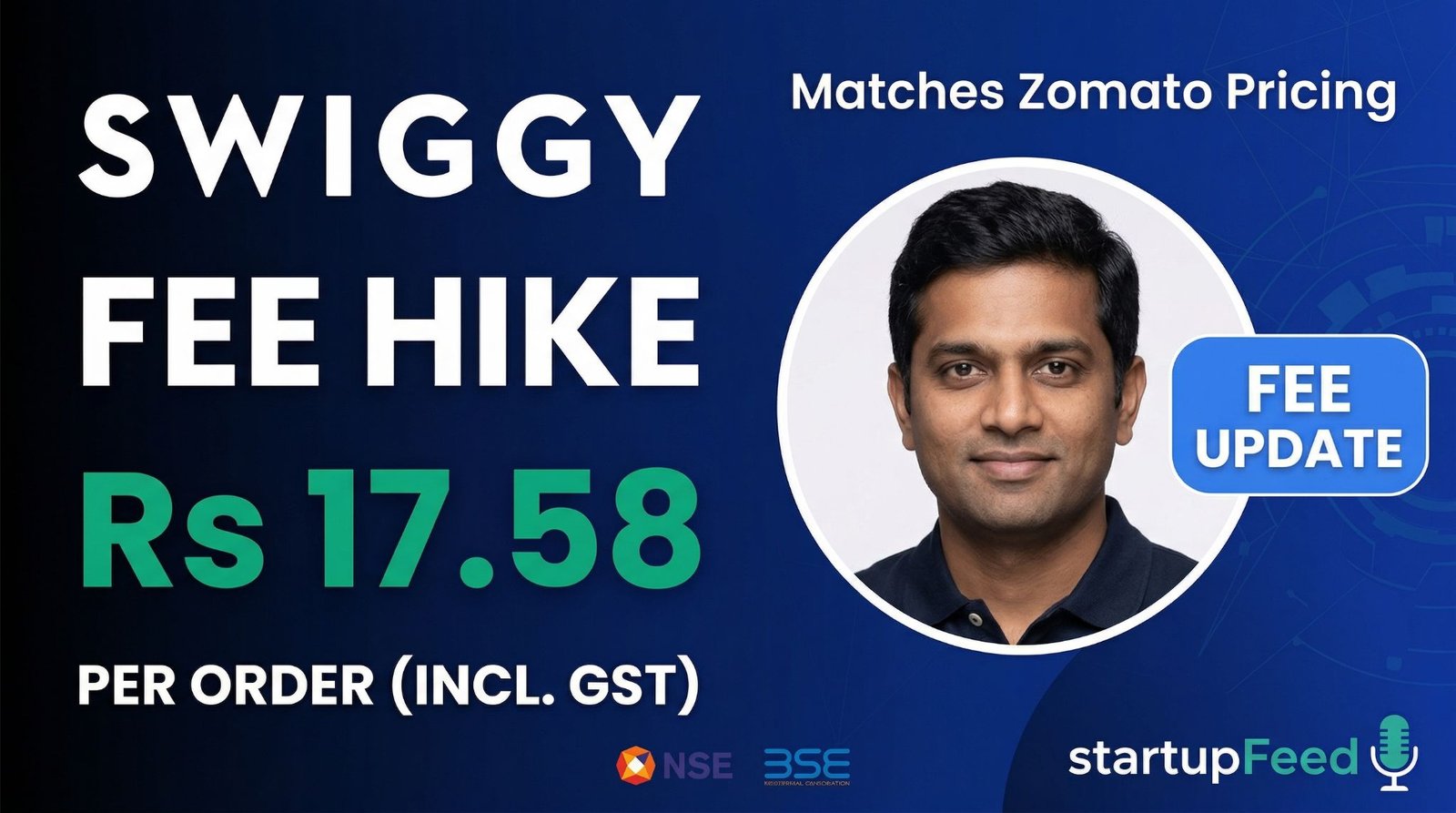
Food delivery giant Swiggy has raised its platform fee by 17% to Rs 17.58 per order (inclusive of GST) — matching rival Zomato’s effective per-order charge for the first time, days after Zomato’s own 19% hike took the fee to Rs 14.90 pre-GST (Rs 17.58 post-GST). The move signals a coordinated margin push by India’s food delivery duopoly, pushing the combined platform fee journey to an 8.8x surge since April 2023.
The near-simultaneous hikes position both platforms to extract higher per-order contribution without volume trade-offs — so far, at least. With Bengaluru-based challenger Rapido’s Ownly entering the market with zero platform fees on March 3, 2026, the duopoly’s pricing power is facing its first credible structural test. Restaurant partners and delivery partners should be watching this closely.
STARTUPFEED INSIGHT
|
Platform Fee Journey: A Timeline
What started as a nominal charge has evolved into a primary monetisation engine for both platforms. Here is how the fee has moved:
| Date | Swiggy Fee | Zomato Fee | Context |
| Apr 2023 | Rs 2/order (launch) | — | Swiggy introduces fee first |
| Aug 2023 | Rs 3–5/order | Rs 2/order (launch) | Zomato follows with own fee |
| Sept 2025 | Rs 12 → Rs 15/order | Rs 10 → Rs 12.50/order | Both hike simultaneously |
| Mar 20, 2026 | Rs 14.99/order (unchanged) | Rs 12.50 → Rs 14.90 (+19%) | Zomato hikes first |
| Mar 24, 2026 | Rs 14.99 → Rs 17.58 (+17%) | Rs 14.90 pre-GST (= Rs 17.58) | Both now at parity post-GST |
Swiggy introduced the platform fee at Rs 2 in April 2023 and has raised it 8.8x to Rs 17.58 in under 36 months. Despite this, order volumes grew 9% for Swiggy and 13% for Zomato in FY25 — suggesting Indian urban consumers have absorbed incremental charges with minimal pushback, so far.
Who Should Be Watching?
| Player | Platform Fee (Mar 2026) | Strategic Implication |
| Swiggy | Rs 17.58 (incl. GST) | Stock down 33% from IPO — margin improvement via fee hikes is now core to investor narrative |
| Zomato (Eternal) | Rs 14.90 + GST = Rs 17.58 | Eternal shares rose 2% post-fee hike announcement — market rewards margin moves |
| magicpin | Rs 14.20 (no hike) | CEO Anshoo Sharma publicly froze the fee — positioning as consumer-friendly alternative to drive adoption |
| Rapido Ownly | Rs 0 platform fee | Zero-commission model in Bengaluru since March 3 — structural disruptor if it scales beyond one city |
The fee gap between Swiggy/Zomato (Rs 17.58) and magicpin (Rs 14.20) now stands at Rs 3.38 per order. At scale, that delta could meaningfully shift cost-conscious consumers toward alternatives — particularly if Rapido’s Ownly expands citywide.
Swiggy Financial Snapshot
Swiggy’s financials reveal why the company is pushing hard on per-order monetisation:
| Metric | Q3 FY25 | Q3 FY26 |
| Operating Revenue | Rs 3,993 Cr | Rs 6,148 Cr (+54% YoY) |
| Net Loss | ~Rs 686 Cr | Rs 1,056 Cr (widened) |
| Stock Price vs IPO | IPO: Rs 420 (Nov 2024) | Rs 280 (–33%) |
| Market Capitalisation | — | Rs 77,372 Cr (~$8.2 Bn) |
Revenue growth of 54% YoY is impressive, but widening losses in an environment of rising energy costs — crude oil prices are elevated due to the West Asia conflict — explain why platform fee has become the company’s most direct lever for improving contribution margin without requiring volume growth.
Why Both Platforms Raised Fees Simultaneously
Rising input costs are the stated reason. LPG and crude oil price increases have pushed up restaurant operating costs and delivery partner expenses. Both companies justify fee hikes as necessary to sustain platform operations — a narrative that will face scrutiny if Rapido demonstrates zero-fee viability at scale.
The deeper strategic reality: platform fees have proven to be price-inelastic. Despite an 8.8x increase since 2023, volumes grew through multiple hike cycles. Analysts estimate that for every Rs 1 increase in platform fee, Swiggy gains approximately 20 basis points of EBITDA improvement. This Rs 2.59 hike therefore represents a meaningful, low-friction margin boost.
India’s online food delivery market is valued at approximately $9 Bn as of early 2026, with Zomato commanding 55–58% of gross order value and Swiggy holding 42–45%. The market is projected to grow at a 22.18% CAGR through 2034 — meaning even small per-order monetisation gains compound dramatically as order volumes scale.
What’s Next
Both companies have now standardised at Rs 17.58 per order post-GST — but the ceiling may not be here yet. At the current pace of hikes, the fee could cross Rs 20/order by Q3 FY27, barring meaningful disruption from alternative platforms.
The variable to watch is Rapido’s Ownly. The zero-fee, zero-commission model — launched across Bengaluru on March 3, 2026 — fundamentally challenges the pricing playbook. If Ownly captures 8%+ of monthly active order share in Bengaluru within 12 months, expect Swiggy and Zomato to face investor pressure to slow or reverse fee increases. If Ownly struggles, the duopoly’s fee escalation will continue unchecked.
magicpin’s freeze on platform fees is the other signal. By explicitly positioning against the hike, CEO Anshoo Sharma is making a calculated bet that cost-sensitive consumers will shift share — a play that could work if overall order growth slows in lower-income consumer segments.
The real question: can Indian consumers distinguish between a duopoly coordinating pricing and two companies independently responding to cost pressures? The answer will shape regulatory scrutiny — and the CCI’s appetite to investigate — over the next 18 months.