
Quick Take:
- The Accusation: OpenAI tells US Congress that DeepSeek is “free-riding” on American AI research via distillation
- The Stage: India AI Impact Summit 2026 (Feb 16–20) at Bharat Mandapam, New Delhi
- Key Players: Sam Altman, Sundar Pichai, Dario Amodei, Bill Gates — plus China delegations
- The Stakes: US-China AI rivalry plays out on Indian soil at the Global South’s first major AI summit
- What’s Next: DeepSeek may launch new model during Lunar New Year (Feb 17) — escalating tensions, give bullet form
The Elephant in the Room
The world’s most powerful AI executives are descending on New Delhi this week. But behind the handshakes and keynotes, a bitter accusation is casting a long shadow over the India AI Impact Summit 2026.
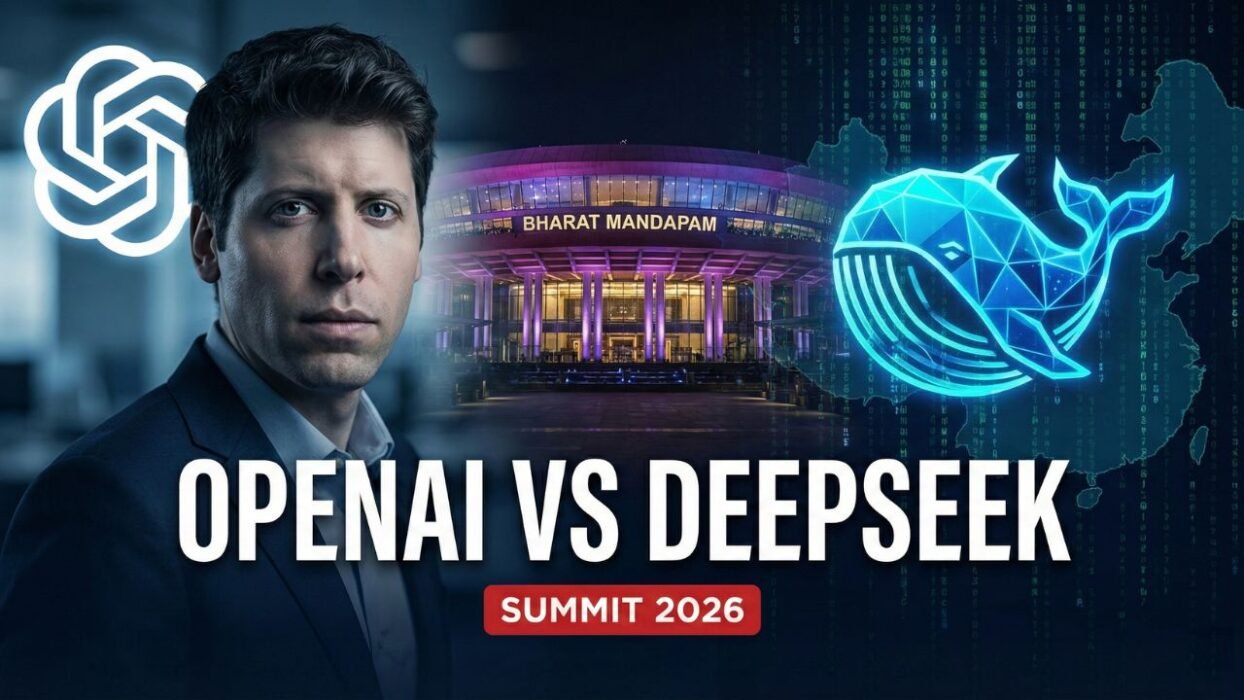
Just days before the summit opened, OpenAI sent a memo to the US House Select Committee on China accusing DeepSeek — the Hangzhou-based startup that shook global markets a year ago — of systematically distilling American AI models to train its own. OpenAI described this as part of DeepSeek’s “ongoing efforts to free-ride on the capabilities developed by OpenAI and other US frontier labs.”
The timing is no accident. And the venue makes it even more charged.
| StartupFeed Insight |
| What’s really happening: This is not just a corporate IP dispute — it is the US-China AI cold war entering its most public phase, with India positioned as the strategic swing state both sides want to court. |
| For founders: The distillation debate signals tightening rules around model access — audit your own AI supply chain now. |
| For investors: Geopolitical AI risk is now a portfolio-level concern, not a footnote in due diligence. |
| For policy makers: India’s neutrality between US and Chinese AI camps gives it rare leverage — but that window is closing fast. |
| Our prediction: India will avoid taking sides publicly but will quietly deepen commercial ties with US labs. By Q3 2026, expect New Delhi to issue its own AI model-origin disclosure framework. |
What OpenAI Actually Said
In the memo — reviewed by Reuters and Bloomberg — OpenAI laid out specific technical claims. The company said it had observed accounts linked to DeepSeek employees developing methods to bypass access restrictions using obfuscated third-party routers.
OpenAI further alleged that DeepSeek employees wrote code to extract outputs from US AI models programmatically for distillation purposes. Distillation, in simple terms, means using one powerful AI model’s outputs to train a newer, cheaper model — effectively transferring years of research at a fraction of the cost.
OpenAI stated it does not permit its outputs to be used to create “imitation frontier AI models.” The company warned that when capabilities are copied through distillation, built-in safety features are often stripped away — raising risks in sensitive domains like biology and chemistry.
Why the Timing Matters
Three factors make this accusation explosive right now.
First, DeepSeek is widely expected to release a new model around Lunar New Year (February 17) — the second day of the India summit. That mirrors the timing of its R1 launch last year, which wiped nearly $500 Bn off Nvidia’s market capitalization in a single session.
Second, the India AI Impact Summit is the Global South’s first major AI gathering — with over 20 heads of state, 3,000 speakers, and delegations from 45 countries including both the US and China. PM Narendra Modi will address CEO roundtables and inaugurate the event at Bharat Mandapam.
Third, OpenAI is aggressively courting India. The company opened its first India office in Delhi last August and now counts 100 million weekly active Indian users — with Indian students forming ChatGPT’s largest user group globally. Sam Altman himself wrote that AI will be built “in India, with India, and for India.”
Framing DeepSeek as a security threat — right as India deliberates its AI partnerships — is a strategic move, not just a legal one.
India: The Prize Both Sides Want
India’s position at this summit is uniquely delicate. According to Stanford University’s Institute for Human-Centred AI, India ranks third globally in AI competitiveness, behind only the US and China.
The country approved $18 Bn worth of semiconductor projects, launched the IndiaAI Mission with an outlay of Rs 10,372 Cr ($1.2 Bn), and recently offered tax holidays for international companies setting up data centres.
Both American and Chinese AI companies want access to India’s developer talent pool, its massive consumer market, and its growing government procurement pipeline. OpenAI and Anthropic are setting up India operations. Chinese open-source models are already widely used by Indian startups for cost efficiency.
The Bigger Picture
| Dimension | OpenAI’s Position | DeepSeek’s Position |
| Business Model | Premium, subscription-based | Free and open-source |
| Development Cost | Billions invested in compute | Built at a fraction of cost |
| Key Accusation | Distillation and IP misuse | Has not publicly responded |
| Safety Stance | Claims safety guardrails lost in distillation | Censors results on China-sensitive topics |
| India Strategy | Office in Delhi, 100 Mn weekly users | Open-source models used by Indian devs |
Republican Representative John Moolenaar, chair of the House China committee, escalated the rhetoric further, calling it “part of the CCP’s playbook: steal, copy, and kill.” White House AI director David Sacks previously cited “substantial evidence” of DeepSeek distilling knowledge from OpenAI’s models. DeepSeek and its parent company High-Flyer have not responded to these claims.
What’s Next
The India AI Impact Summit runs through February 20, with PM Modi’s keynote and CEO roundtable on February 19. Watch for three signals:
- OpenAI may announce expanded India partnerships or investment commitments — using the summit as a platform to deepen its foothold.
- If DeepSeek launches a new model during summit week, expect the distillation debate to dominate headlines and sideline conversations.
- India’s official summit communique will reveal how far New Delhi is willing to go in addressing AI IP protection — or whether it sidesteps the issue entirely.
One thing is clear: the US-China AI rivalry has found a new front, and it is being fought in the corridors of Bharat Mandapam.
The India AI Impact Summit 2026, held February 16–20 at Bharat Mandapam in New Delhi, is the fourth global AI summit following events in the UK (2023), South Korea (2024), and France (2025). It is the first such summit hosted in the Global South. OpenAI, founded by Sam Altman, opened its India office in Delhi in August 2025 and reports 100 million weekly active users in the country. DeepSeek, based in Hangzhou, China, launched its R1 model in January 2025, claiming performance rivaling top US models at significantly lower development costs.