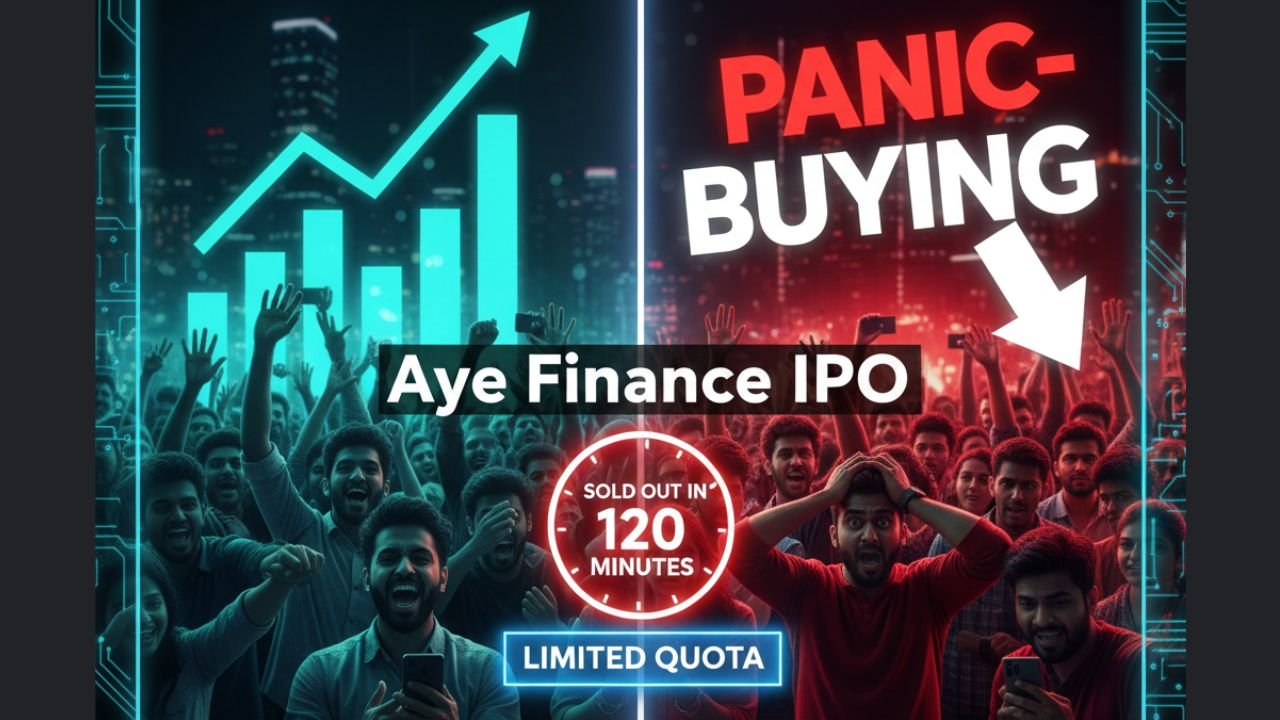

Aye Finance IPO retail investors are experiencing 2026’s most extreme quota squeeze—and the panic is palpable. With just 10% of the ₹1,010 crore mainboard issue reserved for retail, approximately ₹101 crore worth of shares must satisfy what analysts project could be 8-12x oversubscription in the retail category within the first two hours alone.
The February 9-11 subscription window opened Monday, and by 11:30 AM, Aye Finance IPO retail investors had depleted 43% of the allocated quota per preliminary NSE data—velocity suggesting complete oversubscription by lunch. The math is brutal: a minimum investment of ₹14,964 (116 shares at ₹129 upper band) means roughly 67,500 retail applications at minimum lot. With lakhs expected, allotment odds could drop below 15%.
The 10% Quota Trap Driving Aye Finance IPO Retail Investors to Panic
Unlike Hyundai Motor India (35% retail) or Swiggy (35%), Aye Finance IPO retail investors face institutional-heavy allocation: 75% QIBs, 15% NIIs, and just 10% retail.
“The 10% reservation creates artificial scarcity,” explains Aditya Malhotra, equity research head at a Mumbai brokerage. “When Aye Finance IPO retail investors see a limited quota, FOMO kicks in harder than fundamentals. They’re not asking, ‘Should I invest?’—they’re asking, ‘Will I get allotment?’ That psychology drives day-one panic.”
The NBFC sector adds volatility. Aye Finance targets micro-MSMEs (average loan: ₹1.5 lakh) across 21 states with ₹6,027 crore AUM and 42.6% CAGR from FY23 to FY25. Strong growth attracts investors. But rising credit costs—profit declined 40% YoY in H1 FY26 per SBI Securities—raise flags sophisticated investors recognize but retail often ignores.
The grey market premium sits at just ₹1, indicating flat listing gains. Yet Aye Finance IPO retail investors continue applying aggressively.
Why Aye Finance IPO Retail Investors Ignore Warning Signs
Multiple research houses issued caution. SBI Securities advised “avoid,” citing NIM compression, rising impairment costs, and a mortgage-heavy mix requiring monitoring. Swastika Investmart rated it “reasonably priced” at 14x P/E but noted NBFC volatility.
Aye Finance IPO retail investors proceed anyway, driven by three factors:
Mainboard Premium Bias: After 2024’s SME IPO casino, where scam companies targeted retail with fake GMP, mainboard issues feel safer regardless of fundamentals. Aye Finance’s NSE/BSE listing, marquee bankers (Axis, IIFL, JM Financial, and Nuvama), and ₹6,000+ crore AUM create a legitimacy halo.
Underdog Narrative: Micro-MSME lending carries aspirational appeal. Aye Finance IPO retail investors rationalize: “If this helps small businesses, I should support it.” Emotional investing replaces diligence.
Allotment Game: For many, IPO investing became pure lottery mechanics. Apply to every issue, hope for allotment, and sell listing day regardless of fundamentals. With ₹1 GMP, gains look minimal—but Aye Finance IPO retail investors bet on surprise movement or simply “participating.”
Financial advisor Priya Deshmukh observes: “Five clients called Monday asking, ‘How do I maximize Aye Finance allotment?’ Not one asked, ‘Is this good investment?’ The Aye Finance IPO retail investors’ mindset shifted from wealth creation to ticket collection.”
Institutional vs Retail Divergence in Aye Finance IPO Retail Investors Behavior
While retail scrambles, QIBs (75% quota) likely subscribe conservatively. Early anchor reports suggest tepid institutional interest at the ₹129 upper band—several funds seeking discounts or passing.
This divergence reveals inefficiency. Aye Finance IPO retail investors chase limited supply while institutions with majority allocation exercise caution. Result: retail oversubscription masks weak overall demand.
“Classic coordination failure,” notes Dr. Vikram Jain, market researcher. “The 10% quota forces Aye Finance IPO retail investors to compete in a prisoner’s dilemma. Everyone applies immediately because everyone else is—independent of actually believing in prospects.”
Post-listing, this creates vulnerability. If institutional portions undersubscribe while retail hits 12x, the issue could close 3-4x overall—weak by 2026 standards. The listing might see profit-booking from lucky retail allottees dumping for minimal GMP.
EXPERT TAKE:
The Aye Finance IPO retail investor frenzy exposes how structure creates perverse incentives hurting participants it’s designed to protect. The 10% reservation—intended to ensure access—manufactures artificial scarcity, triggering FOMO panic. Retail investors facing less than 15% odds aren’t making investment decisions; they’re buying lottery tickets.
Compare to LIC’s 35% retail quota or recent QSR IPOs with balanced allocations. When retail gets meaningful access, applications pace normally. Investors analyze fundamentals because they’re confident about getting allocated. Aye Finance IPO retail investors’ experience differs: scramble first, think later.
Three action points for quota-squeeze IPOs: First, resist day-one panic. Oversubscription odds don’t improve whether you apply Monday at 9 AM or Wednesday at 3 PM—SEBI’s proportional allotment treats all retail equally. Second, evaluate whether a <15% chance justifies tying up ₹15,000 for three days when capital could be deployed elsewhere. Third, remember listing gains correlate with quality, not quota scarcity.
For policymakers: the 10% retail floor needs reform. When companies deliberately minimize retail to favor institutional blocks, structure should prevent this. Until then, Aye Finance IPO retail investors must recognize a limited quota doesn’t equal limited opportunity—it often equals limited returns.
SUMMARY POINTS:
- 10% retail quota: Only ₹101 crore for retail from ₹1,010 crore total
- 120-minute rush: 43% of the quota filled in first 2.5 hours Day 1
- Allotment lottery: 8-12x oversubscription means <15% allocation odds