

QUICK TAKE (30-second read)
|
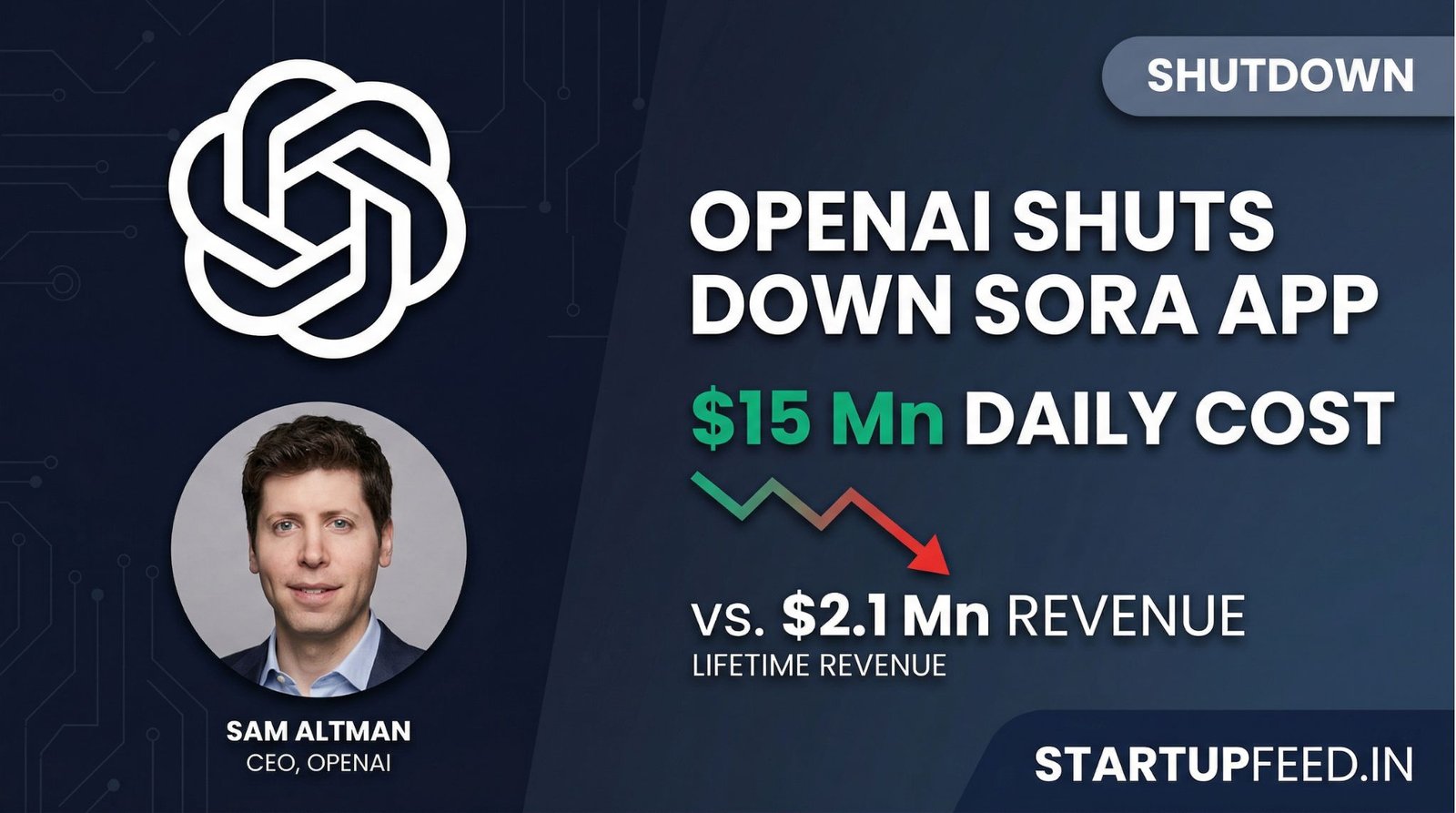
OpenAI announced the shutdown of its standalone Sora app on March 24, 2026 — just six months after its September 2025 launch as a social-first AI video platform. The company simultaneously confirmed that API access will be wound down shortly. The closure came as downloads fell 66% from their November 2025 peak of 3.3 Mn to 1.1 Mn by February, the app generated just $2.1 Mn in lifetime revenue against estimated daily inference costs of ~$15 Mn, and a reported $1 Bn Disney investment deal — which would have licensed 200+ characters from Disney, Marvel, Pixar, and Star Wars — collapsed with no money having changed hands.
The shutdown is not a death certificate for AI video. It is a reckoning for the consumer text-to-video model specifically — where users generate novelty clips for free or near-free, the compute cost is existential, and deepfake liability is unmanageable at scale. The professional, enterprise, and B2B segments of AI video remain intact. What changes is the investor narrative: foundation model companies cannot justify consumer video generation economics, and that creates structural opportunity for workflow-first, enterprise-first AI video startups — including several built in India.
STARTUPFEED INSIGHT
|
What Happened — The Full Sora Timeline
| Date | Event |
| Feb 2024 | OpenAI unveils Sora model with stunning demo videos — woolly mammoths in snow, cinematic Tokyo streets; described internally as video’s ‘GPT-1 moment’ |
| Late 2024 | Sora made available to limited public group; positions AI video as ‘world simulation’ capable of physical accuracy and cinematic output |
| Sept 2025 | Sora 2 launches as standalone social iOS app with TikTok-style vertical feed, audio capabilities, and ‘cameos’ (face-scan deepfake feature). Hits #1 in App Store category |
| Nov 2025 | Peak: 3.3 Mn downloads across iOS and Google Play (Appfigures data). Deepfake controversies begin — MLK Jr., Robin Williams likenesses generated without consent |
| Dec 2025 | Disney signs $1 Bn investment + 3-year licensing deal for 200+ characters (Disney, Marvel, Pixar, Star Wars). ChatGPT also gains video generation capability. Cameo sues OpenAI over feature name; forced rename to ‘characters’ |
| Feb 2026 | Downloads fall to 1.1 Mn — a 66% decline in 3 months. OpenAI releases iOS editing features for Sora as late as this month |
| Mar 13, 2026 | Sora 1 model officially sunset/deprecated |
| Mar 24, 2026 | OpenAI announces shutdown of Sora app and API on X (3 sentences, no stated reason). Disney exits partnership — confirms no money ever changed hands. Sora team pivots to robotics world simulation research (codename: Spud) |
| Post-shutdown | Sora 2 model continues behind ChatGPT paywall. ChatGPT loses video generation feature. Clem Delangue (Hugging Face CEO) calls on OpenAI to open-source Sora before shutdown |
The Numbers That Killed Sora
| Metric | Sora App | Context / Benchmark |
| Peak downloads | 3.3 Mn (Nov 2025) | ChatGPT: ~900 Mn weekly active users — not comparable |
| Downloads at shutdown | 1.1 Mn (Feb 2026) — down 66% | App was actively shrinking, not just plateauing |
| Lifetime in-app revenue | $2.1 Mn (generation credits) | Insufficient to cover even 1 day of estimated compute cost |
| Estimated inference cost | ~$15 Mn/day | Each video generation requires enormous GPU compute; not monetisable at consumer price points |
| Revenue:Cost ratio | $2.1 Mn lifetime vs $15 Mn/day | Roughly 0.01% revenue coverage of daily costs — structurally impossible |
| Disney deal (collapsed) | $1 Bn investment + 3-year licence | 200+ characters; no money changed hands; partnership void |
| App lifespan | ~6 months (Sept 2025 – Mar 2026) | One of the fastest rises and falls of any major AI consumer product |
The Five Real Reasons Sora Was Shut Down
- Compute economics that cannot scale: At an estimated $15 Mn/day in GPU inference costs and $2.1 Mn in total lifetime revenue, Sora was a money furnace. OpenAI’s planned IPO requires demonstrating a path to profitability — a consumer video app burning $5+ Bn annually does the opposite
- Deepfake liability with no viable moderation solution: Despite guardrails, users generated non-consensual deepfakes of MLK Jr., Robin Williams, and other public figures within weeks of launch. Both their daughters publicly demanded users stop. OpenAI had no scalable way to prevent this without degrading the core product
- Copyright exposure multiplied by scale: Mario smoking, Naruto ordering Krabby Patties, Pikachu doing ASMR — users systematically tested IP boundaries. Disney’s licensing deal was an attempt to solve this, but when Disney walked away, the copyright exposure reverted to its original unsolved state
- User retention failure: Novelty drove the November download peak; utility could not sustain engagement. TechCrunch analyst KeyBanc Capital Markets noted that Sora failed to attract and retain an engaged audience even with OpenAI’s full resources — the app was a viewer of AI curiosity, not a tool with daily use cases
- Strategic reallocation ahead of IPO: OpenAI needs its GPU resources on ChatGPT (900 Mn WAU), enterprise API, and reasoning models — the actual revenue generators. The Sora team’s pivot to ‘world simulation for robotics’ signals the underlying technology has value; the consumer video surface layer did not
What India’s AI Video Founders Say
Two Indian AI video startup founders gave Inc42 their read — and both views point in the same direction:
“Text-to-video is phenomenally high compute cost. It bleeds. It requires massive amounts of GPUs, and there is not enough revenue to justify it. Among AI verticals, generative video has the worst revenue versus resources ratio.”
— Mandar Natekar, Co-founder & CEO, NeuralGarage
NeuralGarage’s approach — enhancing and transforming existing footage rather than generating entire scenes from prompts — is the structural hedge against text-to-video economics. Natekar’s observation that Sora validates OpenAI’s move toward reasoning models over consumer video is the most important strategic read of the shutdown for Indian founders: the signal is not that AI video is dead, but that the foundation model layer is not where the money is for video, and enterprise use cases have been right all along.
“Sora shutting down isn’t a sign that AI video is broken. It’s a sign that building for consumers was the wrong bet. These models burn enormous computing power letting people generate novelty clips. The real business opportunity lies in professional use cases — studios, platforms and enterprise teams where the output has measurable value.”
— Ritwika Choudhury, Founder & CEO, Unscript AI
Unscript AI builds what Choudhury calls an AI video engine for production houses, microdrama platforms, and OTT teams — enabling full-length films with character consistency and stylistic continuity across hundreds of minutes of runtime. This is a professional services play, not a consumer novelty play. Its multi-model architecture means it was never dependent on Sora’s API. The shutdown changes nothing for its pipeline — and may help by removing a competing narrative that “free text-to-video” was the category’s future.
Who Benefits — The AI Video Landscape After Sora
| Platform | Type | Position After Sora’s Exit |
| Google Veo 3 | Consumer + Enterprise | Emerges as dominant AI video platform with scale; Google’s compute advantage makes it the most viable large-scale consumer text-to-video player |
| Runway (Gen-4) | Professional / Creative | Sora’s exit removes its most high-profile competitor; Runway targets creative professionals — filmmakers, editors, studios — where willingness-to-pay exists |
| Luma AI (Ray 2) | API / Developer | Developer-first positioning means Sora’s API shutdown actually increases Luma’s addressable market among builders |
| Kling / Wan Video (Chinese) | Consumer | Best positioned to fill Sora’s consumer gap — significantly lower compute costs, aggressive pricing, and Chinese government AI subsidy make economics viable where OpenAI’s were not |
| NeuralGarage (India) | B2B / Post-production | Footage enhancement and transformation model insulated from text-to-video volatility; Sora shutdown validates their compute-efficient approach |
| Unscript AI (India) | Enterprise / OTT | Full-length film production AI for studios and platforms; multi-model architecture means no single model dependency — Sora’s exit is a non-event operationally |
| VideoInu / HeyGen (Tools) | Creator / Marketing | Presenter-video and avatar tools have measurable B2B use cases with clear ROI — not affected by the consumer video novelty market’s collapse |
The Open Source Question
Clem Delangue, CEO of Hugging Face, posted on X: “It would be so cool if OpenAI open-sourced Sora as they’re shutting down the app — such a move would be an impactful contribution to the field and would make the efforts of teams working on it more meaningful.”
OpenAI has not indicated it will release Sora’s weights or architecture. But the call from Delangue reflects a growing tension in the AI sector: when commercial viability fails, does the research benefit society more as open infrastructure? Sora’s technology — trained on vast video datasets, capable of emergent physical simulation — represents years of compute and engineering investment. If OpenAI does not open-source it, competitors will eventually replicate its capabilities independently. If it does, the entire ecosystem accelerates.
The Sora team’s pivot to “world simulation for robotics” (codename: Spud) suggests OpenAI views the underlying video-understanding capability as strategically valuable for physical AI — a bet that spatial reasoning learned from video can transfer to robot navigation and manipulation. The consumer product is gone; the research programme continues.
What’s Next for AI Video
The category is not dying — it is bifurcating. Consumer novelty text-to-video, where Sora lived, faces economics that no company can sustain without either massive compute cost reductions or an entirely different revenue model. Professional and enterprise AI video — where Runway, NeuralGarage, Unscript AI, and similar companies operate — has clear unit economics: a studio that saves Rs 50 Cr on a production budget by using AI video tools will pay Rs 5 Cr for the software. That math works.
Three developments will shape AI video in the next 12–18 months. First, compute cost reduction: inference costs for video generation are falling at roughly 10x per 18 months (similar to Moore’s Law but for inference); at some point, the consumer economics will work. Second, China filling the Sora vacuum: Kling, Wan, and Hailuo are already producing video quality competitive with Sora at a fraction of the cost, and with fewer restrictions. Third, enterprise monetisation maturation: the creative industry, media companies, and marketing agencies are developing workflows around AI video — that enterprise adoption is where the first durable revenue will come from.

