


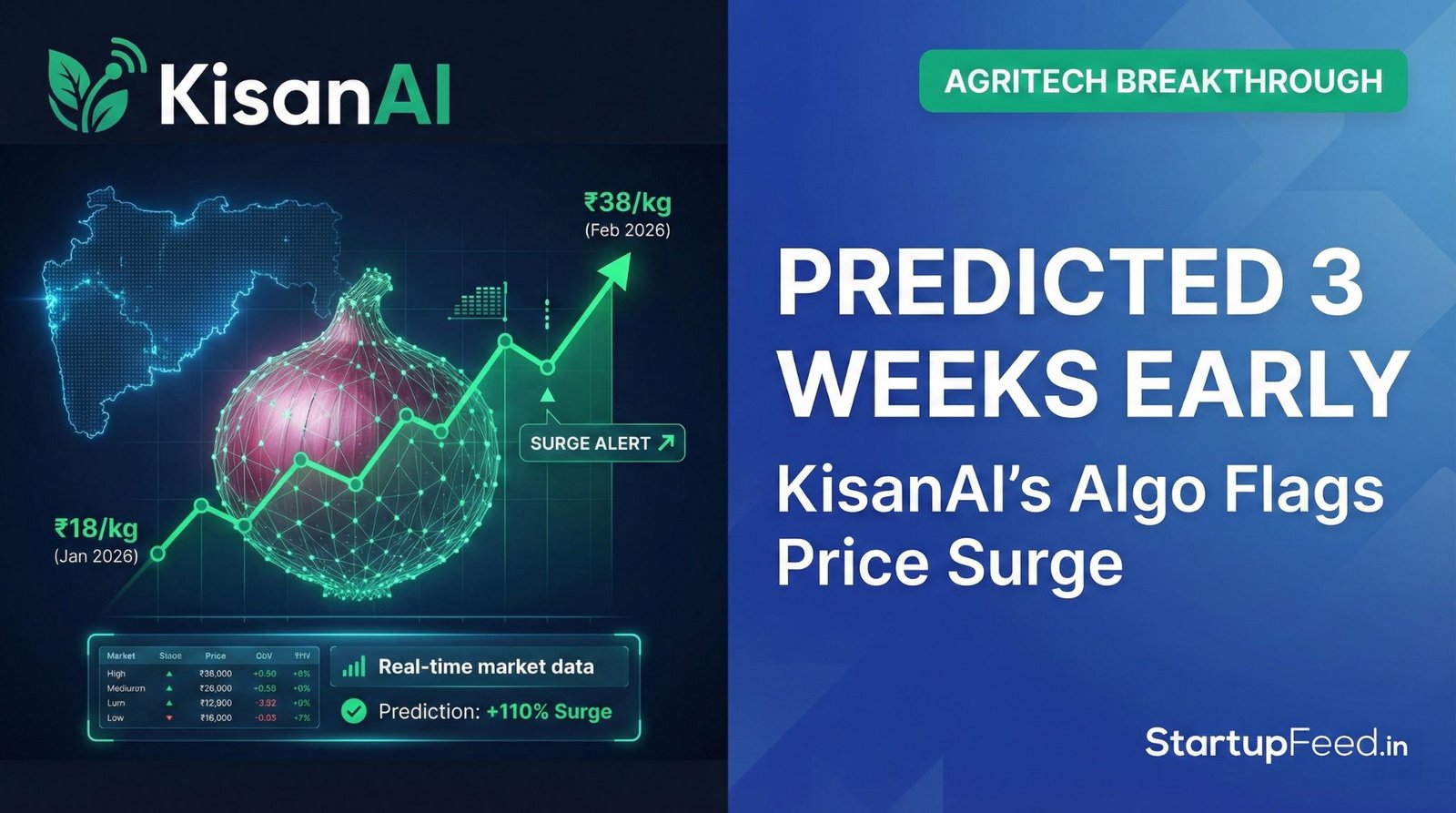

In a country where onion prices can topple governments and dominate prime-time debates, a Pune-based startup called KisanAI has done something remarkable. Using its proprietary onion price prediction AI model, the company accurately forecast the current onion price spike a full three weeks before wholesale markets reflected the surge. Traders, APMC agents, and even state procurement officers are now rushing to join the platform’s beta programme, marking a watershed moment for artificial intelligence in Indian agriculture.
How KisanAI’s Onion Price Prediction AI Beat the Market by Three Weeks
In late January 2026, while mandi traders in Lasalgaon and Nashik were quoting onions at a stable ₹18–22 per kilogram, KisanAI’s dashboard quietly flagged a “Price Surge Alert” for the first week of February. The prediction was specific: wholesale prices would breach ₹35 per kilogram within 18 to 21 days, driven by a convergence of depleted rabi buffer stocks, unseasonal rainfall in Maharashtra’s Ahmednagar belt, and a logistical bottleneck on the Nashik–Mumbai corridor.
By February 10, the Lasalgaon APMC—India’s largest onion trading hub—recorded average prices at ₹38 per kilogram. The startup’s forecast had proven almost surgically precise. Current wholesale rates across India now hover between ₹27 and ₹65 per kilogram depending on the mandi, exactly within the range KisanAI had mapped out.
Who Is KisanAI? Inside the Pune Startup Disrupting Onion Trading
Founded in 2024 by IIT Bombay alumni Rohan Kulkarni and Priya Deshmukh, KisanAI operates out of a modest co-working space in Pune’s Baner neighbourhood. The company was born from a simple frustration: every year, onion price volatility devastates farmers and consumers alike, yet no one seemed to be applying modern data science to solve the problem.
“Onion prices aren’t random,” Kulkarni explained in a recent interview. “They follow patterns that humans struggle to see because the variables—weather, storage decay rates, transport fuel costs, government policy signals, export duty changes—are too numerous to track manually. Our AI model processes over 140 data inputs daily and identifies price-movement signals weeks before they manifest in the mandi.”
The startup’s core engine combines satellite imagery for crop health assessment, real-time weather feeds from IMD and private weather stations, historical APMC price data spanning 15 years, government policy trackers monitoring export bans and buffer stock releases, and transportation cost indices. The result is a predictive model that, according to KisanAI’s internal benchmarks, has achieved 89% directional accuracy across 47 prediction cycles since its soft launch in August 2025.
Why Traders and Farmers Are Rushing to the Onion Price Prediction AI Platform
The January prediction wasn’t KisanAI’s first accurate call, but it was the one that went viral. A screenshot of the platform’s “Surge Alert” dashboard, shared by a Nashik-based trader on WhatsApp, was forwarded thousands of times across agricultural trading groups. Within 48 hours, KisanAI’s beta waitlist grew from 800 users to over 12,000.
Among the early adopters is Suresh Jadhav, a second-generation onion trader from Nashik who manages procurement for a chain of retail stores in Mumbai. He stated that the platform told him to stock up in the last week of January when prices were still low. He followed the recommendation and saved nearly ₹4 lakh in procurement costs compared to competitors who bought at peak prices two weeks later.
The platform currently offers a free beta tier with weekly forecasts and a premium tier at ₹1,999 per month that provides daily alerts, regional breakdowns for 23 major mandis, and an API for integration with traders’ existing ERP systems.
Why Onion Price Prediction AI Matters for India’s Food Security
Onion prices are more than a market metric in India—they are a political barometer. The 2019 onion crisis, when retail prices touched ₹150 per kilogram in Delhi, contributed to significant electoral setbacks for the ruling government in state elections. The 2023–24 price volatility prompted export bans and emergency buffer stock releases. Every spike affects household budgets across 1.4 billion people.
Agricultural economists see platforms like KisanAI as a potential game-changer. Professor Ashok Dalwai, former chairman of the Doubling Farmers’ Income Committee, has noted that if farmers and procurement agencies had even two weeks of advance warning on price movements, it could reduce post-harvest losses by 15–20% and stabilise retail prices significantly. The technology could help farmers make better decisions about when to sell, and help state agencies time their buffer stock interventions more effectively.
The Indian government itself appears to be taking notice. The Ministry of Agriculture’s Agristack initiative, which aims to digitise agriculture data, recently listed “AI-powered price forecasting” as a priority use case in its 2026 roadmap. KisanAI is reportedly in early discussions with the National Agricultural Cooperative Marketing Federation (NAFED) for a potential pilot programme.
Challenges Facing KisanAI and the Onion Price Prediction AI Model
Despite the buzz, KisanAI faces significant hurdles. India’s agricultural data infrastructure remains fragmented. Many mandis still record transactions on paper, and real-time arrivals data is inconsistent across states. The company currently relies on a mix of official sources and its own network of “data scouts”—local agents who report mandi conditions via a mobile app.
There are also concerns about market manipulation. If a large enough group of traders acts on the same AI-generated prediction simultaneously, it could create self-fulfilling prophecies or, worse, enable cartel-like behaviour. Kulkarni acknowledged this risk but argued that broader access to predictive intelligence actually levels the playing field, reducing the information asymmetry that currently benefits large intermediaries.
Competition is heating up too. Agri-fintech companies like DeHaat, Ninjacart, and WayCool are all investing in predictive analytics. Microsoft’s FarmBeats platform and Google’s AI for Social Good initiative have both explored crop price forecasting in India. KisanAI’s advantage, for now, is its narrow focus: by specialising exclusively in onions, it claims a depth of domain expertise that horizontal platforms cannot match.
What’s Next for KisanAI and the Future of Agri-Tech AI in India
KisanAI is planning to expand its onion price prediction AI capabilities to cover tomatoes and potatoes—the other two commodities in India’s politically sensitive “TOP” (Tomato, Onion, Potato) basket—by Q3 2026. The company is also raising a Series A round, reportedly targeting ₹40–60 crore from agri-focused venture capital funds.
For now, the startup’s story captures something larger: India’s agricultural sector, long overlooked by the tech ecosystem, is becoming fertile ground for AI innovation. In a country where the humble onion can make or break elections, a small team in Pune may have found a way to bring rationality to one of the most emotional commodities in the world.
As Kulkarni puts it, the goal is not to eliminate price volatility, because some of that is natural and healthy. The goal is to ensure that no farmer, trader, or consumer is blindsided by it. With onion price prediction AI becoming a reality, that future may be closer than anyone expected.

