
⚡ QUICK TAKE (30-Second Read)
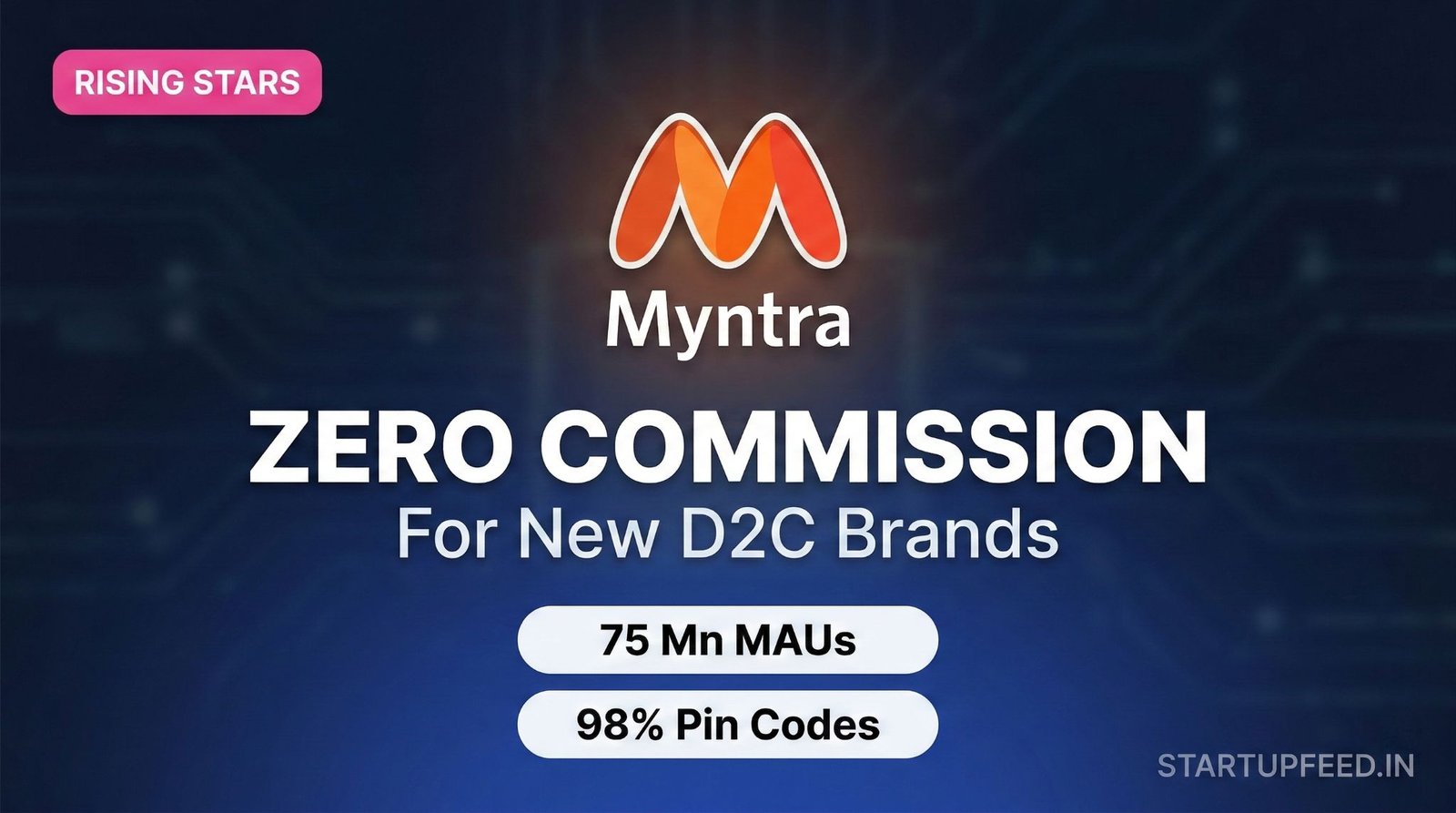
- What: Myntra launches zero-commission model for all new homegrown D2C brands via Myntra Rising Stars (MRS) programme
- When: Announced January 9, 2026; follows a 2025 festive season pilot in women’s ethnic wear
- Who’s Eligible: Made-in-India fashion, beauty and lifestyle brands primarily selling via own website or social media
- Pilot Results: 200+ new brands onboarded in 4 months during festive season 2025 pilot — extended to all eligible D2C brands
- MRS Programme Scale: 2,000+ brands already on the platform across fashion, beauty and lifestyle
- What Brands Get: 75 Mn MAUs, 98% pin code delivery coverage, coupons/bank offer demand levers, personalised discovery
- Myntra Revenue Reality: Commission = only 34% of Myntra’s Rs 6,042 Cr revenue; logistics = 48%, advertising = 15% — making zero-commission viable
- Key Watch-Out: Zero-commission duration undisclosed; sellers still pay logistics, payment processing (~2%), and advertising fees
Myntra, India’s leading fashion e-commerce platform and a Flipkart subsidiary, has launched a zero-commission model for all new homegrown D2C brands joining its marketplace — a structural shift in how one of India’s largest fashion platforms acquires and supports early-stage sellers.
The initiative, announced on January 9, 2026, is being rolled out under the Myntra Rising Stars (MRS) programme and applies to Made-in-India fashion, beauty, and lifestyle brands that primarily sell through their own websites or social media channels. It follows a successful pilot during the 2025 festive season in the women’s ethnic wear category, where over 200 new brands joined the platform within four months, achieving notable scale and customer penetration before the model was extended platform-wide.
For India’s D2C founder community — particularly the thousands of brands selling primarily through Instagram, WhatsApp, and their own Shopify or WooCommerce storefronts — this is the most significant marketplace policy shift since Flipkart’s zero-commission model for sub-Rs 1,000 products in late 2025. Myntra’s move changes the calculus on the classic D2C dilemma: stay independent and control margins vs go marketplace and sacrifice commission. Zero commission removes that core trade-off, at least at entry stage.
StartupFeed Insight
The non-obvious read: Myntra is not giving up revenue — it is shifting when it earns revenue. Commission at 4–20% was a barrier at entry. Now Myntra earns later, through logistics (48% of its existing revenue) and advertising (15%). The more brands it onboards at zero commission today, the larger its future advertising and logistics revenue base. This is a deliberate pipeline strategy, not a charity play.
What this means for D2C founders specifically:
Zero commission lowers the barrier to national scale. A brand with 10,000 Instagram followers can now reach 75 million Myntra MAUs without a commission bite on Day 1. That is a genuine distribution opportunity that did not exist before January 2026.
Zero commission does not mean zero cost. Brands still pay: fulfilment fees, logistics charges per shipment, payment processing (~2%), and — critically — advertising for visibility among 75 million users. A brand that does not invest in Myntra advertising risks being invisible in the catalogue. The saved commission often flows back to the platform as ad spend.
Returns risk is real. Fashion on Myntra sees 15–25% return rates. Under zero commission, brands bear the logistics cost of returns too. For low-ASP (average selling price) brands, high return rates can erode unit economics quickly even with no commission.
Platform dependency is the long-term risk. Once a brand builds its primary revenue on Myntra — with its customer data, algorithm-driven discovery, and fulfilment infra — switching costs rise steeply. The zero-commission entry is the first step in a platform relationship that becomes progressively harder to exit.
Our prediction:
The brands that will win on Myntra Rising Stars are those with product-market fit already proven on their own channels — not first-time founders still validating demand. Myntra’s platform dynamics reward established catalogues with strong reviews, not experimental launches. Founders should treat the zero-commission window as a scaling channel, not a validation tool. Use it to test national breadth after proving depth locally.
What Is Myntra Rising Stars?
| Parameter | Details |
| Programme Name | Myntra Rising Stars (MRS) |
| Launched By | Myntra (Flipkart subsidiary, owned by Walmart) |
| Announced Date | January 9, 2026 (zero-commission model); MRS programme existed prior |
| Target Brands | Made-in-India D2C brands in fashion, beauty and lifestyle — primarily selling via own website or social channels |
| Zero Commission Applies To | All new homegrown D2C partner brands during their initial/early growth phase on the platform |
| Pre-existing Commission Range | 4% to 20% per transaction depending on category (now waived for eligible new brands) |
| Brands Currently on MRS | 2,000+ across fashion, beauty and lifestyle |
| Pilot Details | Festive season 2025, women’s ethnic wear segment — 200+ new brands in 4 months |
| MAUs Available to Brands | 75+ million fashion-forward monthly active users across India |
| Delivery Coverage | 98% of serviceable pin codes via Myntra’s logistics and fulfilment network |
| Discovery Tools | Personalised product discovery, app experience, coupons, bank offers, demand-generation levers |
| How to Apply | Via Myntra’s LinkedIn/Instagram pages or MyntraRisingStars@myntra.com |
| Zero-Commission Duration | Not disclosed — applies during ‘initial/early growth phase’ (no specific timeline published) |
Why Myntra Can Afford Zero Commission
The most important context for understanding this move is Myntra’s existing revenue mix. Many assume that waiving commission is economically painful for the platform. The data says otherwise:
| Revenue Stream | % of Myntra’s Rs 6,042 Cr Revenue | Implication of Zero Commission |
| Logistics & Fulfilment | 48.3% (~Rs 2,918 Cr) | Brands still pay logistics per shipment — Myntra’s largest revenue line is untouched |
| Marketplace Commission | 34% (~Rs 2,054 Cr) | This is what’s being waived for new entrants — but only during early phase, not permanently |
| Advertising | 15.1% (~Rs 912 Cr) | As brands grow, they spend on visibility ads — this grows with the brand count |
| Other | ~2.6% | Payment processing and ancillary fees continue for all sellers |
The arithmetic is clear: Myntra earns primarily through logistics and advertising, not commission. Waiving commission to onboard more brands actually expands the base for its two largest revenue lines. Every new brand on the platform generates logistics revenue from day one (shipments, returns, fulfilment) and becomes a potential advertising customer as it scales. Zero commission is Myntra’s customer acquisition cost for seller acquisition — paid upfront to earn multiples downstream.
What D2C Brands Actually Get on Myntra Rising Stars
| Benefit | What It Means in Practice | Caveat |
| Zero Commission | No percentage cut on GMV sold during early growth phase | Duration not disclosed; transitions to standard 4–20% commission at some point |
| 75 Mn Monthly Active Users | Access to India’s largest fashion-focused online audience — more targeted than Amazon/Flipkart’s general e-commerce user base | Discovery requires either organic catalogue strength or paid advertising investment — MAUs don’t automatically find your brand |
| 98% Pin Code Delivery | National reach from Day 1 — critical for D2C brands currently limited to metro cities via their own logistics | Returns at 15–25% in fashion mean national reach also means national return logistics cost |
| Demand Generation Tools | Coupons, bank offers, promotional placements that drive conversion | These tools often require co-investment from the brand or may be selectively available to brands with stronger catalogue performance |
| Personalised Discovery | AI-driven product recommendations to users based on browsing behaviour | Algorithm favours brands with more reviews, better imagery, higher conversion rates — new brands start at a disadvantage |
| Data & Analytics | Sales data, customer behaviour insights, demand-planning tools | Data stays within Myntra’s ecosystem — brands do not own the customer relationship directly |
| Faster Delivery | Myntra’s logistics network enables same-day/next-day delivery in major cities | Fulfilment fee applies per shipment regardless of commission status |
Myntra on the Initiative
“India’s e-lifestyle industry continues to evolve, with digital-first brands playing an increasingly important role in shaping consumers’ choices. With arguably the highest number of D2C brands, Myntra is dedicated to supporting this burgeoning industry. The Myntra Rising Stars program is introducing models like zero-commission structures to enable a seamless launch on our platform, provide brands with robust technology to create high-visibility touchpoints and allow them to scale their operations with data-driven insights.”
— Maneesh Kumar Dubey, VP – Category Management, Myntra (January 9, 2026)
Dubey’s phrase “arguably the highest number of D2C brands” is strategically deliberate. Myntra is not just making a pricing move — it is staking a category claim: that Myntra is the natural home for Indian D2C fashion, beauty and lifestyle brands, ahead of Amazon, Meesho, and direct Shopify storefronts. The zero-commission model is the mechanism; the positioning play is to become the default launch platform for India’s next wave of homegrown consumer brands.
Platform War for D2C Brands: Who’s Offering What
| Platform | D2C Seller Programme | Commission Model | Reach | Key Differentiator |
| Myntra (Rising Stars) | Myntra Rising Stars — fashion, beauty, lifestyle focus | Zero commission for new brands (early phase); 4–20% thereafter | 75 Mn MAUs; 98% pin codes | Largest fashion-specific audience; highest D2C brand concentration; festive-season discovery traffic |
| Flipkart | Seller Hub; Flipkart Boost | Zero commission for products below Rs 1,000 (Nov 2025); category-wise above | 300 Mn+ registered users; Tier 2/3 strength | Unmatched Tier 2/3 reach; logistics muscle; Walmart backend for scale |
| Amazon India | Amazon Launchpad; Brand Registry | Standard 2–20%+ referral fees; no blanket zero-commission programme | 200 Mn+ users; strong premium/urban | Trust and search visibility; FBA logistics; global brand registry protection |
| Meesho | Open marketplace | Zero commission (since 2021 for most categories) | 120 Mn+ users; strong Tier 2/3/4 | Price-sensitive mass market; social commerce roots; frugal brand positioning |
| AJIO (Reliance) | AJIO Rising (brand onboarding) | Category-specific; competitive for D2C | 50 Mn+ users; growing fast | JioMart integration; offline+online hybrid; Reliance distribution network |
| Direct (Shopify/WooCommerce) | Self-hosted D2C website | Zero commission; full margin control | Only owned traffic; limited organic reach | Full customer data ownership; brand control; no platform dependency |
The competitive picture clarifies Myntra’s strategic positioning: it is not trying to win on price (Meesho does that), reach (Flipkart/Amazon do that), or general merchandise (Amazon does that). Myntra is positioning as the premium fashion-first marketplace for D2C brand builders — offering the most curated, highest-intent fashion audience in India, now with zero entry cost. The 75 million fashion-forward MAUs are worth more to a D2C fashion brand than 300 million general e-commerce users, because conversion rates are higher with a pre-qualified fashion audience.
Who Should Apply to Myntra Rising Stars?
| Brand Profile | Recommended Action | Reason |
| Fashion/beauty/lifestyle D2C brand with Rs 5–50 Cr ARR, selling via Instagram or own website | APPLY NOW — ideal candidate | Zero commission + 75 Mn MAUs is a genuine national scale opportunity at no entry cost; PMF already proven on own channels |
| First-time founder, still validating product-market fit | NOT YET — validate first | Myntra algorithm rewards established catalogues with reviews and conversion history; launching without PMF will produce low visibility even at zero commission |
| Brand heavily dependent on returns-heavy categories (fast fashion, accessories) | APPLY WITH CAUTION | 15–25% fashion return rates + fulfilment fees per shipment can erode unit economics; model your returns cost before committing |
| Regional fashion brand wanting national expansion (Tier 2/3 origin) | STRONG YES | 98% pin code reach is the fastest path to national distribution; Myntra’s fashion-intent audience matches Tier 2/3 aspirational buyers |
| Luxury or premium D2C brand (ASP > Rs 3,000) | EVALUATE CAREFULLY | Myntra’s premium segment is growing but the core audience is mid-market; brand positioning dilution risk vs distribution benefit |
| Beauty/personal care D2C brand | APPLY — strong category | Beauty is Myntra’s fastest-growing non-fashion segment; discovery via its style-driven app works well for beauty new launches |
The Real Risks Founders Must Know
1. Zero Commission Ends — But When?
Myntra has not disclosed how long the zero-commission window lasts. The language used is “during their initial growth phase” — a deliberately vague qualifier. Industry analysts at MediaNama note that this uncertainty carries real consequences for long-term business planning. A brand that builds its unit economics model around zero commission will face a structural shock when standard commissions of 4–20% kick in. Founders must model their P&L at full commission from Day 1, treating zero commission as a windfall benefit, not a permanent baseline.
2. Zero Commission ≠ Zero Cost
Sellers on Myntra Rising Stars still pay: (a) fulfilment and logistics fees per shipment, (b) payment processing (~2%) on all transactions, (c) return logistics costs at industry-average 15–25% in fashion, and (d) advertising spend for visibility — which is effectively required to surface in a 2,000+ brand catalogue. The total platform cost is lower, but it is not zero.
3. Platform Dependency Is the Hidden Price
Every order fulfilled through Myntra means the customer relationship — browsing data, purchase history, contact details — belongs to Myntra, not the brand. Over time, brands on Rising Stars may find that their repeat customers exist in Myntra’s CRM, not their own. This is the trade-off at the heart of every marketplace model: distribution scale in exchange for customer ownership. For D2C founders building towards an eventual acquisition or independent brand value, this trade-off deserves careful consideration.
The Bigger Picture: Why This Matters for India’s D2C Ecosystem
India’s D2C market is projected to reach Rs 4.5 lakh crore (~$54 Bn) by FY27, with fashion, beauty and personal care brands accounting for the majority of brand count if not GMV. The challenge has always been the same: Instagram and WhatsApp can build a brand, but they cannot scale it nationally without logistics infrastructure, payment reliability, and discovery at scale.
Myntra’s zero-commission model directly addresses this bottleneck. By removing the 4–20% commission barrier and offering 75 million fashion-intent users and 98% pin code delivery from Day 1, it is effectively converting India’s most fragmented discovery problem into a solved distribution problem for early-stage D2C brands. The 2025 festive pilot result — 200+ brands onboarded in 4 months with notable scale — is the proof point. At that conversion rate, MRS could onboard 500–600 new brands in 2026 alone, taking the programme to 2,500+ brands by end of year.
For the broader startup ecosystem, the competitive implications are significant: Amazon India and AJIO will face pressure to match or better Myntra’s zero-commission offer for D2C brands. The platform war for India’s D2C seller base — which began with Flipkart’s sub-Rs 1,000 zero-commission move — is now a full-scale competition, and the founders who understand the actual economics (not just the headline commission) will extract the most value.
What’s Next
MRS scale target: Myntra is likely targeting 3,000+ brands on Rising Stars by end of FY27. Watch for expansion into home décor and wellness categories beyond fashion, beauty and lifestyle.
Commission transparency: Industry pressure (from MediaNama and others) will push Myntra to clarify the zero-commission window duration. Expect a formal policy update by mid-2026.
Competitive response: Amazon India’s Launchpad and AJIO Rising will likely revise seller incentive structures in Q1–Q2 FY27. The D2C seller marketplace war will intensify through 2026.
Creator-commerce integration: Myntra is building internal creator ecosystems (shopper-led content where users earn from sales). Expect Rising Stars brands to get access to creator storefronts as the next benefit layer after zero commission.

