


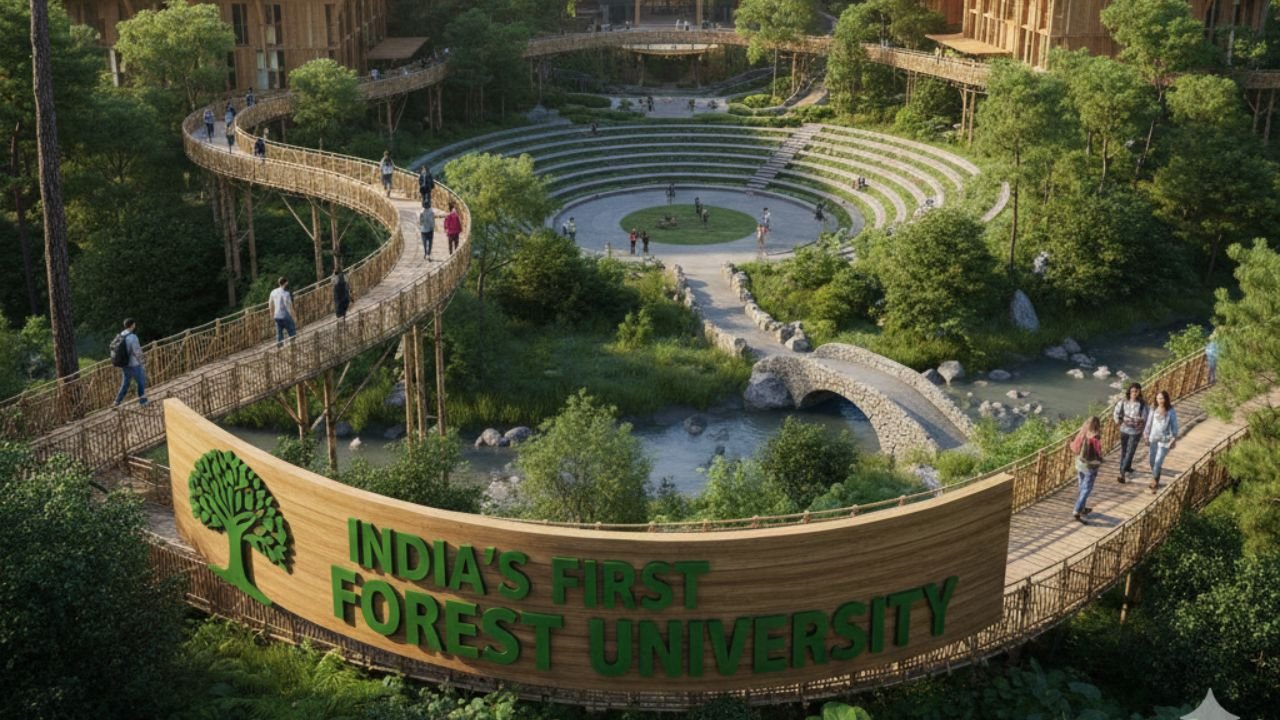

India is set to establish its first-ever Forest University in Gorakhpur, Uttar Pradesh, marking a transformative moment in the country’s environmental education and conservation efforts. The ambitious ₹500 crore project will create a specialized institution dedicated exclusively to forestry, wildlife conservation, and ecological studies—a pioneering initiative that positions India among nations with dedicated forest education infrastructure.
Spread across 125 acres of verdant landscape, the India first Forest University will integrate classroom learning with immersive natural environments, creating a unique educational ecosystem where students study conservation while living within it. The announcement signals the Uttar Pradesh government’s commitment to addressing India’s pressing environmental challenges through specialized education and research.
Breaking Down the ₹500 Crore Forest Education Vision
The Gorakhpur Forest University represents more than just another educational institution—it’s a strategic investment in India’s environmental future. The comprehensive development plan encompasses state-of-the-art academic facilities, research laboratories, wildlife sanctuaries, botanical gardens, and residential infrastructure designed to create a self-contained center of excellence for green education.
Key Project Highlights:
- Total Investment: ₹500 crore (approximately $60 million USD)
- Campus Size: 125 acres
- Location: Gorakhpur, Uttar Pradesh
- Focus Areas: Forestry science, wildlife conservation, ecology, environmental management, biodiversity studies
- Status: Foundation and development phase
- Academic Programs: Undergraduate, postgraduate, doctoral, and diploma courses planned
- Expected Capacity: Thousands of students annually once fully operational
The university’s location in Gorakhpur—eastern Uttar Pradesh’s largest city—provides strategic advantages. The region’s proximity to the Terai forests, Himalayan foothills, and numerous wildlife corridors offers students direct access to diverse ecosystems for field research and practical training.
“This Forest University will bridge the critical gap between theoretical environmental education and practical conservation skills,” explained Dr. Arun Kumar Sharma, a forestry education expert. “Students will learn forest management, wildlife protection, and ecosystem restoration not from textbooks alone but through direct engagement with living forests.”
Why India Needs a Dedicated Forest University Now
India faces unprecedented environmental pressures that demand specialized expertise in forest and wildlife management. Several converging factors make the India first Forest University initiative both timely and critical:
Biodiversity Crisis: India is home to 7-8% of the world’s documented species despite covering only 2.4% of global land area. This biodiversity faces threats from habitat loss, climate change, and human-wildlife conflict. Trained conservationists are essential to preserving these irreplaceable ecosystems.
Forest Cover Challenges: While India has increased forest cover to 21.71% of geographical area (according to the 2021 Forest Survey), quality degradation, fragmentation, and climate vulnerability require sophisticated forest management approaches that current educational systems inadequately address.
Wildlife Conservation Needs: With tiger populations recovering, elephant corridors expanding, and Project Lion underway, India needs wildlife biologists, conservation geneticists, and habitat restoration specialists—professions requiring specialized training unavailable at most conventional universities.
Climate Change Imperative: Forests serve as critical carbon sinks in India’s climate action plans. The country’s commitment to creating an additional carbon sink of 2.5 to 3 billion tonnes of CO2 equivalent through forest cover by 2030 requires thousands of trained forestry professionals.
Employment Generation: The green economy sector, including forestry, wildlife tourism, and environmental consulting, is expanding rapidly. A dedicated Forest University can produce job-ready graduates for this growing sector.
Comprehensive Curriculum: What Students Will Learn
The Gorakhpur Forest University will offer multidisciplinary programs blending scientific rigor with practical conservation skills. Anticipated academic offerings include:
Forestry Science & Management:
- Silviculture and forest regeneration techniques
- Forest resource assessment and inventory methods
- Sustainable timber management and agroforestry
- Forest economics and policy analysis
- Climate-resilient forestry practices
Wildlife Conservation & Biology:
- Wildlife population ecology and monitoring
- Conservation genetics and breeding programs
- Human-wildlife conflict mitigation strategies
- Wildlife forensics and anti-poaching technologies
- Habitat restoration and corridor management
Environmental Sciences:
- Ecosystem services valuation
- Biodiversity assessment methodologies
- Environmental impact assessment
- Climate change adaptation strategies
- Conservation technology and remote sensing applications
Specialized Training:
- Geographic Information Systems (GIS) for forest mapping
- Drone technology for wildlife monitoring
- Camera trap deployment and data analysis
- Community-based conservation approaches
- Eco-tourism development and management
This comprehensive approach ensures graduates possess both theoretical foundations and practical competencies needed for modern conservation challenges.
India’s Forest Education Gap and Global Comparisons
Currently, India’s forestry education is fragmented across agricultural universities and scattered departments within conventional institutions. Only a handful of specialized institutions exist:
- Indian Council of Forestry Research and Education (ICFRE): Research-focused with limited student capacity
- Forest Research Institute (FRI), Dehradun: Offers some degree programs but primarily research-oriented
- Wildlife Institute of India (WII), Dehradun: Specialized in wildlife but limited undergraduate programs
- Agricultural University Forestry Departments: Forestry treated as subset of agriculture rather than distinct discipline
This fragmentation has created a shortage of qualified professionals. India’s Forest Survey reports indicate a need for over 50,000 additional trained forestry personnel to adequately manage the country’s forest resources and wildlife habitats.
Global Comparison:
Countries with strong forestry sectors maintain dedicated forest universities:
- Sweden: Swedish University of Agricultural Sciences with extensive forestry programs
- Finland: Multiple institutions specializing in sustainable forest management
- Canada: University of British Columbia’s Faculty of Forestry among North America’s premier programs
- Germany: Several universities with centuries-old forestry traditions
- China: Beijing Forestry University and over 80 forestry colleges
The India first Forest University initiative brings the country into alignment with global standards for specialized environmental education.
The 125-Acre Living Laboratory Concept
What distinguishes the Gorakhpur Forest University from conventional institutions is its “campus as ecosystem” design philosophy. The 125-acre facility will function simultaneously as educational infrastructure and living conservation laboratory.
Planned Campus Features:
Botanical Gardens: Curated collections of regional flora, medicinal plants, and endangered species providing hands-on taxonomy and plant conservation training.
Wildlife Enclosures & Rescue Centers: Facilities for wildlife rehabilitation, breeding programs for endangered species, and research on animal behavior and veterinary care.
Forest Plots: Managed forest sections representing different successional stages, allowing students to study forest dynamics, conduct silvicultural experiments, and practice sustainable harvesting techniques.
Wetland Ecosystems: Constructed and natural wetlands for aquatic ecology studies, bird watching, and water quality research.
Research Stations: Field laboratories equipped for soil analysis, plant physiology studies, entomological research, and ecological monitoring.
Sustainable Infrastructure: Campus buildings designed using green architecture principles, renewable energy systems, and water conservation technologies—demonstrating environmental principles in practice.
This immersive approach means students won’t just read about forest ecosystems; they’ll measure tree growth, monitor wildlife populations, conduct biodiversity surveys, and implement conservation interventions as part of their regular coursework.
Economic Impact: Green Jobs and Regional Development
The ₹500 crore Gorakhpur Forest University investment will generate substantial economic benefits beyond education. Multiple revenue and employment streams emerge from this initiative:
Direct Employment: Faculty positions, research staff, administrative personnel, field technicians, and support staff creating hundreds of jobs initially, expanding to thousands as the university scales.
Construction Phase: Infrastructure development generates immediate employment for construction workers, architects, landscapers, and material suppliers across the ₹500 crore budget allocation.
Regional Economic Stimulus: Student population influx boosts local businesses—housing, food services, transportation, retail—creating multiplier effects throughout Gorakhpur’s economy.
Tourism Potential: Botanical gardens, wildlife facilities, and campus ecosystems can attract eco-tourists and school groups, generating additional revenue while promoting environmental awareness.
Research Funding: Successful forest universities globally attract substantial research grants from government agencies, international conservation organizations, and corporate sustainability programs—bringing external funding to the region.
Green Economy Workforce: Graduates filling positions in forest departments, wildlife sanctuaries, environmental consulting firms, eco-tourism ventures, and conservation NGOs contribute to broader economic transformation toward sustainable development.
Dr. Meera Iyengar, environmental economist, estimates that specialized forest university graduates command 30-40% higher starting salaries than general environmental science graduates due to their practical skills and specialized knowledge—creating upward economic mobility for students while addressing critical conservation workforce shortages.
Addressing Human-Wildlife Conflict Through Education
One of the India first Forest University’s most critical missions will be training professionals in human-wildlife conflict mitigation—a challenge growing more acute as development pressures increase wildlife habitat fragmentation.
Uttar Pradesh alone experiences significant human-wildlife conflict, particularly involving elephants, leopards, and crop-raiding species. The Gorakhpur region sits near elephant corridors and Terai forest fragments where such conflicts frequently occur.
The university can develop:
Community-Based Solutions: Training students in participatory approaches that engage local communities in wildlife conservation while protecting livelihoods and property.
Technology Applications: Using early warning systems, solar-powered fencing, bio-acoustic deterrents, and satellite monitoring to reduce negative wildlife interactions.
Compensation Mechanisms: Designing equitable, efficient systems for compensating communities affected by wildlife while preventing fraudulent claims.
Corridor Management: Identifying, protecting, and restoring wildlife movement corridors that allow animals to traverse fragmented landscapes without entering human settlements.
Behavioral Research: Understanding animal behavior patterns to predict and prevent conflict situations before they escalate.
This specialized training directly addresses one of India’s most pressing conservation challenges while improving rural livelihoods—demonstrating how the Forest University serves practical development needs beyond abstract environmentalism.
Research and Innovation Hub for Conservation Technology
Beyond education, the Gorakhpur Forest University will function as a research and innovation center developing cutting-edge conservation technologies and methodologies. Potential research focus areas include:
Climate-Resilient Forestry: Developing tree species and forest management practices adapted to changing temperature and precipitation patterns affecting India’s diverse forest types.
Conservation Genetics: Using genetic analysis to guide breeding programs for endangered species, assess population viability, and inform translocation decisions.
Remote Sensing Applications: Leveraging satellite imagery, drone surveillance, and LiDAR technology for forest health monitoring, illegal logging detection, and wildlife population estimation.
Traditional Knowledge Integration: Documenting and scientifically validating indigenous forest management practices, medicinal plant knowledge, and sustainable harvesting techniques from forest-dependent communities.
Carbon Sequestration Studies: Measuring and optimizing forests’ carbon storage capacity to support India’s climate commitments while generating potential carbon credit revenues.
Biodiversity Assessment Tools: Developing efficient, accurate methods for biodiversity surveys using environmental DNA (eDNA), acoustic monitoring, and camera trap networks with AI-powered species identification.
These research programs can attract international collaborations, bringing global expertise and funding to Indian conservation challenges while positioning the university as a center of excellence for tropical and subtropical forest ecosystems.
Political and Strategic Significance for Uttar Pradesh
The Forest University announcement carries substantial political significance for the Uttar Pradesh government, demonstrating commitment to environmental issues in India’s most populous state while potentially attracting green investments and international attention.
For Chief Minister Yogi Adityanath’s administration, the project offers:
Environmental Credentials: Countering criticism of development-focused policies with tangible investment in conservation education and environmental infrastructure.
Educational Expansion: Adding a unique institution to UP’s higher education landscape, complementing conventional universities with specialized green education.
Eastern UP Development: Channeling significant investment to Gorakhpur—historically less developed than western UP—supporting regional balance and economic growth.
Youth Employment: Creating educational pathways for young people interested in environment careers, addressing unemployment while building skilled workforce.
National Leadership: Positioning UP as leader in environmental education, potentially attracting central government funding and recognition for innovative green initiatives.
The ₹500 crore budget allocation signals serious governmental commitment, though implementation timelines, funding disbursement schedules, and operational details remain to be fully articulated.
Challenges and Critical Success Factors
While the India first Forest University vision is compelling, several implementation challenges must be addressed for success:
Faculty Recruitment: Attracting top-tier forestry scientists, wildlife biologists, and conservation experts to Gorakhpur requires competitive salaries, research support, and academic freedom comparable to premier institutions globally.
Infrastructure Quality: The ₹500 crore budget must be efficiently utilized to create genuinely world-class facilities rather than conventional buildings with “forest university” branding—avoiding the mediocrity that plagues some Indian educational infrastructure.
Accreditation and Recognition: Securing UGC recognition, NAAC accreditation, and international academic partnerships necessary for graduate employability and research credibility.
Political Interference: Maintaining academic autonomy and merit-based admissions/hiring despite political pressures that compromise many Indian universities.
Practical Training Balance: Ensuring curriculum balances theoretical rigor with field skills, avoiding the trap of producing graduates with certificates but limited practical conservation competency.
Industry Connections: Developing partnerships with forest departments, wildlife organizations, environmental NGOs, and private sector ensuring students gain internships, placements, and career pathways.
Research Funding: Establishing mechanisms for continuous research funding beyond initial infrastructure investment—successful forest universities globally dedicate 20-30% of budgets to research programs.
Community Integration: Engaging local communities as partners rather than obstacles, particularly tribal and forest-dwelling populations whose traditional knowledge and cooperation are essential for conservation success.
What Students and Parents Should Know
For aspiring environmental professionals and their families, the Gorakhpur Forest University presents exciting opportunities but also requires informed decision-making:
Career Prospects: Forestry and wildlife careers in India offer stable government employment (forest departments, wildlife boards, environmental agencies) plus growing private sector opportunities (environmental consulting, eco-tourism, corporate sustainability, NGO sector).
Admission Competition: As India’s first dedicated Forest University, initial batches will likely face intense competition. Strong performance in biology, chemistry, mathematics, and demonstrated environmental commitment will be essential.
Skill Development: The hands-on curriculum develops practical skills increasingly valued across sectors—GIS mapping, data analysis, project management, community engagement—providing versatility beyond pure forestry roles.
Further Education: Graduates can pursue advanced degrees at premier international institutions, as specialized forestry qualifications from recognized Indian universities are well-regarded globally.
Salary Expectations: Entry-level forestry positions in government start around ₹40,000-50,000 monthly, while private sector conservation roles can offer ₹50,000-80,000 for skilled graduates. Senior positions and specialized roles command significantly higher compensation.
Social Impact: Beyond financial returns, forestry careers offer the satisfaction of meaningful conservation work, wildlife protection, and environmental stewardship—increasingly important to young professionals seeking purpose-driven careers.
Global Conservation Community’s Response
International environmental organizations have noted India’s Forest University initiative with interest, recognizing India’s importance for global biodiversity conservation and the need for trained professionals to manage the country’s critical ecosystems.
Organizations like the International Union for Conservation of Nature (IUCN), World Wildlife Fund (WWF), and Wildlife Conservation Society (WCS) maintain significant programs in India and could become valuable partners for the Gorakhpur institution through:
- Guest faculty and training programs
- Research collaboration and data sharing
- Student internships at international field sites
- Funding for specific research projects
- Technology transfer and methodological expertise
Such partnerships would elevate the India first Forest University to international standards while providing students with global exposure and networking opportunities.
Timeline and Next Steps
While complete operational details remain forthcoming, the Forest University development likely follows this trajectory:
2024-2025: Institutional planning, land acquisition confirmation, architectural designs, faculty recruitment initiation, curriculum development, regulatory approvals
2025-2026: Infrastructure construction, laboratory setup, botanical garden development, initial wildlife facility establishment, first faculty appointments
2026-2027: Pilot programs possible, continued construction, equipment procurement, academic partnerships formalization
2027-2028: Full operational status with initial student batches, research programs launch, community outreach initiation
This timeline assumes efficient implementation, adequate funding disbursement, and minimal bureaucratic delays—variables that significantly impact Indian educational infrastructure projects.
What This Means for India’s Environmental Future
The India first Forest University in Gorakhpur represents strategic investment in the human capital necessary for environmental sustainability. As India balances rapid economic growth with environmental protection, the challenge isn’t just political will or policy frameworks—it’s having sufficient trained professionals to implement conservation effectively.
Consider the numbers: India’s Protected Area Network covers approximately 5% of geographical area (over 170,000 square kilometers) requiring constant management. Wildlife corridors, community forests, and private forest lands extend conservation needs across millions of additional hectares. Each ecosystem requires trained foresters, wildlife biologists, ecologists, and conservation managers.
Currently, India’s forest departments report chronic understaffing with positions vacant due to qualified candidate shortages. The Forest University directly addresses this bottleneck, potentially producing thousands of conservation professionals annually.
Beyond government roles, India’s environmental consulting sector, growing corporate sustainability commitments, and expanding eco-tourism industry all demand forestry expertise. The World Economic Forum estimates green jobs will create 35 million positions in India by 2030—the Forest University graduates will fill crucial portions of this emerging workforce.
A Model Worth Replicating?
If successful, the Gorakhpur Forest University could inspire similar institutions across India’s diverse ecological zones:
- Western Ghats Forest University: Specializing in tropical rainforest ecosystems, coffee-forest systems, and endemic biodiversity
- Himalayan Forest University: Focusing on alpine ecosystems, mountain wildlife, glaciology, and climate change impacts
- Coastal & Marine University: Addressing mangrove conservation, marine biodiversity, coastal ecology
- Arid Zone Forest University: Specializing in desert ecosystem management, dryland restoration, unique arid zone species
Each region faces distinct conservation challenges requiring specialized knowledge—multiple forest universities could create a national network of excellence covering India’s extraordinary ecological diversity.
From vision to reality, from ₹500 crore investment to functional institution, from architectural plans to conservation impact—the India first Forest University journey has just begun.
But one thing is certain: India is investing in its green future, one student, one forest, one species at a time.

