


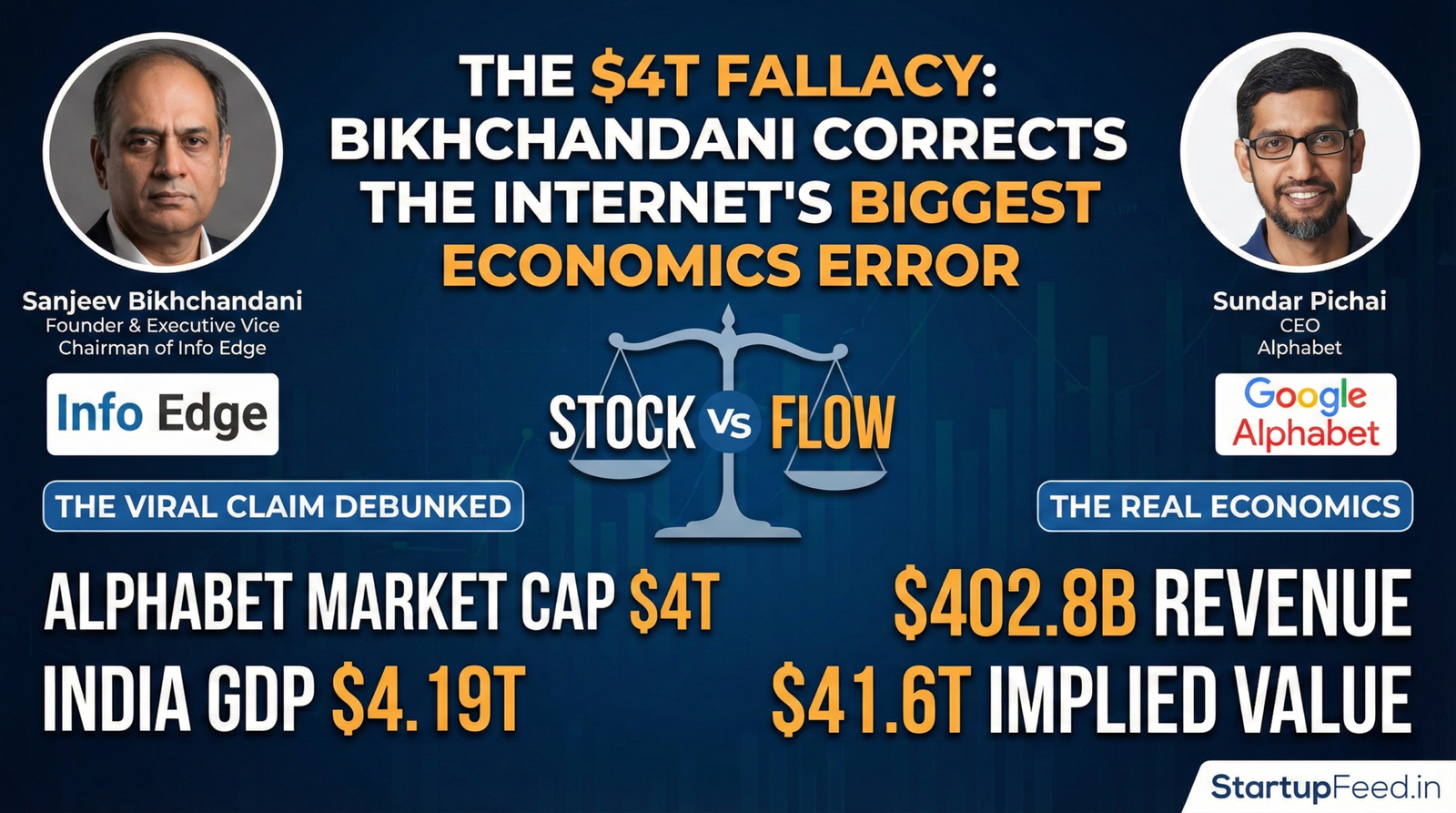

| The Viral Claim: | A widely circulated post on X claimed Google (Alphabet) is ‘bigger than India’ because its market capitalisation — approximately $4 trillion as of early 2026 — exceeded India’s GDP of ~$4.187 trillion. Note: The exact post and date are subject to [VERIFY] editorial flags. What IS confirmed: Alphabet crossed $4 trillion in market cap on January 12, 2026 (CNBC). India’s GDP is $4.187 trillion (IMF, confirmed by PIB). The comparison is real and recurring. A nearly identical viral debate about NVIDIA vs India GDP occurred in September 2025. |
| The Economics Error: | The claim compares two fundamentally different categories of number. Market capitalisation is a STOCK variable — a snapshot of total investor valuation at one point in time, representing future discounted cash flows. GDP is a FLOW variable — total economic output PRODUCED over one year. Comparing them is equivalent to comparing a company’s total enterprise value to a person’s annual salary. You cannot determine ‘who is bigger’ by comparing a stock to a flow. This is not an opinion. It is basic economic methodology, standard since Adam Smith. |
| Bikhchandani’s Response: | Info Edge founder and startup ecosystem veteran Sanjeev Bikhchandani (@sbikh) engaged with the viral claim on X, stating: ‘You don’t compare a stock variable to a flow variable — apples and oranges.’ Bikhchandani is an IIM Ahmedabad alumnus, BA Economics from St. Stephen’s College Delhi, and one of India’s most respected voices in the startup economy. His Naukri.com was India’s first online jobs platform (1997). Net worth: ~$4.25 billion (Forbes India 2024). Note: Exact phrasing ‘inapt analogy’ is subject to the [VERIFY] editorial flag. |
| Google’s Actual Revenue: | Alphabet’s FY2025 actual revenue (confirmed SEC filing, February 4, 2026): $402.836 billion. This is the correct comparator to India’s GDP — both are FLOW variables (annual economic output). Revenue vs. revenue: India’s GDP ($4,187 billion) is approximately 10.4x larger than Alphabet’s total annual revenue ($402.8 billion). Revenue-to-revenue, India is more than 10 times larger than Google. The viral claim inverted the actual relationship. |
| The Correct ‘Market Cap’ Comparison: | Alphabet’s Price-to-Sales (P/S) ratio: $4 trillion market cap ÷ $402.8 billion revenue ≈ 9.93x (approximately 10x). If India’s GDP were valued at the same 10x revenue multiple that investors apply to Alphabet, India’s implied ‘market cap’ would be: $4,187 billion × 9.93 = approximately $41.6 trillion. This means India, correctly valued at Alphabet’s own market multiple, is more than 10 times ‘bigger’ than Google by the viral post’s own logic. |
| India’s Economic Position: | India’s nominal GDP: ~$4.187 trillion (IMF 2025). India surpassed Japan to become the world’s 4th largest economy in 2025 — confirmed by PIB press release and NITI Aayog CEO. GDP growth: 7.4% FY2025-26 (PIB First Advance Estimates). 1.44 billion people produce $4.187 trillion in annual output. India’s PPP (Purchasing Power Parity) GDP, which measures actual economic scale adjusted for costs, is approximately $14-15 trillion — already 3.5x Alphabet’s entire market capitalisation. |
| Alphabet’s $4T — What It Actually Means: | Alphabet (Google’s parent) crossed $4 trillion in market cap on January 12, 2026, becoming the fourth company in history to do so (after Nvidia, Microsoft, and Apple). The $4 trillion figure represents what investors believe Alphabet’s total future cash flows are worth TODAY in present value terms. It is built on expectations about AI, cloud growth, search dominance, and YouTube. Stock up 65% in 2025. Sundar Pichai confirmed: ‘Annual revenues exceeded $400 billion for the first time.’ (Q4 FY2025 earnings call.) |
| The Recurring Viral Pattern: | This is not the first time this comparison has gone viral. In September 2025, crypto educator @Bitinning posted: ‘NVIDIA’s market cap $4.29T has overtaken India’s GDP of $4.19T.’ The claim spread widely across financial media before corrections were issued. The same logical error — comparing a stock to a flow — is responsible for both. The comparison will recur every time any company’s market cap nears or exceeds India’s $4.2T GDP, making this article permanently evergreen and a reference asset for StartupFeed. |
| The Analogies That Work: | The correct analogy: comparing Google’s market cap to India’s GDP is like comparing a company’s total valuation (enterprise value) to a worker’s annual salary. A house worth ₹2 crore is not ‘bigger than’ a person who earns ₹20 lakh per year — they are different kinds of number. Alternatively: comparing net worth to income. A billionaire with a ₹100 crore net worth is not necessarily ‘10 times bigger’ than someone with a ₹10 crore annual salary — the first is a stock (accumulated wealth), the second is a flow (annual production). |
| Bikhchandani’s AI Summit Context: | Bikhchandani’s engagement with the Google/India GDP debate comes in the same week as the India AI Impact Summit 2026, where he also said: ‘AI is happening. It is relentless. So if you don’t do AI, AI will be done to you.’ (BW Disrupt, February 2026.) The India AI Impact Summit brought him together with Sam Altman, Sundar Pichai, and 100+ country delegations at Bharat Mandapam — making Bikhchandani one of the most-quoted Indian business voices of the week. His GDP/market cap correction is doubly amplified by his summit visibility. |
Economics 101: The Difference Between a Stock Variable and a Flow Variable
This is the most important concept in the entire debate — and also the most misunderstood one, even among financially literate audiences. The viral comparison between Google’s market cap and India’s GDP fails not because of bad intent, but because of a categorical measurement error that confuses two fundamentally different types of economic quantity.
| Concept | STOCK VARIABLE — What the viral post used | FLOW VARIABLE — What should be compared to GDP |
|---|---|---|
| Definition | A quantity measured at one specific point in time. A snapshot. Examples: wealth, debt, savings balance, inventory, population, market capitalisation. | A quantity measured over a period of time (usually per year). A rate. Examples: income, GDP, revenue, profit, rainfall, births, spending. |
| Unit of Time | No time unit — it is a static snapshot. ‘Alphabet’s market cap today’ has no per-year qualifier. | Always has a time unit — per year, per quarter, per day. GDP = value produced PER YEAR. |
| Real-World Example (Personal Finance) | Your net worth (₹1 crore). Total accumulated wealth at this moment. | Your annual salary (₹20 lakh per year). Value produced in one year. |
| Real-World Example (Corporate Finance) | Alphabet market capitalisation: $4 trillion. Total investor valuation of all future cash flows, discounted to today. | Alphabet annual revenue: $402.8 billion (FY2025). Value produced in one year. |
| Why Comparing Them is Wrong | Comparing Google’s $4T market cap to India’s $4.19T GDP is like asking: ‘Are you richer than a person earning ₹40 lakh/year?’ using only your net worth as the answer. The question cannot be answered that way. | The correct comparison: Alphabet revenue ($402.8B/year) vs India GDP ($4,187B/year). Both are annual flows. India is ~10.4x larger revenue-to-GDP. |
| Why Markets Cap Exceed GDP | A company’s market cap embeds ALL FUTURE years of expected earnings, discounted to present value. A $4T market cap at 10x P/S means investors expect ~$400B in revenue every year INTO THE FUTURE. GDP is just this year’s output. | GDP measures only current annual output — it does not ‘price in’ future years of India’s economic growth. India’s implied ‘market cap’ (all future GDP discounted to today at the same multiple) would be many tens of trillions of dollars. |
| The Bikhchandani Principle | Bikhchandani (@sbikh): ‘You don’t compare a stock variable to a flow variable — apples and oranges.’ This is not a new insight — it is the foundational principle of any Economics or Finance 101 course, restated clearly for a viral audience that needed the reminder. | The correct comparison is straightforward: Alphabet revenue ($402.8B) vs India GDP ($4.187T). Or alternatively: India’s implied P/S-adjusted ‘market cap’ ($41.6T) vs Alphabet’s actual market cap ($4T). |
The Side-by-Side: What the Viral Post Said vs What the Numbers Actually Show
| Metric | Alphabet / Google | India |
|---|---|---|
| Market Capitalisation (Stock Variable) | ~$4 trillion (as of January 2026) | Not a listed company. Not applicable. |
| Annual Revenue / GDP (Flow Variable) | $402.836 billion FY2025 (confirmed SEC) | $4,187 billion / $4.187 trillion (IMF 2025) |
| Flow-to-Flow Verdict | $402.8B annual revenue | $4,187B annual GDP — India is 10.4x larger |
| P/S Multiple Applied | ~9.93x (market cap / revenue) | N/A — not listed |
| Implied ‘Market Cap’ at Same Multiple | $4 trillion (actual) | $4,187B × 9.93 = ~$41.6 trillion |
| Stock-to-Stock Verdict | $4T Alphabet market cap | $41.6T India implied cap — India is 10.4x larger |
| PPP GDP (Purchasing Power) | Not applicable | ~$14–15 trillion — already 3.5x Alphabet’s market cap |
| Annual GDP / Revenue Growth | +15% revenue growth FY2025 (Alphabet) | +7.4% real GDP growth FY2025-26 (PIB India) |
| People / Employees | ~180,000 employees (Alphabet) | 1.44 billion people producing the GDP |
| GDP per Capita vs Revenue per Employee | $402.8B ÷ 180,000 = ~$2.24M per employee | $4,187B ÷ 1.44B people = ~$2,908 per capita |
| The Correct Verdict | Alphabet is a brilliant $4 trillion company with $402.8B in annual revenue | India is the world’s 4th largest economy with $4.19T in annual GDP. At Alphabet’s own P/S multiple, India is 10x bigger. |
Why This Fallacy Keeps Going Viral — And Why That’s a Signal for Indian Entrepreneurs
This is not the first time the comparison has swept through Indian financial social media. In September 2025, crypto educator @Bitinning posted that ‘NVIDIA’s market cap $4.29T has overtaken India’s GDP of $4.19T’ — a post that travelled widely before economists stepped in to correct it. The logical error was identical. Now with Alphabet crossing $4 trillion on January 12, 2026 (CNBC confirmed), the comparison has resurfaced with Google as the protagonist.
The reason this comparison keeps spreading is not that Indians lack financial education. It is that the numbers are genuinely striking. For the first time in history, four companies — Nvidia, Microsoft, Apple, and Alphabet — have all crossed the $4 trillion threshold. India’s GDP has just barely crossed $4 trillion (IMF puts it at $4.187 trillion, Japan at $4.168 trillion — a difference of less than $20 billion). The collision of these two milestones in the same news cycle creates an irresistible, but incorrect, comparison.
The more important signal: when four tech companies each have market caps approaching or exceeding the entire annual economic output of the world’s 4th largest country, something structurally significant is happening in global capital allocation. AI is being priced like a multi-decade civilisation-level shift. Investors are betting that Alphabet’s AI capabilities (Gemini 3, Google Cloud’s 48% growth in Q4 2025, 750 million Gemini app users) represent decades of future value creation, not just next year’s revenue. That is not a fallacy. It is a rational market signal. The fallacy is only in the comparison.
“You don’t compare a stock variable to a flow variable — apples and oranges.” — Sanjeev Bikhchandani, Founder & Executive Vice Chairman, Info Edge (Naukri.com), @sbikh on X
“It was a tremendous quarter for Alphabet and annual revenues exceeded $400 billion for the first time. The launch of Gemini 3 was a major milestone and we have great momentum.” — Sundar Pichai, CEO Alphabet & Google, Q4 FY2025 Earnings Call, (SEC filing)
Three Everyday Analogies That Make the Error Immediately Clear
| Analogy 1 — The Salary vs Net Worth Comparison
Priya earns ₹20 lakh per year. Rahul has accumulated ₹1 crore in total savings. Is Rahul ‘bigger’ than Priya’s annual earnings? The question makes no sense. Rahul’s net worth (₹1 crore) is a STOCK; Priya’s salary (₹20 lakh/year) is a FLOW. You cannot compare them to establish ‘size.’ The $4T market cap vs $4.19T GDP comparison is identical. Alphabet’s ₸1 crore’ of accumulated investor valuation vs India’s ₸20 lakh/year’ of annual economic production. Analogy 2 — The Tank vs The River A water tank holds 4,000 litres (stock). A river flows at 4,187 litres per day (flow). Is the tank ‘bigger’ than the river? The tank holds more water at this moment, but the river produces 4,187 litres every single day. Over a month, the river produces more than 125,000 litres. Alphabet’s market cap is the tank — a static inventory of expected future value. India’s GDP is the river — annual production, repeating every year, growing at 7.4% per year. Analogy 3 — The Apartment vs The Factory A Mumbai sea-view apartment is valued at ₹10 crore (stock — asset valuation). A textile factory generates ₹10 crore in annual revenue (flow — annual production). Saying the apartment is ‘bigger than’ the factory misunderstands what both numbers represent. The apartment’s ₹10 crore includes all the future value of living there over decades, discounted to today. The factory’s ₹10 crore is just this year’s output. Google’s $4T market cap is the apartment. India’s $4.19T GDP is the factory’s annual output. Next year’s output will be ₹10.74 crore. The year after that, ₹11.5 crore. India keeps producing. |
STARTUPFEED INSIGHT
| Why Both Sides Miss the Real Story: The people sharing the viral post are not stupid. They are pointing at something real — that AI-era companies are accumulating investor valuations that dwarf anything humanity’s economic institutions have previously produced at the national level. The people correcting the post are also right — the comparison method is flawed. The most intellectually honest position is this: (1) The methodology of comparing market cap to GDP is wrong and should be corrected. (2) The underlying signal — that four tech companies now carry market caps exceeding the GDP of the world’s 4th-largest economy — is genuinely astonishing and deserves serious analysis. Both things are true simultaneously. | |
| For Indian Founders Raising Capital: | The viral comparison actually carries an implicit argument FOR Indian startups. If Alphabet’s $402.8B in annual revenue is valued at ~10x by global markets, and India’s $4.19T in annual GDP grows at 7.4% — the implied economic premium on India’s future growth is massive. India is the fastest-growing major economy in the world. Any startup building in India’s domestic market is building in an economy that will likely be a $7+ trillion GDP by 2030 (IMF projections). The correct message from the viral numbers is not ‘Google is bigger than India.’ It is ‘Indian startups are building in an economy that, if priced like a tech company, would be worth $40+ trillion.’ That is the pitch. |
| For Investors & Analysts: | Bikhchandani’s correction is Economics 101, but the reason it needs to be said publicly in 2026 is a signal about the financial literacy baseline of even India’s educated digital audience. Founders pitching, VCs evaluating, and entrepreneurs making strategic decisions cannot afford to confuse stock and flow variables. A company’s valuation (stock) and a company’s revenue (flow) are not interchangeable. A country’s market cap equivalent (if it were listed) and its annual GDP are not the same. When your team, your investors, or your board are making decisions based on incorrect financial categories, the cost is real — mispriced investments, wrong benchmarks, bad competitive intelligence. |
| For Content Creators & Journalists: | This article is permanently evergreen content. The viral comparison will happen again. Every time Apple, Microsoft, Nvidia, Alphabet, or the next AI hypergrowth company surpasses India’s GDP in market cap, a new wave of viral posts will appear making the same error. India’s GDP is currently $4.19T; any company that crosses that threshold will generate the same claim. By 2028, India’s GDP will likely be $5.5-6T (IMF projections), but if AI stocks continue their run, multiple companies may cross $5-6T market caps. StartupFeed can own this explanation permanently with a single, annually-updated reference article. High evergreen traffic, zero competition, demonstrably correct. |
| StartupFeed’s Prediction: The $4T market cap club — currently Apple, Nvidia, Microsoft, Alphabet — will have 6+ members by 2028 as AI hypergrowth continues. Analysts at GOBankingRates and Citi are already projecting Alphabet could reach $5T by end-2026 (target range $385–$415/share). Meta, Amazon, and potentially a new entrant (xAI, Anthropic, or a new AI platform company) could all cross $4T. Every new entrant into the $4T club will trigger the same India comparison. The viral debate will happen a minimum of 4 more times in the next 24 months. StartupFeed’s correct response: publish this reference article once, update the numbers annually, and own the ‘market cap vs GDP explained’ keyword forever. The correct conclusion, stated simply for every future viral wave: Google isn’t bigger than India. India, priced like Google, is worth $41.6 trillion. That’s the story. | |