
Quick Take:
|
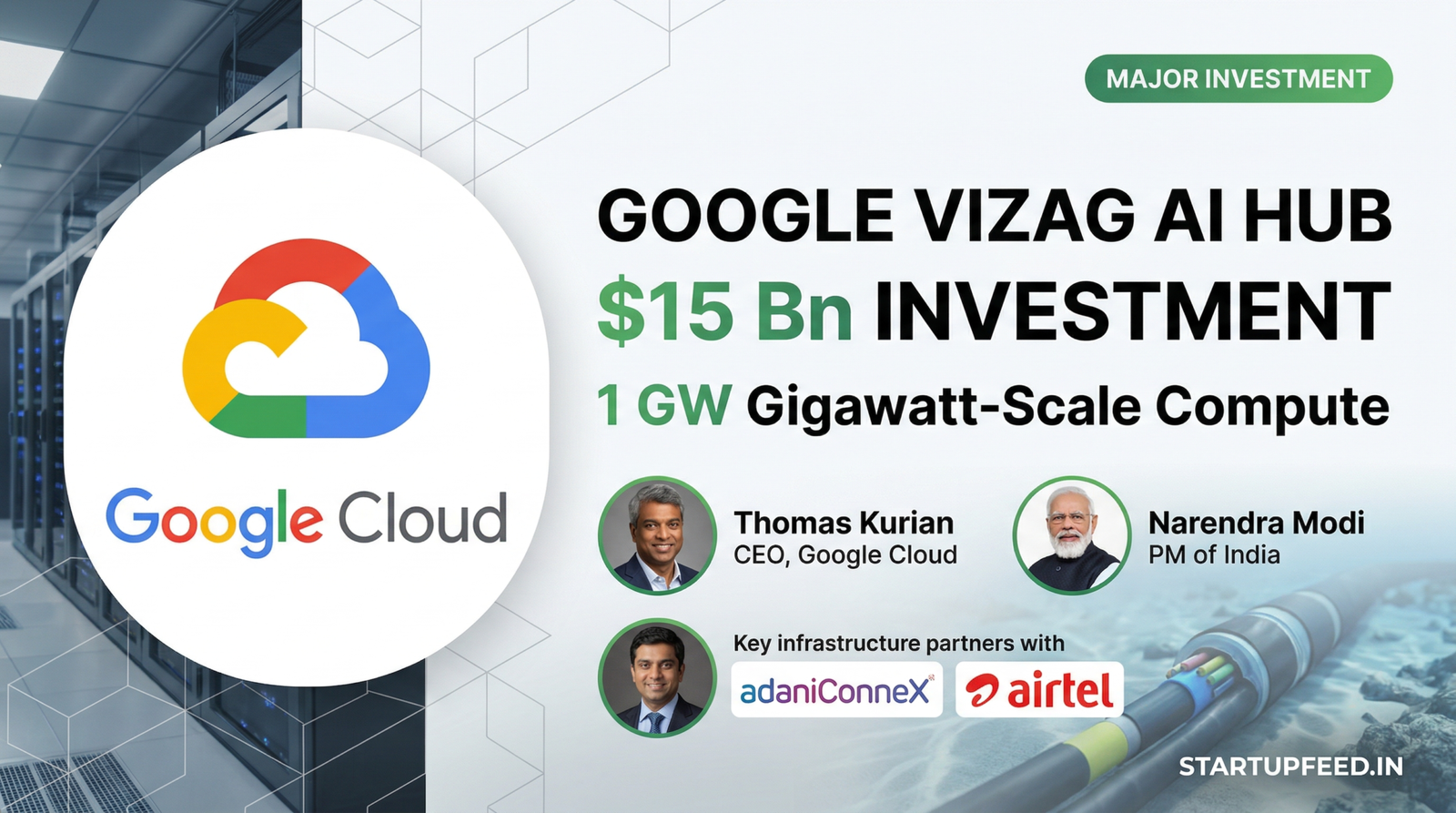
Google has committed $15 Bn (Rs 1.25 lakh Cr) to establish India’s first and largest AI hub in Visakhapatnam, Andhra Pradesh — the company’s single largest investment in India to date. Developed in partnership with AdaniConneX and Airtel, the gigawatt-scale facility will combine AI infrastructure, a new international subsea gateway, and renewable energy systems, positioning Vizag as a critical node in global AI and cloud architecture.
This positions India not as a consumer of global AI infrastructure, but as a builder of it. With 1 GW of compute capacity and direct subsea cable connectivity to Singapore, Australia, and the US West Coast, Google’s Vizag hub extends the country’s digital backbone eastward — something rival cloud providers AWS and Microsoft Azure will be watching closely.
| StartupFeed Insight
What the numbers say: A $15 Bn commitment over five years implies $3 Bn/year in capital deployment — more than the total VC funding India’s startup ecosystem received in any single year between 2020 and 2022. This is infrastructure investment at sovereign scale. What this means for you:
Our prediction: By Q3 2027, at least two other hyperscalers will announce comparable Vizag-adjacent investments to avoid being locked out of India’s eastern connectivity gateway. The subsea cable landing — not the data center — is the real strategic prize. |
Infrastructure Breakdown
The $15 Bn investment spans four integrated components across 600+ acres:
| Component | Details | Key Partners |
| Data Center Campus | Gigawatt-scale compute across 3 campuses (Adavivaram, Tarluvada, Rambilli) | AdaniConneX |
| Subsea Gateway | Multiple international cables landing on India’s eastern coast; connects to Google’s 2 Mn+ miles of global network | Airtel |
| Clean Energy Systems | Solar, wind, storage & new transmission lines to power 1 GW sustainably | AP State + Local Partners |
| Fiber-Optic Network | High-capacity low-latency terrestrial network across Andhra Pradesh | Airtel |
Of the $15 Bn total, the largest allocation goes to the data center campus itself. An MoU between Google Cloud and the Andhra Pradesh government was signed in New Delhi, with Union Finance Minister Nirmala Sitharaman calling it a ‘momentous occasion.’
Scale Context
| Metric | Google Vizag Hub | India VC Ecosystem (FY25) | AWS India (Est. Committed) |
| Investment Size | $15 Bn (Rs 1.25 lakh Cr) | ~$8–10 Bn total AUM | ~$4 Bn (announced 2023) |
| Compute Capacity | 1 GW gigawatt-scale | N/A | ~300 MW est. |
| Timeline | 2026–2030 (5 years) | Ongoing | Multi-year |
| Jobs Created | 30,000 (direct + indirect) | ~450,000 jobs total ecosystem | ~1,35,000 direct est. |
| Status | Construction from Apr 28, 2026 | — | Operational |
For context, Google’s Vizag investment alone exceeds the combined cloud infrastructure commitments announced by all hyperscalers in India between 2020 and 2023. The 1 GW capacity makes it Google’s largest AI hub outside the United States.
What the Leaders Say
|
Kurian’s emphasis on ‘inclusive growth’ — not just enterprise compute — signals Google’s intent to use the Vizag hub to push AI access into Tier 2 and Tier 3 India, not merely serve large corporations. PM Modi welcomed the initiative as “a powerful force in democratizing technology”, framing it within India’s ‘AI for All’ mission.
Capital Deployment Strategy
The investment will be deployed across five core areas:
- Compute Infrastructure: Trillium 6th-generation Tensor Processing Units (TPUs) — 4.7x peak AI performance vs prior generation; 2x more power-efficient.
- Subsea Cable Gateway: New cables connecting Vizag directly to Singapore, Malaysia, Australia, and the US West Coast — bypassing the congested Arabian Sea route entirely.
- Renewable Energy: Clean energy generation, storage, and new transmission lines in Andhra Pradesh to power the facility at net-zero carbon.
- Fiber-Optic Expansion: High-capacity domestic network across AP, extending low-latency AI access to businesses and developers statewide.
- Ecosystem Development: Rs 10,000 Cr in projected revenue for AP government; direct employment for 5,000–6,000 tech professionals.
The emphasis on a subsea gateway over a purely domestic data center signals Google is treating Vizag as a regional AI hub for the entire Indo-Pacific, not just an India play.
Economic Impact
| Impact Metric | Projected Value | Timeline |
| Direct Jobs Created | 5,000–6,000 | By 2028 |
| Total Employment (Direct + Indirect) | Up to 30,000 | By 2030 |
| AP Government Revenue | Rs 10,000 Cr | Over 5 years |
| US GDP Impact (via AI/cloud adoption) | $15 Bn | 2026–2030 |
| Total Jobs (NASSCOM estimate) | ~1.88 lakh (188,000) | Long-term ecosystem |
| AP State GST Waiver (capped) | Rs 2,245 Cr | Construction phase |
The Andhra Pradesh government has offered substantial incentives: stamp duty waiver, 25% discount on industrial water tariffs, electricity duty exemption, a Rs 1/unit discount on industrial power tariff (on a base rate of Rs 5–7), and 100% reimbursement of State GST during construction — capped at Rs 2,245 Cr.
Who Should Be Watching?
| Player | Why This Matters |
| AWS India | Google’s gigawatt-scale compute and eastern subsea gateway directly threatens AWS’s Mumbai-centric dominance; expect an accelerated eastern India data center announcement. |
| Microsoft Azure | Azure’s India West and South regions lack an equivalent subsea gateway — Vizag’s low-latency eastern connectivity is a structural advantage Google now holds. |
| Jio Platforms / Reliance | Jio’s own data center ambitions in Navi Mumbai face a credibility gap against Google’s 1 GW scale; partnership or counter-investment likely by 2027. |
| Indian Startups (AI-native) | Dramatically cheaper and faster Google Cloud AI compute in India creates a launchpad for a new generation of AI-first startups that would previously have needed US infrastructure. |
| Sify Technologies | Already announced Rs 1,500 Cr (US$180 Mn) for a 50 MW edge data center and open cable landing station in Vizag — now directly adjacent to Google’s eastern gateway. |
Google’s India Investment Journey
| Year | Commitment | Focus |
| 2020 | $10 Bn | Google for India Digitization Fund (cloud, AI, connectivity) |
| 2023 | $300 Mn | Anthropic partnership + India Cloud expansion |
| 2024 | $1 Bn+ | Google Cloud expansion, Mumbai & Delhi NCR regions |
| 2026–2030 | $15 Bn | Vizag AI Hub — largest single India investment ever |
| Total (est.) | $26+ Bn | India cumulative commitment |
What’s Next
Construction at the Vizag campus begins April 28, 2026. Google will develop three campuses — Adavivaram, Tarluvada, and Rambilli — in phases through 2030, with subsea cable landing infrastructure expected to go live ahead of full data center operations.
Watch for: competing hyperscaler announcements in the eastern India corridor by late 2026, the formal activation of Vizag’s subsea cable route by 2027, and the first cohort of Indian AI startups building on Trillium TPU infrastructure from within the country.
The real question isn’t whether Vizag becomes India’s AI capital — it’s whether India can train enough AI infrastructure talent fast enough to capture the full economic surplus this hub creates. AP’s universities have roughly 18 months to answer that.
What do you think? Will the Vizag hub make India the AI office of the Indo-Pacific? Share your views on X @StartupFeednews