


Quick Take
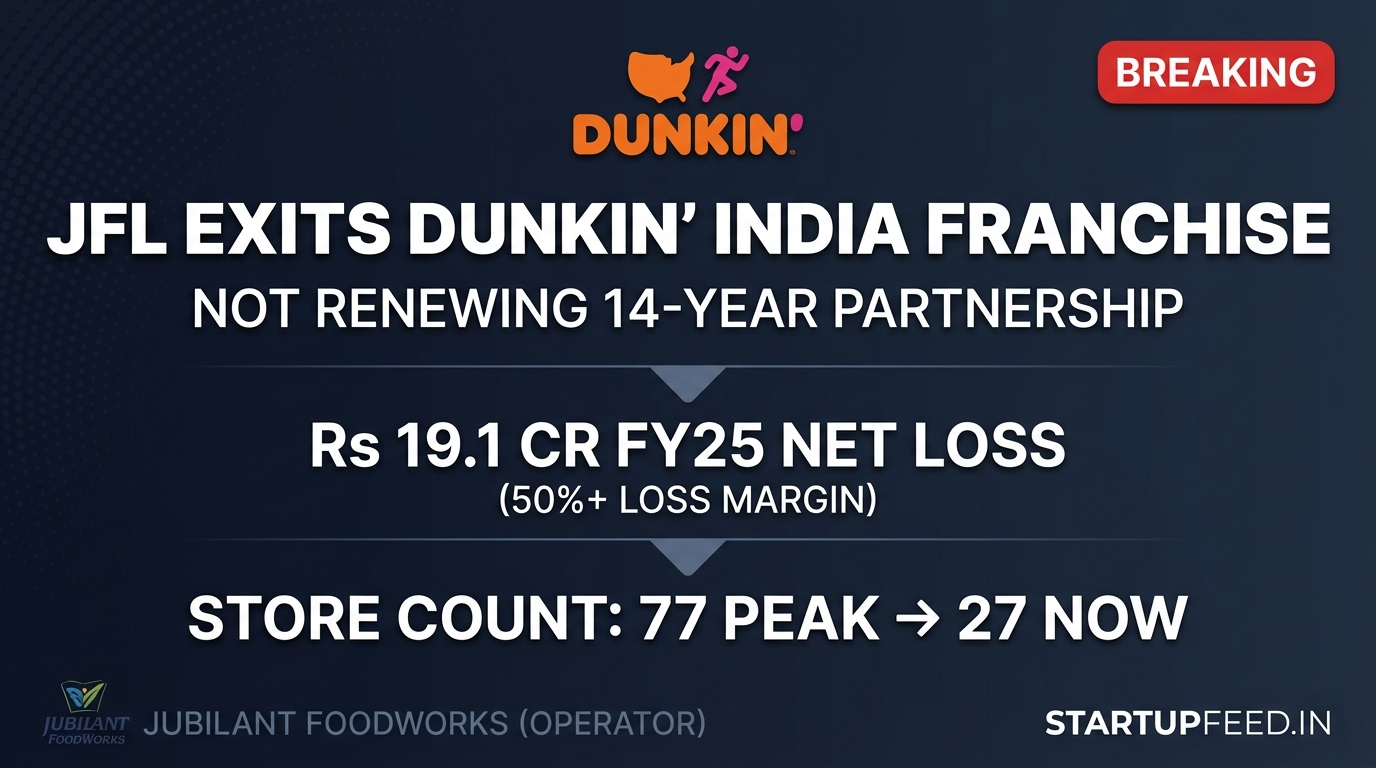
- Financials: Rs 37 Cr revenue, Rs 19.1 Cr loss in FY25 — a loss margin exceeding 50%
- Scale: $2.05 Mn (~Rs 19.1 Cr) loss | Just 0.61% of Jubilant’s total revenue
- Footprint: From 77 stores at peak (2016) to just 27 by December 2025
- Exit Date: Franchise agreement (MUDFA) expires December 31, 2026 — not being renewed
- Root Cause: Cultural mismatch: Indian breakfast habits, undefined positioning, intense QSR competition
Jubilant FoodWorks (JFL), India’s largest QSR operator, has confirmed it will not renew its Master Unit Development Franchise Agreement (MUDFA) with Dunkin’ — ending a 14-year partnership that promised 500 stores but delivered just 27, sustained losses every single year, and a Rs 19.1 crore deficit on revenues of just Rs 37 crore in FY25.
StartupFeed Insight
What went wrong: Dunkin’ never solved the Indian breakfast problem. Its core proposition — grab a donut and coffee on the go — collides head-on with India’s deep-rooted preference for sit-down, savory breakfasts. The brand then tried to be everything (sandwiches, wraps, burgers) and became nothing — stuck between Starbucks’ aspirational positioning and McDonald’s value dominance.
Warning signs for employees at similar brands: When a brand’s store count drops from 77 to 27 over 9 years with zero net additions in the last fiscal year, a franchise exit is a question of when, not if.
Lesson for founders & operators: A 50%+ loss-to-revenue ratio sustained over a decade is not a growth phase — it is a structural failure of product-market fit. The moment a brand becomes a ’rounding error’ in its operator’s P&L (0.61% of revenue), the exit clock starts.
The bigger picture: Dunkin’s failure is a masterclass in why international franchise expansion requires localization at the product, not just the marketing level. Domino’s India succeeded by indigenizing the menu. Dunkin’ didn’t. The Indian QSR market now belongs to those who understood the Indian palate — not those who imported a foreign habit.
The Rise — How It Started
On February 24, 2011, at Hotel Oberoi in Delhi, Dunkin’ Brands CEO Nigel Travis welcomed Jubilant FoodWorks as its newest international master franchisee. The deal — the largest international store development commitment in Dunkin’ Donuts’ history at the time — called for 500+ stores across India over 15 years.
The first outlet opened in Connaught Place, New Delhi in May 2012, branded ‘Dunkin’ Donuts & More.’ The ‘& More’ suffix was telling from day one — a signal that the brand already sensed donuts alone would not cut it in India. By 2016, JFL had expanded to 77 stores across major cities, fueled by early curiosity and the novelty of an American brand.
But the ambition of 500 stores never materialised. What followed instead was one of the most methodical retreats in Indian QSR history.
The Fall — 9 Years of Decline
By June 2018 — just six years into operations — Dunkin’ had already shut more than half its stores, bringing the count down from 77 to 37. JFL’s CEO at the time, Pratik Pota, framed it as discipline: closing the most unprofitable outlets, cutting overheads, and focusing on core categories.
The brand attempted pivots — adding tea (to target the Indian chai drinker), introducing wraps and burgers (to compete with fast-food giants), and repositioning as an all-day eatery. None of it worked at scale. By December 2025, just 27 stores remained. In FY2024-25, Dunkin’ recorded zero net store additions — compared to Domino’s India which crossed 2,179 stores, Popeyes which hit 61, and even JFL’s own Hong’s Kitchen which had 33.
The February 2026 investor presentation by JFL labelled Dunkin’ and Hong’s Kitchen as ‘Emerging business units drag on margins — focus on unit economics.’ Not a growth story. A drag story.
What Went Wrong — The Analysis
| Failure Factor | What Happened |
| Wrong breakfast format | Dunkin’ sells grab-and-go donuts + coffee — India eats sit-down, savory breakfasts (paratha, idli, dosa) |
| No clear positioning | Not a café (vs Starbucks), not a value chain (vs McDonald’s) — stuck in no man’s land |
| Menu over-extension | Added burgers, wraps, sandwiches trying to be everything, weakened core identity |
| Premium pricing mismatch | Donuts priced at Rs 60–100+ in a market with strong value expectations |
| Domino’s overshadow | JFL’s management bandwidth, marketing budget, and capital allocation all favoured Domino’s |
| Cultural mismatch | The donut-coffee habit is distinctly American — no equivalent cultural trigger in India |
‘Issues with Dunkin’ in India largely stemmed from its lack of a clear, focused positioning.’
The Brand’s India Journey
| Year | Milestone | Store Count |
| Feb 2011 | MUDFA signed — 500-store commitment over 15 years | — |
| May 2012 | First store opens at Connaught Place, New Delhi | 1 |
| 2016 | Peak expansion reached | 77 |
| June 2018 | First major store rationalisation; CEO cites cost discipline | ~37 |
| FY2021–FY24 | Continued store closures; multiple menu pivots attempted | ~31 |
| Dec 2025 | Store count at lowest ever recorded | 27 |
| Mar 30, 2026 | JFL board decides not to renew MUDFA | 27 |
| Dec 31, 2026 | Franchise agreement expires; Dunkin’ exits India | 0 (projected) |
Financial Snapshot — The Numbers That Sealed the Exit
| Metric | FY2025 Value |
| Dunkin’ Revenue (India) | Rs 37 Cr |
| Dunkin’ Net Loss (India) | Rs 19.1 Cr (~$2.05 Mn) |
| Loss Margin | >50% of revenue |
| Dunkin’ % of JFL Total Revenue | 0.61% |
| JFL Total Consolidated Revenue (FY25) | Rs 6,104 Cr |
| Domino’s India Revenue Contribution | >95% of JFL revenue |
| Domino’s India Stores (FY25) | 2,304 stores across 475 cities (+19% YoY revenue) |
| Popeyes India Stores (FY25) | 61 stores |
At just 0.61% of JFL’s revenue and a loss margin exceeding 50%, Dunkin’ had become operationally irrelevant to the company that operated it — a rounding error with negative returns.
JFL’s Strategic Pivot — Where the Capital Goes Now
By stepping away from Dunkin’, Jubilant FoodWorks is sharpening its focus on high-conviction bets. In the same board meeting where the Dunkin’ exit was confirmed, JFL also announced the extension of its Domino’s India franchise rights for another 15 years — with an option for a further 10-year renewal.
Popeyes, JFL’s fried-chicken bet, is the brand earmarked for aggressive expansion. The QSR operator is also investing in its in-house concepts — Hong’s Kitchen (Chinese QSR) and Ekdum! (biryani) — as well as Turkey-based café chain Coffy across international markets.
| JFL Brand | India Stores (FY25) | Trajectory |
| Domino’s India | 2,304 | Core — 15-yr franchise extension confirmed |
| Popeyes | 61 | High growth — flagship expansion bet |
| Hong’s Kitchen | 33 | Emerging — unit economics focus |
| Dunkin’ | 27 | Exiting — Dec 31, 2026 |
Employee Impact
Dunkin’ India currently employs staff across 27 outlets. JFL has not disclosed total headcount figures for the Dunkin’ division specifically. The company has stated it will handle the phased exit with three potential paths for existing stores: rationalisation (closing underperforming outlets), asset sale (selling equipment and infrastructure), or transfer of franchise rights to a potential new master franchisee.
Employees at Dunkin’ India outlets are advised to monitor formal announcements from JFL regarding store-specific timelines. The phased closure is expected to begin by October 2026, with full exit by December 31, 2026.
Lessons for the Ecosystem
- Product-market fit is non-negotiable, even for global giants: Dunkin’ is the largest donut-and-coffee chain in the US. That dominance meant nothing in a market where the breakfast habit is fundamentally different.
- Localization must go beyond menu tweaks: Adding tea and wraps is surface-level adaptation. True localization means rethinking the core value proposition — what problem does your product solve for an Indian consumer at 8am?
- Operator focus matters: JFL’s management bandwidth and capital allocation were overwhelmingly directed at Domino’s. A brand that is 0.61% of revenue will never get the attention needed to turn around.
- Know when to walk away: JFL’s clean exit — planned, phased, and communicated well in advance — is actually a sign of management maturity. Holding on to a structurally broken franchise longer would have been the real mistake.
Jubilant FoodWorks Limited (NSE: JUBLFOOD) is India’s largest QSR operator, founded in 1995, operating Domino’s Pizza, Popeyes, Hong’s Kitchen, and Dunkin’ (until Dec 2026) across India and 5 international markets. The company reported FY26 total revenue of Rs 9,544 crore (+17.2% YoY). Dunkin’ Donuts, founded in 1950 in Massachusetts and acquired by Inspire Brands in 2020, is the largest coffee-and-donut chain in the United States with over 13,000 global locations.

